
A lead lands on a client's site after clicking a paid ad. They're interested, they have a real problem, and they're ready to ask a question. Then they hit a contact form, submit it, and wait.
That gap is where a lot of agency performance gradually breaks down.
The campaign may be solid. The targeting may be right. The landing page may convert well enough. But if the prospect has to leave the channel they're already using, or wait for a follow-up that comes hours later, intent cools off fast. The old model assumes buyers will tolerate delay. Most won't.
For agencies, that creates both a delivery problem and a revenue opportunity. Clients still want more leads, but many of them need better lead capture, faster qualification, and a way to continue the conversation inside channels people already use. A conversational marketing platform sits in that gap. Done well, it doesn't just add chat to a website. It gives agencies a service they can package, standardize, and resell across WhatsApp, SMS, web chat, and social messaging.
Table of Contents
- The End of the Waiting Game in Marketing
- What Is a Conversational Marketing Platform Really
- How It Differs From Your Existing Agency Tech Stack
- The Architecture of a Scalable Agency Platform
- Profitable Agency Use Cases and ROI Examples
- Your Agency's Go-to-Market Checklist
- The Future Is Conversational and Your Agency Should Lead It
The End of the Waiting Game in Marketing
The weak point in many campaigns isn't traffic. It's the handoff.
A prospect clicks from Instagram, Facebook, or TikTok, lands on a page, and wants a quick answer before they commit. Instead, the business asks them to fill out a form, check their email later, or wait for a sales rep to call. That process was acceptable when email carried most of the follow-up. It feels slow now.
That shift is visible in channel behavior. A Salesforce survey reported that 83% of marketers say social media has become their primary customer acquisition channel, and the same material notes that people increasingly expect to reply in-channel and get instant answers. That's one reason speed and channel choice now affect conversion directly, as summarized in Sprinklr's write-up of the Salesforce survey.
What agencies see in the field
Agency owners usually recognize this pattern before clients do. The ads are working well enough to drive attention. The offer gets clicks. But the prospect's next step creates friction:
- They have one urgent question and the page doesn't answer it.
- They don't want a sales call yet but they will reply to a message.
- They're on mobile and would rather continue on WhatsApp or social DMs than complete a long form.
- They expect acknowledgment right away and interpret silence as disorganization.
The first responder often gets the conversation. The business that replies tomorrow gets the leftover intent.
That's why conversational marketing has moved beyond “live chat on the homepage.” For agencies, it's become a way to close the response gap between click and contact.
Why the old funnel leaks
Traditional lead gen treats inquiry capture and lead qualification as separate events. First the user submits. Later someone follows up. In practice, those steps should often happen in the same interaction.
A conversational flow can ask the first qualifying question immediately, route based on intent, and keep the exchange going inside the buyer's preferred channel. That matters most when the buyer is already warm and doesn't need more content. They need a timely answer and a clear next step.
For agencies building new services, this changes the offer. You're not just promising more lead volume. You're selling a faster path from attention to conversation, with less drop-off between the two.
What Is a Conversational Marketing Platform Really
A conversational marketing platform isn't just a chatbot builder.
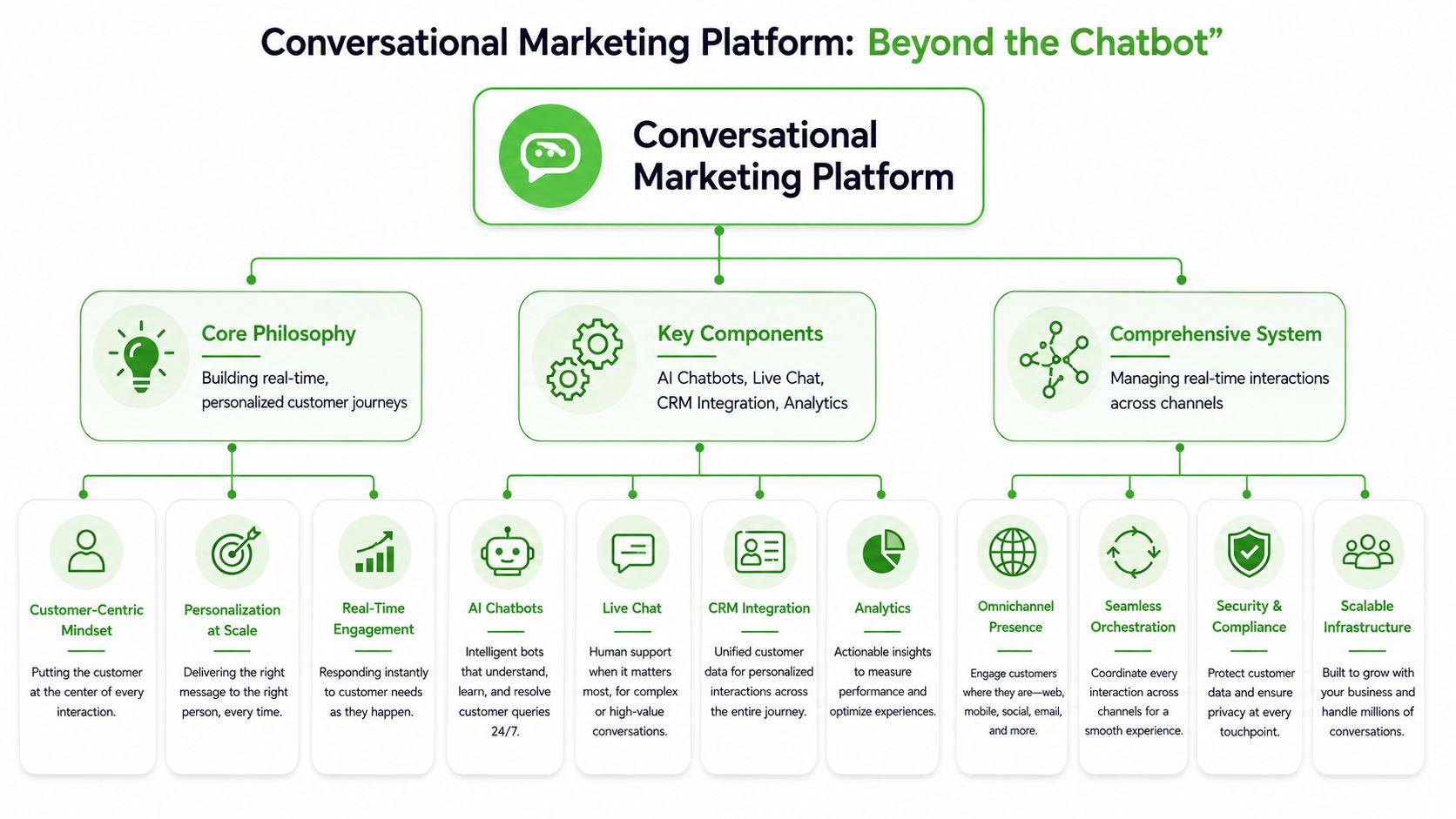
It's a system for running real-time, two-way interactions across customer touchpoints so the business can capture intent, qualify leads, answer questions, and move people to the next step without breaking the flow. Traditional marketing broadcasts. A conversational system responds.
It's a conversation layer, not a widget
Think of the difference between a billboard and a good store clerk. The billboard says the same thing to everyone. The clerk asks what you need, listens to the answer, and guides you based on context.
That's the useful way to understand a conversational marketing platform. It acts as the engagement layer between traffic and action. It can start with automation, continue with structured qualification, and hand off to a human when the exchange becomes nuanced or high value.
This isn't a fringe behavior anymore. Mailmodo's conversational marketing statistics guide reports that almost 1.5 million people had at least one conversation with a chatbot within the past year, and about 82% of respondents would talk to a chatbot if it helped solve their issue faster. For agency operators, the takeaway is simple: buyers will engage in conversation if the interaction is useful and quick.
Components of a modern setup
The strongest platforms combine several layers into one operating system rather than making teams stitch everything together manually.
| Component | What it does | Why agencies care |
|---|---|---|
| Channel management | Handles website chat, WhatsApp, SMS, and social messaging | Lets agencies meet clients where response speed matters most |
| Automation flows | Asks questions, tags leads, triggers routing | Reduces manual qualification work |
| Human handoff | Passes conversations to sales or support when needed | Keeps automation from becoming a dead end |
| CRM sync | Pushes conversation data into contact records | Preserves context for reporting and follow-up |
| Analytics and attribution | Shows source, journey stage, and response outcomes | Makes the service easier to justify and retain |
Practical rule: If a platform can't move smoothly from automation to human conversation, it isn't a conversational system. It's a scripted gatekeeper.
Agencies should also avoid the trap of treating “AI” as the product. Clients don't buy AI for its own sake. They buy faster response, cleaner qualification, and a better handoff into sales. The platform matters because it turns those outcomes into a repeatable service instead of a collection of disconnected tools.
How It Differs From Your Existing Agency Tech Stack
Most agencies already have chat tools, a CRM, some email automation, and maybe a helpdesk. That's why buyers often ask whether a conversational marketing platform is redundant.
It isn't, but the overlap confuses people.
Where agencies get confused
A standalone chatbot usually handles a narrow use case. It answers FAQs, collects a few fields, and stops there. A CRM stores records and helps sales teams manage relationships over time. Email automation sequences messages based on triggers, but it usually doesn't support live, back-and-forth interaction inside the buyer's preferred channel.
A conversational marketing platform sits across those functions. It orchestrates the live exchange, captures structured answers in real time, and routes the prospect toward content, sales, or support based on what they say.
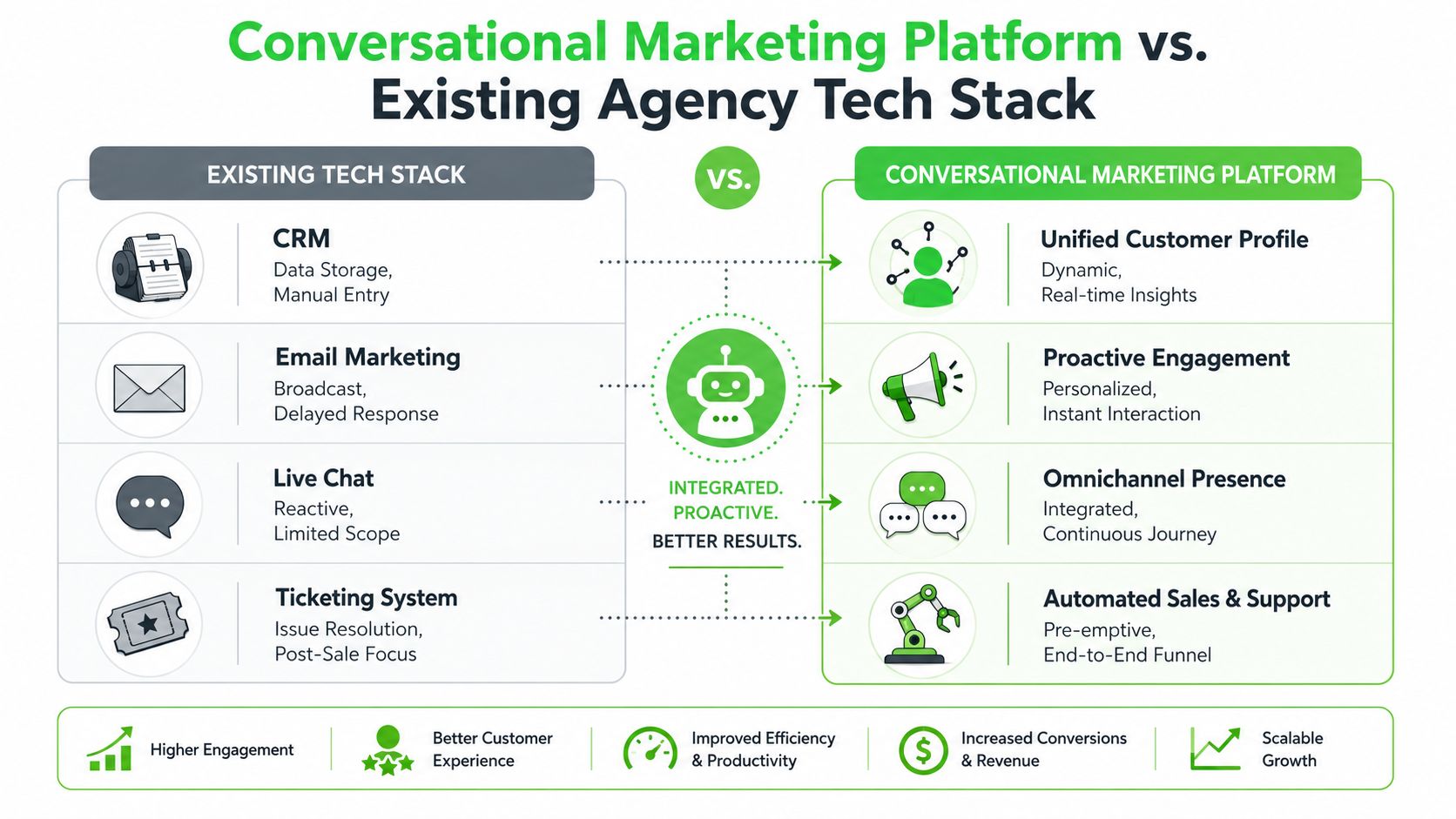
That distinction becomes important when agencies are packaging services. If you position the platform as “another chatbot,” clients compare it to low-cost widgets. If you position it as a real-time qualification and routing layer, the value becomes much clearer.
The practical role in your stack
The simplest way to frame it is this: your CRM is the system of record, but the conversational platform is the system of engagement.
| Criterion | Conversational Platform | Standalone Chatbot | CRM |
|---|---|---|---|
| Primary job | Real-time engagement and routing | Narrow scripted interaction | Record management and pipeline tracking |
| Interaction style | Two-way, contextual, channel-aware | Usually fixed and limited | Usually indirect and operator-led |
| Channel handling | Multi-channel conversation flows | Often single placement | Depends on integrations |
| Handoff capability | Built for bot-to-human transitions | Often weak or manual | Usually happens after capture |
| Agency resale value | High when white-labeled and standardized | Lower, often seen as a feature | High for operations, not for live capture |
Agencies should also be careful not to force the platform into roles it shouldn't own.
- It shouldn't replace the CRM. It should enrich it.
- It shouldn't replace strategy. It only makes good routing and messaging scale.
- It shouldn't replace people in every workflow. High-consideration sales still need human judgment.
A weak implementation adds one more inbox. A strong implementation creates one connected conversation from click to close.
That's the difference clients feel. Instead of bouncing between ad platform, landing page, form, inbox, and CRM, the business gets a coordinated path. Instead of asking staff to manually reconstruct intent from fragmented touchpoints, the system captures context as the conversation unfolds.
The Architecture of a Scalable Agency Platform
Agencies don't need a flashy demo. They need an operating model they can deploy repeatedly.
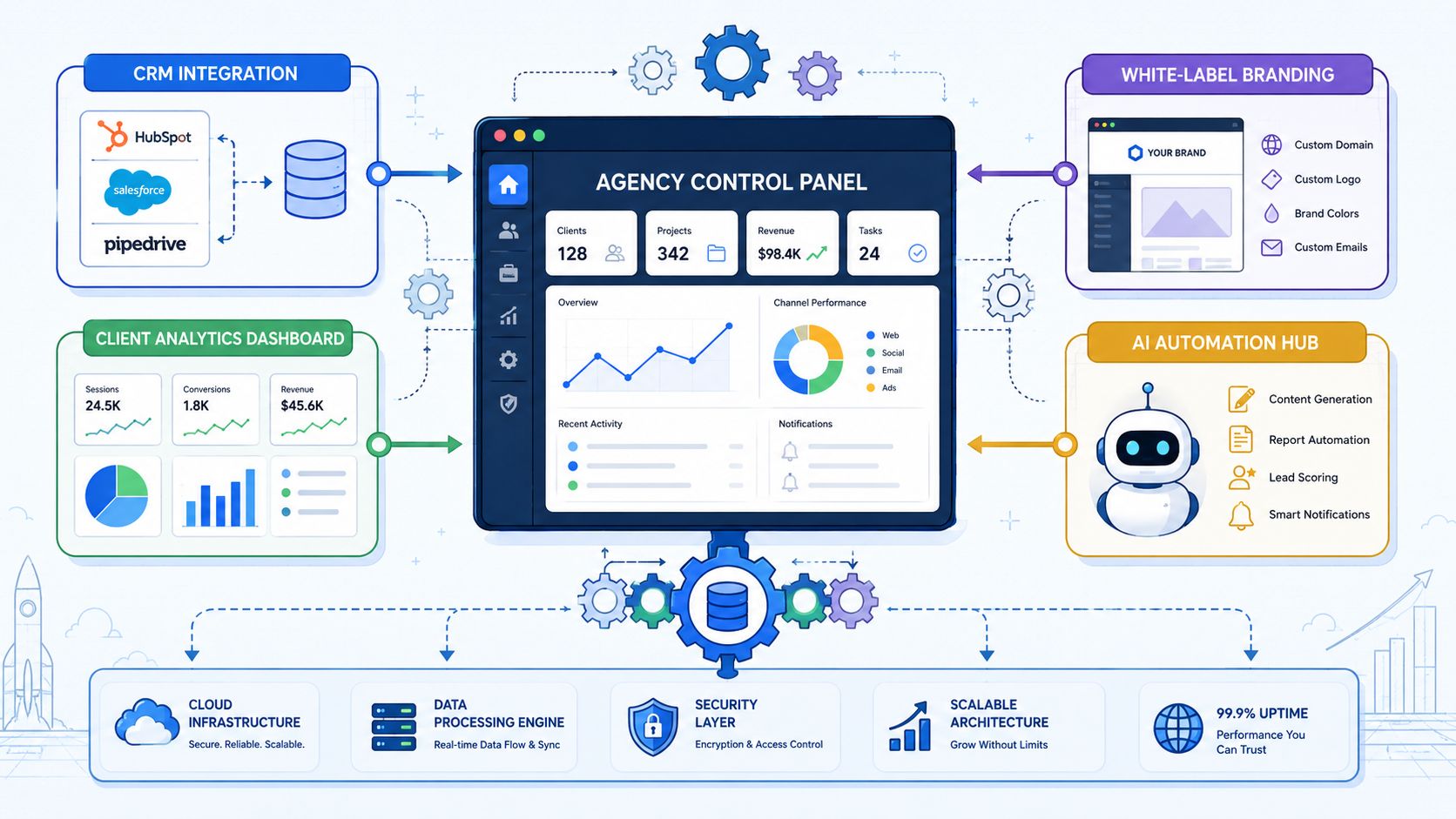
The mistake is building each client setup from scratch. That creates fragile workflows, inconsistent onboarding, and a service that depends too much on one strategist or one automation builder. A scalable agency model needs architecture first.
Why conversation track architecture matters
The most useful framework here is conversation track architecture. Annuitas describes it as a reusable set of templates that align people, technology, and data around the buyer journey. For agencies, that's what turns conversational marketing from custom labor into a productized service.
In practice, that means creating repeatable tracks such as:
- New lead qualification from paid traffic
- Reactivation of cold prospects through messaging
- Appointment booking with reminders and rescheduling
- Sales handoff for high-intent conversations
- Post-purchase support and upsell within the same thread
Each track should include triggers, qualification logic, fallback paths, handoff rules, message libraries, and CRM field mapping. If those pieces aren't templated, every new client becomes a reinvention project.
The features that protect margins
Not every platform is suitable for agencies or resellers. The must-haves are operational, not cosmetic.
A unified inbox: Teams need one place to manage incoming conversations across channels, assign ownership, add notes, and preserve context. Without that, response quality drops when volume increases.
Real-time qualification logic: The platform should ask structured questions, tag intent, and route fast. If qualification depends on staff reading every message manually, the service won't scale.
Strong handoff controls: Automation must know when to stop. High-value conversations need clear routing to a salesperson, advisor, or account manager.
Broadcast and re-engagement tools: Especially on WhatsApp and similar channels, agencies need a practical way to send updates, offers, reminders, and follow-ups without rebuilding lists in separate systems.
White-label readiness: Custom branding, client workspaces, role-based access, and billing flexibility matter more than most agencies expect. If the vendor owns the client relationship, your margins and retention get squeezed.
Productized service beats bespoke setup. The more your team can reuse tracks, prompts, routing rules, and onboarding steps, the easier it is to sell profitably.
The architecture should also account for attribution. Once a lead moves from ad click to website chat to WhatsApp, teams still need to know where that conversation started, who owns it now, and what outcome it produced. Agencies that ignore this early usually end up with activity but weak reporting.
Profitable Agency Use Cases and ROI Examples
The strongest agency offers are tied to specific operational pain, not abstract “engagement.”
A conversational marketing platform earns its place when it removes a bottleneck the client already feels. The good news is that many common clients have the same bottlenecks: slow qualification, missed appointments, weak follow-up, and disconnected handoffs.
Here's one example of the kind of workflow agencies often sell into local and service-based businesses:
Real estate and high-intent buyer qualification
Real estate teams often attract inquiries that look similar on the surface but vary wildly in urgency. One prospect wants to book a viewing this week. Another is “just exploring.” A form captures both as leads, but it doesn't separate intent in the moment.
A conversational flow can ask immediate qualification questions such as location preference, budget range, and time horizon. The system can then route hot buyers to an agent, send relevant listings to mid-intent leads, and hold lower-intent prospects in a longer nurture path.
This is where modern platforms stand out. Salesloft's overview of conversational marketing describes the category as using targeted messaging and intelligent chatbots to engage visitors immediately, ask qualification questions on the spot, and route prospects in real time. That's a far better fit for real estate than waiting for an agent to call back after a form fill.
Service businesses that need booking speed
Dentists, clinics, home services, and repair companies often lose business because admin teams can't respond quickly enough during busy hours. The problem isn't demand generation alone. It's response handling.
A conversational setup works well here because the next step is usually simple:
- Is this a new or existing customer?
- What service do they need?
- When are they available?
- Is the request urgent?
Once those answers are captured, the system can route to booking, collect any needed details, and push the conversation to staff only when there's an exception. Agencies can package this as a front-end conversion service plus an operational efficiency service, which makes retention easier.
After the booking layer is in place, richer workflows become possible.
Coaches, creators, and community-led offers
Coaches, consultants, and info-product businesses often have a different problem. They don't just need one-to-one support. They need a repeatable way to handle audience questions, launch follow-ups, and offer progression without relying on endless DMs.
Messaging-based conversational workflows can support:
- Launch response handling when prospects reply to a promotion with objections or questions
- Application qualification before a sales call
- Community updates that keep members warm between offers
- Upsell paths based on engagement or previous purchase context
This use case is attractive for agencies because the service often expands naturally. A client may start with lead qualification and then add nurture, event reminders, customer support routing, or paid community engagement. That creates account growth without requiring a new category of software each time.
The practical lesson is to sell use cases, not features. Clients don't buy “omnichannel conversational orchestration.” They buy fewer missed buyer conversations, cleaner qualification, and faster movement to the next step.
Your Agency's Go-to-Market Checklist
Many agencies don't fail because demand is weak. They fail because they choose a platform that works in a demo but breaks under delivery pressure.
The platform has to support resale, client management, and reporting. If it only works well for a single brand with a technical operator behind it, it won't hold up as an agency service.
What to evaluate before you resell
One of the biggest gaps in the market is operationalizing WhatsApp and similar channels without losing attribution, governance, or scalability. That's the core issue highlighted in Insider One's discussion of conversational marketing strategy. For agencies, the question isn't whether conversation matters. It's whether the platform can support repeatable deployment across multiple clients.
Use this checklist before you commit:
White-label depth: Can you put the service under your own brand, client-facing domain, and billing model, or are you just referring users into someone else's product?
Channel practicality: Does the system support the channels your clients use, especially WhatsApp, SMS, website chat, and social messaging? Channel coverage matters less than channel execution.
Attribution continuity: Can you preserve lead source and campaign context after the conversation moves from ad click to chat to messaging app?
Handoff governance: Can managers assign conversations, track ownership, and audit what happened? Without this, scale creates chaos.
Automation flexibility: Can your team build qualification paths, route by answers, and branch by intent without engineering support every time?
CRM and API access: If the platform traps data inside its own inbox, reporting becomes painful and clients eventually notice.
Don't buy on AI copy alone. Buy on routing, handoff, attribution, and deployability.
How to package the service
A sellable agency offer usually needs three layers.
First, a setup layer. This includes channel connection, message flows, lead routing, CRM sync, and team training. Clients understand setup fees when there's a visible implementation process.
Second, a management layer. This covers ongoing optimization, message refinement, handoff rules, inbox supervision, and reporting. Within this layer, recurring revenue resides.
Third, an expansion layer. Once the base workflow works, add booking automation, reactivation campaigns, community broadcasts, or support deflection.
A few packaging rules help:
- Start with one core workflow: New lead qualification is usually the easiest.
- Define ownership early: Agencies should decide who answers what, and when humans step in.
- Report on business outcomes: Tie the service to booked calls, qualified inquiries, or response handling quality rather than vanity metrics.
- Standardize onboarding: Every custom exception reduces margin.
Agencies that win here don't sell “chat.” They sell a managed conversational acquisition system with clear scope, governance, and repeatable deployment.
The Future Is Conversational and Your Agency Should Lead It
The shift isn't about adding one more tool to the stack. It's about adapting to the way buyers already behave.
People ask questions in the moment. They expect fast replies. They want to continue in the same channel where they started. Agencies that understand this can move beyond campaign delivery and into a more defensible role: building the response layer that turns attention into pipeline.
That matters because the service is sticky when it's implemented well. Once a client relies on conversational qualification, routing, and follow-up across channels like WhatsApp, replacing the agency becomes much harder than swapping out an ad creative or landing page.
It also creates a cleaner business model for the agency. A productized conversational marketing platform service can combine setup revenue, monthly management, and channel-specific expansion work. The key is discipline. Standardized conversation tracks, strong attribution, governed handoffs, and white-label delivery protect margin far better than custom one-off automation projects.
There's also a practical advantage for agencies serving crowded markets. Plenty of firms can run ads. Fewer can build the system that catches intent immediately, qualifies it properly, and keeps the conversation moving.
That's the opportunity. Not to chase another shiny feature. To own a part of the client's revenue process that's becoming more important every year.
If you want to launch a white-labeled WhatsApp offering without stitching together multiple tools, Double My Leads is built for agencies and SaaS teams that want to package conversational marketing as a service. It gives you branded workspaces, an unlimited real-time inbox, broadcast and automation tools, source attribution, and predictable pricing so you can sell and scale client messaging operations under your own brand.


