
Most advice about local presence dialing still talks as if matching a prospect's area code is a cheat code for connect rates. That was never quite true, and by 2026 it's even less defensible. The tactic still matters, but it's an optimization lever, not a growth engine, and the data now shows why that distinction matters. Skipcall's local presence dialing analysis notes a 50%+ lift on cold lists in 2023, dropping to about 30% by 2026, while a separate guide summarizes the current 2024 to 2026 range as 20% to 40% for most operations.
The practical lesson is simple. If your list quality is weak, your caller reputation is messy, or your team is already getting spam labeled, local presence won't rescue the campaign. It can still help, but the easy gains have been compressed as buyers got used to matched-area-code calls and carriers got stricter about filtering and caller-ID scrutiny.
Table of Contents
- Why Local Presence Dialing Is Not the Silver Bullet It Used to Be
- How Local Presence Dialing Actually Works
- The Conflicting Data on Connect Rates and Lift
- Compliance Risks That Can Destroy Your Agency
- Implementation Playbook for Number Management and Rotation
- When Local Presence Dialing Makes Sense Versus Alternatives
- Integrating Local Presence with WhatsApp and Omnichannel Strategies
Why Local Presence Dialing Is Not the Silver Bullet It Used to Be
Local presence dialing became popular because it solved a real problem. Cold prospects ignore unfamiliar numbers, and a matching area code can buy a little trust at the first ring. That part hasn't changed. What has changed is the size of the lift, and that shift should change how agencies plan around it.
The early advantage has narrowed
The historical pattern matters. Skipcall's 2023 to 2026 benchmark shows the lift moving from 50%+ on cold lists in 2023 to about 30% by 2026, with a broader 20% to 40% range cited for 2024 to 2026. That's not a rounding error. It means the marginal value of local presence has compressed by at least 10 to 30 percentage points depending on the benchmark you use.
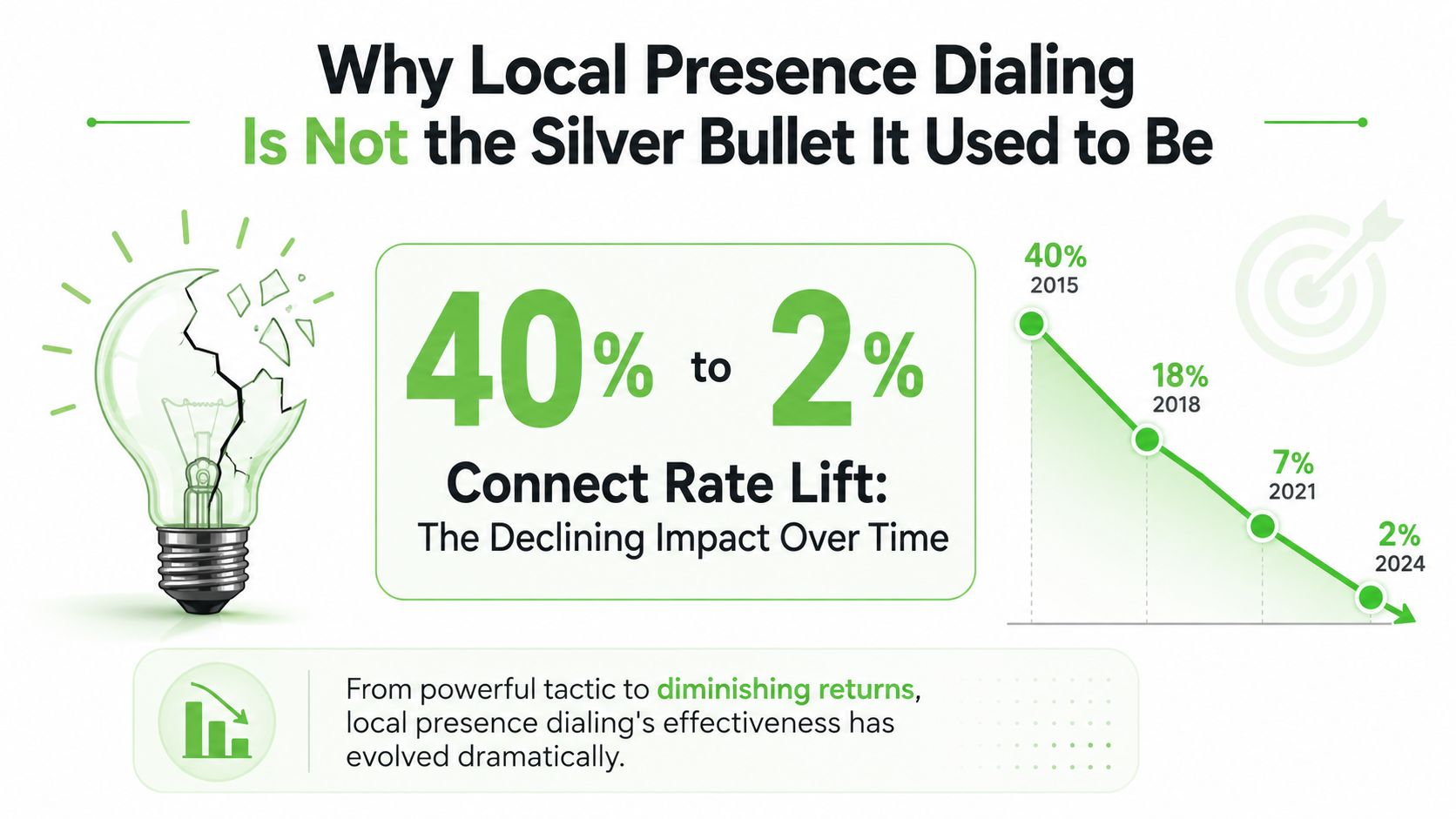
A lot of teams still talk about the tactic as if area-code matching alone creates demand. That's the wrong mental model. It helps at the margin when buyers are scanning an unknown number, but that benefit now sits inside a much harsher environment of spam filtering, reputation systems, and caller-ID skepticism.
Practical rule: treat local presence dialing as a tactical nudge, not a core acquisition strategy.
Why the same tactic feels weaker now
The decline makes sense operationally. Once buyers learned that a local number doesn't guarantee a local caller, the psychological advantage shrank. At the same time, carriers and device ecosystems got better at judging whether a call looks legitimate, so the caller's reputation now matters as much as the area code itself.
For agencies, that changes budgeting and expectation-setting. Local presence is still worth testing, especially in multi-region outbound programs, but it doesn't deserve the same status as list hygiene, offer quality, or disciplined cadence design. Teams that put it at the center usually overestimate what a number can do and underestimate what bad sequencing can destroy.
What overhyped looks like in practice
The overhyped version sounds like this, local numbers will fix pickup rates. That's too broad to be useful. The better framing is narrower, local presence can improve familiarity when the number is real, the reputation is clean, and the campaign is already built on qualified data.
The most reliable teams use it as one line item in a broader dialing stack. They test it, monitor the results by campaign, and switch it off when the operational overhead outweighs the gains.
How Local Presence Dialing Actually Works
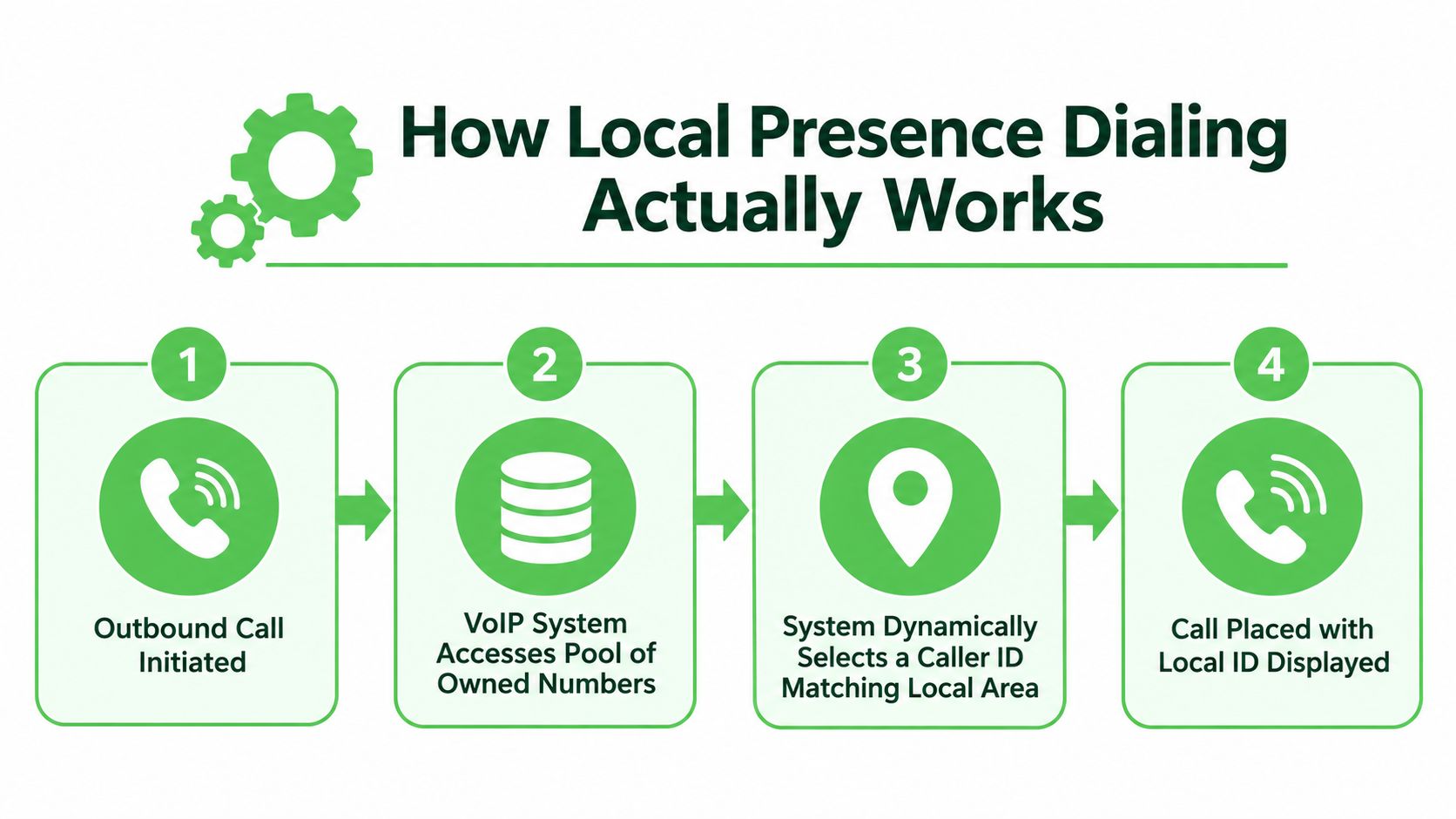
The mechanics are straightforward once you strip away vendor jargon. A local presence system uses real owned business numbers and dynamically swaps the outbound caller ID so it matches the prospect's area code. Nextiva's explanation of local presence dialing describes the core workflow clearly, caller ID selection happens in real time, and callbacks route back to the original rep or workflow.
The call flow in plain English
First, the dialer reads the prospect's phone number and identifies the area code. Then it checks the pool of numbers your team owns across target geographies. From there, it selects the number that best matches the recipient's area code and displays that number as the caller ID.
The key detail is that the displayed number isn't fake. It has to be a number your business owns or leases, and it needs to function properly when someone calls back. If the callback doesn't route to the right person, the whole setup starts to look sloppy and trust erodes fast.
What the infrastructure has to support
Operationally, local presence needs three things. It needs enough numbers across the geographies you care about, it needs dialer logic that can match area codes in real time, and it needs callback routing that lands in the right queue or on the right rep's line. If any one of those breaks, prospects get a confusing experience and your internal team loses confidence in the system.
If the callback path is broken, local presence stops being a trust tactic and starts becoming a support problem.
The cleanest deployments keep the number pool tied to CRM records, campaign rules, and rep ownership. That makes it easier to see which numbers are working, which ones are getting flagged, and which campaigns are burning through reputation too quickly.
The Conflicting Data on Connect Rates and Lift
Local presence dialing gets debated because the numbers do not line up neatly across studies. Some vendors still report noticeable lift, while other analyses show little difference once you measure actual connect rates instead of campaign narratives. Both findings can be true at the same time, depending on the list quality, the market, and the way the test was built.
The optimistic view and the skeptical view
On the optimistic side, current industry guidance still describes a 20% to 40% lift for many operations in the 2024 to 2026 window, with earlier results reported as 50%+ on cold lists in 2023. That can matter if your outbound team is already disciplined and needs a small edge to earn more live conversations. It is a useful lift in the right setup, but it is not a blanket outcome and it should never be presented that way.
On the skeptical side, Orum's analysis of local presence dialing connect rates found 4.6% connect rates for local calls versus 5.5% for non-local calls, and said the difference was not statistically significant. That matters because it cuts against the assumption that area-code matching always produces better pickup rates. If anything, it shows how easy it is to overread a narrow win or lose sight of a weak one.
Why results diverge so much
The gap usually comes from method and measurement. A team with poor list hygiene can make any caller ID strategy look bad, while another team with cleaner data, better reputation management, and stronger sequencing can make local presence look stronger than it really is. In that second case, the lift may come from the broader outbound system, not from the number swap alone.
Market structure matters too. In large markets, prospects already distrust unknown calls, and spam labeling can erase most of the local-familiarity effect. In smaller or more geographically concentrated programs, a local number can still feel relevant enough to earn a pickup.
How to judge your own fit
Use local presence when answer rates are the bottleneck and the audience spans multiple geographies. Be cautious when the campaign already has high call volume, weak number hygiene, or a long trail of recycled contacts. In those environments, the caller-ID tactic cannot make up for a damaged calling stack.
The better internal question is whether local presence works on your list, in your market, with your current reputation posture. If you cannot answer that, run a controlled test and compare outcomes campaign by campaign rather than trusting a headline or a vendor promise.
Compliance Risks That Can Destroy Your Agency
Compliance is where agencies get reckless fastest. The lure is obvious, a local number can make a call feel familiar, so some teams start stretching the rules to force that effect. That's exactly where the legal risk spikes.
Why spoofing is the wrong line to cross
The line between legitimate local presence and illegal caller ID spoofing is simple. Local presence uses real owned numbers that route back to your business. Spoofing uses misleading caller ID with intent to deceive, which is prohibited under federal caller-ID rules. That distinction matters because your intent and your number ownership both shape the risk profile.
The safest agencies treat every displayed number as an asset they must be able to defend. They verify ownership, confirm callback functionality, and document where each number is used. If you can't explain why a number appears on a prospect's screen, you probably shouldn't be using it.
The checklist you can't skip
- Number ownership verification: every visible number should be real, owned, or legitimately leased by the business.
- Do-Not-Call scrubbing: local presence doesn't exempt anyone from DNC procedures.
- Time-of-day discipline: calls still need to respect local calling windows.
- Consent and opt-out handling: if your workflow requires consent, local presence doesn't change that requirement.
- Documentation: keep records of number assignment, campaign use, and callback routing logic.
The operational mistake I see most often is assuming the caller ID layer can be fixed later. It can't. Once a campaign starts generating complaints, the damage can outlive the entire list segment.
Rule of thumb: if compliance is an afterthought, local presence becomes a liability amplifier, not a conversion tool.
Implementation Playbook for Number Management and Rotation
Number management is where good intentions turn into an operational system. The core job is to keep numbers fresh, avoid overuse, and make sure flagged numbers are rested before they drag down the whole campaign. AMDify's local presence dialing guide recommends capping each number at roughly 150 to 250 calls per day and keeping 2 to 3 times more numbers than your immediate need so flagged numbers can rest for 30+ days.
Build the pool before you need it
The temptation is to buy just enough numbers for the launch date. That's too tight. A healthier setup starts with surplus capacity so rotations don't get jammed the first time a number is flagged or a geography starts producing heavy volume.
For agencies, that means planning pools by territory and campaign, not by vanity. A number should exist because it can absorb volume safely, not because it matches a nice-looking region code. If you already know a segment is aggressive on call volume, give it more breathing room from day one.
Track number health like a rep scorecard
| Number Management Benchmarks | Recommendation | Rationale |
|---|---|---|
| Daily calls per number | 150 to 250 | Keeps any single number from carrying too much volume |
| Pool size vs. immediate need | 2 to 3 times larger | Gives you room to rotate and rest flagged numbers |
| Rest period for flagged numbers | 30+ days | Helps reduce repeated spam exposure |
| Rotation discipline | Frequent and even | Prevents one DID from becoming the campaign's weak link |
The practical workflow is boring, and that's a good sign. Rotate the load, watch for spam labels, and retire numbers that keep underperforming even after rest. If a number starts getting flagged, don't fight it for sentimental reasons.
Use external number resources wisely
For teams still sorting through how to source and manage business numbers, Hosted Telecommunications' virtual number advice is a useful reference point for thinking about number provisioning, ownership, and setup discipline. The key is to treat number acquisition as infrastructure, not a one-off purchase.
When Local Presence Dialing Makes Sense Versus Alternatives
Local presence looks attractive because it promises familiarity without rewriting the rest of your outbound stack. That's useful in some contexts, but there are plenty of situations where another channel or number strategy is cleaner and more effective.
Compare the use cases, not the hype
If your team is calling across several states or metro areas, local presence has a real place in the workflow. If you're mostly calling inside one market, the benefit shrinks because your team should already sound local enough through your established presence. In that case, branded caller ID or a stronger outbound sequence may be a better use of effort.
Toll-free numbers are simple and recognizable, but they don't create the same local familiarity. Branded caller ID can be stronger when the recipient's device displays the company name, because it reduces ambiguity instead of trying to simulate geography. SMS-first outreach works better when the audience prefers fast written communication, while omnichannel sequencing often outperforms any one number strategy because it gives prospects multiple ways to respond.
Match the tactic to the revenue motion
- Use local presence dialing when the sales team is doing high-volume outbound across many regions and answer rate is the main bottleneck.
- Use branded caller ID when trust and recognition matter more than area-code matching.
- Use SMS-first outreach when the audience responds better to text than voice.
- Use an omnichannel sequence when deals need repeated touches and a single call rarely closes the loop.
The strongest fit is usually a high-value B2B sale with a defined region mix and a rep team that can handle real callback volume. The weakest fit is a small team with limited call throughput and little appetite for number management overhead.
Don't overinvest in the wrong lever
Local presence should rarely be the only improvement you make. If your script is weak, your list is stale, or your cadences are sloppy, the number on the screen won't save you. The better play is to test it against your current approach, keep the winner, and move on quickly if the lift is marginal.
Integrating Local Presence with WhatsApp and Omnichannel Strategies
Local presence gets stronger when it stops pretending to be a standalone system. The best outbound teams use it as an opener, then move interested prospects into richer channels where the conversation can continue with less friction. That's where WhatsApp, email, and scheduled follow-ups start to matter.
Make the first call do less work
A local number can earn the first answer, but it shouldn't carry the entire relationship. Once the prospect engages, shift them into a channel that makes follow-up easier and more conversational. For agencies running WhatsApp workflows, that usually means using the call to open the door, then continuing with messaging that keeps the thread alive.
That sequencing is especially clean when the CRM records every touchpoint and the rep can see which number, message, or reply created movement. Without that attribution, teams start crediting the wrong channel and scaling the wrong step.
For the automation side, Technioz's chatbot development best practices is a useful companion read if your workflows include conversational handoff, routing logic, or AI-assisted follow-up. The same discipline that makes a good chatbot useful also makes an omnichannel sequence easier to trust.
Build one handoff, not three disconnected campaigns
Local presence, WhatsApp, and email should feel like a single motion. The call creates recognition, the message reinforces context, and the follow-up keeps momentum without forcing the prospect back through a cold start. Agencies that coordinate those touches usually get a cleaner picture of attribution and a less chaotic handoff between reps and automation.
The lesson is not that local presence becomes more important in omnichannel. It becomes more useful when it's no longer asked to do all the work by itself.
Double My Leads helps agencies launch and resell modern messaging workflows without building the stack from scratch. If you're pairing local presence dialing with WhatsApp nurturing and multi-step follow-up, visit Double My Leads to see how a white-labeled WhatsApp platform can fit into a broader outbound system.


