
Stop Juggling Spreadsheets: Find Your Perfect Insurance CRM
Leads are coming in from forms, referrals, phone calls, and maybe a rater or landing page. Renewal dates live in one place, notes live somewhere else, and producers keep their own follow-up system in their heads. That works for a while, until it doesn't. The first real sign is usually simple: someone who should've received a quote follow-up or renewal reminder didn't.
A good CRM fixes that. It gives your agency one operating system for lead intake, policy pipelines, renewals, follow-ups, task assignment, and client communication. In larger markets, CRM has already become a baseline business tool. HubSpot cites Grand View Research that over 91% of companies with more than 10 employees use CRM systems, which helps explain why insurance buyers now evaluate CRM around automation, workflow fit, and integrations instead of basic contact storage.
In today's market, speed-to-lead and client communication are paramount. Integrating modern channels like WhatsApp directly into your CRM is no longer a luxury, it's a competitive advantage. Look for platforms that support these workflows.
Insurance agents also face a different buying decision than most sales teams. You're not just choosing a place to store contacts. You're choosing how your team handles renewals, policy servicing, quoting handoffs, commissions, and producer accountability. That's why the best CRM for insurance agents depends less on flashy dashboards and more on whether the system matches how your agency sells and services policies.
This guide gets to the list quickly, but it doesn't stop there. You'll get practical tool-by-tool trade-offs, a decision framework, recommendations by agency size, and a comparison matrix placeholder you can use to short-list your finalists. By the end, you'll have the clarity to choose the best CRM to scale your book of business.
Table of Contents
- 1. AgencyZoom (by Vertafore)
- 2. AgencyBloc
- 3. Radius (Radiusbob)
- 4. Insureio
- 5. Better Agency
- 6. VanillaSoft
- 7. Shape Software (Shape CRM)
- 8. LeadSquared (Insurance CRM)
- 9. Salesforce Financial Services Cloud (Insurance)
- 10. Zoho CRM (Insurance Solution)
- Top 10 CRMs for Insurance Agents, Feature Comparison
- Take the Next Step Implement and Grow
1. AgencyZoom (by Vertafore)
AgencyZoom makes sense fast if you run a P&C agency and don't want to spend months translating a general CRM into insurance language. Its value is straightforward: lead routing, nurture automations, renewal workflows, win-back campaigns, cross-sell prompts, and producer scorecards are already aimed at agency operations instead of generic deal stages.
That matters because a lot of CRM projects fail at the same point. The software can technically do what you need, but your team has to invent the process from scratch. AgencyZoom avoids much of that setup burden for independent agencies that want proven workflows right away.
Why AgencyZoom works well in P&C
Its strongest appeal is operational fit. If your team lives in renewals, remarketing, referrals, reviews, and producer accountability, AgencyZoom is easier to understand than a broad CRM that needs extensive customization.
- Lead routing: New leads can move to the right producer quickly, which is critical when inbound response time affects close rates.
- Retention workflows: Renewal reminders, win-back campaigns, and cross-sell sequences are built around recurring insurance work instead of one-time transactions.
- Producer visibility: Dashboards and goal tracking help managers spot who's following process and who's just “working their desk.”
Practical rule: If your agency wants a CRM to feel like an insurance operating system on day one, insurance-native workflow matters more than broad feature count.
The trade-off is specialization. AgencyZoom is most compelling for P&C-heavy agencies, especially those already tied into the Vertafore ecosystem. If you're primarily life, health, or benefits, the fit is less obvious. Pricing also isn't public, so you'll need a sales conversation to understand total cost.
For agencies that want insurance-specific workflows instead of building them in a horizontal platform, AgencyZoom is one of the clearest options on the board.
2. AgencyBloc
AgencyBloc sits in a different category than a pure sales CRM. It's built for life, health, Medicare, and group benefits agencies that need CRM functions alongside policy tracking, commissions, and enrollment workflows. That combination is what makes it attractive. You're not stitching together a contact manager, a commissions tool, and a separate quoting process if one platform can handle more of the core workflow.
This is one of the better fits for agencies that have already outgrown a lightweight pipeline tool. If your team tracks policy activity, tasks, commissions, marketing outreach, and client records across multiple systems, AgencyBloc offers a cleaner center of gravity.
Where AgencyBloc fits best
The main strength here is consolidation. Agencies in life and health often don't just need “better follow-up.” They need one place to connect sales activity with downstream operations.
- Client and policy records: The CRM side supports tasks, activities, and policy-centered organization rather than simple lead cards.
- Commissions tracking: Many general CRMs often fall short in this area. If reconciliation matters to your business, purpose-built tools usually save real administrative pain.
- Quoting and enrollment support: Benefits and Medicare workflows often involve more handoffs and status management than a standard sales CRM expects.
There is a cost to that breadth. Some solo agents will find the platform heavier than they need, especially if they just want a cleaner pipeline and automated reminders. AgencyBloc also doesn't publish pricing publicly, so evaluating fit requires a demo and a clearer scope discussion.
Plainly put, this is a strong choice when your agency wants CRM plus agency-management-style depth in one stack. You can review AgencyBloc directly if your business leans life, health, Medicare, or employee benefits.
3. Radius (Radiusbob)
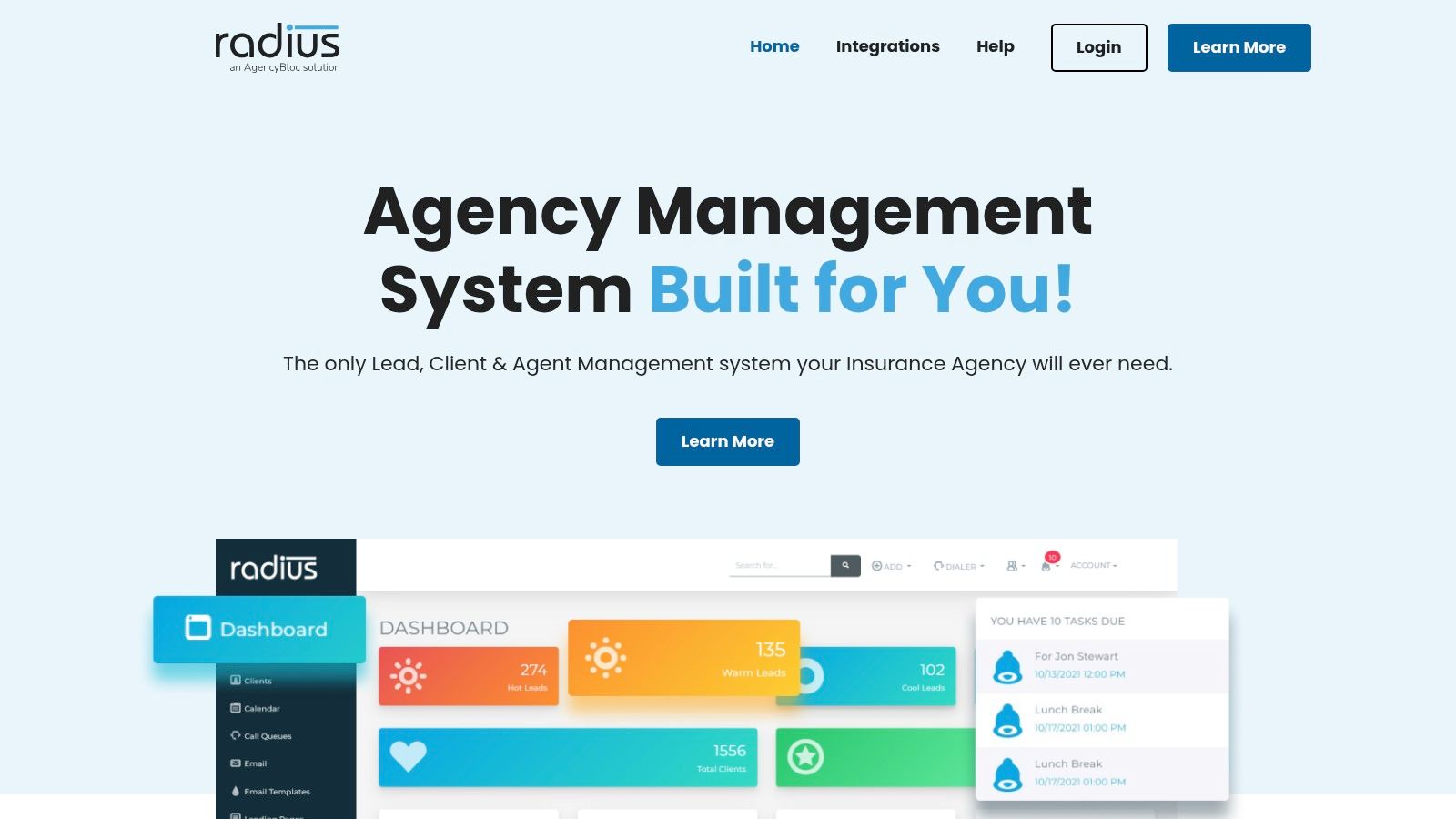
Radius is a practical pick for agencies that sell by phone and don't want a separate dialer, call recording tool, scheduler, and CRM all fighting each other. It's insurance-specific, but its personality is closer to a sales engagement platform with insurance data structures than a deep AMS.
That's not a criticism. For many teams, especially life and health shops or smaller P&C teams working purchased leads, speed and contact volume matter more than elaborate back-office workflows. Radius is built for that reality.
What Radius does better than many general CRMs
The all-in-one communication stack is the point. Built-in dialing, call recording, conferencing, email and SMS automations, appointment scheduling, and lead distribution reduce app sprawl. Fewer disconnected tools usually means fewer dropped follow-ups.
- Phone-first workflow: Producers can move from lead assignment to outreach without jumping across systems.
- Lead funnel management: Automated distribution and workflow rules help managers keep new leads moving.
- Commission and product tracking: Useful when you need more than just a notes field but less than a full agency management platform.
Radius also has a lower-friction entry point than many quote-based insurance tools because it offers a free trial. That makes it easier to validate whether your team likes the workflow before committing to a full rollout.
The downside is depth. If you need rich policy servicing, broad integrations with agency management systems, or complex renewal operations, Radius can feel more sales-first than operations-first.
Fast outreach tools help only if your team works assigned tasks every day. A dialer inside the CRM doesn't fix weak process by itself.
If your agency's biggest pain is lead response and producer activity, not enterprise process design, Radius deserves a close look.
4. Insureio
Insureio is one of the easiest tools on this list to place. If you're in life insurance, final expense, simplified issue, no-exam products, or annuities, it lines up with how your business runs. Quoting, e-app and drop-ticket flows, case status tracking, lead routing, and marketing features all sit inside the same platform.
That bundled approach matters because life insurance teams often buy separate tools for quoting, lead nurturing, websites, and application workflows. Insureio reduces that stack, especially for producers, agencies, IMOs, and FMOs that want one login for more of the sales process.
Best use case for Insureio
Insureio is strongest when quoting and application flow are part of daily production. It's not trying to be a generic CRM for every insurance vertical. That focus is its advantage.
- Life-focused quoting: The platform centers on products and workflows life producers use.
- E-app and drop-ticket support: This shortens the distance between lead interest and submitted business.
- Agency hierarchy tools: Routing and recruiting features make it relevant beyond the individual producer level.
Another practical plus is transparency. Insureio is one of the few purpose-built insurance tools here with a clearer plan structure and a try-free option, which makes early evaluation less opaque than many enterprise-style products.
The limitation is obvious too. If your business is primarily P&C, or you need broad AMS-style servicing workflows, this isn't the best fit. Advanced bulk email is also handled as an add-on, so agencies with heavier outbound marketing should scope that early.
For life-focused shops that want quoting, e-apps, and CRM in one place, Insureio is one of the most natural fits on this list.
5. Better Agency
Better Agency is built for independent agencies that want speed to value more than endless customization. That's a smart positioning. Many agencies don't need a platform project. They need sales, service, claims, and renewal automations working this month, not next quarter.
It stands out because the workflows are prebuilt and agency-friendly. Video proposals, review requests, pipeline stages, and follow-up campaigns are framed around common independent agency motions rather than generic CRM terminology.
Why Better Agency is attractive for independents
The practical appeal is simple. You can launch faster because the system assumes you're running an agency, not a software company with an internal admin team.
- Prebuilt automations: Sales, service, claims, and renewals are already represented in campaign logic.
- Communication tools: Two-way email sync and customer-facing proposal and review workflows support the day-to-day agency experience.
- Integration flexibility: Zapier connectivity and links to raters and AMS tools help fill gaps where needed.
One thing I like in tools like this is honest scope. Better Agency doesn't pretend to replace every system in every agency. If you need deep quoting, complex policy administration, or broad AMS functionality, you may still need connected tools.
Pricing transparency is another plus. In a category where many vendors hide pricing behind demos, that alone can make short-listing easier. But the product remains most compelling for P&C-focused independents. Life and health agencies will likely find the workflow depth lighter than what they need.
For agencies that want practical automations without a long implementation runway, Better Agency is a strong contender.
6. VanillaSoft
VanillaSoft is not the tool I'd recommend when policy servicing is your biggest challenge. It is the tool I'd look at when your agency lives or dies by speed-to-lead, queue-based outreach, and producer talk time. In insurance distribution, that's a real use case.
This platform is built around structured outreach. Dynamic queues, dialing, SMS, email, call recording, transcription, and compliance-oriented telecom options make it better suited to call-heavy teams than many classic CRMs.
When VanillaSoft is the right choice
The best reason to buy VanillaSoft is discipline. It tells reps what to do next. That's useful in high-volume lead environments where contacts age quickly and manual prioritization breaks down.
- Queue-based execution: Reps don't have to decide who to call next. The system serves the next action.
- Multi-channel outreach: Voice, SMS, and email sit in one workflow.
- Compliance-aware setup: Regulated outreach teams often need more than a basic dialer.
There's also a broader market reason tools like this keep showing up in insurance stacks. By 2026, one insurance CRM analysis said many carriers were choosing platforms based on integration architecture and measurable outcomes, with business cases often targeting 8 to 15x ROI over three years. The takeaway isn't that every agency will hit that result. It's that CRM is being judged as an operating system tied to production metrics, not just lead storage.
VanillaSoft fits that thinking when the operating bottleneck is outreach execution. It's less compelling when your bigger issue is renewals, commissions, or policy-centric servicing. For call-intensive teams, VanillaSoft is worth serious consideration.
7. Shape Software (Shape CRM)
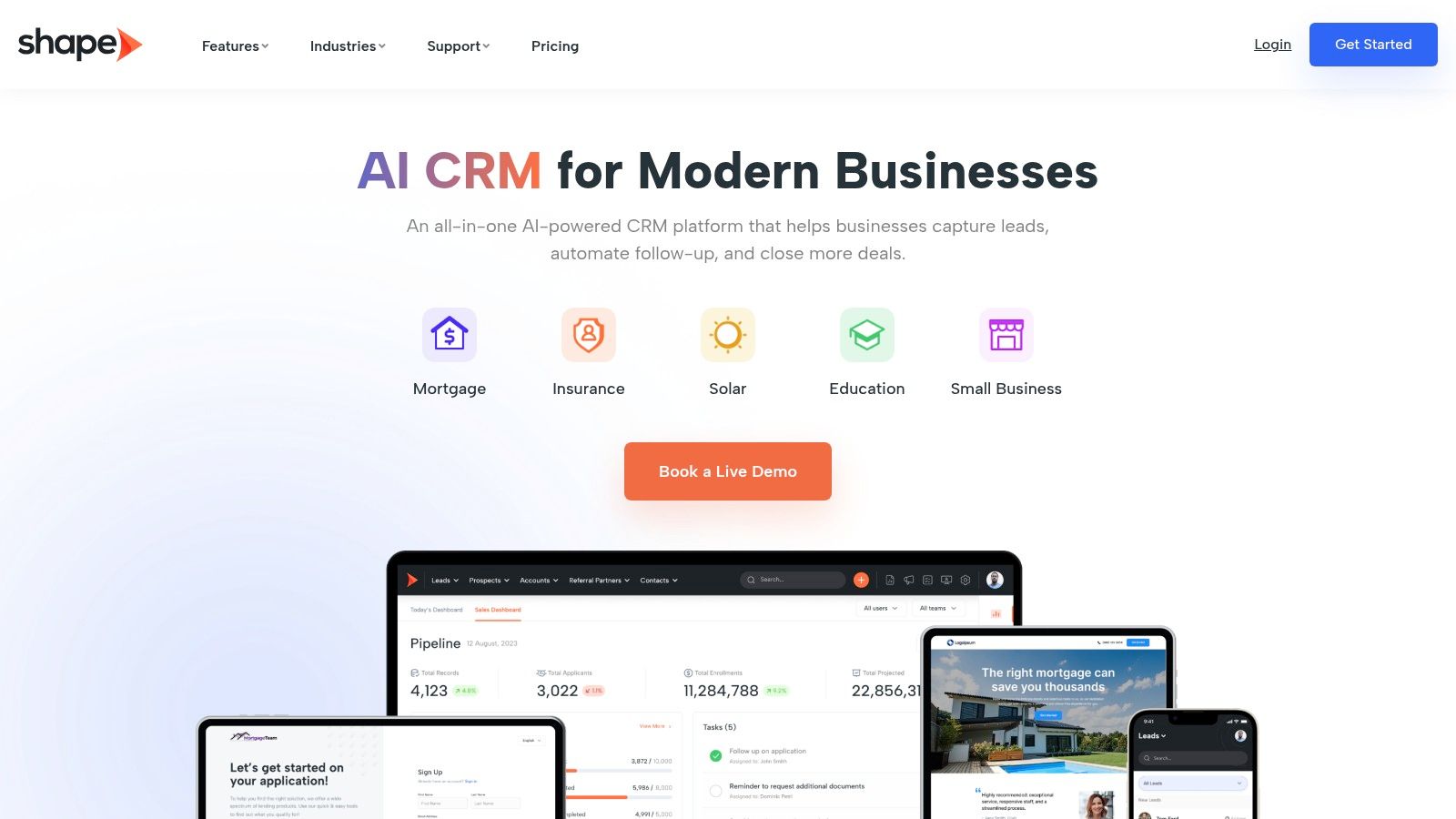
Shape sits between a vertical CRM and a communication platform. That's useful for insurance teams that want texting, calling, email, automations, portals, and mobile access under one roof without assembling everything from separate vendors.
It's a broader system than some of the insurance-native tools above. That can be good or bad depending on your team. Agencies with active sales teams and multi-step client communication often like this kind of platform because it centralizes activity. Solo agents can find it heavier than necessary.
What to watch before you buy Shape
Shape's value comes from native communication tools and vertical-ready templates. If your current setup has one app for calling, another for texting, another for forms, and a basic CRM trying to hold it together, Shape can simplify that.
- Multi-channel engagement: Calling, SMS, and email automations reduce the need for extra communication tools.
- Industry templates: Insurance-oriented pipelines give you a faster starting point than a blank CRM.
- Add-on marketplace: You can expand functionality without rebuilding platforms from scratch.
The caution is implementation discipline. Flexible systems can become messy if nobody defines pipeline stages, ownership rules, and follow-up standards. A broader platform doesn't automatically mean a better rollout.
Buy the system your team will actually work inside every day. The best CRM for insurance agents isn't the one with the longest feature page. It's the one that matches your sales motion and service model.
Pricing typically requires talking to sales, so budgeting takes a bit more effort. If your team wants communications and CRM in one place with room to scale, Shape Software is a credible option.
8. LeadSquared (Insurance CRM)
LeadSquared is a more operational and distribution-focused choice than most small agencies need, but it becomes interesting fast once multiple locations, field teams, partner channels, or regulated onboarding enter the picture. It's designed for structured insurance sales processes, not just a basic producer pipeline.
What separates it is process control. Multi-channel lead capture, workflow automation, KYC-related add-ons, field-force tracking, distributor management, and API-led implementation all point to a platform meant for scale and coordination.
LeadSquared's strongest fit
This is one of the clearer options for broker networks, agencies with distributed teams, and organizations that need a formal onboarding path. If your business involves branch operations, partner distribution, or field sales visibility, general CRMs often start to feel thin.
- Lead distribution: Useful when volume and territory logic matter.
- Workflow depth: Visual automations make structured handoffs easier to manage.
- Compliance-oriented onboarding: KYC and related workflows matter in regulated environments.
LeadSquared is not a lightweight buy. Implementation scope can expand quickly, and smaller agencies may feel like they're paying for machinery they won't use. But if operational complexity is already part of your business, that depth is the point, not the problem.
The bigger strategic trend supports tools like this. Industry guidance increasingly treats CRM selection as part of stack design, not a standalone purchase. In practice, buyers now weigh whether a general CRM, an insurance-native system, or a broader workflow layer best fits the agency. That distinction is central to Word & Brown's discussion of CRM trade-offs for insurance brokers.
For multi-location and process-heavy teams, LeadSquared Insurance CRM is built for serious workflow management.
9. Salesforce Financial Services Cloud (Insurance)
Salesforce is the most extensible option on this list. That's why it keeps showing up in large insurance environments. If you need householding, policy and coverage data models, service workflows, analytics, portals, and a huge partner ecosystem for telephony, e-sign, marketing, and quoting, Salesforce belongs in the conversation.
But the same thing that makes Salesforce powerful also makes it expensive to get wrong. You don't buy Salesforce Financial Services Cloud because you want “a better pipeline.” You buy it because you need platform depth, custom process design, and long-term scalability.
Why Salesforce wins bigger environments
In larger agencies and carrier-adjacent environments, integration architecture usually matters more than out-of-the-box simplicity. That's one reason broader insurance CRM guidance often separates horizontal CRMs from insurance-native platforms based on operating model. Agencies built around inbound demand, forms, nurture campaigns, and workflow automation often do well in CRM-first stacks, while servicing-heavy teams need stronger interoperability and custom workflow depth. That pattern is reflected in Salesmate's overview of common CRM choices for insurance.
- Platform extensibility: You can shape the system around your agency instead of forcing your agency around the software.
- Ecosystem: AppExchange and implementation partners give Salesforce unusual range.
- Enterprise controls: Security, auditability, automation, and advanced reporting are major strengths.
The weakness is total cost of ownership. Admin skill, partner help, and governance usually aren't optional. Smaller agencies often underestimate that and end up with a complex system nobody fully uses.
If you have a larger team, multiple lines, or a real need for custom workflows and deep integrations, Salesforce Financial Services Cloud is one of the safest long-term bets.
10. Zoho CRM (Insurance Solution)
Zoho stays on insurance shortlists for one reason. It offers a lot of flexibility without forcing agencies into an enterprise-level project. For small teams, solo agents, and growing brokerages, that matters more than prestige.
Zoho CRM's insurance solution page points buyers toward custom pipelines for policy types, premiums, and renewals, along with workflow automation, email and SMS integrations, AI assistance, and access to the wider Zoho suite. That makes it a practical middle ground between bare-bones CRMs and highly specialized insurance platforms.
Why Zoho stays on shortlists
Zoho is usually attractive when the agency needs customization but doesn't want heavy consulting. It's especially useful if you may later want connected tools like help desk, accounting, campaigns, or broader back-office apps inside one vendor family.
- Flexible setup: You can tailor pipelines and fields around your process without starting from zero.
- Affordable path in: Smaller teams often prefer this over quote-based enterprise software.
- Suite expansion: Zoho One can become a bigger operating stack as the agency grows.
The compromise is that Zoho isn't insurance-native in the same way AgencyZoom or Insureio is. You'll likely do more setup work to get policy-centric workflows right. If you buy it expecting instant insurance best practices out of the box, you may be disappointed.
Still, there's a reason general-purpose CRMs remain common in this market. Industry roundups keep grouping platforms like Salesforce, HubSpot, and Zoho among the usual contenders, which suggests there isn't one dominant insurance CRM winner for every use case. HubSpot's insurance guidance also reflects how common CRM adoption has become across larger businesses and why workflow fit now matters so much in selection. You can explore Zoho CRM for insurance if you want a flexible, budget-conscious platform with room to grow.
Top 10 CRMs for Insurance Agents, Feature Comparison
| Solution | Core features (✨) | UX / Quality (★) | Value & Pricing (💰) | Target audience (👥) | Unique selling points (🏆) |
|---|---|---|---|---|---|
| AgencyZoom (Vertafore) | P&C CRM: lead routing, renewals, producer dashboards, Vertafore integrations ✨ | ★★★★ Mobile apps; insurance workflows | 💰 Quote required | 👥 P&C agencies & producers | 🏆 Insurance-native playbooks & Vertafore ecosystem |
| AgencyBloc | Life/health AMS: CRM, commissions, quoting & enrollment ✨ | ★★★★ AMS-grade features for benefits teams | 💰 Quote (AMS capabilities) | 👥 Life, Medicare & group benefits agencies | 🏆 Built-in commissions + enrollment workflows |
| Radius (Radiusbob) | CRM + built-in dialing, call recording, scheduling ✨ | ★★★★ Sales-engagement focused; quick start | 💰 15‑day trial → quote | 👥 Life/health call centers & small P&C shops | 🏆 Integrated dialer + CRM for calling teams |
| Insureio | Life-focused quoting, e-apps, marketing & case tracking ✨ | ★★★★ Purpose-built for life producers | 💰 Try-free option; add-ons for bulk email | 👥 Life producers, IMOs/FMOs | 🏆 Quoting + carrier e‑app flows and case status |
| Better Agency | Prebuilt sales/service/renewal campaigns, proposals ✨ | ★★★★ Fast launch with preconfigured automations | 💰 Transparent base pricing (includes 3 users) | 👥 Independent P&C agencies | 🏆 100+ prebuilt automations; quick time-to-value |
| VanillaSoft | Queue/progressive dialer, VoIP, SMS, compliance bundles ✨ | ★★★★ Proven for high-volume calling teams | 💰 Quote/bundle pricing | 👥 Call-heavy distribution & regulated teams | 🏆 Next-best lead engine + compliance tools |
| Shape Software | Financial services CRM: dialer, SMS, portals, add-ons ✨ | ★★★★ Vertical templates; mobile & portals | 💰 Quote-based | 👥 Financial services & insurance teams | 🏆 Flexible add-on marketplace & native comms |
| LeadSquared (Insurance) | Lead capture, KYC/eKYC, field-force & partner mgmt ✨ | ★★★★ Strong compliance & workflow orchestration | 💰 Quote-based (enterprise) | 👥 Carriers, brokers, multi-location firms | 🏆 KYC/Video-KYC + distributor/field-force controls |
| Salesforce Financial Services Cloud | Insurance data model, householding, portals, analytics ✨ | ★★★★★ Enterprise-grade, extensible & analytic | 💰 Higher TCO; quote-based | 👥 Enterprises, regional brokerages, carriers | 🏆 Scale, AppExchange ecosystem & deep customization |
| Zoho CRM (Insurance) | Custom pipelines, workflows, insurance templates ✨ | ★★★★ Budget-friendly; fast setup | 💰 Free tier & low-cost plans | 👥 Small agencies & growing teams | 🏆 Cost-effective + Zoho One ecosystem integration |
Take the Next Step Implement and Grow
The shortlist matters, but implementation matters more. Agencies rarely regret choosing a CRM that fits their workflow. They do regret buying a platform based on a feature checklist, then discovering nobody agreed on pipeline stages, renewal ownership, lead routing rules, or what should trigger a follow-up sequence.
Start with your actual agency motion. If you're a solo producer or very small shop, simplicity wins. You need fast setup, clean follow-up, renewal reminders, and basic visibility into who needs attention next. That usually points toward tools like Zoho CRM, Better Agency, Radius, or Insureio if you're life-focused. The right choice is the one you'll fully use in the next month, not the one you might grow into three years from now.
For small brokerages, the decision usually hinges on specialization. A P&C-heavy independent agency may get more value from AgencyZoom or Better Agency because the workflows are already aligned to renewals, producer accountability, and retention campaigns. A life, health, Medicare, or benefits agency is often better served by AgencyBloc or Insureio because policy tracking, commissions, and enrollment flow aren't side issues. They're the core of the business.
Larger agencies and more complex distribution teams should think in systems, not apps. That means asking how the CRM connects to policy administration, quoting, document handling, calling, portals, and reporting. That broader lens matches where the market has gone. CRM buying is no longer just about contact storage or lead capture. It's about measurable operations, workflow design, and integration architecture. That's why platforms like Salesforce Financial Services Cloud, LeadSquared, and sometimes VanillaSoft or Shape become more relevant as process complexity increases.
Don't let demos distract you from the real test. Ask each vendor to show your renewal workflow, your lead assignment logic, your commission visibility, and your service handoff. If they can't model your day-to-day work, it's not the right system.
A practical buyer's checklist is simple. Check whether the CRM handles your lines of business well. Check whether your producers will use the interface. Check how renewals, service tasks, and communications are logged. Check what needs a third-party integration. Check how hard reporting is for a manager, not just an admin. Then check what happens after the sale. Onboarding, migration help, and account support often decide whether the rollout succeeds.
If your agency depends heavily on inbound leads, don't ignore communication channels while evaluating CRM options. Fast response and organized conversation history are part of the customer experience now. That's one reason many agencies are also exploring tools that improve messaging workflows around the CRM itself. If that's relevant to your operation, this guide for insurance agents on AI offers ideas on how teams are using AI-assisted communication to support sales and inbound handling.
You may also find that the best setup isn't one platform doing everything. In some agencies, the winning stack is a CRM plus a purpose-built communication layer or lead capture tool. Double My Leads can fit into that conversation where WhatsApp-based lead capture and messaging workflows support agency marketing and then feed the CRM your team already uses.
Choose two or three finalists. Book live demos. Bring your real workflows into the room. Ask each vendor to show exactly how your agency would run inside the system next week. That's how you find the best CRM for insurance agents for your agency, not somebody else's.
If your agency wants to add WhatsApp-based lead capture, messaging, and follow-up around the CRM you choose, Double My Leads is worth a look. It gives agencies a way to run white-labeled WhatsApp workflows, organize conversations, assign chats, and capture leads that can support the rest of the sales process.


