
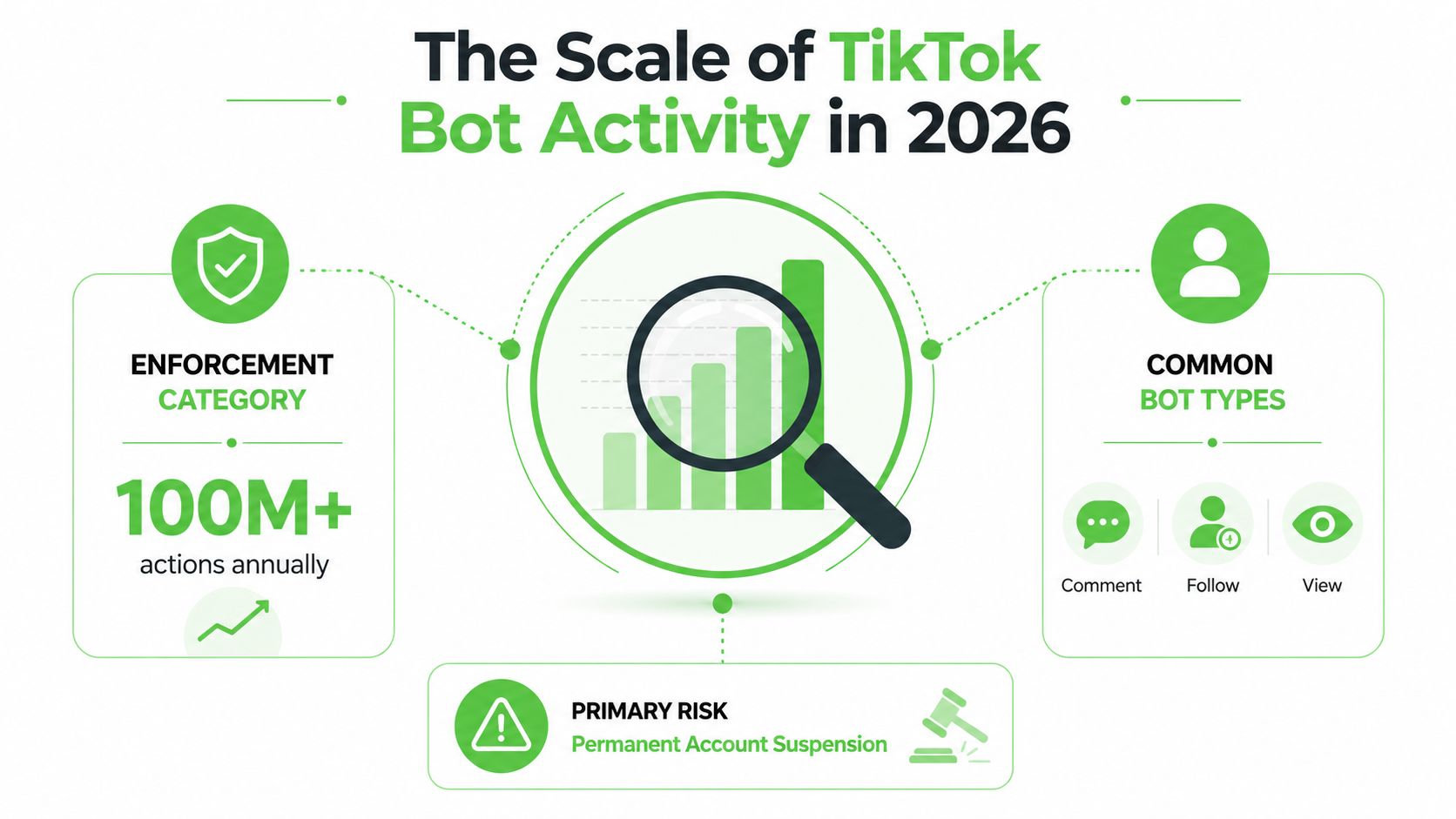
TikTok's own enforcement history makes one thing clear, bot activity isn't a fringe growth hack anymore, it's an industrial-scale moderation problem. In 2022, the platform said it removed nearly 160 million fake accounts, over 256 million total accounts, and nearly 413 million videos, while also cutting off 20 million accounts suspected to be under age 13 and more than 50 million fake or scam-operated accounts, all from TikTok enforcement data summarized here. By 2024, third-party reporting based on TikTok enforcement data pointed to even larger cleanup efforts, including roughly 348 million fake accounts in Q3 2024 and, in a separate Statista-backed summary, about 6 billion fake followers and 7 million fake likes removed in Q4 2024 from this enforcement summary.
That scale changes the conversation for marketers. A TikTok bot is no longer just a cheap script that inflates vanity metrics, it's any software that performs TikTok actions in a way that mimics a human but isn't one, whether that means following, liking, commenting, viewing, scraping, or posting at a pace a real person wouldn't sustain. If your workflow simulates user behavior instead of using approved tools and legitimate automation, you're in bot territory.
Practical rule: if the tool's main promise is to make your account look more active than it really is, TikTok will probably treat it as suspicious.
Table of Contents
- What a TikTok Bot Really Is in 2026
- The Four Main Types of TikTok Bots
- How TikTok Detects Bots
- TikTok Policy and Legal Risks You Cannot Ignore
- Safe Automation vs Risky Bot Behavior
- Routing TikTok Leads into WhatsApp and Your CRM
- Your TikTok Growth Action Plan This Week
What a TikTok Bot Really Is in 2026
The simplest way to define a TikTok bot is this, software that does TikTok work without a person doing each action manually. That can mean something obvious, like auto-liking hundreds of videos, or something quieter, like posting on a schedule, scraping comments, or sending repetitive replies from a script. The line between helpful automation and a bot gets crossed when the behavior is meant to imitate a real user instead of support a real workflow.
The mental model that keeps teams out of trouble
A normal automation tool helps a human move faster. A bot tries to replace the human signal altogether. That's the difference between a legitimate scheduling tool that publishes content you already wrote and a fake engagement service that floods a post with likes to make it look important.
TikTok's own platform rules make that distinction matter. In its developer documentation, the company restricts app names that imitate TikTok and requires region-specific approval for some launches, including US approval from TikTok for mini-app deployment, which shows how seriously it treats imitation and unauthorized distribution in its ecosystem, see TikTok's basic information and specifications. That's not just branding hygiene. It reflects a broader trust model, if the platform sees mimicry, it assumes risk.
For marketers, the practical test is easy. Ask three questions:
- Does the tool create fake human behavior? If yes, that's bot-like.
- Does it inflate engagement, views, comments, or follows? If yes, that's a red flag.
- Would you be comfortable explaining it to TikTok support? If not, don't ship it.
The realistic worst case isn't just losing a single post. You can lose account trust, get limited reach, or have the account removed if the behavior looks coordinated or deceptive. That's why the topic matters before you install anything, not after a penalty lands.
What users often confuse with bots
A lot of teams call every automation a bot, and that causes bad decisions. A CRM sync, a scheduled post, or a lead-routing workflow isn't the same thing as a fake follower farm. But once the software starts imitating taps, scrolls, or interactions, the risk profile changes fast.
The Four Main Types of TikTok Bots
Many lump every TikTok bot into one bucket, but the market splits into four useful archetypes. Once you know the pattern, you can spot the promise, the target behavior, and the compliance risk in seconds.
Growth automation bots
These are the loudest ones. They try to boost follow counts, likes, comments, or views by simulating engagement at scale, like a stadium of people clapping on cue. A vendor might pitch it as “organic growth software,” but if the product is really generating fake taps or artificial attention, it's a growth bot.
The value claim is simple, fast visibility. The first red flag is also simple, the tool's output is engagement that doesn't come from actual viewers. TikTok's removal of fake followers and fake likes in the enforcement data above shows why this category stays under pressure.
Chatbot-style response automation
These tools act like scripted receptionists. They don't always try to fake popularity, but they do attempt to answer comments or messages automatically, often with rigid templates. That can be useful when it stays inside approved workflows, but it turns risky when it starts impersonating a person or mass-posting identical replies.
The promise is speed in community management. The risk flag is sameness, repeated phrases, identical timing, and no real human review.
Moderation bots
These are the silent janitors. They scan comments, filter spam, remove profanity, or hide obvious abuse. In a clean setup, they help a team keep a large account usable without forcing someone to read every comment by hand.
The business value is operational. The policy risk appears when the moderation system overreaches, suppresses legitimate users, or gets used to manipulate conversation rather than protect it.
Scraping and analytics bots
These look like market researchers with notebooks. They collect public data, count trends, or monitor competitor content at scale. The output can inform strategy, but the collection method matters more than the dashboard.
The red flag here is covert extraction. If the tool is pulling data in ways TikTok didn't authorize, or if it is paired with fake engagement behavior, the risk compounds quickly.
Rule of thumb: if a vendor can't explain whether its system is creating activity, filtering activity, or observing activity, it's probably marketing a bot as something safer than it is.
How TikTok Detects Bots
TikTok does not need to inspect code to spot automation. It looks at patterns, then compares a profile's behavior with large sets of other sessions to judge whether the activity fits normal human use or a coordinated script. That matters for marketers because the same systems that filter fake views can also shape how TikTok evaluates lead generation traffic and the quality of the audience sending those leads into downstream workflows, including WhatsApp handoffs and CRM routing.
Signals that give automation away
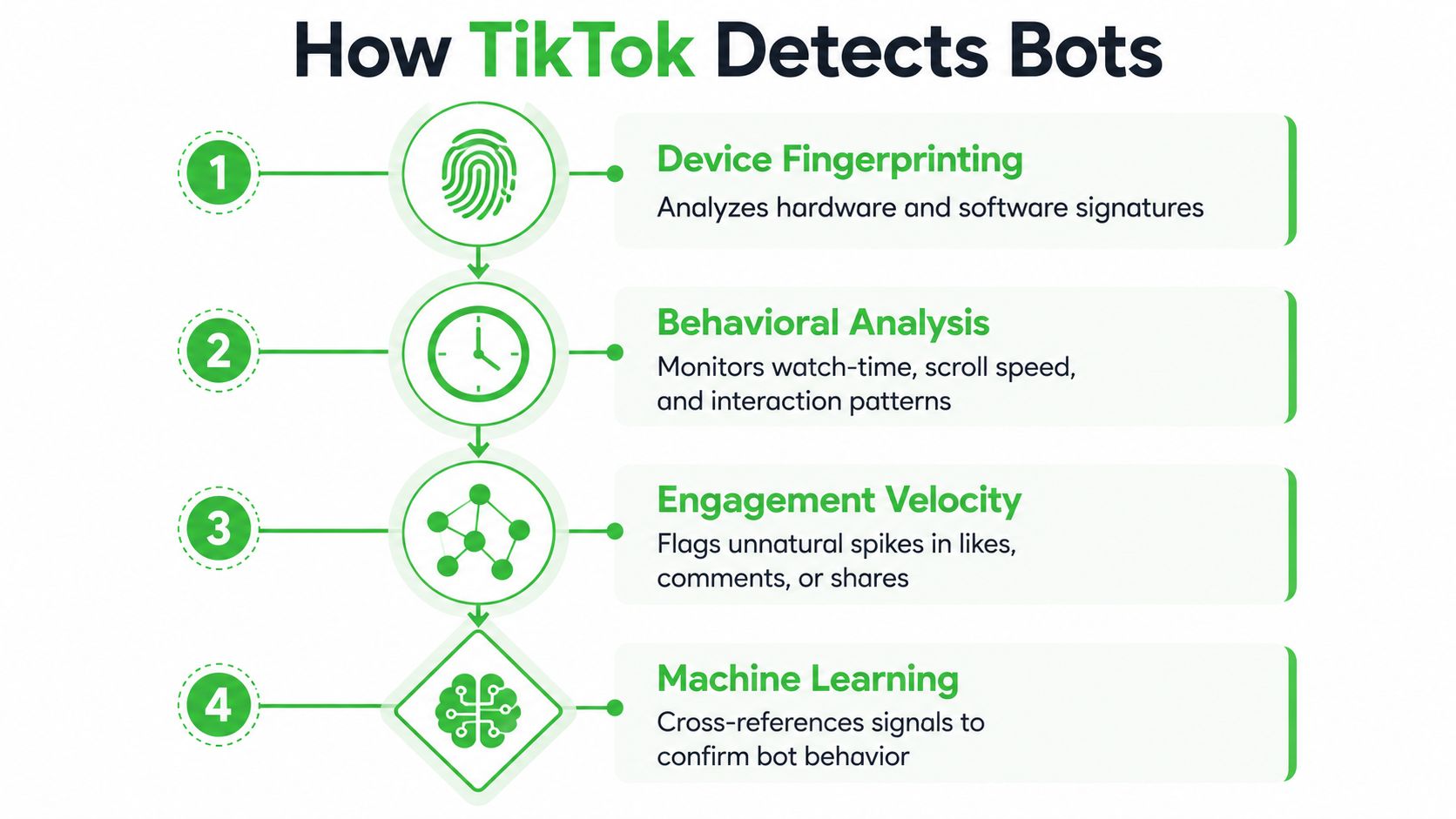
The first layer is device fingerprinting, which means the platform can compare hardware and software signatures. If many accounts seem to come from the same technical setup, that clustering becomes a warning sign.
The second layer is behavioral analysis. Human watch time, scroll speed, pauses, and taps are messy. Automated behavior is often too tidy, too fast, or too repetitive, which makes it easier to separate from normal use.
The third layer is engagement velocity. Real posts usually pick up attention unevenly. Bot-driven activity often arrives in bursts that do not fit the account's history, the audience size, or the way a real community reacts.
The fourth layer is machine learning, which compares the signals above across many sessions. TikTok does not need every signal to be perfect. It only needs enough overlap to decide the activity belongs to a pattern, not to a single harmless anomaly.
For a non-engineer, the practical point is simple. One suspicious action can blend into the background. A network of coordinated actions becomes easier to spot because the repetition shows up in timing, device patterns, and interaction shape. That is why a small test can pass unnoticed while a larger bot operation gets flagged quickly.
If you want a practical external explainer on the detection side, this a practical guide to bot traffic detection on TikTok breaks down why view patterns and abnormal traffic clusters are easier to spot than they look from the outside.
Why scale amplifies detection
A lone bot account can hide in the noise. A large cluster creates repeated behavior, shared fingerprints, synchronized timing, and obvious interaction patterns. Once those signals line up, the system has much less room to treat the activity as random.
That is why enforcement data matters. TikTok has already shown it can remove fake activity at large scale, which means its detection stack is built for volume, not just edge cases.
TikTok Policy and Legal Risks You Cannot Ignore
TikTok bot risk is not just a terms-of-service problem. For marketers, it sits at the intersection of account identity, content disclosure, and how the platform decides whether activity looks human or manufactured.
The rules that matter most
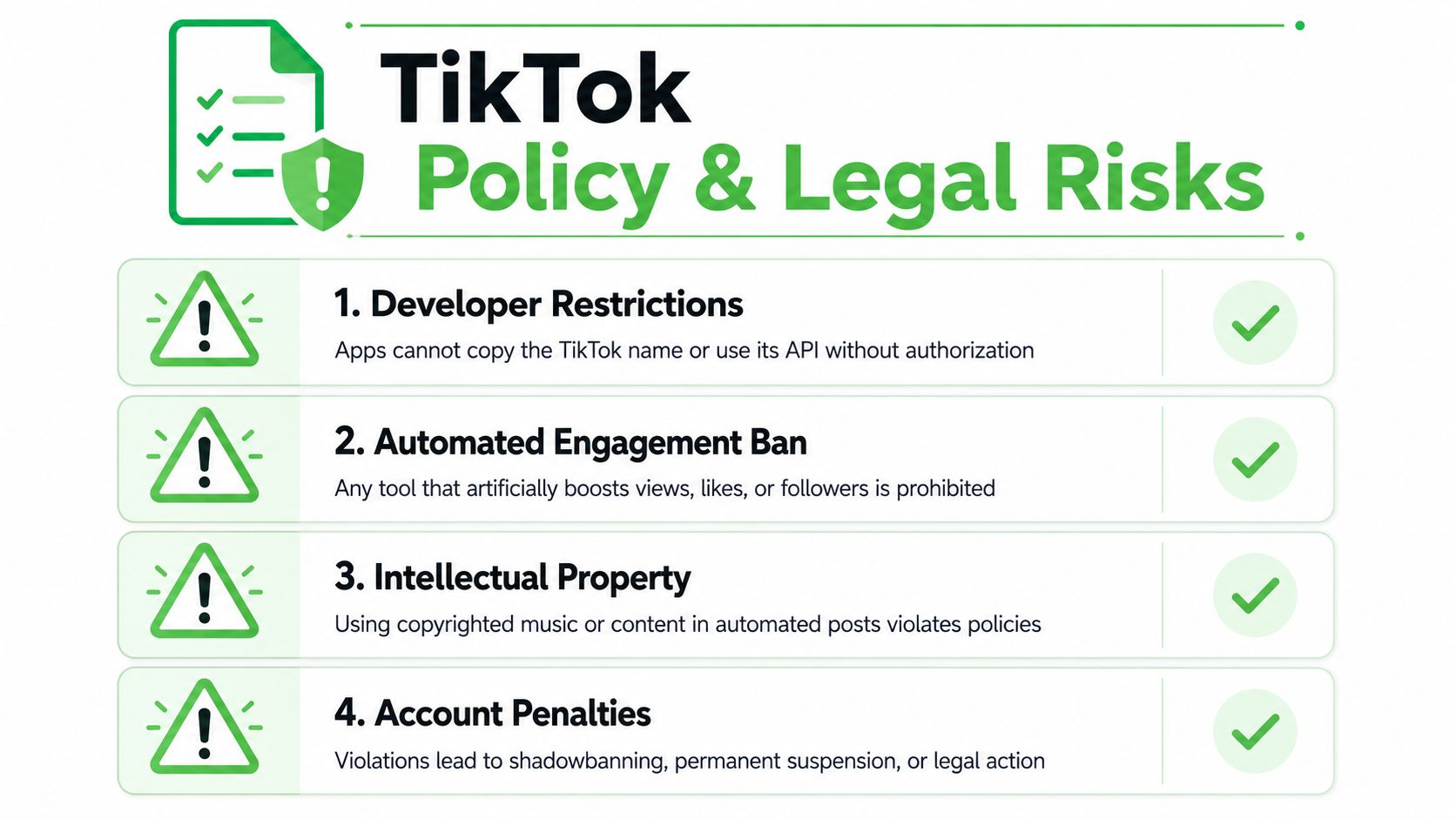
TikTok's developer docs prohibit app names that try to copy TikTok, including examples like “TikTok” and “Tik Tok,” and they also set region-specific launch requirements such as US approval for mini-app deployment. That is a useful signal for teams building around automation, because it shows the platform is watching imitation and distribution, not just obvious spam. For a closer read on naming, approvals, and regional rollout requirements, see TikTok's official developer specifications for app naming and regional approvals.
TikTok also says AI-generated or synthetic media must be labeled, and users can report manipulated media through its safety tools, see TikTok's AI-generated content guidance. A bot-driven workflow can cross into policy trouble if it posts synthetic creative without clear disclosure, especially when the automation is designed to look like ordinary human publishing.
Age and identity enforcement matter too. The enforcement data above includes 20 million accounts suspected to be under age 13 removed in 2022, which shows the platform's trust systems are built to catch more than spam. They also screen for identity problems, age compliance, and patterns that do not fit normal account behavior. Once bot activity enters the mix, the account can look even less trustworthy.
The business risk is broader than suspension. Teams can also see shadow banning, weaker distribution, reduced trust, or a damaged ad environment around the account. Those outcomes are rarely announced cleanly, so a penalty can start as partial reach loss before it becomes a full account action.
Why teams get surprised
The usual failure point is a workflow, not a bad intention. A growth team signs up a vendor, repeats the same actions too often, or ships synthetic content without labeling it. The account starts to look harder to trust, even if nobody meant to trigger enforcement.
That pattern is common in agency work too, especially where TikTok lead capture is routed into WhatsApp and CRM systems. A team may want a fast handoff, but the path from comment, form, or message to the next step still has to stay inside policy. For a practical example of that kind of handoff, see this TikTok Shop automation guide.
If a workflow depends on hiding automation, it is already unstable.
Safe Automation vs Risky Bot Behavior
The cleanest way to judge a vendor is to ask whether it supports a human workflow or impersonates one. If it helps you organize, publish, label, or measure, it may be acceptable. If it tries to look like a crowd, it usually isn't.
A simple comparison grid
| Category | What it does | TikTok risk posture | Typical outcome |
|---|---|---|---|
| Official tools | Schedules posts, tracks analytics, manages approved workflows | Usually safer because it stays inside platform rules | Predictable operations |
| Authenticated APIs | Connects approved systems to data or publishing flows | Safer when permissions are explicit | Cleaner reporting and handoffs |
| Engagement pods | Trades likes, comments, or shares among participants | Risky because activity is coordinated and artificial | Trust loss and weak reach |
| Follower services | Sells follows or views at scale | High risk because it inflates vanity metrics | Penalties or cleanup |
| Human-simulation bots | Mimics taps, scrolls, and reactions | Highest risk because it fakes user behavior | Account action |
What to ask before you buy
A good vendor should be able to answer these plainly:
- What action is automated? If the answer is “engagement,” be careful.
- Does it require fake accounts or borrowed accounts? That's a major warning sign.
- Can a human approve the output before it ships? If not, you're probably looking at risky automation.
For brands that need real workflow support, a TikTok Shop automation guide can help you think in terms of process automation instead of engagement inflation. That mindset is the difference between a system that survives review and one that gets swept away in enforcement.
The market pitch often sounds identical across categories, so the label on the landing page doesn't matter much. The behavior underneath does.
Routing TikTok Leads into WhatsApp and Your CRM
TikTok is a discovery channel. WhatsApp is where conversations become qualified. The smart move is to connect them with a traceable handoff instead of trying to force TikTok itself to do the whole job.
A compliant lead flow that agencies can run
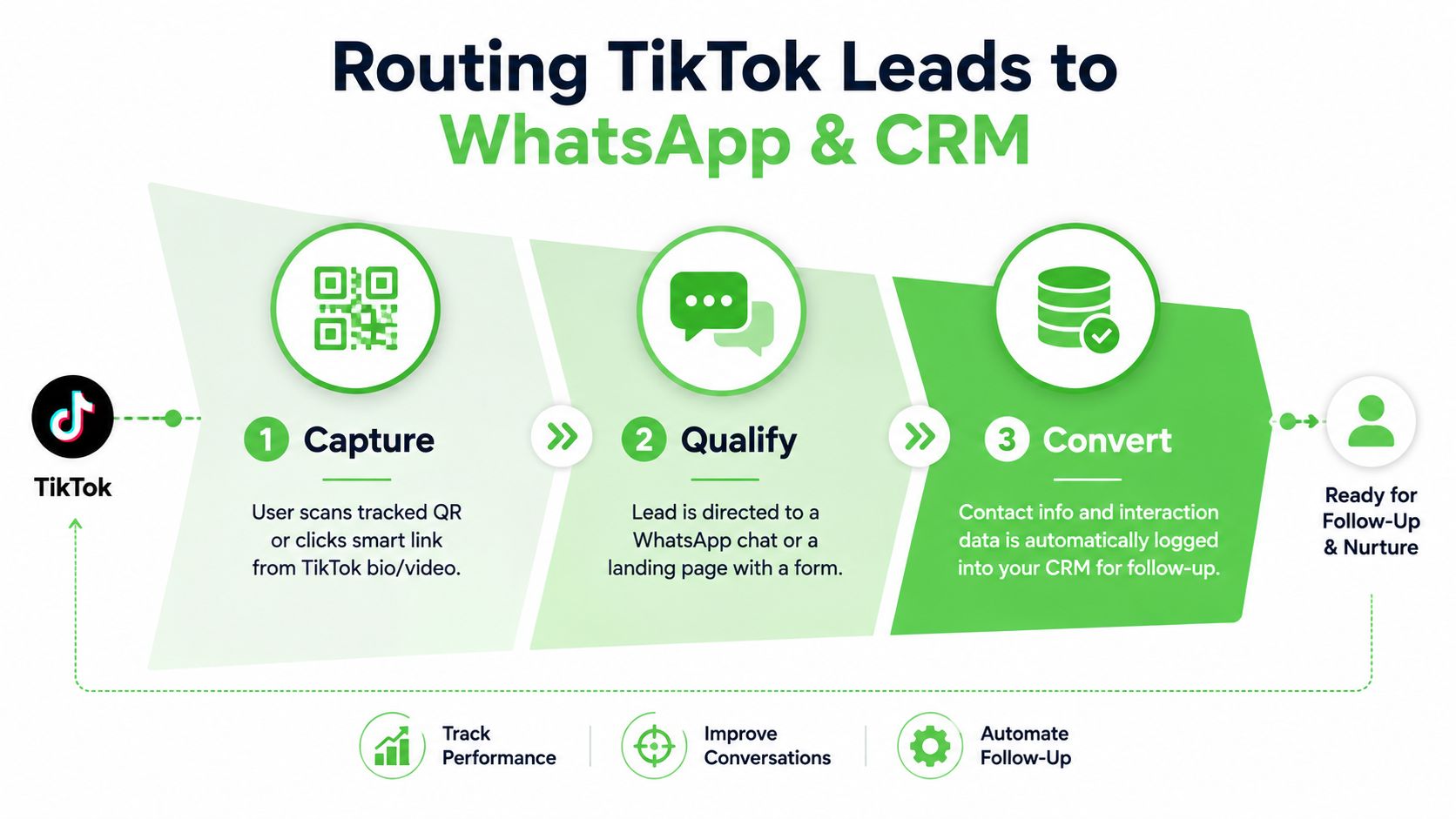
Start with a tracked smart link or QR code in the bio, caption, or video overlay. When someone taps it, the click becomes a lead event you can attribute to a specific post, creator, or campaign. That gives you a clean source trail before the conversation even begins.
Next, route the visitor into a WhatsApp inbox or a landing page with a short form. For teams managing communities or launches, WhatsApp Community Announcement Groups can keep the communication structured without turning it into spam. The point is to move the person into a channel where your team can respond quickly and document the interaction.
Then sync the contact into your CRM with source attribution. If an agency knows that a lead came from a specific TikTok video and then engaged on WhatsApp, follow-up becomes much smarter. Sales can prioritize based on origin, not guesswork.
Why this works better than bot chasing
TikTok bots try to fake interest. This flow captures real intent. It also gives you proof if someone asks where a lead came from, which matters when a campaign is reviewed internally or by a platform partner.
A platform like Double My Leads fits this style of workflow because it centers on QR-based number connection, tracked links, broadcasts, and CRM sync, rather than fake engagement. That's the right model for agencies that want repeatable lead capture without building on a policy landmine.
What to document
Keep a short internal note that shows:
- Where the click came from
- Where the conversation moved
- Where the contact was stored
- Who owns the follow-up
That record won't make a bot safe, but it will make legitimate automation easier to defend.
Your TikTok Growth Action Plan This Week
Don't try to “solve TikTok” with one tool. Build a workflow that survives scrutiny and still produces leads. If you need a useful benchmark for content-side planning, this strategy guide for short-form creators is a better reference than any bot pitch.
Five moves to make now
- Audit every current TikTok tool. Separate official tools, authenticated analytics, and content publishing from anything that simulates engagement or impersonates users.
- Replace risky automation with approved workflow tools. If a vendor exists to inflate likes, follows, or comments, retire it and move to safer reporting or scheduling software.
- Set up one tracked TikTok-to-WhatsApp path. Use a smart link or QR code so every click has source attribution before the lead enters chat.
- Label synthetic media properly. If your team uses AI-generated content, follow TikTok's labeling guidance so the post doesn't look deceptive.
- Write a one-page policy note. Document what your team automates, what a human reviews, and where the lead data lands in CRM or WhatsApp.
The outcome you want is simple, growth that can pass a policy review without losing momentum. That's the business case for disciplined automation.
If you want a safer way to turn TikTok attention into tracked WhatsApp conversations, Double My Leads gives agencies a practical stack for QR-based lead capture, community broadcasts, and CRM attribution. Visit Double My Leads to build a workflow that brings in leads without relying on bot behavior.


