
Most agencies hit the same ceiling. You can improve delivery, tighten scope, and raise retainers, but revenue still tracks too closely to hours, headcount, and client churn. A great month usually means the team is overloaded. A slow month means the pipeline slipped.
That's why so many agency owners start looking for something productized. Not another service package with a nicer name. An actual recurring offer that clients keep paying for because it becomes part of how they run sales, follow-up, and customer communication.
A white-label CRM can be that offer. But the decision isn't as simple as picking a platform, adding your logo, and sending invoices. The core question is whether you should resell a broad, all-in-one CRM or build a more focused, channel-specific product around how clients communicate today. For many agencies, that second path is the more practical one.
Table of Contents
- Building Your Next Revenue Stream
- What Is a White-Label CRM Really
- Key Benefits and Use Cases for Resellers
- Deconstructing the Core CRM Features
- Technical Integration and Channel Focus
- Your Procurement and Implementation Checklist
- FAQs for Aspiring CRM Resellers
- How do you handle data migration for a new client
- What kind of margin should you expect in the first year
- Can you bill clients directly under your own brand
- How technical does your team need to be
- Should you choose a generic CRM or a channel-first platform
- What's the biggest mistake new resellers make
Building Your Next Revenue Stream
The most common trigger is familiar. An agency is good at lead generation, paid media, SEO, funnels, or outbound. Clients get results, but every expansion requires more work from the team. The owner wants recurring revenue that doesn't rely on adding another account manager every time the book of business grows.
A white-label CRM changes the shape of the business. Instead of billing only for campaign execution, you start billing for the system clients use every day. That makes your agency harder to replace because you're no longer just the company running ads or managing automations. You become the company that owns the operating layer where leads are captured, routed, followed up with, and reviewed.
That stickiness is real, but it only happens when the CRM is tied to a business process the client values. If you sell access to a generic dashboard that nobody opens, clients will treat it like line-item software and cancel fast. If you package the platform around a specific operational outcome, such as lead follow-up, appointment recovery, pipeline visibility, or WhatsApp engagement, the offer gets stronger.
A common agency fork in the road
One path is service-heavy. Keep selling custom work, accept that delivery complexity grows, and push prices higher to protect margin.
The other path is capitalizing on your operations. Productize part of what you already do and charge monthly for access, setup, support, and strategic oversight.
That second path usually works best when you do three things well:
- Sell a system, not a login. Clients buy a workflow they can rely on.
- Tie the offer to an urgent problem. Missed leads, slow follow-up, scattered communication, and poor visibility are easier to sell than “digital transformation.”
- Keep implementation repeatable. If every client gets a one-off build, you've recreated agency work inside a software wrapper.
Agencies make better resellers when they stop thinking like tool buyers and start thinking like operators.
Where recurring revenue actually comes from
The software fee is only one piece. In practice, agencies build revenue around setup, onboarding, workflow design, reporting, support, and ongoing optimization. That mix matters because software alone is easy to compare. A packaged operating system with training and accountability is harder to commoditize.
The mistake is assuming any white-label CRM will automatically create this. It won't. The platform gives you a base. Your positioning, implementation model, and support process are what turn it into a recurring revenue stream.
What Is a White-Label CRM Really
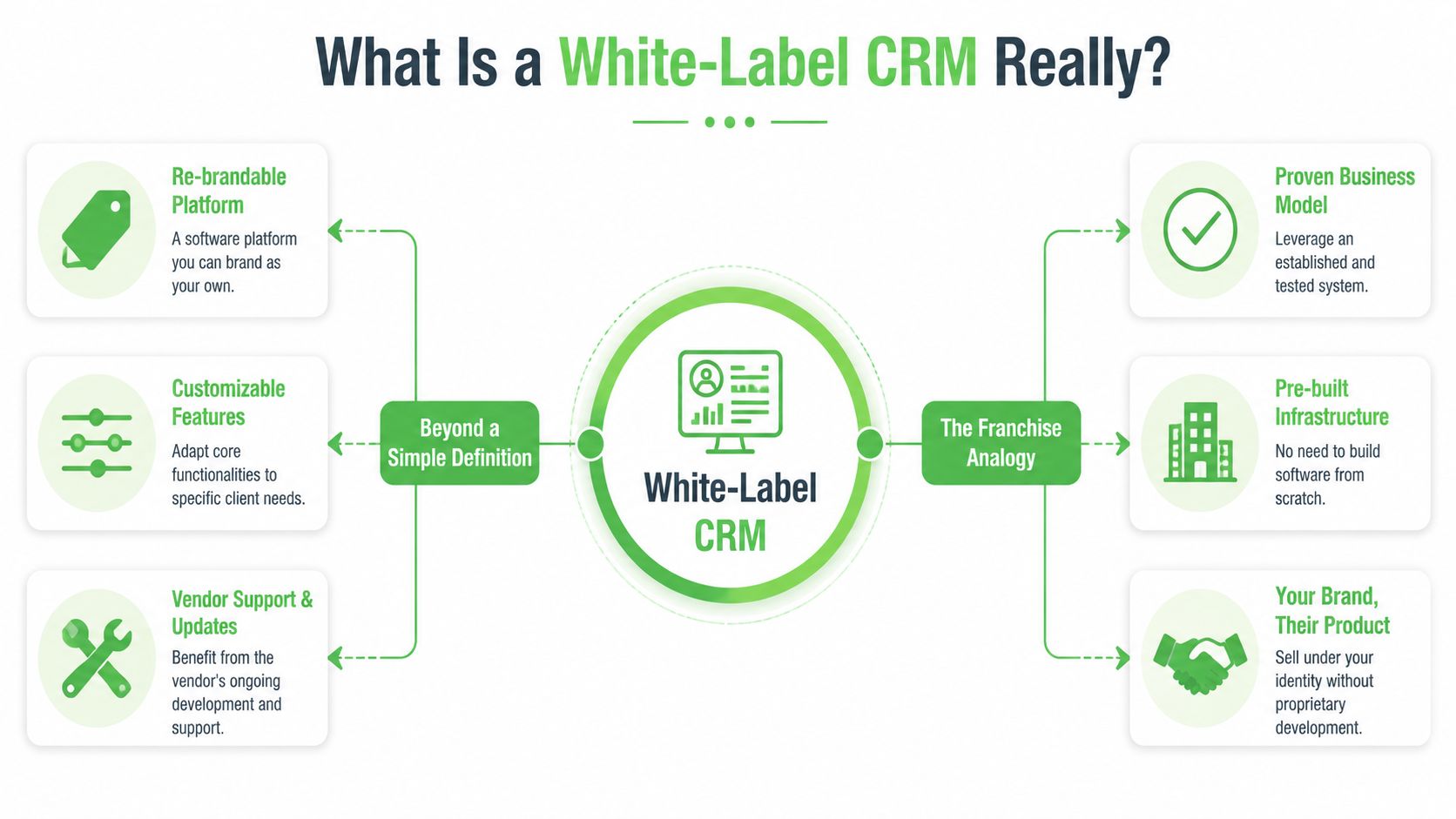
A white-label CRM is usually a pre-built multi-tenant platform that agencies or SaaS companies can rebrand with their own logo, colors, and domain, then resell under their own name, as explained by Krayin's overview of white-label CRM architecture. The practical value is straightforward. You don't have to build the underlying CRM primitives, such as data models, user roles, and workflow layers, from scratch.
That's the technical definition. The easier way to think about it is a franchise model.
You control the storefront. The vendor runs the kitchen.
The business model behind the software
In a franchise, you don't invent the menu, train chefs from zero, or design the supply chain yourself. You start with a working system and make it marketable in your territory. A white-label CRM works the same way. The software vendor provides the engine. You add the brand, packaging, niche positioning, and client-facing experience.
That distinction matters because many agencies overestimate what they're buying. They think they're getting a product they own. Most of the time, they're getting access to a product they can present as their own. Those are not the same thing.
Here's what the model usually includes:
- Brand control: Your logo, colors, and domain shape the visible experience.
- Shared infrastructure: The vendor maintains the underlying application across multiple tenants.
- Resale rights: You package and sell access under your own commercial terms.
- Less engineering dependence: Your team doesn't need to build the platform core in-house.
Why agencies buy instead of build
Building a CRM from scratch sounds attractive until you map the work. Contact structure, permission models, views, activity history, workflow automation, user management, reporting logic, and maintenance all need to function before the platform is even sellable. Then you still have to host it, support it, and keep it current.
A white-label CRM shortens that path. You're buying speed and reducing technical dependency.
Practical rule: If your edge is niche positioning, client acquisition, and process design, buy the infrastructure. Build only when product control is the business itself.
The trade-off is control. You gain speed, but the vendor still controls the deeper product roadmap. That's fine when the platform aligns with what you need to sell. It's a problem when your clients need workflows the vendor doesn't prioritize.
Key Benefits and Use Cases for Resellers
Reselling a white-label CRM works when the platform reinforces the service you already deliver. It fails when the software becomes a detached side offer with no operational role in the client account.
For agencies selling outcomes, not software
For marketing agencies, the biggest upside is client retention. When your team owns lead capture, follow-up structure, automation, and reporting inside a branded system, replacing your agency becomes harder. The client isn't just comparing campaign performance. They're evaluating whether another provider can also rebuild the operational layer behind it.
A CRM can increase account depth. Instead of offering “monthly marketing,” you offer a system for pipeline management, lead handoff, follow-up accountability, and client visibility.
A few use cases show up repeatedly:
- Lead management for service businesses: Form submissions, ad leads, and inbound inquiries need routing and follow-up.
- Sales oversight for small teams: Owners want visibility without juggling spreadsheets and inboxes.
- Client portals and reporting layers: Agencies package campaign visibility with action history and contact context.
- Retention plays: The more the client's daily workflow lives in your branded environment, the less replaceable your agency becomes.
If you're already productizing intake and qualification, an AI-powered white label form platform can fit well upstream of a CRM because forms often determine data quality, routing logic, and the first client experience.
For SaaS firms and niche operators
SaaS companies sometimes use white-label CRM as an expansion layer. Instead of building adjacent functionality internally, they add a branded CRM environment around their existing product and keep users inside one ecosystem.
Creators, coaches, community managers, and niche operators can also use the model. The strongest versions aren't sold as “a CRM for everyone.” They're sold as a purpose-built operating system for a specific audience. A community operator might package member onboarding, segmented messaging, and follow-up flows. A local lead-gen business might package inquiry management and reactivation.
What works is narrow positioning. What doesn't work is trying to win on software breadth alone.
| Reseller type | Strong fit | Weak fit |
|---|---|---|
| Agency | CRM tied to client acquisition or follow-up | Generic access sold with no process ownership |
| SaaS company | CRM that extends an existing product ecosystem | Platform resell that distracts from core product |
| Community operator | Structured engagement and communication workflows | Broad CRM pitch with little relevance to audience |
Clients don't buy “more features” nearly as often as they buy a cleaner process.
Deconstructing the Core CRM Features
The feature list matters less than most resellers think. Plenty of platforms look impressive in demos. Far fewer are easy to package, configure, and support across different client accounts.
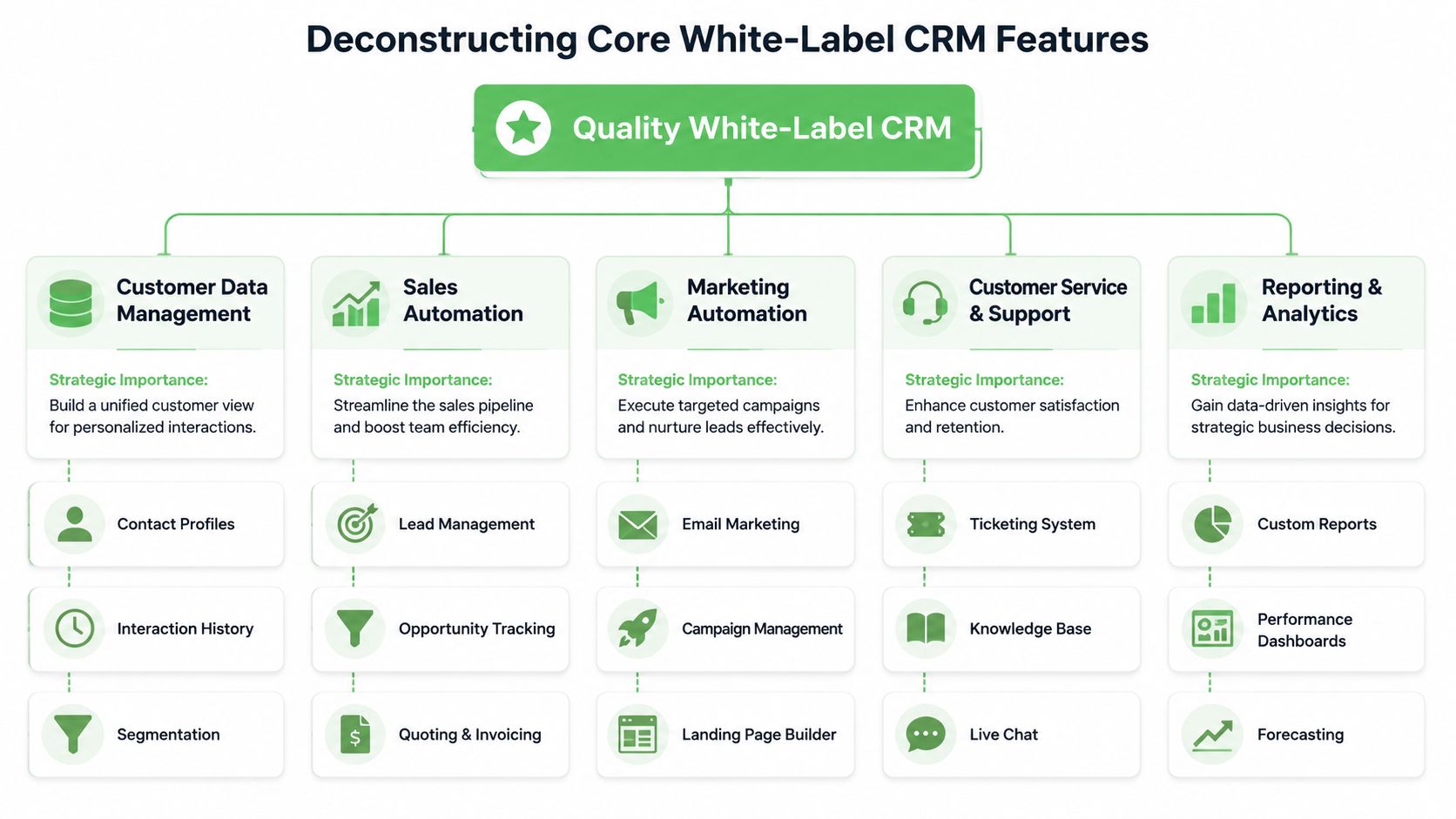
A quality white-label CRM needs enough structure to manage customer data, pipeline movement, communication history, and reporting. But for agencies, its greatest advantage lies elsewhere.
This visual gives a useful top-level map of the moving parts:
What matters more than the feature list
For agencies, the main technical advantage is configurable workflows and automations. White-label CRM products commonly expose tables, fields, relationships, permissions, pages, and views for customization, along with lead-nurture and follow-up automation, as described in Knack's explanation of white-label CRM customization. That architecture lets you adapt one core engine to multiple verticals while the vendor handles core maintenance and support.
That's why two platforms with similar headline features can perform very differently in practice. One lets you create reusable account templates for a med spa, real estate team, or home services client. The other forces every implementation into the same generic layout.
The reseller question is simple. Can you turn the platform into a repeatable product without fighting it?
The reseller view of CRM features
Look at features through this lens:
- Custom fields and relationships: These let you model how a specific business works.
- Permissions and views: Critical when clients have multiple users, locations, or departments.
- Automation builders: Useful when they reduce repetitive follow-up and handoff friction.
- Reporting and dashboards: Valuable when they answer client questions without manual pulling.
- Communication history: Important because teams need context before they call, text, or reply.
A lot of agencies get distracted by long feature grids. I'd rather see fewer modules with stronger configurability than a bloated product with shallow execution.
For teams that rely on email follow-up inside their CRM workflows, it's also smart to test email deliverability before blaming the automation logic. Sending setup problems often look like CRM problems when they're really inbox placement issues.
A short product walkthrough can help teams evaluate what configuration looks like in practice:
Technical Integration and Channel Focus
A common agency scenario looks like this. The client buys because you promised better follow-up and faster response times. Two weeks later, the team is staring at a generic dashboard, half the modules are irrelevant, and the only workflow they care about, handling incoming WhatsApp conversations and turning them into booked calls or sales, still takes too many clicks.
That is usually a platform selection problem, not a sales problem.
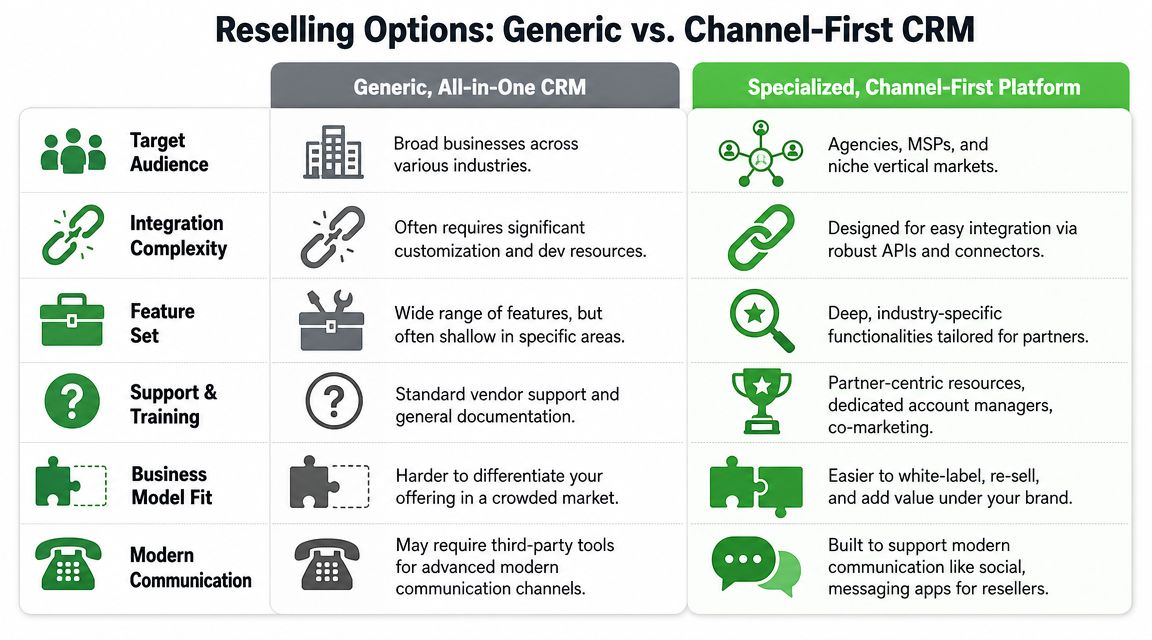
A broad white-label CRM still fits some offers. If the client needs pipelines, forms, call tracking, email sequences, and reporting in one place, the all-in-one model can hold together well. But agencies that want to productize a specific service need to ask a harder question. Should the CRM sit at the center of the offer, or should the offer be built around the channel where customer conversations already happen?
Why channel focus changes the technical decision
Generic CRMs sell breadth. Agencies support adoption. Those are different jobs.
In practice, breadth creates extra setup work. You configure pipelines, user roles, custom fields, automations, notification rules, templates, and integrations before the client gets value from the core service. That can work if you charge for implementation and the client will use the wider system. It hurts margin if your actual offer is narrower, such as WhatsApp lead response, broadcast campaigns, or inbox management for a local sales team.
Use a workflow-fit test before you choose the platform:
| Question | All-in-one CRM | Channel-first platform |
|---|---|---|
| Does the client need a single system for several teams and functions? | Often a good fit | Usually too narrow |
| Is your offer tied to one high-response communication channel? | Often adds extra layers | Usually a better fit |
| Will your team be responsible for custom setup and ongoing support? | Higher support load | Lower scope if the use case is clear |
The technical trade-off is straightforward. All-in-one systems give you more surface area to sell. Channel-first systems give you a tighter service package, faster onboarding, and clearer client expectations.
Where integration work affects your margin
Resellers often underestimate integration labor. The full cost involves more than just connecting tools. It is testing edge cases, handling user permissions, training staff, and fixing channel-specific failures after launch.
For a broader CRM, that may include form routing, calendar logic, telephony, email authentication, pipeline mapping, and reporting cleanup. For a channel-first product, the integration list is usually shorter, but the details matter more. You need to confirm message delivery rules, inbox routing, automation triggers, template approval where relevant, and account security. If the platform handles customer messaging, security review should be part of procurement. The Affordable Pentesting guide is a useful reference for evaluating SaaS security before you put client communication data into a reseller platform.
That narrower setup can be a commercial advantage. Clients do not buy “software architecture.” They buy a working communication system tied to revenue.
When a specialized platform is the better product
A channel-first platform is usually the stronger choice when your agency is selling a specific operating system for one service. WhatsApp follow-up, broadcast campaigns, shared team inboxes, community messaging, and response automation fit that model.
In that case, the platform does not need to become the client's master database. It needs to support the service you are reselling with less friction and less training overhead.
Double My Leads is one example of that category. It is positioned for agencies and SaaS teams that want a white-labeled WhatsApp workflow layer with branded domains, inbox management, broadcasts, automations, and QR-code-based number connection. That is a different strategic choice from reselling a general CRM. You are packaging a channel-specific service with software attached, not trying to replace every system the client already uses.
That distinction matters for positioning and retention. Buyers understand a focused offer faster. Your team supports a narrower stack. Your recurring revenue is tied to an outcome the client can see in daily operations.
Your Procurement and Implementation Checklist
Platform selection is where many resellers get lazy. They watch a polished demo, ask about branding, and assume the rest will work itself out. It won't.
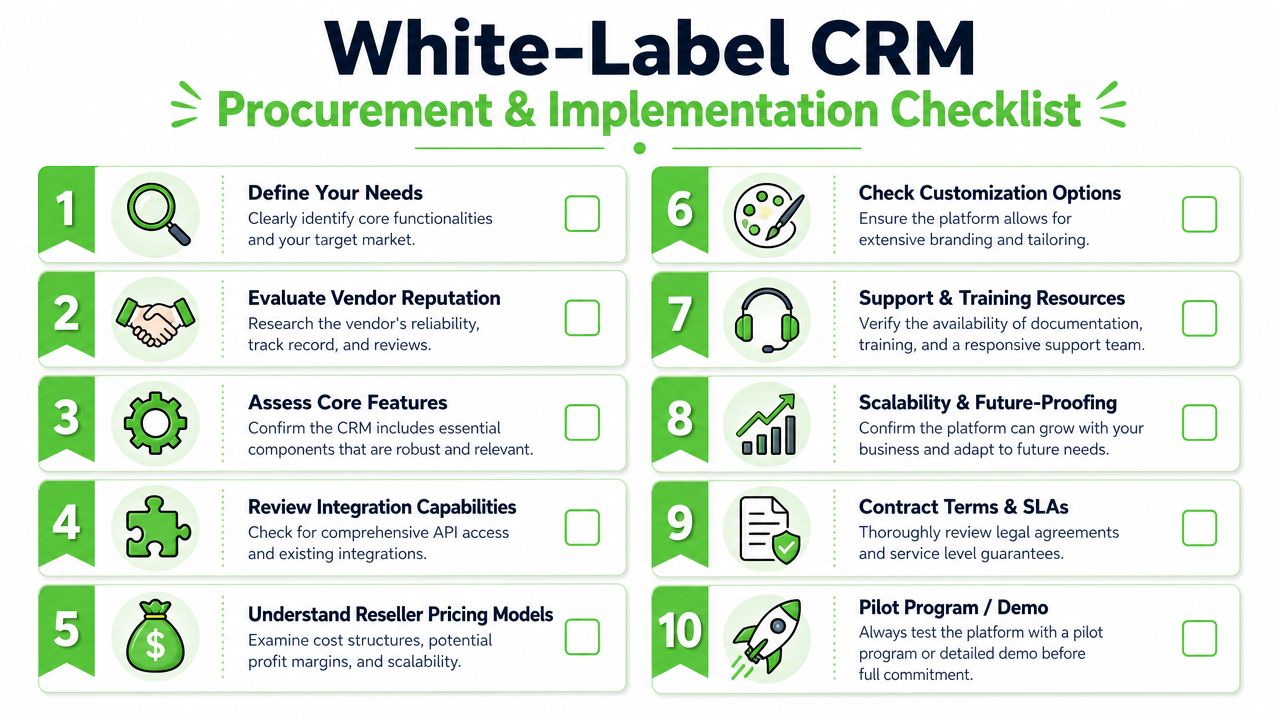
The first screen you should look past is the login page. Branding is easy to show. Operational durability is harder. Pipedrive's discussion of white-label CRM trade-offs makes a point many buyers miss: users are usually responsible for onboarding, support, and positioning, while still having limited control over broader product development and vendor dependence. That constitutes the core procurement issue.
What to verify before you sign
Treat vendor evaluation like service design, not software shopping.
- Check the support model. Ask who handles platform bugs, what response process exists, and what your team must solve alone.
- Review the branding depth. Logo swaps are basic. Domain control, email presentation, and client-facing consistency matter more.
- Inspect configuration flexibility. If you can't adapt fields, permissions, views, and workflows cleanly, packaging by niche gets difficult.
- Understand account economics. Your margin depends on how the vendor prices access and how much labor your team adds around it.
- Request a pilot environment. Don't rely on a sales demo. Set up a real internal use case and walk through onboarding yourself.
Security review belongs here too. If you're reselling software into businesses that care about data handling, basic due diligence shouldn't be skipped. A practical reference point is this Affordable Pentesting guide, which helps frame what SaaS security review can involve before you put client data into a platform.
What usually breaks after the sale
Implementation rarely fails because the feature list was short. It fails because the operating model was vague.
Common failure points look like this:
- No onboarding process: Clients get logins but no guided rollout.
- Weak positioning: The offer sounds like software access instead of a business solution.
- Support confusion: Clients don't know whether to contact you or the vendor.
- Vendor dependency shock: A missing feature sits on the roadmap and you can't force it forward.
The real test isn't “Can I resell this?” It's “Can my team support this without creating a new service mess?”
FAQs for Aspiring CRM Resellers
How do you handle data migration for a new client
Start with the records the client needs to operate day to day. Contacts, active deals, open conversations, and current pipeline data usually matter more than a perfect historical import. Older records can come later if they are clean enough to justify the work.
Migration problems usually start in the old system. Duplicate contacts, broken field mapping, and inconsistent tags create more delays than the new platform does. Scope the cleanup before you price the job.
What kind of margin should you expect in the first year
Margin depends on three things. Vendor pricing, your support model, and how much setup work each client needs.
A reseller who sells a broad CRM with custom pipelines, automations, and reporting may bill more per account, but the delivery load is heavier. An agency selling a channel-specific product, such as WhatsApp follow-up and inbox management, often has a narrower offer, faster onboarding, and clearer support boundaries. That can make margins easier to protect, even if the software fee itself is not dramatically different.
Can you bill clients directly under your own brand
Often, yes. But confirm the commercial terms before you build the offer around that assumption.
Some vendors allow full control over branding, invoicing, and client ownership. Others keep parts of billing or account control on their side. If you want recurring revenue that behaves like your own product line, those details matter as much as the feature set.
How technical does your team need to be
Your team does not need to build software. It does need someone who can configure workflows, set permissions, troubleshoot delivery issues, and handle light integrations without turning every client request into a support ticket for the vendor.
The technical bar also changes by platform type. A traditional CRM usually asks for broader system design. A channel-first platform asks for tighter operational knowledge inside one communication channel.
Should you choose a generic CRM or a channel-first platform
Choose the platform that matches the service you want to package.
If clients expect you to improve sales operations across multiple teams, a traditional white-label CRM makes sense. If they are hiring you for one outcome, such as WhatsApp response handling, lead follow-up, broadcasts, or shared inbox workflows, a channel-first platform is often easier to position and easier to deliver well. That difference matters if your goal is to productize a service, not just resell software access.
What's the biggest mistake new resellers make
They attach their brand to software before they define the operating model around it.
Clients are not buying logins. They are buying setup, process, accountability, and a clear path to adoption. The better your service wrapper is, the less likely the platform becomes a support burden.
If your agency wants to sell a branded recurring offer around WhatsApp follow-up, broadcasts, and inbox operations, Double My Leads is one channel-specific option to evaluate. As noted earlier, it fits agencies and SaaS teams that want a white-labeled WhatsApp product under their own brand, which is a different decision from choosing a broad all-in-one CRM.


