
You already know the pattern. A client signs a website project, you launch it, everyone is happy for a month, then the work tapers off and the relationship drifts into low-value maintenance. Meanwhile, the client still wants something that feels bigger, stickier, and harder for competitors to displace.
That's why agencies keep looking at white label mobile apps. Not because they want to become app developers, but because they want a service they can resell under their own brand, package into recurring revenue, and use to deepen client retention. The promise is real. The risk is real too. The part most vendors gloss over is app store approval, especially when the product is template-based and repeated across many accounts.
If you're evaluating this as a new revenue stream, don't start with the dream. Start with the operating model. A white label mobile app can work well for an agency, but only if the provider can help you ship branded apps that survive Apple and Google review, not just generate a build.
Table of Contents
- Why Your Agency Needs a White Label App Strategy
- What Exactly Are White Label Mobile Apps
- Comparing the Technical Approaches for Resellers
- Building Your Business Model and Monetization
- Your Guide to Launch Onboarding and App Store Success
- Your Action Plan for Reselling Mobile Apps
Why Your Agency Needs a White Label App Strategy
Most agencies hit the same ceiling. Service revenue depends on new deals, retainers get squeezed, and clients compare your work to cheaper alternatives because they don't see enough proprietary value in the relationship.
A branded mobile app changes that conversation. It gives you a higher-trust offer that sits closer to the client's customer experience. That makes your agency harder to replace than a team that only runs ads, writes content, or manages funnels.
The economics are one reason this category keeps getting attention. One industry guide says white label apps generally cost between $1,000 and $50,000, with subscription models from $100 to $2,000 per month. The same source positions them as a lower-cost route than custom development for teams that want to launch faster and keep upfront risk lower, according to QuickWorks on white label app costs.
The agency upside is bigger than the app itself
The app is rarely the whole product. The actual offer usually includes strategy, branding, onboarding, support, and light consulting around growth.
That creates several advantages:
- Higher client stickiness because the app becomes part of day-to-day operations, membership access, community delivery, booking, or communication.
- Cleaner recurring revenue because you can wrap hosting, updates, support, and content changes into a monthly plan.
- Better positioning because you stop selling only campaign execution and start selling owned digital infrastructure.
Practical rule: If the app is the only thing you sell, you'll compete on price. If the app sits inside a managed growth offer, margins usually look better and churn tends to be lower.
It also lets you avoid building an internal mobile team
That matters more than many agencies admit. Hiring iOS and Android engineers, handling releases, managing store assets, and dealing with submission issues is a different business from running a client services firm.
With the right provider, your team can stay focused on sales and account management while the vendor handles the build system and release mechanics. That's also why partner selection matters so much. If you're already evaluating adjacent delivery models, this guide on choosing white-label dev partners is useful because it frames the due-diligence questions most resellers skip.
The opportunity is strong. The mistake is assuming “fast and cheap” automatically means “safe and scalable.”
What Exactly Are White Label Mobile Apps
A white label mobile app is a mobile product built by one company and sold under another company's brand. Your client sees your agency's brand, your client's brand, or both. They don't see the original software provider.
The simplest way to think about it
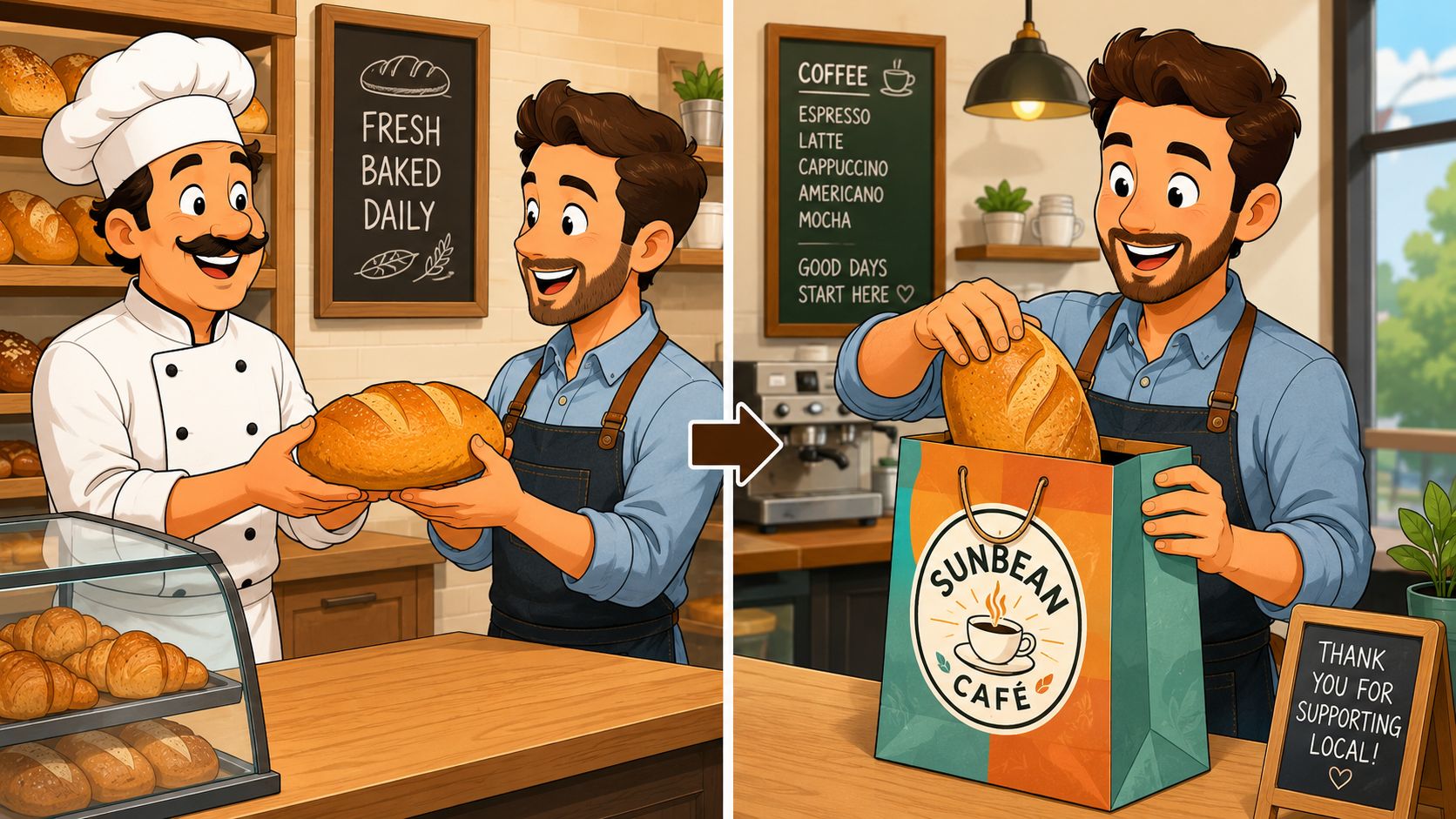
Think of a bakery that makes bread for a local cafe. The cafe puts the bread in its own bag, sells it under its own name, and owns the customer relationship. The bakery still makes the bread. The cafe owns the presentation, packaging, and sale.
That's how most white label mobile app deals work.
The provider builds and maintains the app platform. The reseller, often an agency or SaaS company, brands the experience and sells it to end customers. If you're looking at broader platform models, Capgo's overview of enterprise white label solutions is a helpful reference point for how these arrangements are structured in practice.
What you own and what you do not
At this stage, agencies need to be clear before they pitch anything.
Here's the cleanest breakdown:
| Area | Usually owned by reseller | Usually owned by provider |
|---|---|---|
| Brand and positioning | Yes | No |
| Client relationship | Yes | No |
| Billing to end customer | Often yes | Sometimes shared |
| Core codebase | No | Yes |
| Platform infrastructure | No | Yes |
| Product roadmap | Limited influence | Yes |
| Store submission mechanics | Shared | Often provider-led |
That shared ownership model is the reason white label can be attractive and frustrating at the same time. You avoid the burden of custom development, but you also inherit platform constraints.
A good white label arrangement doesn't give you full control. It gives you enough control to sell confidently without taking on a software company's overhead.
White label mobile apps also sit in a middle ground between two alternatives that agencies often confuse.
A custom app is built from scratch for one client. It offers more control, but it also brings larger cost, longer timelines, and a heavier support burden. A DIY app builder gives the client tools to assemble their own product, but that often weakens your agency's role and makes the experience feel generic.
White label works best when the app solves a repeatable problem. Membership access, local business loyalty, internal communication, coaching programs, directories, lightweight commerce, and niche community products all fit well. Highly novel products with unusual workflows usually do not.
The key is to sell the right level of uniqueness. Brand differentiation matters. Full software originality usually doesn't.
Comparing the Technical Approaches for Resellers
Agencies often buy the sales story first and inspect the technical approach later. That's backward. The underlying delivery model affects user experience, maintenance burden, feature access, and review risk.

One practical benchmark matters here. White label mobile apps are typically delivered as native iOS and Android applications that a third party builds and a reseller brands as its own. Even with a shared codebase, the app still has to meet store packaging, signing, and review requirements. The operational upside for agencies is that the provider can generate custom builds and handle App Store or Google Play submission, reducing the need for in-house mobile engineering, as outlined by Mighty Networks on white label mobile apps.
Web app wrappers
A wrapper is usually a website placed inside a thin mobile app shell. It's one of the fastest ways to get something into an app-like format.
The appeal is obvious. If your client already has a responsive website, the provider can move quickly. Content updates often stay simple because the web layer does most of the work.
The downside is just as obvious once you've seen a few of these fail review. If the app feels like a website in disguise, the stores may treat it that way. Performance can feel flat. Access to deeper device features is often limited or awkward. The product may also struggle to justify why it belongs in an app store at all.
Wrappers can work for very narrow use cases. They are a weak choice if your pitch depends on premium experience or long-term defensibility.
PWAs
A Progressive Web App sits in the browser but behaves more like an app than a normal website. Users can save it to their home screen, and the experience can feel lighter than a full website.
For some agencies, this is the right call. You avoid parts of the app store process and reduce dependence on review decisions. That makes PWAs attractive for internal tools, event hubs, portals, or markets where app store presence isn't central to acquisition.
But a PWA is still not the same as a store-listed native app. If your client wants App Store visibility, native install behavior, or the perception of a fully branded mobile product in the major marketplaces, a PWA may feel like a compromise.
Native white label builds
This is the strongest option for most serious resellers. The app is compiled for iOS and Android, branded for the end customer, and submitted through the normal store process.
That usually gives you better performance, a stronger user experience, and a cleaner path to mobile features. It also aligns better with buyer expectations when they hear the phrase “mobile app.”
Here's the trade-off comparison:
| Approach | Speed to deliver | App store viability | Device feature access | Brand perception | Operational complexity |
|---|---|---|---|---|---|
| Wrapper | Fast | Riskier | Limited | Often weaker | Low to moderate |
| PWA | Fast | Not store-first | Moderate | Mixed | Low |
| Native white label build | Moderate | Stronger if differentiated | Better | Stronger | Moderate |
Don't ask a provider only whether they can publish an app. Ask what happens when Apple decides the app looks too generic, too repetitive, or too close to a website wrapper.
The wrong technical model creates downstream business problems. Clients don't care whether your vendor used a shared codebase. They care whether the app got approved, performs well, and stays live.
For agencies, that means the best provider isn't always the one with the slickest demo. It's the one with the clearest answer to review risk, release handling, and product differentiation.
Building Your Business Model and Monetization
If you resell white label mobile apps as one-off projects, you'll leave money on the table and create support headaches. The better model is to package them as a recurring service with a setup component.
That structure matches how clients experience value. They don't just buy an app file. They buy launch support, branding, ongoing updates, and someone to call when store issues show up.
How agencies usually price this
The cleanest model has three layers.
First, there's a setup fee. This covers brand intake, asset prep, configuration, store listing work, and launch coordination. It also filters out weak-fit clients who want premium outcomes on bargain expectations.
Second, there's a monthly platform fee. This is your recurring base for hosting, software access, support, and release management. You can bundle light changes into that plan and define what counts as out-of-scope work.
Third, there are add-ons. Margins improve with these.
Common add-ons include:
- Content population for agencies whose clients don't have app-ready material
- CRM or marketing integrations when the app needs to connect with an existing stack
- Push campaign management for membership, coaching, or event-driven clients
- Priority support for clients who want tighter response expectations
- Design enhancement work when a standard template needs stronger brand expression
A lot of agencies undersell here because they think clients only compare app prices. In practice, clients compare business outcomes and convenience. If you remove operational friction, your offer becomes easier to justify.
Best-fit offers by client type
The strongest offers are niche-specific.
A gym might need a branded member hub with schedules, updates, and class access. A coach might want a mobile content library, program delivery flow, and community layer. A local multi-location business may want loyalty, announcements, bookings, and offers in one place.
Different clients buy different versions of the same underlying system. That's good for you. It means you can standardize delivery while tailoring the sales narrative.
Here's a simple packaging lens:
| Client type | Strong app angle | Best commercial model |
|---|---|---|
| Local service business | Booking, loyalty, updates | Setup fee plus monthly support |
| Coach or educator | Program access, member experience | Tiered subscription |
| Community brand | Content and engagement hub | Subscription plus premium onboarding |
| Small business team | Internal communication or resources | Seat-based or flat monthly retainer |
Agencies win with white label apps when they productize the service. Every exception, custom promise, and vague scope line pushes you back toward low-margin custom work.
The profit potential is real because the same platform can be sold repeatedly with different branding and positioning. The trap is letting every client drag the offer into bespoke territory.
If a prospect needs unusual workflows, highly custom permissions, or distinctive product logic, that may be a custom software project, not a white label resale opportunity. Saying no to those deals protects the business model.
Your Guide to Launch Onboarding and App Store Success
This is where most reseller plans get tested. A white label app is easy to sell in a proposal deck. It becomes hard when you need to collect assets, package a branded build, prepare listings, survive review, and support the client after launch.
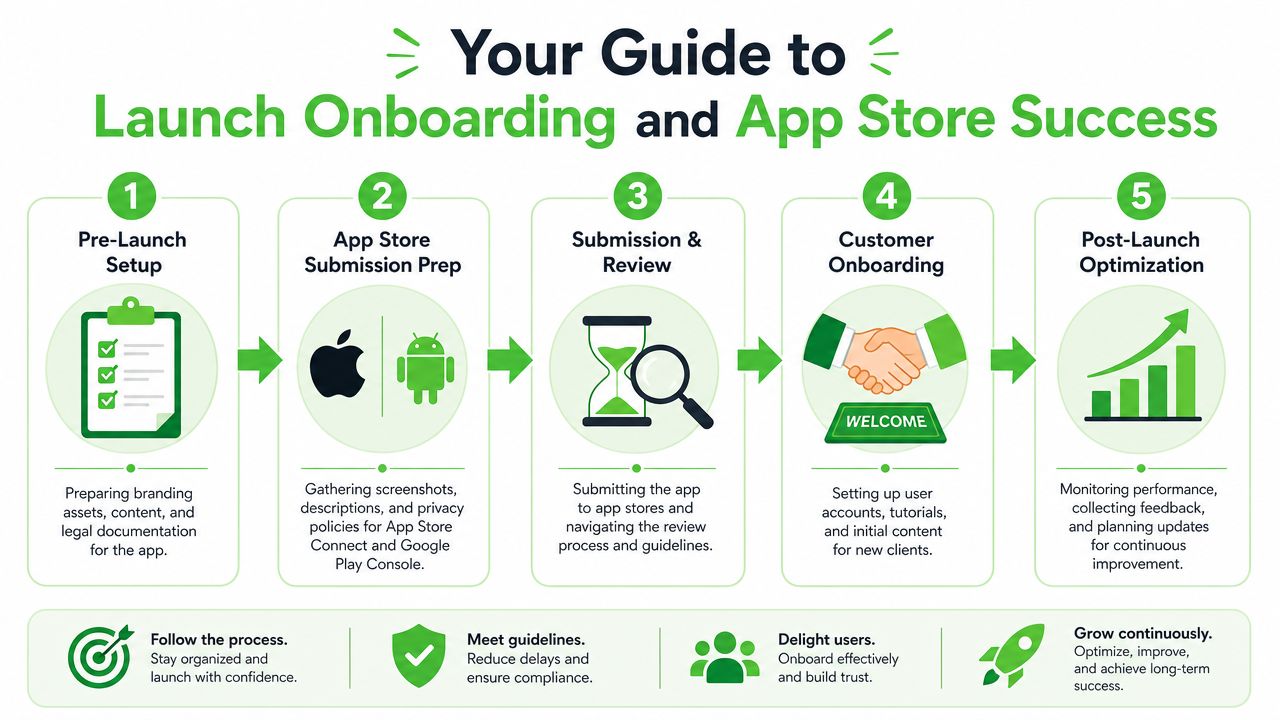
Get the launch assets right first
A white label launch succeeds or stalls based on operational discipline. One practical benchmark is the branding asset set required before release. A high-resolution 1024×1024 app icon, a splash screen, and explicit color-code specifications are standard inputs for producing a store-ready branded build. Because the application is pre-built, launch speed improves and early costs can drop. One industry guide also says white label app builders can avoid the roughly $100,000+ spend often associated with a basic custom app by reusing proven functionality, according to WeWeb's guide to white label app builders.
Before your provider starts packaging anything, collect:
- Brand assets including logo files, app icon direction, splash visuals, and approved color codes
- Store copy such as app name, subtitle, short description, long description, and category choices
- Policy documents including privacy policy and any client-specific legal pages
- Access details for the reseller's or client's developer accounts, depending on the publication model
Miss any of those and you create delays that clients often misread as technical incompetence.
Treat store approval as a product requirement
Apple changed the environment in 2017 when it introduced Guideline 4.2.6, which targets apps built from a “commercialized template or app generation service.” Industry analysis notes that the rule remains active and that apps relying on generic templates or simple web views can be rejected if they don't provide enough unique functionality, as explained in Teacode's analysis of white label applications.
That policy matters because many white label products still look repetitive across accounts.
There's also a practical review risk around Apple's Guideline 4.3 for “Design Spam.” A more realistic operational view is that Apple can reject apps that look too similar, too thin, or too close to a website wrapper. Current guidance emphasizes using the reseller's own Apple Developer Account, offering native functionality beyond a web view, and introducing enough UI differentiation to pass review. That's one of the clearest gaps in beginner content on white label apps, and 8th Light's guidance on managing white label mobile applications is worth reading closely.
If your provider's review strategy is “we usually get apps through,” that isn't a strategy. You need a repeatable explanation for account ownership, uniqueness, functionality, and resubmission handling.
A practical approval checklist looks like this:
- Use the correct developer account. Don't let a provider hide every app under its own umbrella unless there's a strong reason and a clear contract.
- Avoid simple website clones. If the mobile app adds little beyond opening a website, review risk rises.
- Differentiate the UI and flow. Small branding changes alone may not be enough.
- Make the app useful on its own terms. Native navigation, device-aware behavior, and app-specific experience matter.
- Plan for rejection handling. Ask who writes the response to reviewer feedback and who owns revisions.
A lot of agencies skip those questions because they assume the vendor has it covered. Then the first rejection turns into finger-pointing.
Later in the process, onboarding the end customer matters just as much as submission mechanics. If your agency needs a simple framework for optimizing your customer onboarding, that resource is useful because it helps structure the handoff after launch.
Here's a helpful visual for the internal rollout and review process:
What a solid onboarding flow looks like
Once the app is approved, the job isn't finished. Clients still need a usable operating rhythm.
A strong onboarding flow usually includes:
- Admin training so the client knows how to manage content, updates, or users
- Launch messaging for their audience, including install instructions and first actions
- Support boundaries that define who handles bugs, content edits, store issues, and user questions
- A post-launch review cycle to gather friction points before they turn into complaints
The first week after launch tells you whether you sold a product or created a burden. If the client can't manage basic operations, the app becomes your agency's problem.
The agencies that succeed here don't just resell software. They manage launch readiness, expectation setting, and review risk with the same care they'd bring to a paid media campaign or CRM migration.
Your Action Plan for Reselling Mobile Apps
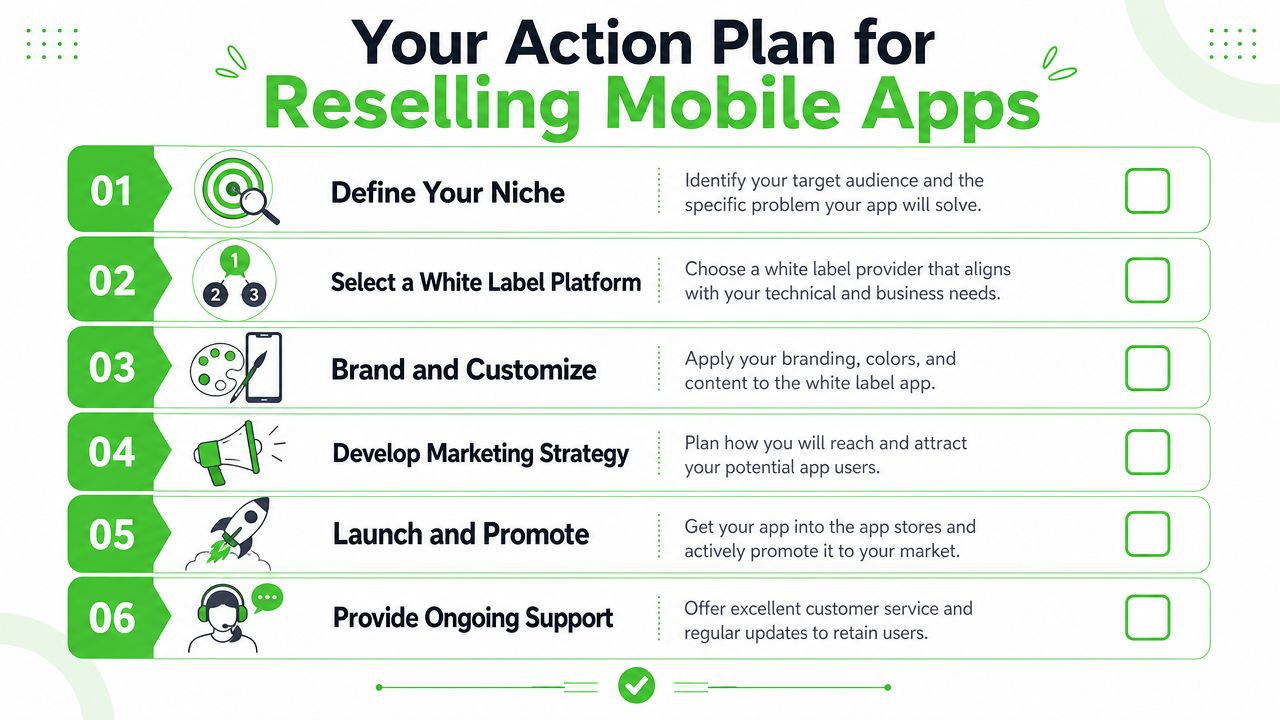
If you want to resell white label mobile apps well, keep the plan tight. Don't start by shopping features. Start by choosing a market and a delivery model you can support repeatedly.
A practical reseller checklist
Use this as your shortlist before you sign any provider or sell your first app package.
- Choose a narrow use case first. Start with one niche where the app solves a repeatable business problem, not a vague branding goal.
- Vet the provider on approval risk. Ask how they handle Apple review, how they address template concerns, and what happens after a rejection.
- Inspect the actual product model. Find out whether it's a wrapper, PWA, or native build. Don't accept fuzzy language.
- Define your commercial structure. Separate setup work from recurring support and decide what add-ons you'll sell.
- Standardize onboarding. Build one asset checklist, one launch workflow, and one support model before you sell at scale.
- Keep customization disciplined. Brand variation is fine. Bespoke product logic usually destroys the economics.
A simple decision table can help:
| Question | Good sign | Warning sign |
|---|---|---|
| Can the provider explain review risk clearly? | Yes, in operational detail | Vague reassurance |
| Is the app meaningfully differentiated? | Yes | Looks nearly identical across clients |
| Can your team sell and support it repeatedly? | Yes | Every deal becomes custom |
| Does the offer create recurring value? | Yes | Mostly one-time revenue |
The main lesson is straightforward. White label mobile apps can become a strong agency revenue stream, but only when you treat store compliance, onboarding, and packaging as core parts of the offer. Agencies that ignore those details usually end up blaming the model. Agencies that plan for them often build a durable service line.
If you like the white label model because it creates recurring revenue without forcing you to build every tool from scratch, Double My Leads is worth a look. It gives agencies and SaaS teams a way to launch a white-labeled WhatsApp offering under their own domain and branding, with shared inboxes, broadcasts, automation, and predictable monthly pricing. It's a practical fit if you want another sticky communication product to bundle alongside client acquisition and retention services.


