
One 2025 benchmark puts the average cost per lead at $228.15 for roofing companies, and says some high-competition markets run $400 to $600+ per lead PipelineOn's roofing Google Ads benchmark. Such data highlights the situation for Google Ads for roofers. It's not a cheap lead source, it's a high-stakes acquisition channel where every wasted click can turn into a very expensive lesson.
That's why the winning question isn't, “How do I get more traffic?” It's, “How do I make every qualified lead profitable?” In roofing, the margin lives in intent control, conversion tracking, lead qualification, and speed to response. If those pieces aren't tight, Google Ads becomes a fast way to buy noise.
Table of Contents
- Why Google Ads for Roofers Is a High-Stakes Game
- The Foundational Strategy Before You Spend a Dollar
- Building Your High-Intent Roofing Campaign Structure
- Crafting Ad Copy and Landing Pages That Convert
- Optimizing for Profit Not Just Clicks
- Agency Playbook Advanced Lead Management and Scaling
Why Google Ads for Roofers Is a High-Stakes Game
Roofing is one of the clearest examples of a channel where high intent and high cost show up together. A lead can be valuable because the job value is large, but the same market pressure that makes the work profitable also pushes paid search costs up fast. In practice, that means roofing advertisers often pay well over $100 per qualified lead in major markets, and the benchmark cited above matters because it frames what a realistic acquisition cost looks like.
The spread tells the story. Roofers are not competing in a stable, low-friction acquisition environment. Some campaigns land around $130 to $180 per lead, while others climb to $400 to $600+ per lead PipelineOn's roofing Google Ads guide. The gap is usually caused by account structure, traffic quality, and whether the landing page turns a visitor into a booked estimate.
Practical rule: if the account cannot tell you which queries produced real jobs, it is not optimized, it is just active.
ROAS matters more than clicks
Roofing Google Ads has matured into a return on ad spend discipline, not a vanity-metric game. PPC Chief reports an average roofing-services ROAS of 7x, with a $126 cost per lead and an 8.2% conversion rate PPC Chief's roofing benchmark. In a well-run account, that means every $1 spent on ads can generate about $3 to $8 in revenue, depending on the job mix and close rate.
That framing changes how you manage the channel. A click is not the goal. A form fill is not the goal. A qualified conversation that becomes a booked job is the goal. The roofers who win on Google Ads treat it like a sales system with strict economics, not a traffic source with vague upside.
Profitability also depends on what happens after the lead comes in. Fast qualification, then immediate follow-up through WhatsApp or a similar channel, helps separate real jobs from tire-kickers before the estimate calendar fills with weak prospects. That step is often ignored, even though it is one of the fastest ways to protect margin in a market where every unqualified lead eats budget.
A roofing account can look healthy on clicks and still lose money. The work is won by the advertisers who control intent, qualification, and follow-up with discipline.
The Foundational Strategy Before You Spend a Dollar
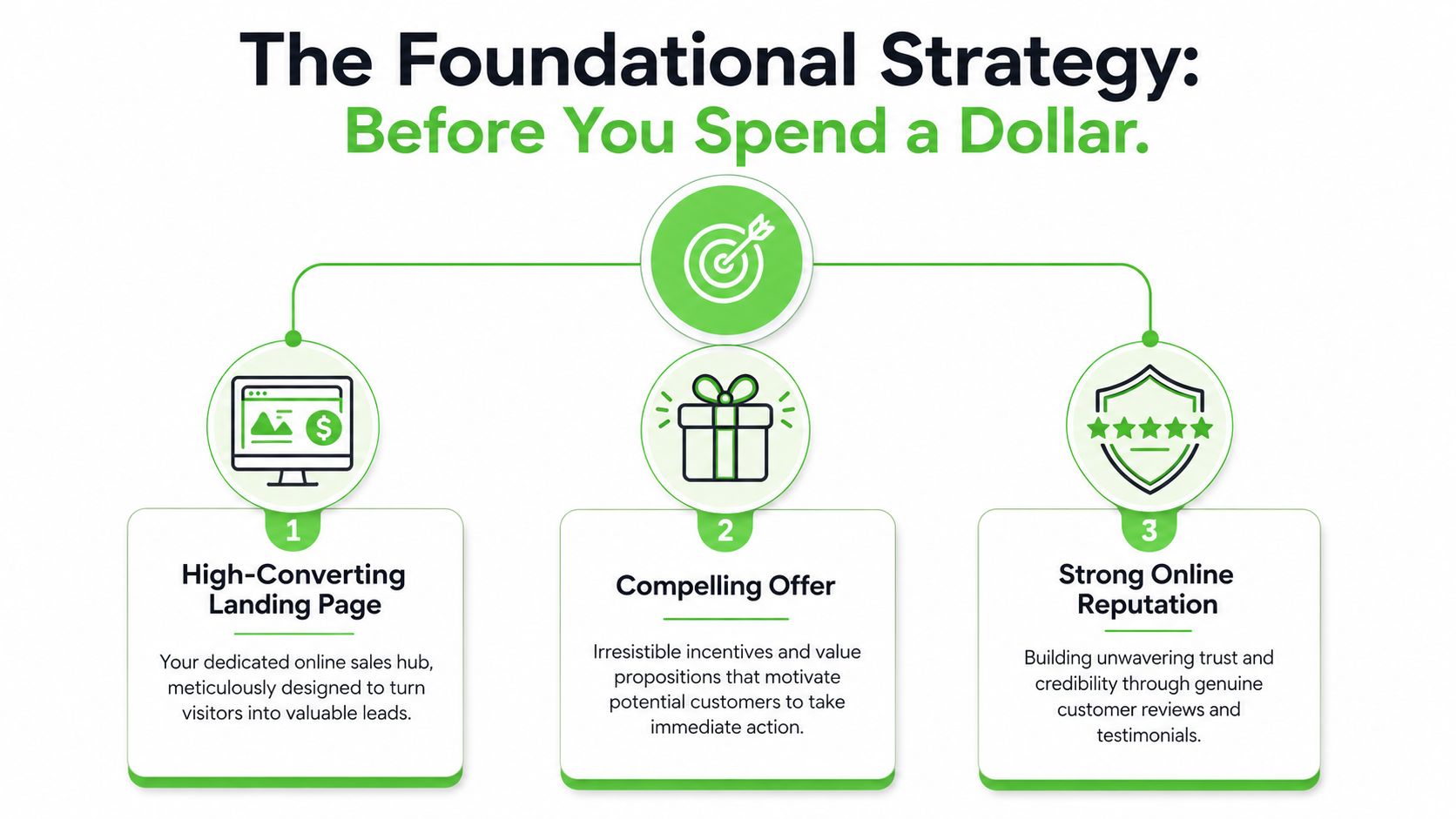
The ad account is only one part of the machine. If the landing page is generic, the offer is weak, or conversion tracking is incomplete, Google Ads will faithfully deliver expensive traffic into a broken funnel. Roofing is especially unforgiving because the visitor often arrives in a problem-solving mindset, not a browsing mindset. They're trying to decide whether the roof needs repair, replacement, or urgent attention now.
High-Converting Landing Page
A roofing landing page should feel like a sales desk, not a brochure. The first job is to answer the homeowner's immediate question, “Can these people solve my problem quickly and credibly?” That means a clear service headline, a visible phone number, a short form, and proof that the company handles real roof issues in the local area.
The best pages keep friction low and trust high. Show completed work, review snippets, service-area clarity, and any financing or emergency-response language that fits the business. If the page makes people hunt for a number or scroll through generic company history, the ad spend is bleeding before the first call.
Compelling Offer
Roofing ads rarely win because the headline is clever. They win because the offer reduces uncertainty. A homeowner with a leak, storm damage, or aging shingles wants a fast reason to take the next step. Free estimates, emergency response, inspection support, and straightforward next steps work because they match the urgency of the problem.
A weak offer pushes visitors back into comparison mode. A strong offer moves them from curiosity to action. The landing page should make the next step obvious without over-explaining the company's entire origin story.
Strong Online Reputation
Trust signals matter because roofing is a high-anxiety purchase. People don't just want a contractor, they want reassurance that the contractor will show up, diagnose correctly, and finish the job cleanly. Reviews, testimonials, project photos, and local proof reduce that risk.
A useful resource on web performance best practices is PageSpeed Plus's guide to improving web page performance, because even a convincing page can underperform if it loads slowly or feels clumsy on mobile. That matters here because many roofing leads come from urgent, mobile-first searches. If the page drags, the click becomes a waste before the form even loads.
Building Your High-Intent Roofing Campaign Structure
A roofing search campaign should start small and stay strict. Practitioner guidance points to a tight keyword set of 5–15 high-intent terms at launch, with phrase match and exact match prioritized over broad match YouTube keyword strategy guidance. That approach reduces irrelevant traffic and makes it easier to see which searches produce booked work.
The mistake many advertisers make is trying to cover too much too early. They blend repair, replacement, storm damage, and research terms in one campaign, then wonder why the search terms report is full of junk. That's not a scaling problem. It's a structure problem.
Separate by service and intent
Roof repair and roof replacement should not live in the same bucket if the business treats them differently. A repair lead often wants speed. A replacement lead often wants comparison, financing, and more sales support. Storm damage belongs in its own lane because urgency and messaging change the whole conversation.
Geography matters too. A company covering multiple cities should split by service area when the markets behave differently. That makes budget control easier and keeps one neighborhood from draining spend meant for another.
Sample High-Intent Roofing Ad Groups & Keywords
| Ad Group | Keyword Examples (Phrase Match) | Intent Level |
|---|---|---|
| Roof Repair | “roof repair near me”, “leaking roof repair”, “roof patch service” | High |
| Roof Replacement | “roof replacement near me”, “new roof contractor”, “replace roof quote” | High |
| Emergency Roofing | “emergency roof repair”, “roof tarping service”, “storm roof repair” | High |
| Local Contractor | “roofer near me”, “roofing contractor [city]”, “licensed roofer” | High |
The point of the table isn't breadth, it's discipline. Each ad group should map to one problem and one buyer intent. If a searcher wants a replacement estimate, don't send them into a repair message just because the keywords are related.
Practical rule: if you can't describe the ad group in one sentence, it's probably too broad.
Crafting Ad Copy and Landing Pages That Convert
Roofing clicks are expensive enough that the ad has to earn the landing-page visit before the page ever loads. Roofing advertisers should expect starting max CPC bids around $30 to $35, and some keywords may need over $42 just to appear on the first page Roofing CPC guidance. That reality rewards precision, not cleverness.
The ad should speak directly to trust and urgency. “Licensed and insured,” “24/7 emergency response,” and “free estimates” are the kinds of cues that fit the buying moment because they answer questions the homeowner already has. The copy doesn't need to be flashy. It needs to feel safe, local, and immediately useful.
Ad copy that earns the click
A strong roofing ad usually follows a simple pattern. Start with the service, add a trust signal, then end with a reason to act now. Sitelinks, call extensions, and location extensions help because they give the user more than one path to convert without forcing them to search the site.
- Lead with service clarity: “Roof Repair in [City]” is more useful than a branded slogan.
- Add trust quickly: “Licensed & Insured” and “Local Roofing Experts” reduce hesitation.
- Use urgency when it's real: “Emergency Roof Help” works when the service is able to support it.
The landing page has to mirror the ad. If the ad promises emergency help, the page shouldn't open with generic company copy. It should open with the call-to-action, a click-to-call number, and proof that the business handles the exact problem that was searched.
Landing page structure that keeps expensive clicks alive
A roofing landing page should be lean. Put the phone number in view, keep the form short, use real project photos, and show testimonials near the conversion point. The best pages do not ask the visitor to wander a homepage maze.
The page also needs to load cleanly on mobile. Heavy scripts, oversized images, and cluttered layouts make the click more expensive than it already is. If the mobile experience feels sluggish, the user will leave before the lead form matters.
Practical rule: every second of friction on a roofing landing page compounds the cost of the click.
Optimizing for Profit Not Just Clicks
The search terms report is where true account health is revealed. Roofing guidance explicitly warns against wasting spend on queries like “how to patch a shingle” and “salary,” because those clicks almost never turn into jobs Roofing negative keyword guidance. That's the difference between an account that looks busy and an account that stays profitable.
The most important habit is to treat irrelevant search terms as a weekly cleanup task, not a one-time setup item. DIY searches, job seekers, research queries, and education terms should be excluded fast. If they're allowed to linger, they gradually consume budget while your actual buying-intent terms get less room to work.
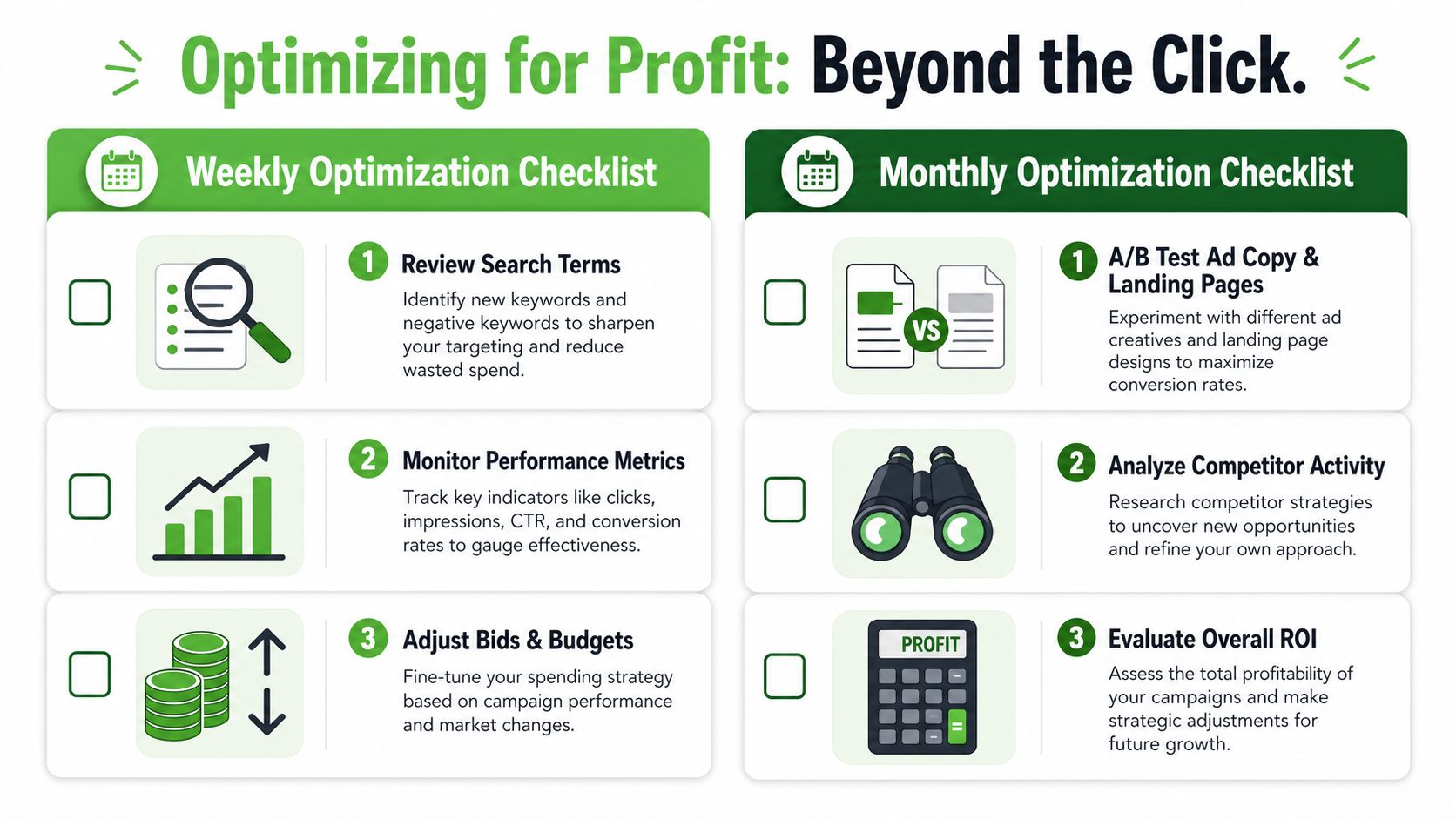
Weekly cleanup
The weekly job is simple. Read the search terms, block the junk, and shift attention to the queries that are producing real conversations. That includes keeping an eye on device performance, geography, and time of day so bids and budgets follow the best traffic.
- Review search terms: add negatives for DIY, jobs, and informational queries.
- Watch conversion quality: not every lead is equal, so compare calls and forms against actual booked work.
- Reallocate budget: move spend away from pockets that attract curiosity and toward intent-heavy terms.
Monthly refinement
The monthly job is about pattern recognition. Review which ad groups produce the best lead quality, which pages convert most reliably, and where the funnel leaks after the click. If a service line keeps attracting the wrong intent, separate it or tighten the messaging.
This is also where you revisit the bidding logic. If the campaigns are active but weak, the problem may be query quality, not demand. Underbidding can make delivery look bad when the underlying problem is that the bids are too low for the market.
The right mindset is simple. More traffic is not better traffic. Better traffic is better traffic.
Agency Playbook Advanced Lead Management and Scaling
Google Ads doesn't end when the form submits. For roofers, the speed of the first response often decides whether a lead turns into a booked estimate or disappears into a competitor's inbox. That's why the post-click workflow deserves as much attention as the keyword list.
A strong model is to trigger an instant WhatsApp message as soon as a lead fills out the form. The lead gets a fast, familiar channel for conversation, and the roofing company gets a way to reach the prospect while the problem is still hot. That matters because roofing buyers are often juggling multiple contractors, and the first useful response tends to win the opening of the sales conversation.
Why instant follow-up changes the economics
Most lead systems treat the form fill as the finish line. In practice, it's the start of the sales race. If a roofing company waits too long to respond, the lead cools off, or worse, books with someone else who replied first.
WhatsApp is useful here because it compresses the gap between lead capture and live communication. A form submission can trigger a short, automated message that confirms receipt, requests a photo, or asks the homeowner to share the best time to talk. That gives the sales team context before the first call and keeps the lead engaged without making them wait.
A workflow agencies can package
For agencies, the value is bigger than lead gen. A white-labeled WhatsApp workflow can be sold as part of a higher-value service layer, because it connects acquisition to follow-up instead of leaving the client to improvise. That makes reporting cleaner too, since the agency can point to the full path from ad click to first conversation.
A practical setup looks like this:
- Form submission lands instantly: the lead is captured on the roofing page.
- WhatsApp follow-up fires immediately: the prospect gets a short, direct message.
- Sales notes get added fast: the team can tag, assign, and continue the conversation without losing context.
The business advantage is obvious. The agency stops selling ads as a commodity and starts selling a measurable response system. The roofing client gets faster engagement, and the agency gets a stronger reason to stay embedded in the account.
If you want a roofing PPC system that focuses on profit, not just lead volume, Double My Leads is a strong place to start. Use it to tighten follow-up, speed up contact, and turn paid traffic into booked conversations before your competitors do.


