
A lead calls your main number after seeing a landing page, a review profile, or a paid ad. The phone rings on a desk nobody is near, or it hits a founder's cell while they're in a demo, or it goes straight to a voicemail box that still says “leave me a message.” By the time anyone notices, the prospect has already moved on.
For agencies and SaaS companies, that's rarely just a support issue. It's a routing issue, a response-time issue, and often a workflow issue. Phone call forwarding looks like a basic phone feature, but in practice it's the first control layer in a lead capture system that stays available when your team is busy, remote, off-hours, or distributed across tools.
Used casually, it just sends calls somewhere else. Used well, it protects inbound demand, keeps campaign response paths clean, and gives your team a foundation for voicemail, CRM handoff, and message-based follow-up.
Table of Contents
- The High Cost of a Single Missed Call
- What Is Phone Call Forwarding and Why It Matters
- The Four Main Types of Call Forwarding Explained
- Strategic Business Use Cases for Agencies and SaaS
- How to Implement and Troubleshoot Call Forwarding
- Integrating Call Forwarding into Advanced Workflows
- Privacy Portability and Final Considerations
The High Cost of a Single Missed Call
The expensive part of a missed call isn't the ring itself. It's the context around it.
A high-intent buyer usually calls after they've already done some work. They searched, compared, clicked, read, and decided your company was worth contacting. When nobody answers, you haven't just lost a phone interaction. You may have lost the warmest point in the buying window.

Agencies know this pattern well. A prospect calls about SEO, paid media, web design, or local lead generation. The account manager is in a client meeting. The owner is driving. The front desk line isn't staffed. The caller hangs up, fills out a competitor form, or chooses the company that answered first.
SaaS teams see the same thing in a different form. The call might be a demo request, an upgrade conversation, or a frustrated customer on the edge of churn. If it goes nowhere, the cost shows up later in pipeline quality, slower sales cycles, or support strain.
A useful breakdown of this problem appears in MoveJoy's analysis of lost moving leads. The industry example is specific, but the lesson carries across any business that depends on inbound phone intent. Missed calls don't stay isolated. They disrupt attribution, follow-up, and revenue operations.
Why missed calls pile up quietly
Missed calls aren't typically a result of carelessness. They happen because phone setups still assume one person, one device, one location.
Common failure points look like this:
- The main number goes to a single handset: If that person is unavailable, the business is unavailable.
- Voicemail acts as the backup plan: That's too passive for leads who expected live contact.
- The team relies on ad hoc forwarding: Someone turns it on during travel, then forgets to update it.
- Routing lives outside business rules: Calls don't follow schedules, ownership, or campaign context.
Practical rule: If your lead flow depends on someone remembering to manually redirect calls, your system is fragile.
Phone call forwarding fixes the first layer of the problem. It creates continuity. One number can keep working even when the primary device, person, or location can't take the call. That sounds modest, but it's the difference between a business number that merely exists and one that actively captures demand.
What Is Phone Call Forwarding and Why It Matters
The easiest way to explain phone call forwarding is this: it's digital mail forwarding for voice.
A customer calls your published business number. Instead of stopping at that original destination, the call gets redirected to another number or endpoint based on rules you've set. The caller doesn't need to know any of this is happening. To them, they called your business. To you, the call reached the person or system most likely to handle it.
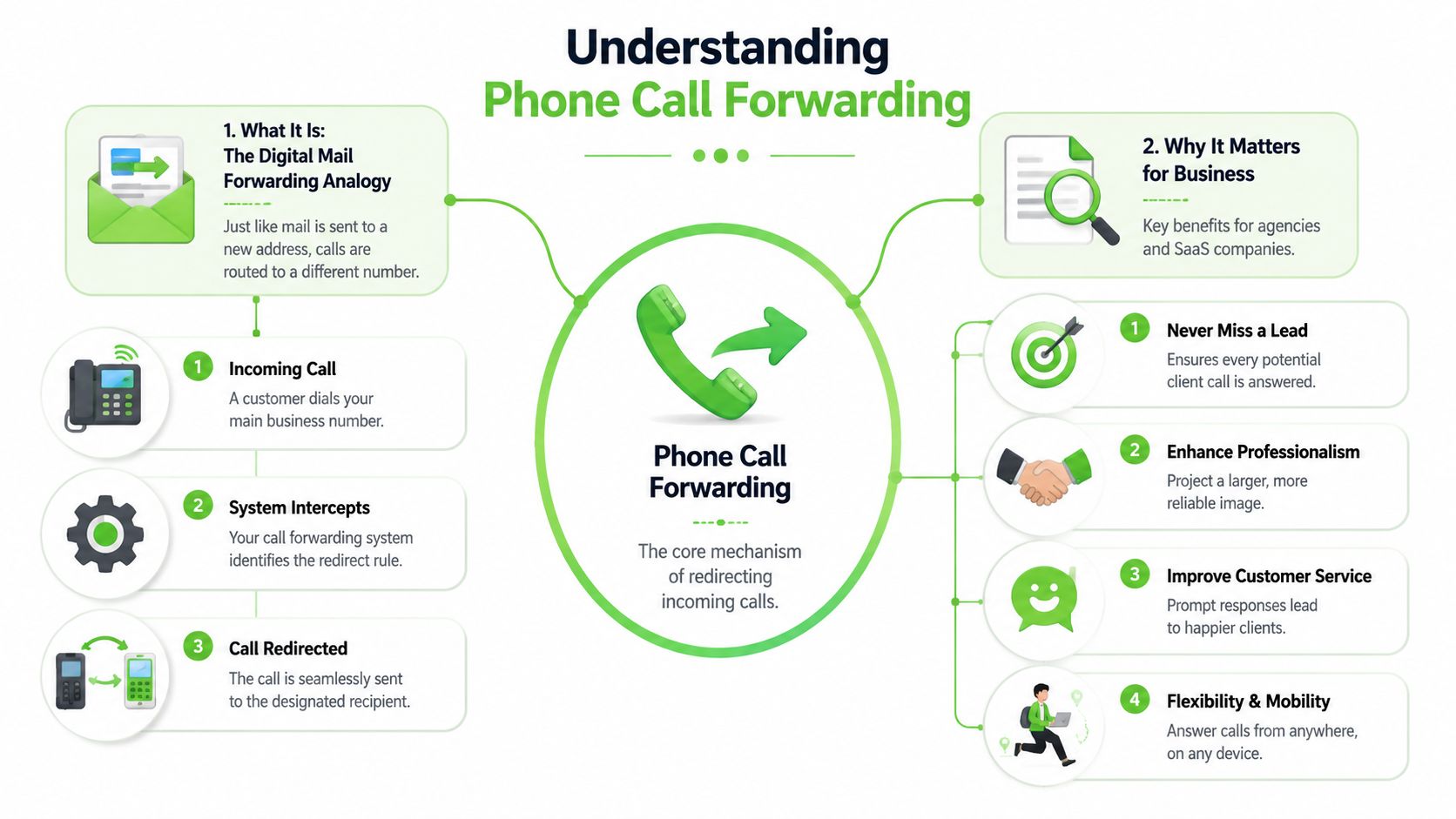
That distinction matters because many teams treat forwarding like an app feature when it's often deeper than that. In many cases, forwarding is handled by the carrier, the phone system, or the network layer. It isn't just a convenience toggle. It's part of how calls are routed before the interaction ever reaches your inbox, CRM, or receptionist workflow.
It's not just about availability
A lot of business owners think of forwarding as a travel setting. Forward the office line to a mobile, take calls on the road, turn it off later.
That's useful, but narrow. In lead management, forwarding does more important work:
- It protects the public number: You can market one number consistently while changing where calls go behind the scenes.
- It reduces dead ends: Calls can reach a teammate, another line, a voicemail destination, or a managed service.
- It keeps response paths professional: The caller reaches a business workflow instead of a random personal handset with the wrong greeting.
- It supports mobility: Remote teams can answer under one brand without sitting in one office.
Why agencies and SaaS companies should care
For agencies, the phone number on a site or campaign often represents the last mile between attention and a booked sales conversation. If that number isn't resilient, paid traffic and referral traffic lose value the moment someone calls.
For SaaS, the stakes are slightly different but just as real. A support line, sales number, or onboarding contact path needs to route intelligently when the first destination can't answer. Otherwise the company looks smaller, slower, and less reliable than it really is.
Forwarding isn't a phone trick. It's a promise that the number your market sees will still work when conditions change.
What doesn't work
What usually fails is the halfway setup. A team adds a call forwarding rule but never tests it across devices, voicemail behavior, or business hours. Or they forward every call all the time, which keeps calls from being missed but also strips the original line of any chance to ring locally.
The best setups respect the role of the number. Some numbers should always redirect. Others should ring first, then escalate. The difference shapes lead experience, team workload, and how much control you keep over the call path.
The Four Main Types of Call Forwarding Explained
Not all phone call forwarding behaves the same way. The right setup depends on whether you want every call moved immediately, only certain failed calls rerouted, multiple destinations alerted at once, or the whole call path managed through a business phone platform.
In GSM and 3GPP networks, call forwarding exists as a supplementary service with distinct command codes for different conditions, including unconditional forwarding, forwarding on busy, on no reply, and when unreachable. Some European and U.S. mobile networks also support a ring-delay parameter in 5-second increments, which changes how long a phone rings before forwarding triggers and directly affects abandonment rates and completion on the original handset versus voicemail or another destination, as described in the Wikipedia overview of call forwarding.
Call Forwarding Types Compared
| Forwarding Type | How It Works | Best For |
|---|---|---|
| Unconditional | Every incoming call is redirected immediately | Travel, temporary staffing gaps, dedicated campaign routing |
| Conditional | Calls forward only when the line is busy, unanswered, or unreachable | Protecting leads while still giving the main device a chance to answer |
| Simultaneous Ring | Multiple devices ring together for the same inbound call | Small teams that want the fastest live pickup |
| Diversion to VoIP or Cloud PBX | Calls move into a hosted business phone environment with routing logic | Agencies and SaaS companies that need schedules, ownership, and workflow control |
Unconditional forwarding
This is the cleanest and bluntest version. Every call to the original number gets sent somewhere else immediately. The original phone doesn't ring.
That's useful when the published number should act as a front door but never as the final destination. A common example is forwarding a local marketing number straight to a centralized sales desk or a founder forwarding an office line to a mobile while out of town.
The downside is obvious. You lose local ringing on the original endpoint, which means no chance for that device or user to catch the call first.
Conditional forwarding
Conditional forwarding is usually the better business default. Instead of redirecting everything, it forwards only under a specific condition such as busy, no answer, or unreachable.
This setup preserves local responsiveness first. The original phone can still ring. If no one picks up, the call moves on. For many teams, that strikes the right balance between accessibility and control.
Simultaneous ring
Simultaneous ring isn't always labeled as traditional forwarding, but operationally it solves the same problem. One inbound call triggers ringing on more than one device or user at once.
For a lean agency sales team, this can be powerful. The first available person answers, and the prospect doesn't care which handset won the race. The risk is internal chaos if multiple people think they own the same call or if no follow-up logging happens after pickup.
If more than one person can answer, you need a clear owner after the call ends.
Diversion to VoIP or Cloud PBX
Forwarding becomes infrastructure rather than a personal setting. Calls arrive at a hosted system first, then get routed according to business logic.
That logic might include schedules, fallback paths, departments, or user availability. It's the strongest option when your number needs to support a repeatable lead handling process rather than a single user's convenience.
Strategic Business Use Cases for Agencies and SaaS
The most useful way to think about call forwarding is as a routing policy, not a rescue feature. Once you see it that way, it becomes easier to align phone behavior with lead intent, staffing reality, and message workflows.
For business-grade deployments, forwarding can be part of a broader policy layer. Selective forwarding may be limited to specific caller numbers on some fixed-line providers, with lists of roughly 12 to 15 numbers, while enterprise systems can combine forwarding with schedules and conditional rules. CenturyLink also notes an operational difference that matters: always-forward rules mean the original device never rings, while conditional rules preserve local ringing first and only reroute if the line is unavailable, which helps reduce missed-call risk while controlling unnecessary forwarding traffic in its guide to selective call forwarding.
For agencies handling new business calls
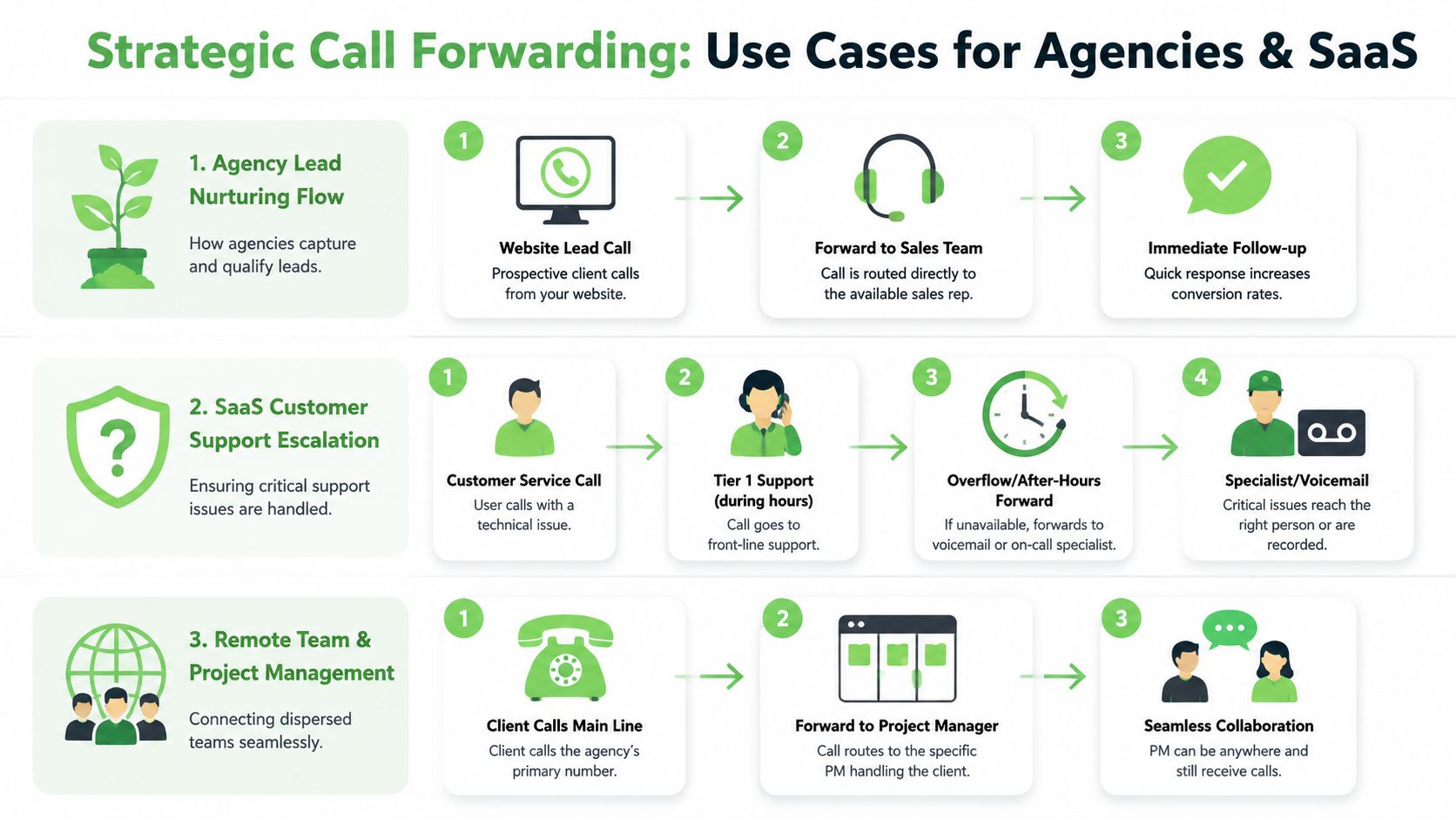
An agency might run separate numbers for different campaigns, landing pages, or client-facing brands, then forward those numbers into one intake process. That keeps campaign identity clean without forcing the team to manage separate phones.
A few smart patterns:
- Campaign-specific intake: Route calls from a dedicated number to the salesperson or team handling that offer.
- After-hours coverage: Forward evening and weekend calls to an answering service, backup line, or monitored voicemail path.
- Account-based routing: Send client calls for ongoing projects to the project manager or account lead first.
This video gives a useful visual reference for how teams think about business call routing in practice.
For SaaS teams balancing sales and support
SaaS companies usually need more separation. Sales wants fast pickup on demo and pricing calls. Support needs escalation paths. Customer success wants continuity for existing accounts.
That doesn't mean every phone path needs a complicated phone tree. It means the forwarding rules should match the job:
- Sales inquiries: Keep the main rep or queue first, then forward on no answer.
- Support overflow: During operating hours, ring tier-one support first. After-hours, redirect to on-call coverage or voicemail designed for urgent triage.
- Executive or success calls: Route by relationship, not just by department.
Where simple forwarding stops being enough
Some teams start with blanket forwarding and then wonder why the experience feels sloppy. Every call hits one mobile. Nobody knows campaign source. Existing customers and new leads mix together. Ownership gets blurry.
That's the point where you move from “send the call somewhere” to “route the call according to a business rule.” The feature may still be called forwarding, but the mindset changes. You're not just avoiding missed calls. You're designing the first response step in a customer journey.
How to Implement and Troubleshoot Call Forwarding
Many guides become unhelpful. They tell you to dial a star code or open a settings menu, then stop. In real deployments, forwarding often fails because carriers, devices, SIM configurations, and phone systems don't behave the same way.
A common gap is carrier- and device-specific activation failure. Verizon documents *72 for immediate forwarding, *71 for busy or no-answer forwarding, and cancellation with *73, while Samsung documents forwarding through Phone > Settings > Supplementary Services and may require choosing SIM1 or SIM2 first. Independent help content also notes that pausing too long after dialing *72 can cause a fast busy signal, and some phones or carriers hide the setting entirely, as summarized in Vonage's troubleshooting-oriented call forwarding guide.
Three common ways to set it up
Carrier star codes
This is still common on mobile and landline services. You dial a code, enter the destination number, and let the network apply the routing rule.
Use this when:
- Your provider supports it clearly: Carrier instructions are documented and current.
- You need a quick reroute: Travel, outages, and temporary coverage gaps are typical cases.
- You don't control a business phone dashboard: The carrier path may be your simplest option.
Phone settings on the device
Many smartphones expose forwarding options in call settings or supplementary services. This can work well, but only if the carrier and device support the same feature set.
Use this when:
- You need per-device control: One user wants to change behavior without touching the broader phone system.
- You're working with dual SIM devices: Some phones require you to choose the active SIM first.
- The menu is available and functioning: On some handsets, it won't be.
VoIP or Cloud PBX dashboards
Hosted systems usually make forwarding easier to manage because you can define rules from an admin panel. This is often the most practical setup for agencies and SaaS teams.
Use this when:
- You want schedules and conditions: Office hours, overflow logic, and ownership rules are easier to maintain.
- Multiple users need structured routing: The business line shouldn't depend on one person's handset settings.
- You need change control: Admins can update routing without physically touching a device.
Why forwarding fails in real life
The most common problem is assuming generic instructions apply everywhere. They don't.
A Verizon code won't necessarily work on another carrier. An Android tutorial may not match a Samsung menu path. A dual SIM phone may look configured while the wrong SIM remains active. International providers can also use different service codes and rules. If you're dealing with Australian business mobile setups, this walkthrough on managing Telstra calls for your small business is a practical example of why provider-specific instructions matter.
The fix is usually not “try harder.” The fix is checking the exact combination of carrier, device, and phone system involved.
A practical troubleshooting checklist
Confirm which layer controls routing
Is forwarding set by the carrier, the handset, or the VoIP admin portal? If you don't know that first, you'll test the wrong place.Check the forwarding type
Immediate forwarding behaves differently from busy or no-answer forwarding. If the original device still rings, you may have set a conditional rule rather than an always-forward rule.Verify the destination number carefully
Formatting issues, stale numbers, or forwarding to a restricted destination can break the rule.Test from an outside number
Internal test calls can behave differently. Use a separate mobile or colleague's phone and watch what happens end to end.Review voicemail interactions
Sometimes the original carrier voicemail catches the call before the forwarding condition finishes. That can make forwarding appear broken when timing is the underlying issue.
Integrating Call Forwarding into Advanced Workflows
Forwarding becomes far more valuable when you stop treating the phone call as the end of the event.
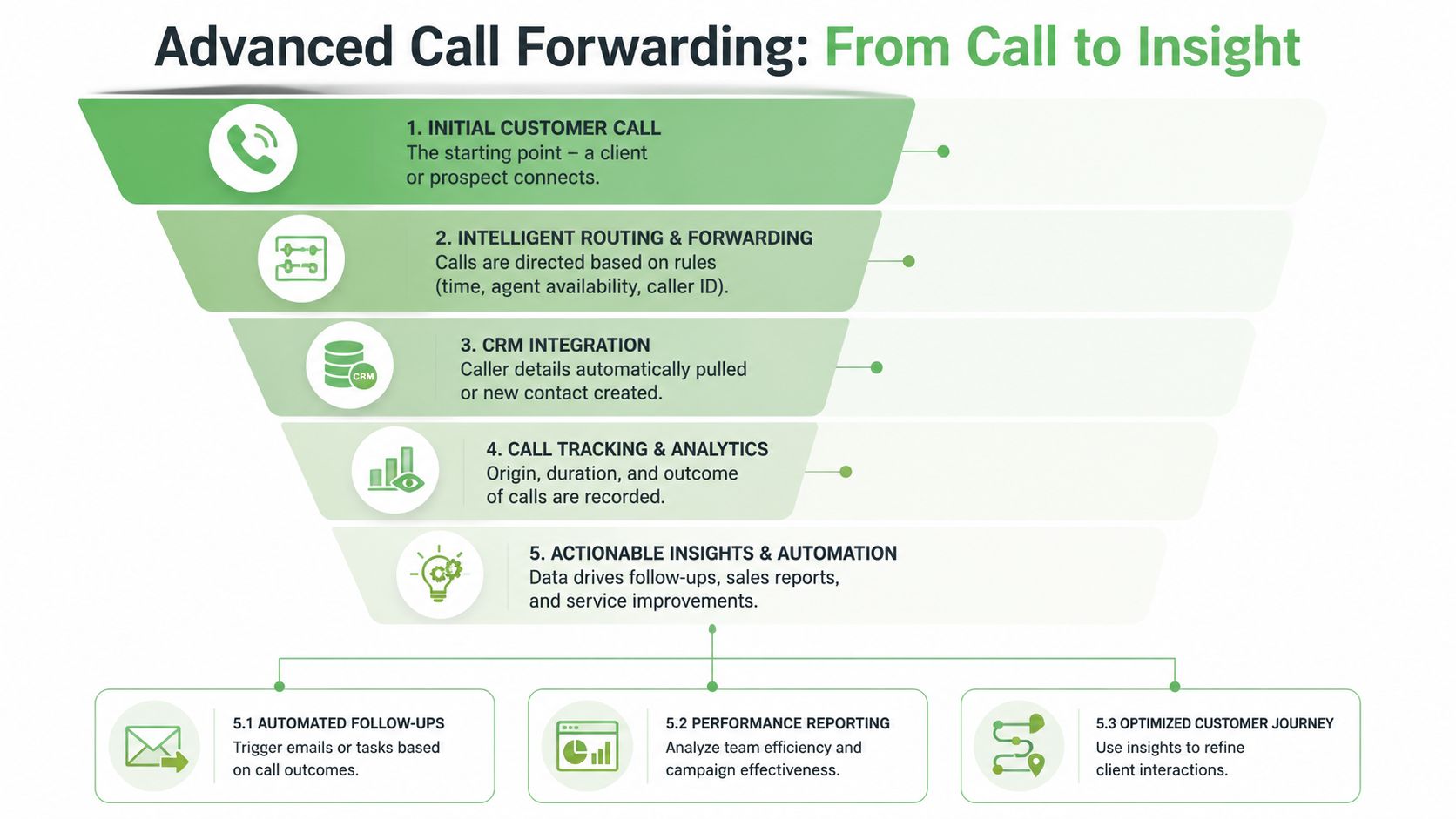
A call is a trigger. If a lead reaches a person, that should create ownership. If the call misses, that should create a follow-up path. If the call forwards to voicemail, that should create a task, a transcript, or a message thread someone can act on quickly.
From missed call to managed conversation
Agencies and SaaS operators can gain much more benefit from a simple phone feature.
A strong workflow often looks like this:
- Forward unanswered calls to a smart voicemail destination: Instead of a dead inbox, the message lands in a monitored team process.
- Send transcriptions to a shared inbox or ops channel: Sales, support, or success can see context without listening to every recording manually.
- Create or update a CRM record: The call event becomes attached to a lead, account, or opportunity.
- Trigger immediate follow-up messaging: If no one answered live, the prospect still gets a fast acknowledgment.
That last step matters more than is often recognized. A forwarded or missed call can trigger a message such as “Sorry we missed your call. How can we help?” The channel could be SMS or WhatsApp, depending on your workflow and contact strategy. The point isn't to replace the call. It's to keep the conversation alive while the intent is still fresh.
Why this matters for modern lead operations
Phone call forwarding is often the first event in a multi-channel funnel. Someone calls. The system routes the call. The outcome then determines what happens next.
If your setup is mature, that outcome can drive:
- Lead assignment: The correct rep owns the conversation immediately.
- Follow-up speed: Missed calls no longer disappear into a passive inbox.
- Campaign visibility: Tracked numbers can map inbound calls to sources and offers.
- Operational learning: You can review where calls were answered, missed, rerouted, or abandoned.
A phone system becomes strategic when call outcomes create the next action automatically.
For agencies, this means turning inbound call handling into a sellable operational service. For SaaS teams, it means connecting voice to the same lifecycle discipline already used in email, chat, and product onboarding.
Forwarding isn't the whole workflow. It's the entry point that makes the workflow possible.
Privacy Portability and Final Considerations
Before you roll call forwarding out widely, check two practical details. First, verify how caller ID behaves in your setup. In some systems, the recipient sees the original caller's number. In others, they may see the number that was called or a company number depending on the phone system and routing method. That affects how quickly your team can recognize the caller and how cleanly calls log into downstream tools.
Second, think about number continuity. Most businesses shouldn't change the public number customers already know just because the backend routing needs to improve. Keep the brand-facing number stable when possible, and change the forwarding logic behind it. That preserves recognition while giving your team more flexibility.
A final caution matters here. Not every forwarding option is equally appropriate. Immediate forwarding is useful when you need total redirection. Conditional routing is usually better when you still want the original line to try first. Selective forwarding can be helpful when only certain callers should take a different path. The right choice depends on whether your goal is coverage, speed, segmentation, or control.
Phone call forwarding still sounds like a legacy feature. In practice, it's a frontline business tool. It protects lead capture, supports distributed teams, and gives agencies and SaaS companies a reliable handoff point into modern messaging and sales workflows.
If your team wants to turn missed calls into live conversations, automated follow-up, and a branded messaging workflow, Double My Leads gives agencies and SaaS businesses a fast way to launch white-labeled WhatsApp operations, connect inbound lead sources, and keep conversations moving after the phone stops ringing.


