
QR code marketing is the use of scannable codes to move audiences from any physical or digital surface into a trackable online destination, and in 2026 over 90% of marketers use them. That makes it less of a novelty and more of a default acquisition and attribution tool.
What matters now is not the square itself, but what happens after the scan. The work sits in the redirect, the landing experience, and the analytics that tell you whether the scan became a lead, a sale, or just a glance.
Table of Contents
- What QR Code Marketing Actually Means in 2026
- How a Scan Turns Into a Marketing Action
- Key Use Cases That Drive Real Lead Generation
- Why WhatsApp QR Codes Are the Highest-Leverage Pattern
- Tracking and Measurement That Actually Matters
- Best Practices and Common Pitfalls to Avoid
- A One-Week Implementation Roadmap for Agencies
What QR Code Marketing Actually Means in 2026
QR code marketing is a measurement system, not just a printed code. It connects an offline impression or an on-screen prompt to a tracked digital action, which is why the channel has moved into the mainstream. Bitly's 2025 survey found that over 90% of marketers were already using QR codes, 94% had increased usage in the previous 12 months, and 88% said consumer sentiment had improved over the same period, according to Bitly's QR code statistics.
That adoption matters because it changes how you should think about the channel. A QR code is the doormat. The redirect is the front door. The landing page is the living room. If people scan but never reach a relevant destination, the campaign hasn't done its job.
Static and dynamic codes are not the same thing
A static QR code locks the destination in place. That can be fine for a one-off, low-stakes use, but it gives you no flexibility once it's printed. A dynamic QR code decouples the visible code from the target URL, so you can change the destination later and keep the same printed asset alive.
That flexibility is the difference between decoration and infrastructure. Dynamic codes also make measurement possible at campaign level, because teams can route scans through tracked URLs and analytics layers. A practical explanation is available in the Cisco Meraki QR code guide, which is useful if you're trying to explain the concept to a client who still thinks a QR code is just a shortcut.
Practical rule: if the code can't be updated after print, it's not a marketing system, it's a one-time link.
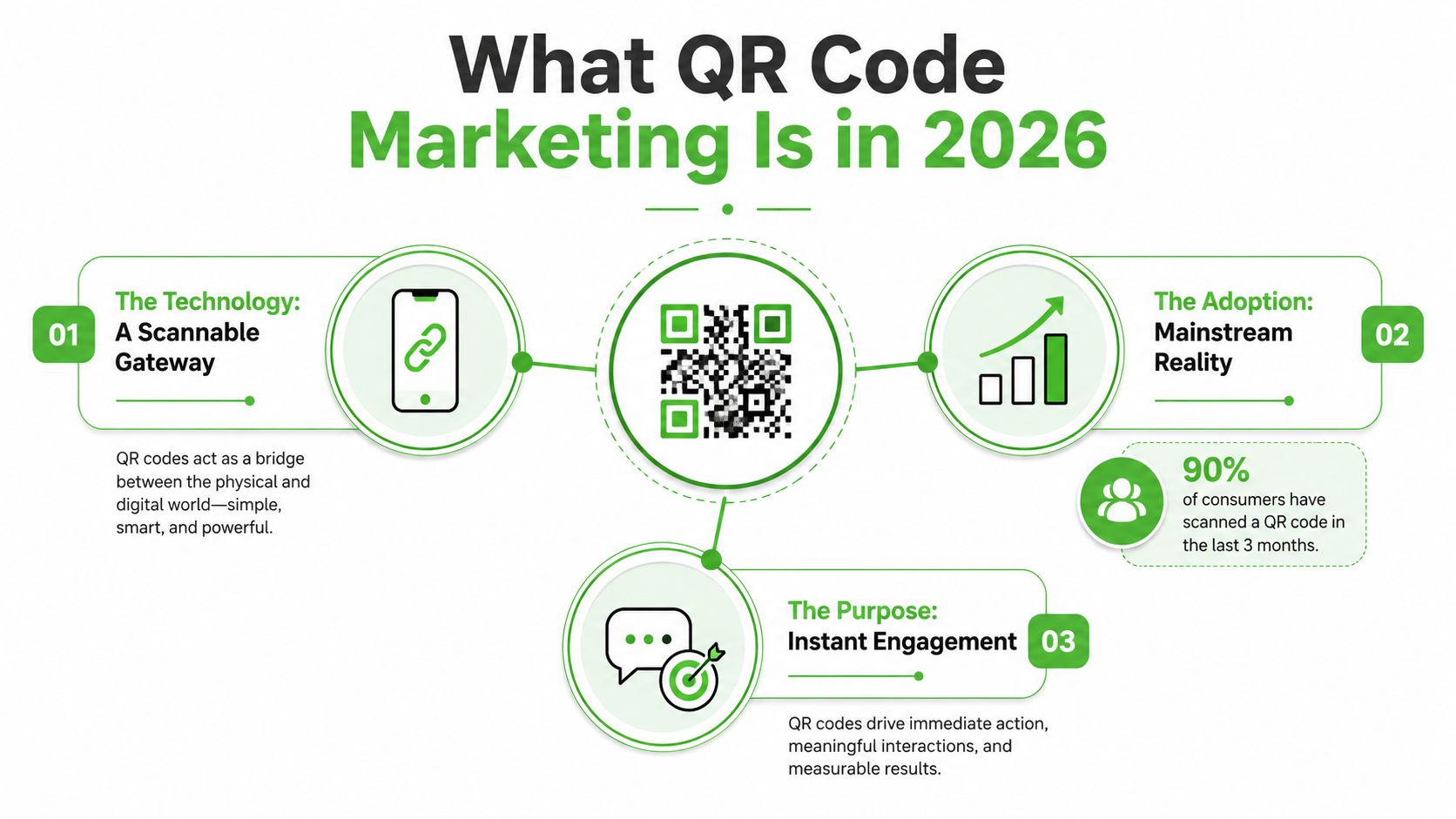
For an agency owner, the shortest accurate definition is this, QR code marketing is the use of scannable codes to send people from a physical or digital touchpoint into a measurable online journey. Once you can say that cleanly, you can audit every placement by asking a simple question, did this touchpoint create a trackable action or just more noise?
How a Scan Turns Into a Marketing Action
A QR scan looks instant to the user, but the marketing system behind it has several parts. First, a team generates the code and embeds a destination or trigger. Then a phone camera reads it. Then the user is sent through a redirect layer, often dynamic, before they land on a tracked destination.
That sequence matters because every step can be measured or improved. The code is only the entry point. The redirect, the destination, and the tracking setup are what turn a scan into an attributable marketing event.
The scan path is an engineering chain
In practice, a marketer usually cares about five things after the scan, time, location, device type, identity, and intent. Dynamic QR codes can capture scan timing and device data, then pass people into tracked URLs where analytics can connect the visit to a campaign source. That is why QR marketing behaves more like a funnel than a flyer.
A simple coffee shop example makes this concrete. A table tent can hold a QR code that opens a WhatsApp order thread, tags the source as “table 4 flyer,” and starts a conversation before a human steps in. The code itself didn't create the lead, the routing logic did.
A scan is not the result. It's the start of a tracked handoff.
When teams miss this, they end up counting scans without knowing whether those scans generated anything useful. When they get it right, one scan can produce a conversation that sales can follow, an order that finance can trace, or a support request that operations can close.
The mental model agency teams should keep
Think of QR code marketing as a scan-to-conversion path. A person sees a placement, scans it, reaches a destination, and either converts or drops out. The only reason to care about the scan is because it can be linked to the next action.
That's also why the quality of the destination matters as much as the code itself. Clear instructions raise scan likelihood. Relevant routing raises engagement. Fast load behavior and a clean post-scan experience improve the chance that attention turns into revenue.
Key Use Cases That Drive Real Lead Generation
The strongest QR deployments are placed where intent already exists. That's why the best use cases map neatly to the funnel. Some placements capture attention, some qualify interest, some convert, and some retain.
Different placements do different jobs
Offline-to-online placements are the most obvious. Product packaging, retail signage, event booths, print ads, and posters can all push someone from a physical surface into a digital action. Their job is usually capture or convert, depending on the promise behind the code.
Digital placements can work too. Email signatures, social posts, and landing pages can use QR codes when the goal is to move someone into a different action, like a phone handoff, a messenger thread, or a sign-up flow. Post-purchase placements, like receipts, delivery inserts, and review prompts, are usually about retain and re-engage.
| QR Code Placements by Funnel Stage | Funnel Stage | Primary Metric |
|---|---|---|
| Packaging | Capture | Scans and repeat scans |
| Retail signage | Convert | Scan-through rate and conversion rate |
| Event booths | Capture | Unique scans |
| Email signatures | Convert | Landing-page views |
| Receipts | Retain | Review or return visits |
| Delivery inserts | Retain | Follow-up actions |
If you need a field-tested reference for operational use, the QR code guest check in guide is a helpful example of how a physical touchpoint can be turned into a structured digital workflow.
Scan-to-messenger is the pattern to watch
The most valuable 2026 pattern for many agencies is scan-to-messenger, especially when the destination is WhatsApp. It turns passive attention into an active conversation in one tap, which is much closer to lead capture than a typical website visit.
A practical audit is simple. Ask where people already pause, look, or ask for help. Then ask what action you want them to take at that moment. If the answer is “go to a homepage,” the placement probably isn't doing enough. If the answer is “start a conversation, book a demo, claim an offer, or request help,” the QR code has a real job.
Why WhatsApp QR Codes Are the Highest-Leverage Pattern
WhatsApp QR flows are powerful because they shorten the path from scan to reply. The user scans a code, opens a click-to-chat flow, and lands in a channel where the conversation is already native to the device. That removes a lot of the friction that slows down form-based lead gen.
Why scan-to-chat changes the economics
A wa.me link inside a QR code turns any printed asset into a conversation trigger. Instead of asking someone to type a URL, fill out five fields, and wait for a reply, the code opens a message thread where intent can be captured immediately. For lead-gen teams, that is often the biggest advantage point in the whole funnel.
This matters even more when the lead source is a reseller, gym, clinic, showroom, or local service business. A mirror sticker, a trial pass flyer, or a reception poster can each point to a different pre-tagged chat path. The source tag lets the team see which placement created the lead before a salesperson even takes over.
Useful operating rule: the faster the first reply, the less likely the lead is to cool off before qualification starts.
The reason this pattern usually outperforms a generic landing page is simple. A conversation can qualify intent while the user is still warm. A form often creates delay, and delay costs attention.
The agency scenario that makes it obvious
A local gym can place QR stickers on mirrors, posters, and trial-pass flyers. Each scan opens a WhatsApp conversation with a different source tag, and an auto-welcome flow asks whether the person wants a class pass, membership pricing, or a trainer call-back. A human then steps in with context already attached.
The important part is not the app, it's the sequence. The code captures the moment, the chat flow captures the intent, and the handoff captures the lead. That's why QR plus WhatsApp is so useful for agency owners who care about lead cost, response speed, and attribution quality.
Tracking and Measurement That Actually Matters
QR campaigns get misread when teams stop at scan count. Scan volume tells you that people noticed the code. It does not tell you whether the code created value. A better measurement stack includes total scans, unique scans, scan-through rate, landing-page view rate, conversion rate, revenue per scan, and repeat-scan signals.
Measure the funnel, not the sticker
The useful formula is simple, scan-through rate = scans ÷ estimated impressions. That ties performance back to placement quality instead of just raw activity. Dynamic QR codes and UTM parameters let teams connect each scan to a source, a campaign, a geography, and a device class through standard web analytics.
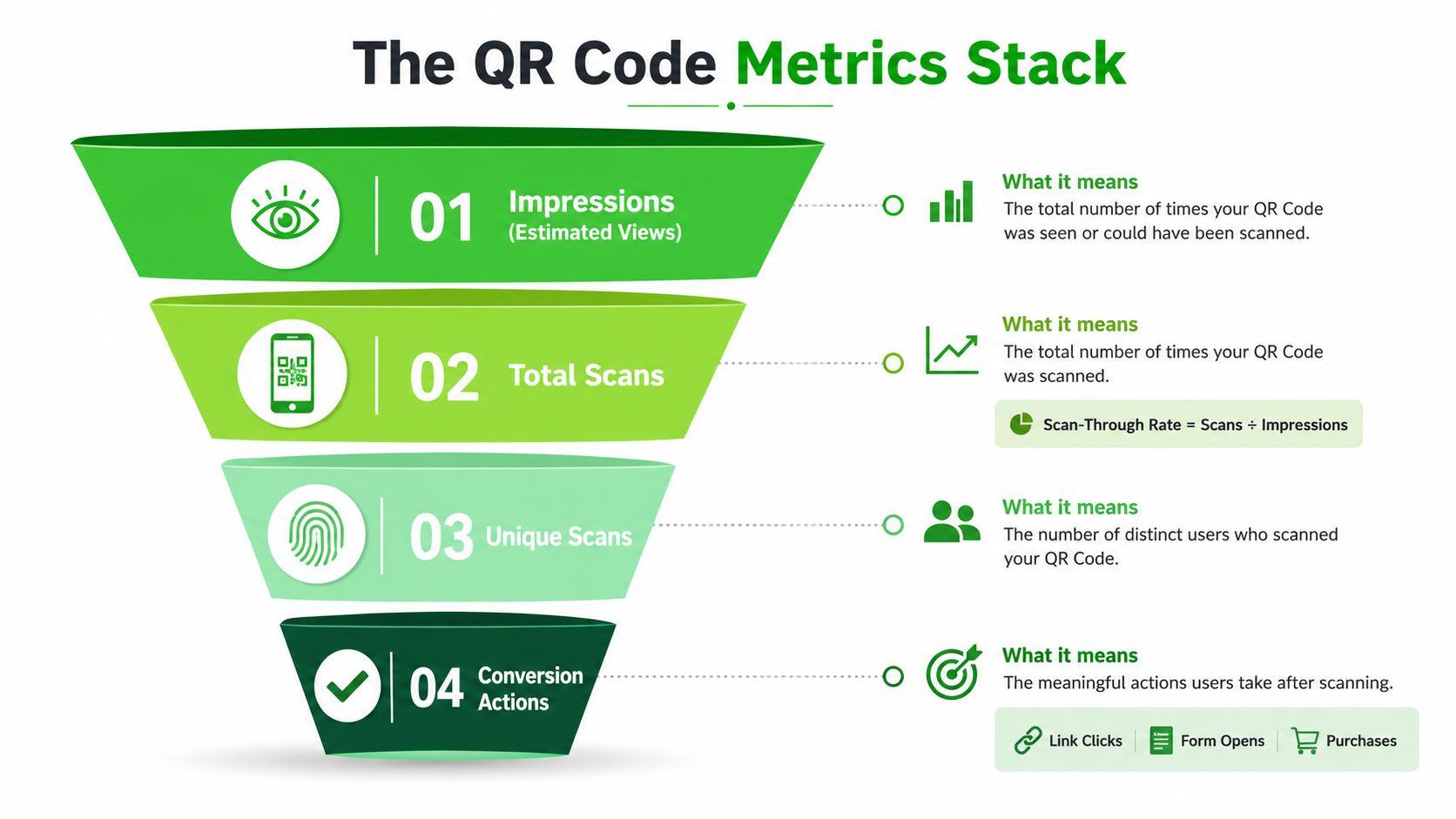
The point of this stack is attribution quality. A campaign with fewer scans can still be stronger if those scans move farther down the funnel. That's why scan count by itself is a vanity metric unless it's paired with downstream outcomes.
Baselines are what separate traffic from lift
The strongest teams compare QR performance against a baseline. That can be a previous placement, an alternate CTA, a different location, or a non-QR control. The question isn't just “did people scan,” it's “did this placement create incremental action compared with what we would have gotten otherwise?”
If a placement cannot be measured, it should not be scaled.
That rule saves agencies from printing more of the wrong thing. It also forces clearer naming conventions, cleaner URL tagging, and more disciplined reporting. Once those habits exist, QR code marketing stops being a guessing game and starts behaving like a performance channel.
Best Practices and Common Pitfalls to Avoid
Most QR failures are avoidable. They come from design mistakes, weak routing, or bad placement decisions, not from the technology itself. A good campaign clears those risks before anyone prints or posts anything.
Do the basics well
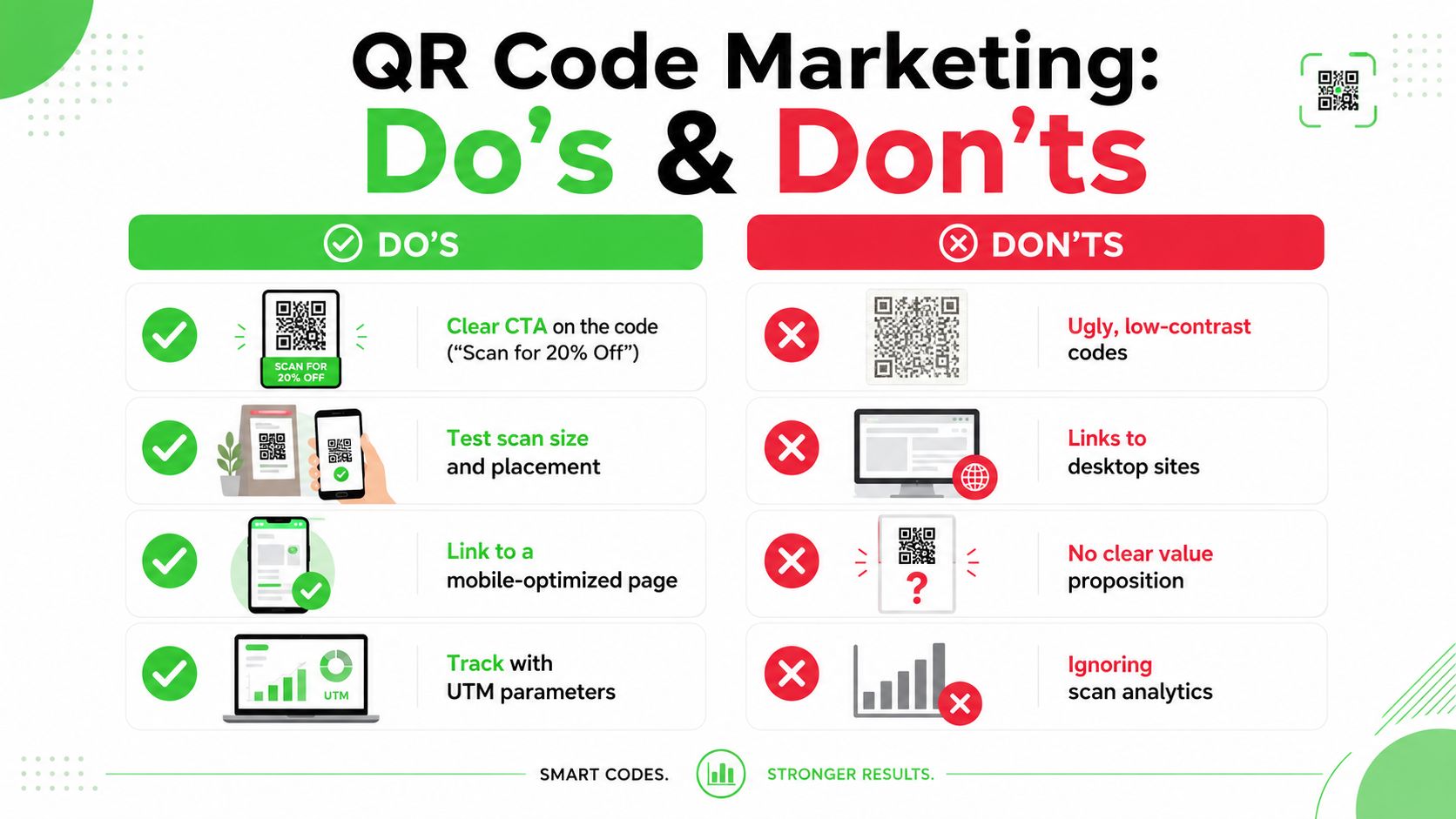
Use a clear CTA. People scan faster when they know what they'll get. “Scan for a quote,” “Scan to order,” or “Scan for a callback” works better than a lonely square.
Use dynamic codes for anything that lives beyond a quick test. If the destination changes and the code is static, the print asset is dead weight. Dynamic routing keeps the code useful after distribution.
Tag every destination. UTM naming conventions matter because they preserve attribution across placements and channels. Without them, you'll know the code was scanned, but not what it did for the pipeline.
Avoid the usual failure modes
Do not place codes where nobody pauses. A beautiful code on a fast-moving surface, a reflective angle, or a cramped corner will underperform because people can't scan it comfortably.
Do not send mobile users to a desktop-first page. The destination is opened on a phone, so the landing experience needs to be designed for a phone. If the first screen feels clumsy, the scan is wasted.
Do not leave WhatsApp flows cold. If you're using a messenger handoff, pre-tag the source, respond quickly, and make the human takeover feel natural. The code starts the conversation, but the follow-up closes the loop.
Checklist to keep handy: clear CTA, dynamic routing, tagged links, mobile destination, visible placement, fast follow-up.
The broader lesson is simple. The QR code is not the campaign. The destination and follow-up are the campaign.
A One-Week Implementation Roadmap for Agencies
A clean agency rollout doesn't start with print, it starts with the workflow. On day one, the team connects a WhatsApp number through QR scan access, so the account is ready without a heavy setup burden. On day two, the workspace gets branded under the agency's own domain and visual identity.
By midweek, the team builds tracked smart links and QR codes that capture leads before a conversation starts. Then they add an auto-welcome flow with assignments, tags, and quick replies, so no scan gets stranded. After that, broadcast capabilities, CRM participant sync, and source attribution can be layered in for clients who need more than one-off chat flows.
The business reason agencies like this structure is margin control. A flat monthly fee is easier to resell than variable per-message charges, especially when the agency is packaging WhatsApp as a managed offer instead of a one-off tactic.
The shortest way to explain the opportunity is this, QR code marketing is the on-ramp, WhatsApp is the conversation layer, and the platform underneath decides whether that attention becomes a repeatable service or just a loose experiment.
If you want to turn QR scans into a measurable lead engine, Double My Leads gives agencies a way to launch white-labeled WhatsApp workflows, tracked QR entry points, and source-attributed conversations without the usual setup drag. It's built for teams that want QR code marketing to feed a real resale offer, not just generate more scans.


