
You're likely staring at the same problem every agency hits sooner or later. Email is still getting opened, SMS is getting pricier to use as a default, and clients keep asking why the conversation can't happen where their customers already live. At that point, WhatsApp stops being a nice-to-have channel and becomes the channel you need to productize, especially if you're responsible for lead gen, support, or community offers that depend on fast replies and rich context.
Table of Contents
- Why Agencies Are Moving to WhatsApp
- What a WhatsApp Messaging Platform Is
- Implementation Models Agencies Can Choose
- Core Features That Drive Revenue
- Security, Compliance, and Pricing Models
- Agency and SaaS Use Cases for White-Label Reselling
- Onboarding Checklist and Decision Matrix
Why Agencies Are Moving to WhatsApp
The turning point usually happens in a sales review. The team has the nurture emails, the reminders, and the follow-ups, but the client still wants a channel that feels like a conversation, not a campaign blast. Someone on the call says, “Can we just do this in WhatsApp?” and suddenly the question is whether your stack can handle texts, images, voice notes, documents, and replies without losing context.
The inbox has become the product
That's why agencies are moving from channel management to inbox management. WhatsApp isn't just another place to send a message, it's where the whole interaction happens, from first touch to handoff to resolution. If your workflow breaks when a prospect sends a voice note or a support agent needs to see the last file shared, you don't have a messaging strategy, you have a delivery problem.
WhatsApp's scale makes that shift hard to ignore. Statista estimates the platform reached 2.96 billion global unique users by June 2024, up 34% from the beginning of 2021 (Statista WhatsApp topic overview). Industry summaries also place monthly active users above 3 billion, with WhatsApp available in more than 180 countries, which is why it matters for global agencies and not just one market.
Practical rule: if the client's buyers already use WhatsApp daily, forcing them back into email forms or web chat is friction you don't need.
Reach matters, but so does utility
The best WhatsApp deployments I've seen aren't just broadcasting. They're moving useful information fast, through a channel people answer. That includes appointment reminders, lead qualification, service updates, and information-heavy use cases where search, email, or a website fall apart.
WhatsApp's usage intensity explains why teams keep adopting it. Industry estimates consistently put daily message volume at over 100 billion messages, with some 2024 to 2026 summaries citing 150 billion per day, and daily active usage near 2.3 billion people, or about 83% of monthly users (Statista WhatsApp topic overview). If you're building an agency offer around response speed, this is the channel to take seriously.
The blunt takeaway is simple. Agencies don't need another “send message” feature. They need a WhatsApp messaging platform that can become part of the client's operating system.
What a WhatsApp Messaging Platform Is
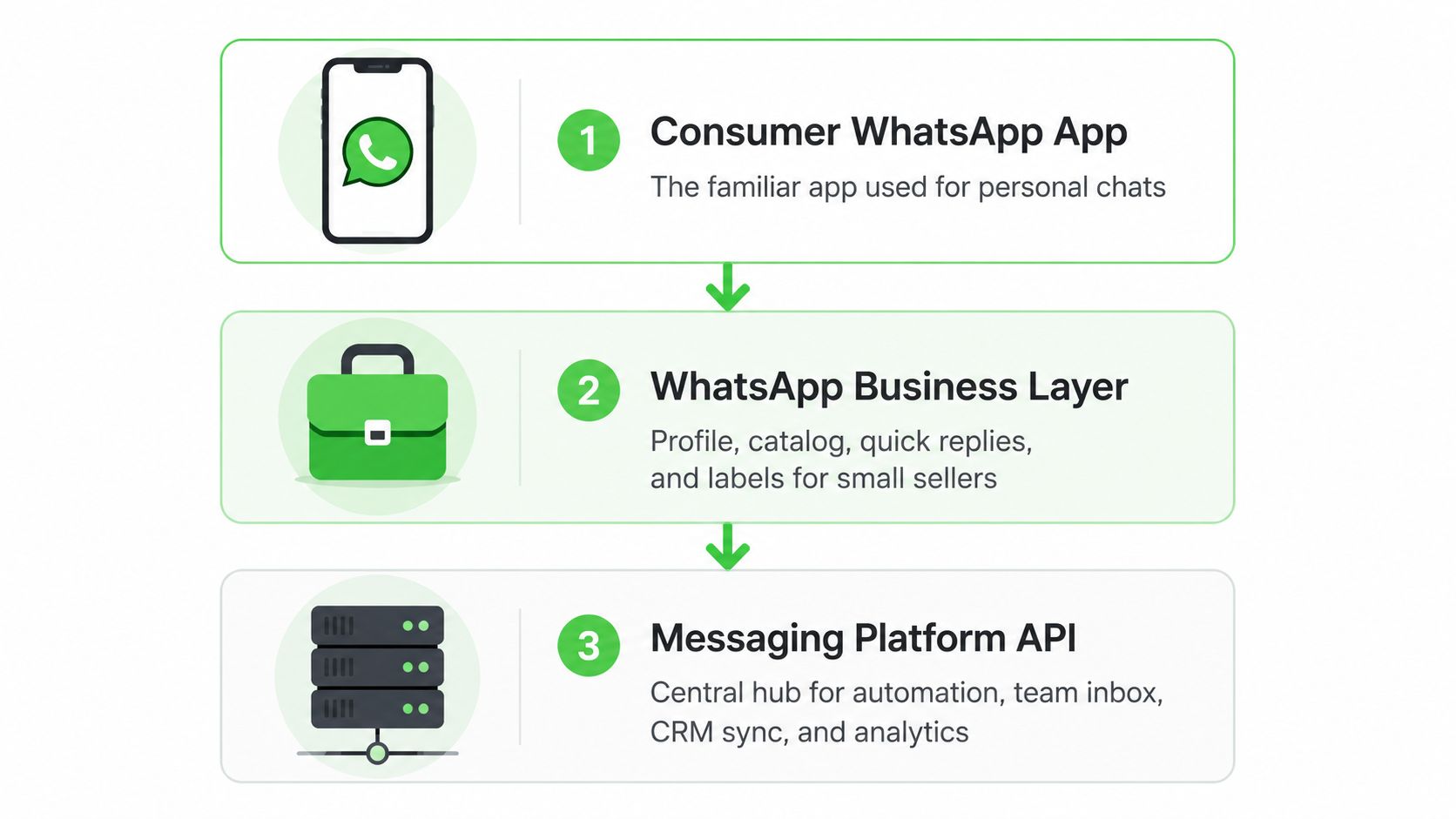
A lot of people say “WhatsApp platform” when they mean different things. That creates bad buying decisions. A real WhatsApp messaging platform has three layers: the consumer app, the business layer, and the automation layer.
Start with the app everyone already knows
The first layer is the consumer WhatsApp app. People already use it, trust it, and expect it to be simple. Agencies build on that familiarity because clients do not want to teach customers a new portal just to start a conversation.
The second layer is WhatsApp Business, where a phone number becomes a business identity. It adds profile details, business context, and basic tools that help a small seller look organized without custom development.
The third layer is the platform layer, where the number becomes part of a programmable workspace. Automation, shared inboxes, CRM sync, routing, and analytics live here, and this is the layer agencies can package and sell as a product.
If you want a technical reference for the developer side of the stack, the API docs from Saaspa.ge make the split between message sending and platform behavior easier to map.
The difference is control
Clients usually miss this part. “Sending WhatsApp messages” is not the same as running a WhatsApp platform. Sending is a feature. A platform gives you workflow control, team access, inbox governance, and reusable client setups.
A good platform turns a phone number into infrastructure, not a side channel.
That difference matters for agencies because the platform layer is what you can package. You can charge for onboarding, access, branding, workspace setup, lead routing, and managed operations. If all you have is a sending tool, every client change still turns into manual service work.
A useful mental model is simple. The app is the conversation surface, the business layer is the storefront, and the platform layer is the operating system. If a vendor cannot keep those layers separate, it usually cannot support a serious agency workflow either.
Implementation Models Agencies Can Choose
The two implementation paths are not equal, and pretending they are wastes time in demos. One model is built for speed and packaging, the other is built for developer control. Agencies should short-list based on margins and onboarding friction first, not on feature lists.
QR-linked inbox model
The QR-linked inbox model is the fastest way to get a client live. You scan a code, link the number into a shared workspace, and start operating from a browser-based inbox. There's no heavy integration work, no developer backlog, and no long setup ritual before the first message goes out.
That's why this model fits resellers, lead-gen agencies, and small to mid-sized client accounts. You can onboard quickly, keep the experience consistent, and sell the workspace as a managed service. The tradeoff is that you usually get less raw customization than a deep API build, but for most agency deals that's not the bottleneck.
The other reason I like this model for agencies is margin predictability. If the pricing is flat, you can wrap a service margin around it without worrying that client volume will eat your profit.
Cloud API model
The WhatsApp Cloud API is the more technical path. Meta hosts the messaging endpoints, so developers can wire WhatsApp into custom systems, CRMs, and internal workflows. That gives in-house teams more control over brand experience and automation logic, but it also adds setup burden and usually demands more operational discipline.
This model makes sense when the client has a technical team or when the agency is building a custom product rather than reselling an inbox. It's the better fit for deeper integration work, but it's slower to launch and less forgiving if the team behind it wants a plug-and-play client rollout.
Here's the clean split:
- Pick QR-linked inboxes when you want fast onboarding, simple operations, and agency resale.
- Pick Cloud API setups when you need developer-led customization, deeper integrations, and more control over how messaging fits the client stack.
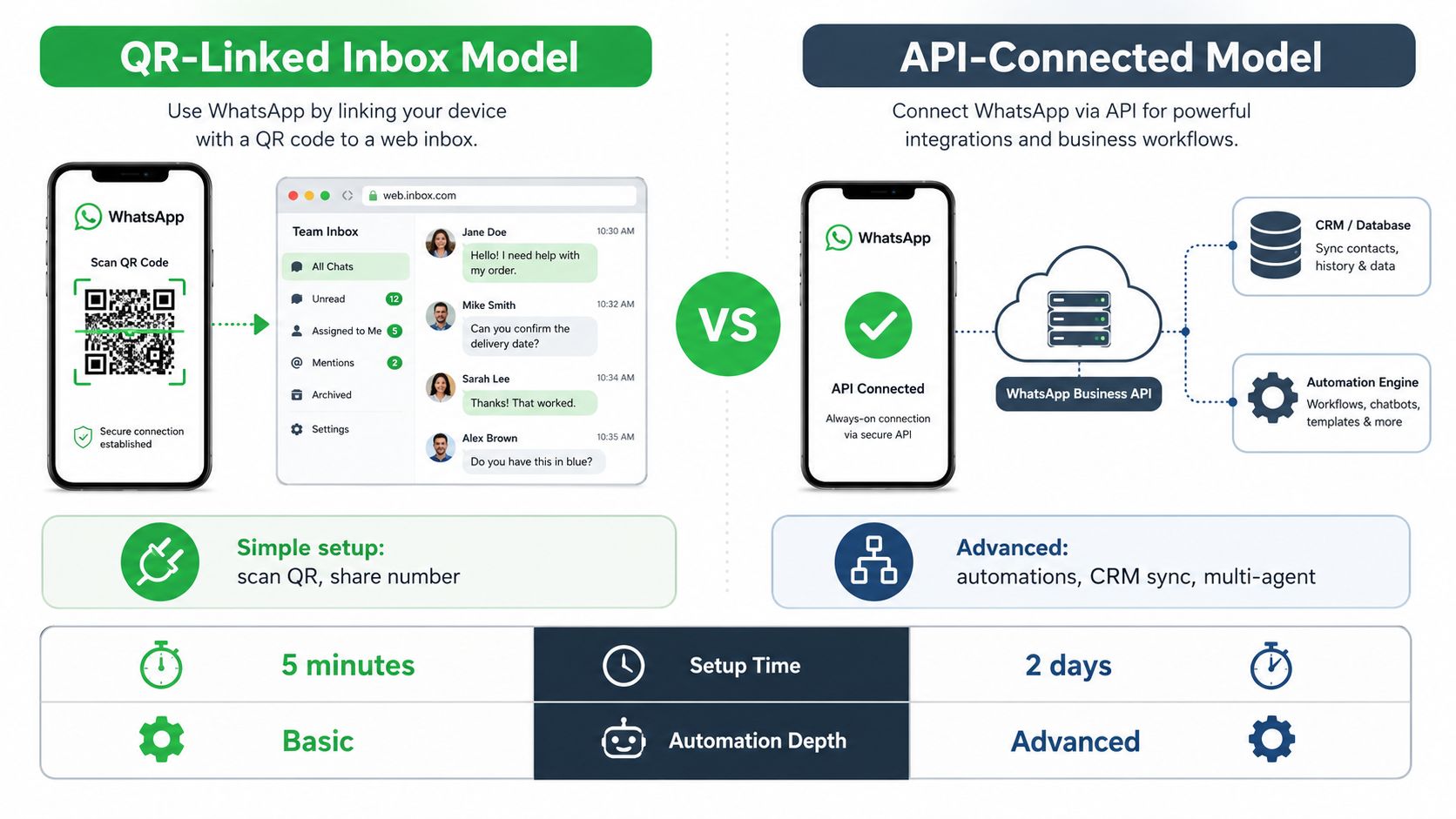
The decision is usually obvious once you stop talking about “WhatsApp” as a generic channel. If your business model is resale and service, go QR-linked first. If your business model is engineering and custom workflows, go Cloud API.
Core Features That Drive Revenue
Revenue doesn't come from having the longest feature list. It comes from removing friction at the exact points where leads stall, handoffs break, or conversations go cold. In practice, the highest-value WhatsApp features are the ones that improve speed-to-lead, attribution, and team throughput.
Start with broadcasts and structured follow-up
Broadcasting matters because agencies need reach, but raw reach without control turns into noise. Community Announcement Groups, scheduled campaigns, and rich media messages are the basic distribution layer, and they matter most when a client is already sitting on an audience they underuse.
I'd rank auto-welcome flows just below that. They shorten the time between a new contact and a live conversation, which is where a lot of agency value sits. If your platform can greet, qualify, and route without manual intervention, you've already improved the economics of the account.
Smart links and QR codes belong here too. They're not glamorous, but they solve attribution. When a prospect scans a code or taps a tracked link, you know where the conversation started, and that makes downstream reporting much cleaner.
Then look at operational throughput
The inbox itself is where deals are won or lost. A multi-agent inbox with assignments, notes, tags, and quick replies lets a team handle more threads without turning every conversation into a scavenger hunt. Once client work scales beyond one operator, this stops being optional.
CRM participant sync is the next layer because it keeps WhatsApp from becoming a dead-end channel. If contacts, notes, and conversation context can move into the CRM, your team can build proper follow-up pipelines instead of relying on memory. That's a real revenue lever because it reduces missed handoffs.
Rich-media support matters too, especially for agencies selling offers that depend on documents, voice notes, images, or video. A platform that handles media cleanly feels much more usable to sales and support teams.
For agencies experimenting with conversational workflows, the AI chat bot builder from CodeDesign.ai is worth reviewing alongside inbox automation, because it helps separate simple reply handling from more structured agent flows.
Agency rule: if a vendor demo spends all its time on message sending and not on assignments, tags, and CRM sync, you're looking at a toy, not a platform.
The shortest version is this. Prioritize broadcasting, auto-welcome flows, attribution, CRM sync, and team inbox controls. Treat everything else as secondary unless the client has a very specific use case.
Security, Compliance, and Pricing Models
Deals stall here, and margins get decided here. If legal, ops, or finance feels unsure, the sales cycle slows down fast. If your pricing is sloppy, the account looks fine in the first month and painful by the third.
Verify the operating model before you sell it
A Cloud API setup usually comes with tighter setup discipline, including Meta Business verification and approved template handling. That is not a problem. It just means the agency sales motion has to be cleaner from the start. If the vendor cannot explain account ownership, approval flows, and delivery rules in plain language, you will end up fixing the mess after the contract is signed.
Every WhatsApp messaging platform should also handle opt-in, opt-out, and template approval correctly. That is table stakes. Agencies should ask how the platform handles linked-device security, where access data is stored, and what happens when a user changes numbers or leaves the client account.
Ownership needs to be crystal clear. If the client cannot say who owns the number, who can enter the inbox, and how a message gets approved or routed, the setup is not ready for production. That gap creates avoidable risk for the agency and for the client.
Price for margin, not for convenience
Per-message pricing looks harmless until volume climbs. Flat-fee pricing is easier to resell because it lets the agency hold margin as client usage grows. If you are managing workspaces across multiple accounts, that predictability matters more than a polished pricing page.
This is the same pricing logic agencies should apply across software offers. The pricing AI features guide from 925 studios is useful context because it reinforces a simple rule, fixed plans are easier to sell, while usage-linked costs can squeeze profit.
Use the pricing model that fits the client's operating rhythm:
- Flat fee works when you want clean packaging, easier resale, and predictable margin.
- Per-message works when the vendor is built around usage-based economics and you are willing to absorb variance.
If you are the agency, the first model should be the default. Only accept per-message pricing when the client's usage is volatile. Finance teams do not appreciate a pricing structure that gets harder to explain every month.
Agency and SaaS Use Cases for White-Label Reselling
The business model changes once the platform becomes white-label. At that point, you're not just using WhatsApp for clients, you're selling a WhatsApp-powered workspace under your own brand. That shift matters because it turns a service line into a product line.
What white-label really means in practice
White-labeling is more than a logo swap. The agency can run a custom domain, branded colors, client-facing login, workspace billing, and access control under its own commercial structure. That lets you present the platform as part of your offer instead of making the client see the underlying vendor every time they log in.
That's a cleaner sale for agencies because the client buys a business outcome, not a software dependency. It also makes recurring revenue more defensible, since the workspace, the billing, and the support layer all sit inside the agency's wrapper.
The other important point is that white-labeling improves productization. When the same setup can be reused across multiple clients, the agency isn't rebuilding from scratch every time. That's the core economic advantage.
Where agencies and SaaS teams use it
The strongest use cases cluster around teams that already communicate in threads and need a repeatable operating layer. Lead-gen agencies use it to manage inbound WhatsApp conversations. AI automation agencies package chat agents on top of the inbox. Coaches and info-product marketers use it for community announcements and paid audience access. Creators use it as a newsletter-style channel that feels more immediate than email.
A lot of teams also use WhatsApp for a purpose that mainstream platform content misses. Research on Spanish-language WhatsApp services found that people were using it for practical help with bureaucracy, health insurance, immigration status, and other information needs, not mainly for political news (Documented Semanal). That's a useful reminder that the channel's value isn't just reach, it's reducing friction where other channels underperform.
For agencies trying to productize quickly, Double My Leads is one option in this category. It offers a white-labeled WhatsApp workspace with QR onboarding, broadcast features, assignments, notes, tags, and Stripe-based billing under the agency's own branding.
Why agencies resell this instead of just using it
Because the resale story is cleaner than the service story. If the platform supports client access, workspace branding, and billing controls, the agency can sell setup, management, and ongoing access as a recurring product. That's very different from doing one-off support inside a client's existing stack.
The commercial logic is direct. White-label turns a WhatsApp inbox into recurring software revenue, and that's what agencies should care about.
Onboarding Checklist and Decision Matrix
A good rollout should feel boring in the best way. If the setup is clean, the team can launch quickly, prove value, and avoid spending a week wrestling with access and configuration. The checklist below is the one I'd hand to a new operator.
Six-step onboarding path
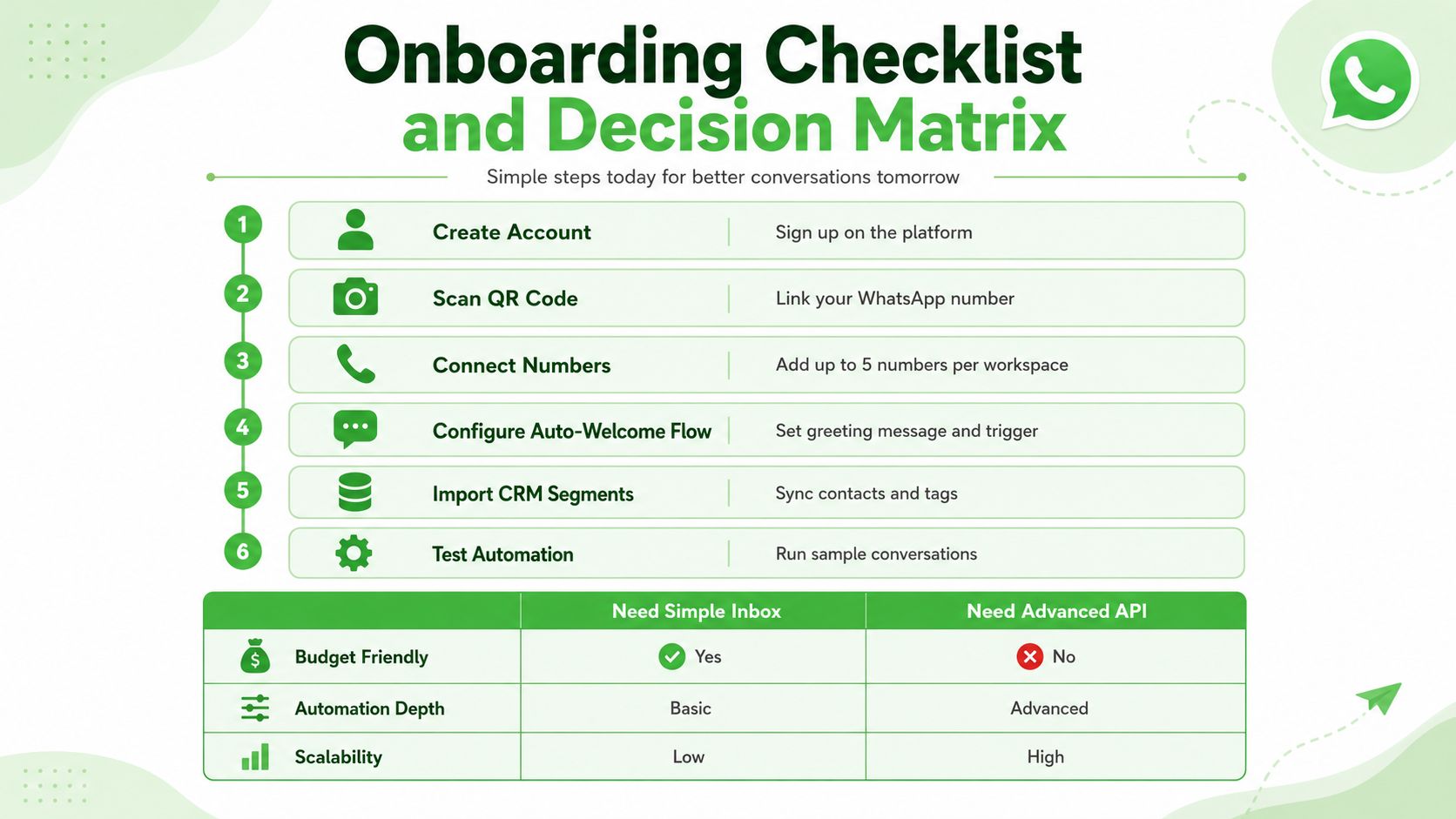
- Create the account. Set up the workspace and confirm who owns it internally.
- Scan the QR code. Link the WhatsApp number into the inbox or platform.
- Connect the numbers. Add the client's active lines and keep ownership documented.
- Configure the auto-welcome flow. Set the first greeting, the trigger, and the handoff rules.
- Import CRM segments. Sync contacts, tags, and any critical source data.
- Test the automation. Send sample conversations, verify routing, and check the inbox view.
If you're using a QR-linked model, the setup is intentionally simple. If you're using a Cloud API model, expect a more technical handoff and more time spent on configuration and approvals. The point is not to overengineer the start.
Decision matrix for choosing a WhatsApp messaging platform
| Criterion | QR-Linked Inbox | Cloud API Platform |
|---|---|---|
| Setup time | Fast | Slower |
| Pricing | Flat-fee friendly | Usage-linked more common |
| White-label depth | Strong for agencies | Varies by vendor and build |
| Media support | Good for everyday client work | Strong with custom integration |
| API access | Limited or layered on top | Native and deeper |
| Compliance posture | Operationally simple | More process-heavy, more control |
That matrix is the cleanest way to choose. If you need a simple inbox, predictable margins, and fast onboarding, pick the QR-linked route. If you need developer control, deeper integrations, and a more custom product, pick the Cloud API route.
Double-check the vendor's billing model, client access rules, and handoff process before you commit. That's where the platform quality shows up.
If you want a white-labeled WhatsApp stack that an agency can resell, Double My Leads is built for that workflow, with QR onboarding, a shared inbox, broadcast tools, and branded workspaces under your own billing structure. Visit Double My Leads if you want to evaluate a flat-fee WhatsApp setup against a Cloud API-first build and decide which model fits your margins and client control needs.


