
Most explanations of the WhatsApp revenue model stop too early. They tell you how Meta monetizes business messaging, point to the scale, and leave you with the impression that this is a clean channel to resell.
For agencies, it often isn't.
WhatsApp is a powerful business channel, and Meta has built a serious revenue engine around it. But the official pricing logic that works for Meta can be a terrible fit for agencies, Go High Level operators, and SaaS resellers trying to sell simple monthly plans. The problem isn't demand. The problem is billing design. If your underlying costs change by conversation category and country, your margins don't stay stable for long.
That matters when you're packaging client services, deciding who owns the tech stack, and deciding on your marketing strategy in a way that won't turn delivery into a finance problem. The core question isn't just how WhatsApp makes money. It's whether you can build a predictable business on top of the same model.
Table of Contents
- Beyond the Hype What Agencies Must Know
- The Three Pillars of WhatsApp's Monetization Engine
- Decoding Conversation Based Pricing Mechanics
- The Reseller's Dilemma Margin Chaos and Unpredictability
- The Solution White Label Platforms and Predictable Profits
- Actionable Monetization Strategies for Your Agency
- The Future of WhatsApp Commerce and Your Next Move
Beyond the Hype What Agencies Must Know
The popular advice says WhatsApp is easy to monetize because businesses already want to be there. That's only half true. Demand is real. The messy part starts when an agency tries to resell access, automation, support, and campaign execution under a plan a client can understand.
Meta's incentives are straightforward. It wants a pricing model that scales globally across business messaging. Agencies need something different. They need margins they can forecast, packages they can explain in one sentence, and invoices that don't trigger a long email thread every month.
The core mismatch
The WhatsApp revenue model is optimized for platform monetization, not reseller simplicity. That distinction changes everything.
A platform can charge based on usage across countries, message categories, and business types because the platform sits at the infrastructure layer. An agency doesn't. An agency sits between platform complexity and client expectations. The minute you absorb cost volatility while selling fixed retainers, you're taking pricing risk that the client never sees.
Practical rule: If your wholesale cost is variable and your retail offer is fixed, you don't have a pricing model. You have a margin gamble.
Why agencies feel this faster than brands do
A single brand can sometimes tolerate variable platform costs because it's measuring channel ROI internally. Agencies rarely get that luxury. They have to standardize delivery across multiple clients with different geographies, use cases, and support demands.
That creates a familiar pattern:
- Sales wants simplicity: A clean monthly package closes faster than a usage matrix.
- Ops wants consistency: Teams need repeatable workflows, not constant pricing exceptions.
- Finance wants predictability: Margin swings make planning harder than the service itself.
When people talk about the WhatsApp revenue model as if it's only a story about Meta's monetization, they miss the operational reality for resellers. The attractive market is real. The official billing mechanics can still make the business hard to scale.
The Three Pillars of WhatsApp's Monetization Engine
WhatsApp makes sense once you see it as a free consumer product with a business monetization layer built around it. Personal users stay outside the billing system. Businesses fund the system.
Free for users paid by businesses
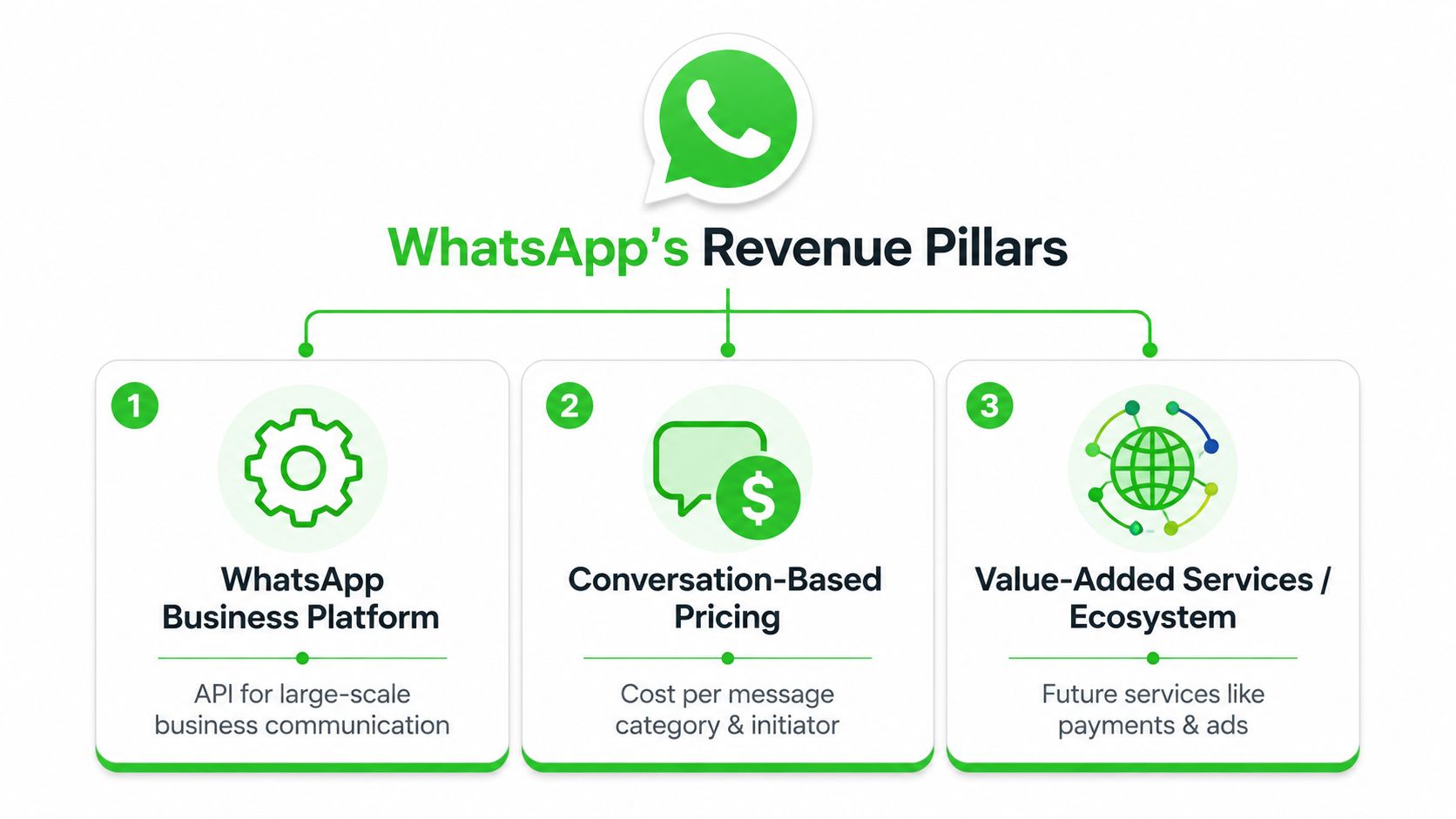
The first pillar is the WhatsApp Business Platform API. That's the direct monetization engine. WhatsApp's Business Platform API reached an estimated $1.2 billion in 2025, while Click-to-WhatsApp advertising generated an estimated $12 billion in Meta revenue in 2025. The same source says total direct and indirect WhatsApp revenue is projected to reach $3 billion in 2026 (Revenue Memo on how WhatsApp makes money).
The second pillar is Click-to-WhatsApp ads. This sits in Meta's ad ecosystem rather than inside WhatsApp billing itself. A business runs ads on Facebook or Instagram, and the call to action opens a WhatsApp conversation. That makes WhatsApp part of Meta's ad monetization machine without charging personal users for chat access.
The third pillar is WhatsApp Pay and related ecosystem services. Payments inside chat expand monetization beyond messaging. That matters because it shifts WhatsApp from being only a communication channel to being part of the transaction layer too.
Why agencies should care about all three
Agencies usually focus on the API because that's what they touch operationally. That makes sense, but it can narrow your view.
A better mental model is this:
| Pillar | What it does | Why it matters to agencies |
|---|---|---|
| Business Platform API | Monetizes business messaging directly | Determines delivery cost and service design |
| Click-to-WhatsApp ads | Turns ad clicks into chat starts | Feeds leads into WhatsApp workflows |
| Payments and ecosystem services | Monetizes transactions and added services | Expands what clients expect inside chat |
The official WhatsApp revenue model isn't one product line. It's a commercial system. Agencies that only think about message sending often underprice setup, automation, routing, CRM sync, and post-click conversion work.
The channel isn't just chat. It's acquisition, conversation handling, and increasingly commerce in one place.
That broader view matters because agencies don't win by reselling access alone. They win by packaging the operational layer around the channel.
Decoding Conversation Based Pricing Mechanics
The part that causes the most confusion is the billing logic inside the Business API. WhatsApp doesn't think in terms of unlimited seats or simple subscriptions. It thinks in conversations, and those conversations are priced differently depending on what type of interaction is happening and where the user is located.
What a conversation actually means
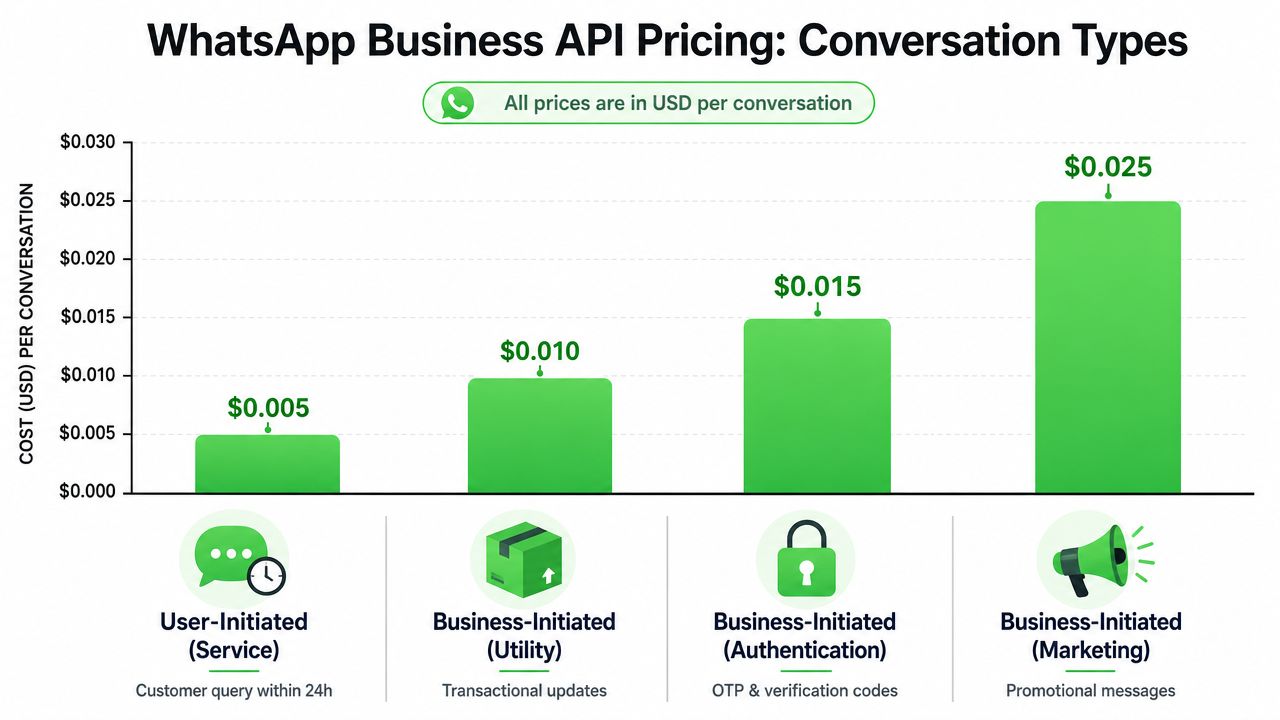
Under the WhatsApp Business API model, businesses are charged per 24-hour conversation window. Pricing varies by message category and user country. The cited range is $0.005 to $0.085 per conversation, with an example where a marketing conversation in the US costs about $0.085 while a service conversation in India costs about $0.005 (Fluxnote's guide to how WhatsApp makes money).
The categories commonly discussed are:
- Marketing: Promotional outreach and campaign messages.
- Utility: Transactional updates such as order or shipping notifications.
- Authentication: Verification and one-time passcode flows.
- Service: Customer-initiated support within the service window.
Those categories aren't just labels. They affect your cost base. A client running support-heavy conversations in one market can look economical. Another client sending promotional traffic in a higher-cost market can eat margin quickly.
Why usage billing feels simple until you resell it
At the platform layer, usage billing is rational. Businesses pay in proportion to activity. At the agency layer, it creates friction because most clients don't want a telecom-style invoice for what they assume is "just messaging."
If you're designing your own offer, it helps to understand the logic behind Suby's guide to usage billing. Usage-based pricing can work when customers directly understand the consumption unit and accept variability. Many local service businesses, coaches, and small teams don't. They want a stable monthly number.
A practical way to view this:
| Pricing reality | What the agency experiences |
|---|---|
| Category-based pricing | Different campaign types create different cost profiles |
| Country-based pricing | The same client offer can carry different margins by region |
| 24-hour windows | "More messages" doesn't always map neatly to "more cost" in client conversations |
That gap between platform logic and client buying behavior is where most packaging problems start.
The Reseller's Dilemma Margin Chaos and Unpredictability
The official model works well for Meta because Meta owns the rails. Agencies don't. They buy on variable terms and try to sell on fixed ones. That's where the reseller problem begins.
Startup Booted notes the hidden cost directly: per-conversation pricing creates unpredictable, volatile margins for agencies reselling WhatsApp, and because costs vary by message type and country, forecasting becomes difficult enough to break the flat-fee reseller model (Startup Booted on how WhatsApp makes money).
Where the model breaks for agencies
The failure point usually isn't at launch. It shows up after a few clients are active and behavior diverges.
One client uses WhatsApp lightly and asks mostly support questions. Another sends more promotional campaigns. A third has users spread across markets with different conversation costs. If all three are on the same monthly plan, your revenue is fixed while your underlying expense profile keeps moving.
That leads to margin chaos in several forms:
- Unstable gross margin: The same package can be healthy one month and thin the next.
- Harder forecasting: You can't model growth cleanly when usage mix matters as much as client count.
- Sales friction: Custom usage explanations slow deals that should be simple.
- Client distrust: Bills that swing without clear expectations create support issues.
Agencies don't struggle because clients dislike WhatsApp. They struggle because clients expect software-style pricing while the underlying economics behave more like metered infrastructure.
What does not work in practice
Some responses sound logical but fail operationally.
The first is passing through every conversation cost with a markup. That preserves margin in theory, but it weakens the sales offer. Clients compare it to a software subscription and feel like they're being billed for every interaction.
The second is averaging costs across accounts. That works briefly, then a few heavy accounts distort the economics.
The third is under-scoping service and hoping automation reduces usage enough to protect margin. Hope isn't a pricing strategy.
A reseller-friendly WhatsApp business needs three things at once: simple packaging, stable unit economics, and enough control over branding to make the service yours. The official conversation model gives you the channel. It doesn't give you that business model.
The Solution White Label Platforms and Predictable Profits
The cleanest fix is to stop building your offer directly on top of volatile conversation economics and move to a white-label platform with flat monthly pricing. That changes the agency's role from pass-through reseller to packaged service provider.
What a flat fee changes
A flat-fee model does more than simplify billing. It changes how you sell, onboard, and retain accounts.
With a stable platform cost, agencies can:
- Sell subscriptions confidently: One monthly price is easier to position than a variable usage schedule.
- Protect margin: You know your software cost before the client starts sending.
- Bundle services cleanly: Automation setup, inbox management, lead routing, and campaign execution fit into one commercial package.
- Create a branded asset: The client sees your platform, your service, and your process.
White-labeling becomes practical rather than cosmetic. If you're already familiar with the playbook for agencies offering whitelabel ads, the same strategic idea applies here. Control the delivery environment, simplify the offer, and keep the client relationship tied to your brand instead of the underlying vendor.
One example is Double My Leads, which offers agencies a white-labeled WhatsApp setup with flat monthly pricing, branded workspaces, QR-code number connection, inbox workflows, broadcasts, and optional Cloud API support. The key point isn't that every agency needs the same vendor. It's that the flat-fee white-label model solves the core reseller economics problem the official pricing model creates.
What to look for in a white label stack
Not every WhatsApp tool fixes the business model issue. Some repackage the same volatility with a nicer dashboard.
Use a decision lens like this:
| Decision area | What to look for |
|---|---|
| Billing model | Flat monthly pricing or clear wholesale terms you can package |
| Brand control | Custom domain, branding, and client-facing ownership |
| Operational tools | Shared inbox, assignments, notes, tags, templates, routing |
| Growth features | Broadcasts, smart links, QR codes, CRM sync, automation hooks |
A quick product walkthrough helps make the difference tangible:
A good reseller platform doesn't just lower technical friction. It removes billing ambiguity from the client relationship.
That's why the flat-fee approach is more than a nicer pricing page. It gives agencies a model they can scale.
Actionable Monetization Strategies for Your Agency
Once the cost base is predictable, pricing gets easier. The next question is how to package the service so clients buy outcomes, not just WhatsApp access.
Four packaging models that are easier to sell
You don't need one universal pricing template. You need a structure that matches how your clients buy.
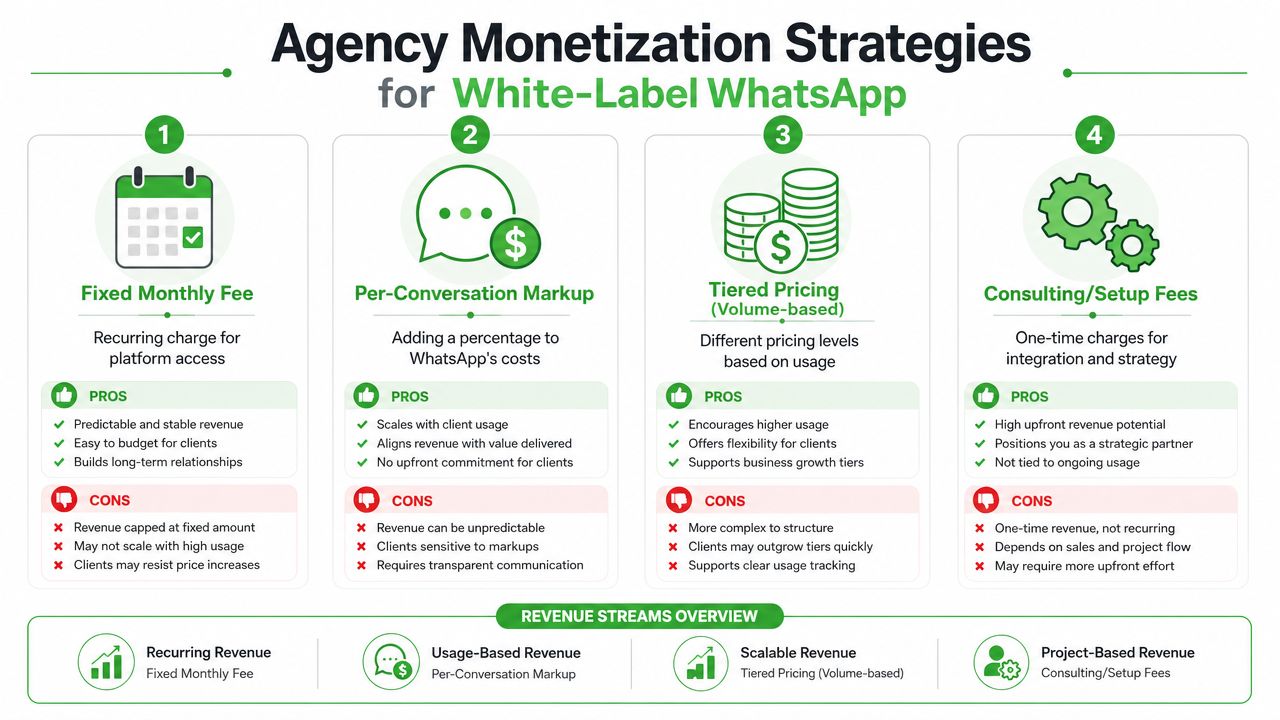
- Fixed monthly platform fee: This is the simplest model. Charge a recurring fee for inbox access, basic automation, and team workflows. It fits local businesses, coaches, and service companies that want predictability.
- Tiered plans: Create plan differences based on seats, brands, workspaces, support level, or automation depth. This works well when clients vary in organizational complexity rather than message volume.
- Setup and implementation fees: Charge separately for onboarding, template creation, workflow logic, CRM mapping, and staff training. This protects your time and keeps the recurring plan cleaner.
- Managed service retainers: Package the platform with campaign execution, lead follow-up rules, chatbot management, and reporting. Clients usually understand this better than raw access resale.
How to avoid underpricing
The biggest pricing mistake agencies make is charging for the inbox and giving away the operating layer.
Your value usually sits in the work around the channel:
- Workflow design: Routing, assignment logic, auto-replies, and qualification paths.
- Campaign operations: Broadcast planning, list hygiene, timing, and follow-up.
- Conversion handling: Lead response standards, appointment booking flows, handoff rules.
- Integration work: CRM sync, source attribution, and internal team processes.
A simple internal rule helps. Price the software for access. Price your service for advantage.
If a client would lose momentum without your setup, automations, and response design, you aren't selling "a WhatsApp tool." You're selling a revenue workflow.
Agencies that think this way usually land on one of two strong offers: a software-style recurring plan with paid onboarding, or a managed retainer where WhatsApp is one part of a larger conversion system. Both are easier to defend than metered pass-through billing.
The Future of WhatsApp Commerce and Your Next Move
The next shift in the WhatsApp revenue model isn't just more business messaging. It's a broader commercial stack inside and around the app.
A notable change emerged in mid-2025. WhatsApp began testing vertical video ads in Status and Channels, which points to a future where in-app advertising and transaction fees from WhatsApp Pay could become larger revenue drivers alongside the business messaging layer (analysis of WhatsApp's emerging ad shift).
The revenue mix is getting broader
That matters for agencies because it changes what clients will expect from WhatsApp. The platform is moving beyond "support and notifications" into a mix of acquisition, engagement, and transaction activity.
When monetization broadens, service opportunities broaden too:
- More ad-to-chat workflows
- More commerce use cases inside conversation
- More need for branded operational layers that businesses can control
The agencies that benefit most won't be the ones explaining Meta's pricing tables. They'll be the ones offering a usable system clients can adopt quickly.
Why agencies should move now
The practical opportunity is clear. Businesses want direct messaging channels that feel immediate and familiar. Agencies need offers that don't punish them for adoption.
That is why white-label WhatsApp delivery matters now. It gives you a way to participate in a growing channel without inheriting all the volatility of the official pricing model. You're not fighting Meta's monetization strategy. You're building a reseller model that works alongside it.
If you want to turn WhatsApp into a branded recurring revenue offer instead of a usage-billing headache, Double My Leads is worth evaluating. It's built for agencies and SaaS teams that want a white-labeled WhatsApp service with flat monthly pricing, client-facing branding, and fast onboarding.


