
Agencies don't have a software problem anymore. They have a coordination problem. By 2026, running a marketing agency typically means juggling at least ten distinct SaaS tools every day across CRM, project management, reporting, social media, email, paid ads, creative production, time tracking, accounting, and AI tooling, according to Inflowave's agency software overview. That stack can work, but only if each tool has a clear role.
That's why choosing marketing software for agencies by use case matters more than chasing a single “best” platform. Some agencies need a white-labeled CRM. Others need reporting depth, social production, or a way to resell WhatsApp outreach without usage fees eating margin. The global market for marketing and advertising agency software is projected to reach $105.33 billion by 2025, growing at a 17.81% CAGR, according to Data Insights Market. That growth signals something practical: agency software has become operating infrastructure, not a nice-to-have.
If you're rebuilding your stack this year, start with the client experience you want to deliver, then work backward into tools. For agencies that also want a broader front-end experience layer, a white-label DXP for agencies can sit alongside the platforms below.
Table of Contents
- 1. Double My Leads
- 2. HighLevel (GoHighLevel)
- 3. Vendasta
- 4. SharpSpring by Constant Contact
- 5. AgencyAnalytics
- 6. Semrush (for agencies)
- 7. Cloud Campaign
- 8. Sprout Social (Agency Partner Program)
- 9. ActiveCampaign (for Agencies / Reseller Program)
- 10. Birdeye (Reseller/Agency Programs)
- Top 10 Agency Marketing Software Comparison
- Next Steps: Select, Migrate, and Launch
1. Double My Leads
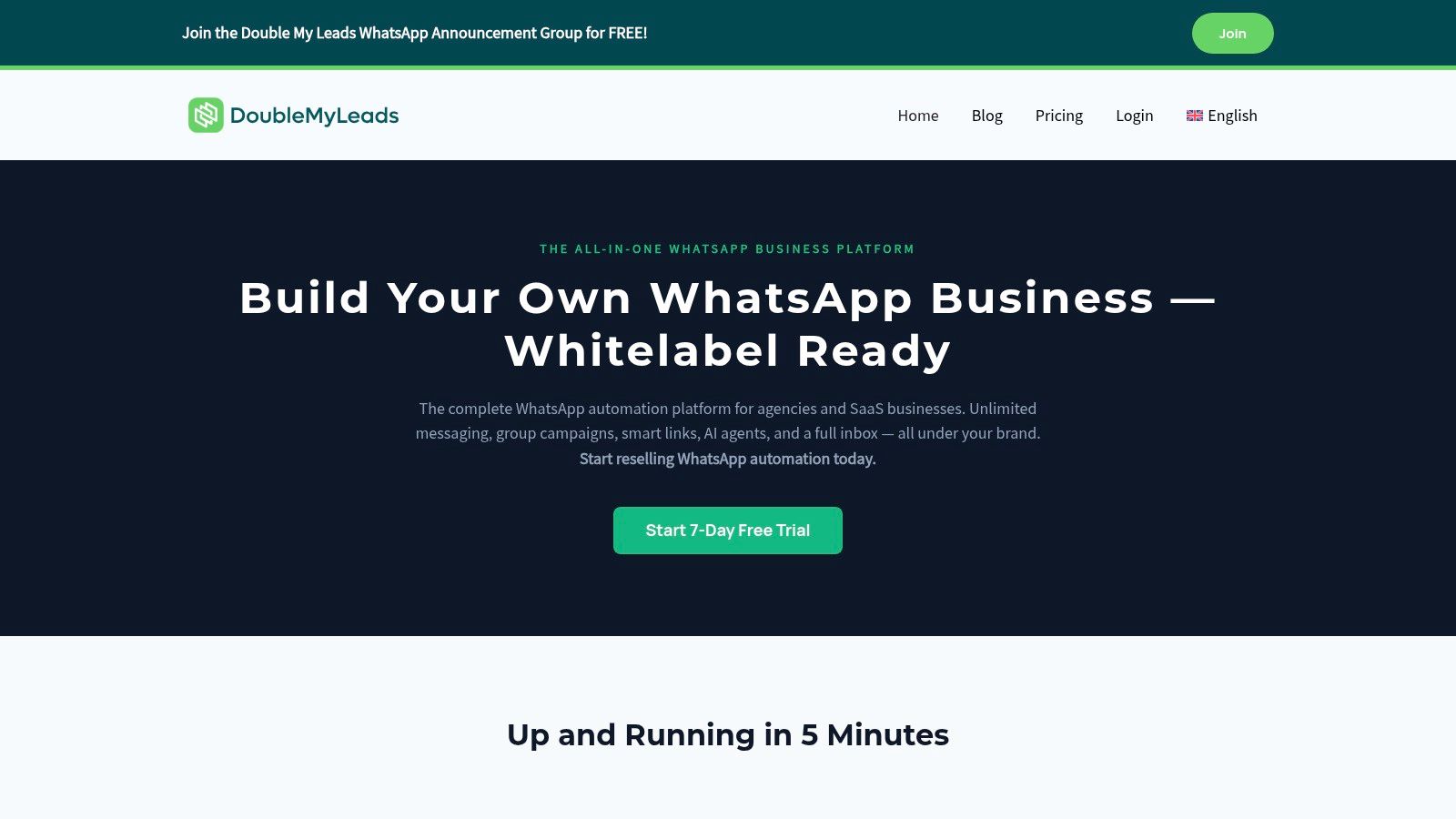
Double My Leads earns a place near the top of this list because it addresses a specific agency use case that broader platforms often treat as an add-on: WhatsApp outreach that can be packaged, priced, and delivered without hard-to-model usage costs. For agencies selling lead follow-up, newsletter distribution, reactivation campaigns, or community-based offers, that distinction affects margin more than feature count does.
Many agency software comparisons focus on channel coverage. A more useful lens is resale economics. If WhatsApp delivery depends on variable message fees, forecasting client profitability gets harder as volume rises. Double My Leads takes a different approach with flat subscription pricing, white-label workspaces, and client billing support, which makes it easier to structure a repeatable offer.
Why it stands out
The platform is built for agencies that want WhatsApp to operate as a service line, not just a communication feature inside a larger stack. Core functions include a shared team inbox for text, images, video, documents, and voice notes, along with assignments, notes, tags, and quick replies. On the outbound side, it supports WhatsApp Announcement Groups, smart links, QR codes, scheduling, auto-welcome flows, and CRM participant sync with source attribution.
The operational model is the more interesting part.
Double My Leads uses QR-based onboarding for the standard setup, which reduces launch friction for agencies that want to get client campaigns live without adding Meta Business verification to the initial rollout. That shortens time to first campaign, and time to first campaign usually determines whether a new channel becomes a real offer or stays stuck in internal testing.
Practical rule: Agencies adopt new delivery channels faster when setup, billing, and client handoff are clear in week one.
There is also an API and MCP Server for teams that want to connect WhatsApp activity to broader automation systems. That matters less on day one than on month three, once the agency has a working offer and needs routing, enrichment, or CRM sync beyond the default workflow.
Pricing and margin logic
The pricing structure is unusually clear for an agency-oriented messaging tool. The site shows a 7-day free trial, a Pro plan at $297 per month, support for 3 devices on Pro, and additional devices at $19 per month. The Starter tier includes 1 device, and the product notes a per-device Announcement Group limit.
That structure gives agencies a straightforward way to model margin before rollout:
- Base cost is predictable: Flat monthly pricing is easier to forecast than per-message billing.
- Resale is built into delivery: White-label workspaces and Stripe billing support make it possible to package the software as part of a branded client offer.
- Capacity planning is visible: Device limits and Announcement Group limits force teams to estimate volume early, which reduces pricing mistakes later.
The non-obvious advantage is financial discipline. Usage-based tools can look cheaper at the start, then become harder to price once a few clients scale. A flat-cost model can be less feature-rich than a full communications suite and still produce better agency economics if it keeps gross margin stable.
Implementation notes
Double My Leads fits agencies that already know WhatsApp is central to the offer. That usually includes lead generation firms, newsletter operators, creator-focused agencies, community-led brands, and automation shops that sell conversational follow-up.
A practical rollout usually follows four steps:
- Start with one repeatable package: Launch one offer such as lead follow-up, reactivation, or a WhatsApp newsletter before adding more services.
- Set branding at the beginning: Apply domain, logo, colors, and billing flow early so the workspace feels like your product from the first client demo.
- Use trackable entry points first: Deploy smart links, QR codes, and chat widgets before adding more advanced broadcast or routing logic.
- Integrate after the workflow works manually: Use the API once message flow, ownership, and client reporting are already defined.
Agencies migrating from a general-purpose CRM should also check three things before switching active campaigns: contact consent status, message ownership by team member, and how source attribution will map into the new workspace. Those details decide whether reporting stays credible after migration.
Used this way, Double My Leads works well as a focused WhatsApp layer inside an agency stack. It is not trying to replace every other system. It gives agencies a cleaner way to package WhatsApp outreach, protect margin, and launch faster.
2. HighLevel (GoHighLevel)
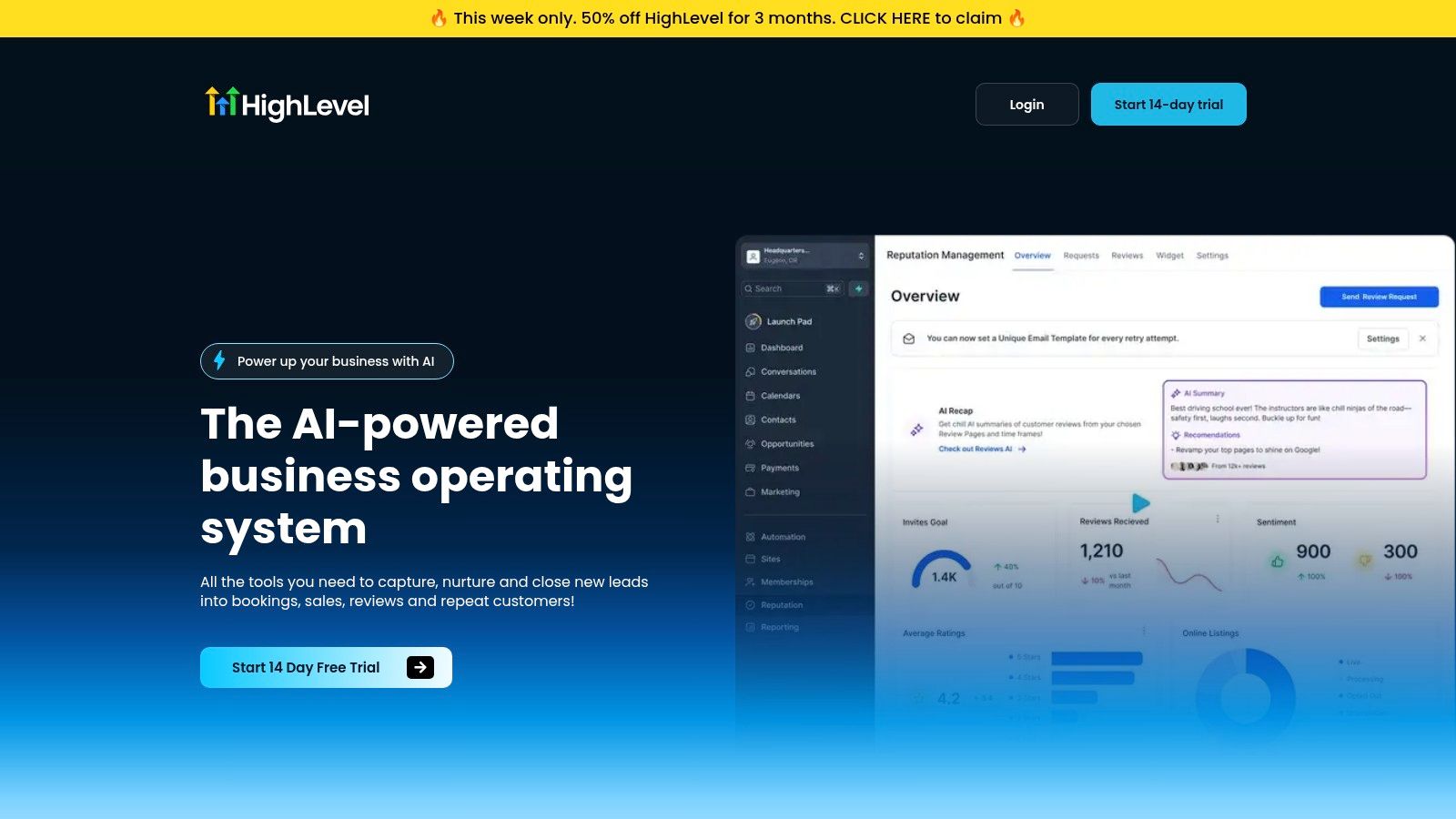
HighLevel remains one of the clearest choices for agencies that want consolidation first. Funnels, pipelines, automations, calendars, forms, memberships, chat, and resale workflows all sit under one agency-oriented platform. If your biggest pain is tool sprawl, HighLevel addresses that pain directly.
Its main appeal isn't that every module is the deepest in its category. It's that agencies can package a broad operating system under their own brand. White-label SaaS mode, sub-accounts, rebilling, and centralized client management make it attractive for firms that want recurring platform revenue alongside services.
Best fit
HighLevel is strongest when your agency sells process consistency. Franchises, local service agencies, appointment-based businesses, and lead generation shops usually benefit most because the same funnel and follow-up mechanics can be duplicated across many client accounts.
That same breadth creates a tradeoff. The platform has a real learning curve, and usage-based add-ons can make cost forecasting less tidy than the base subscription suggests. Teams that adopt it successfully usually define a minimum viable implementation first, then expand modules later.
HighLevel works best when you treat it like a packaged operating model, not a feature buffet.
If you're using it for form-heavy acquisition, this guide on advanced GoHighLevel forms is a useful complement to the native stack.
3. Vendasta
Vendasta takes a different path. Instead of asking agencies to master one execution suite, it gives them a white-label environment to sell, fulfill, and manage a catalog of digital services for SMB clients. That makes it feel less like a single tool and more like a commercial shell for an agency business.
The practical advantage is speed to market. If your agency wants to offer listings, reputation, websites, ads, SEO, proposals, automations, and optional fulfillment without building each service line from scratch, Vendasta shortens that path.
Where Vendasta wins
Vendasta is strongest for agencies serving local and small business accounts that buy bundled digital services. The rebrandable client portal and storefront help position the agency as the vendor of record, while the marketplace reduces the burden of sourcing each underlying product independently.
There's a tradeoff, though. Broad catalogs create setup work. Agencies have to decide what they want to sell, how they'll package it, and which offers they'll fulfill themselves versus outsource.
- Best for packaged services: Agencies with repeatable local marketing offers.
- Less ideal for custom operators: Teams that prefer hand-built delivery and narrow specialization.
- Commercial upside: One vendor relationship can support a multi-service client portal.
Vendasta is less about deep execution in one channel and more about fast commercial expansion under your brand.
4. SharpSpring by Constant Contact
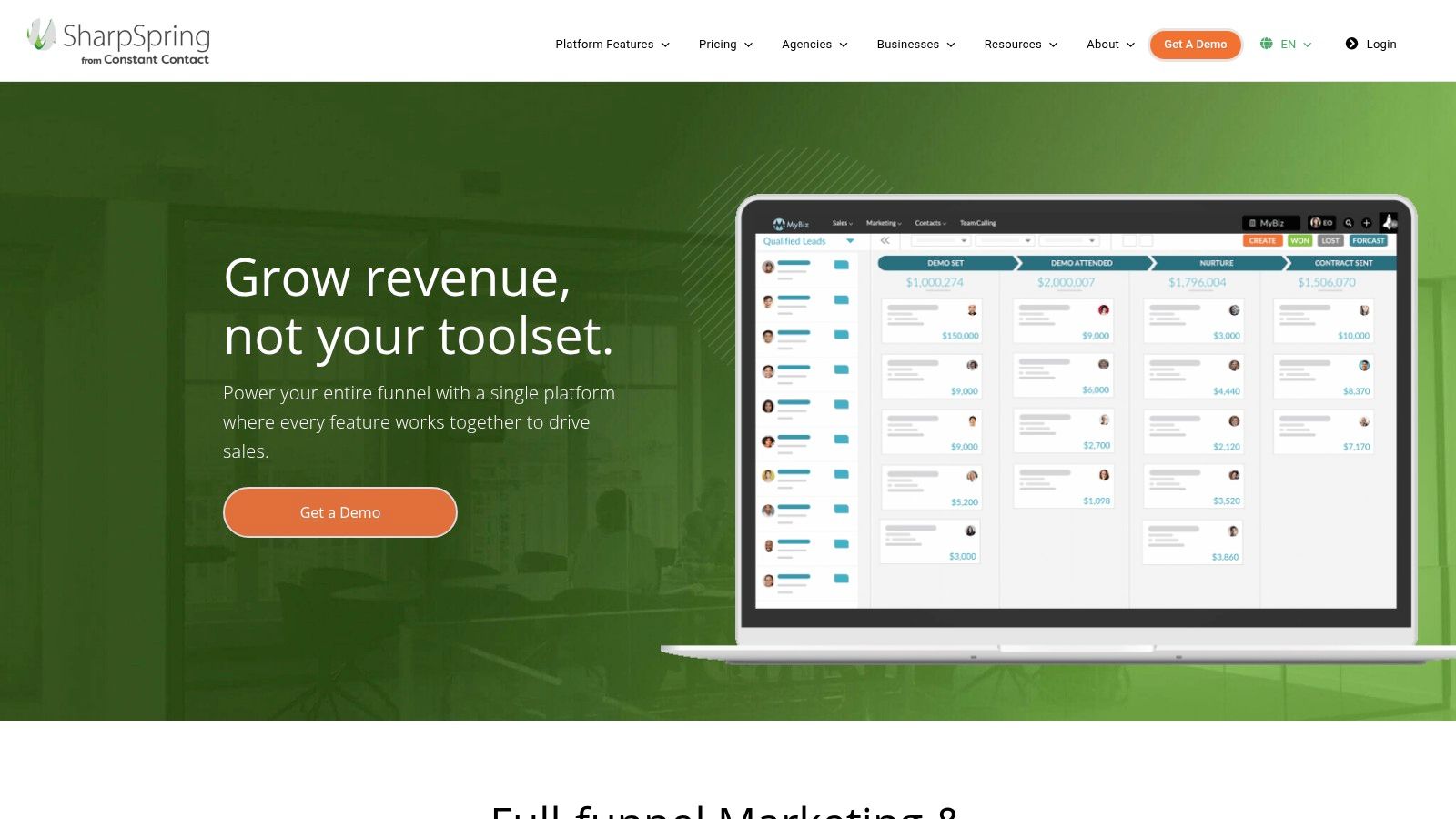
SharpSpring by Constant Contact sits in an interesting middle ground. It isn't trying to be a giant app marketplace, and it isn't positioned like an ultra-light point solution. Its identity is agency-centered marketing automation with CRM and white-label control.
For agencies that want to resell automation rather than just manage campaigns manually, that matters. A rebrandable interface, white-label URLs and materials, and a multi-client console make the platform feel native to an agency business model.
Agency-centered automation
SharpSpring works well for firms that need a consistent automation engine across many clients. Email, behavior tracking, forms, landing pages, CRM, and template sharing across accounts support a repeatable service model.
The caveat is commercial transparency. Pricing usually requires a sales conversation, which makes it harder to compare quickly against more public pricing models. That doesn't make it a poor fit. It just means buyers need a tighter implementation plan before entering procurement.
A sensible use case is an agency that wants to own nurture, follow-up, and client-facing automation under its own brand, without committing to a more sprawling all-in-one suite.
5. AgencyAnalytics
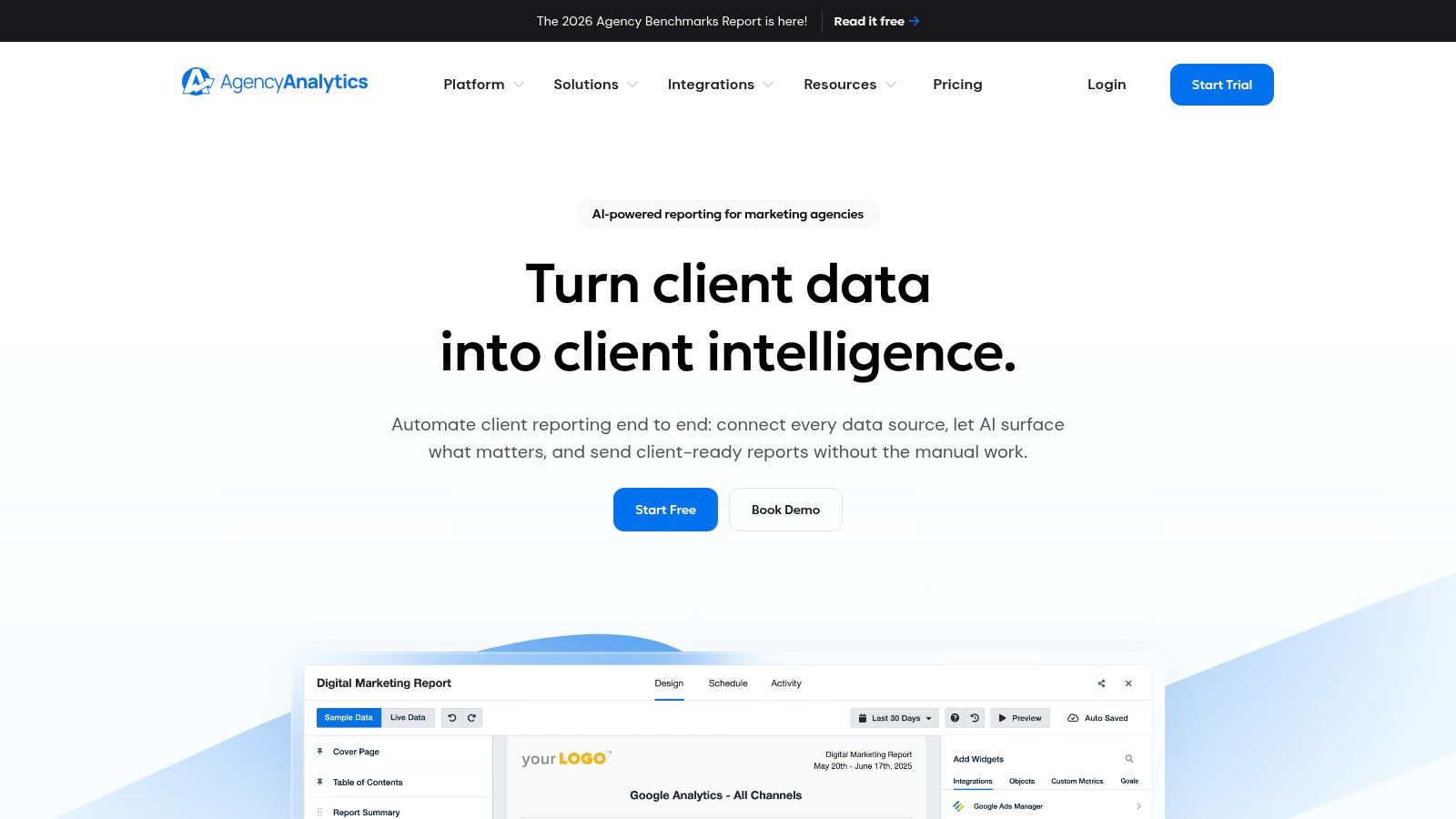
AgencyAnalytics is for agencies that already execute well and need cleaner reporting. That distinction matters. Reporting software shouldn't be judged by whether it can also run your CRM, publish social posts, and send email. It should be judged by whether clients can understand performance faster and whether your team can produce that view with less labor.
AgencyAnalytics leans into that role. Automated reports, roll-up dashboards, white-label portals, branded emails, custom domains, and API access all support a reporting-first workflow across many client accounts.
Reporting at agency scale
This category has one useful benchmark from the broader tool market. High-performing marketing agency tools tend to see user adoption rates in the 85 to 95% range when they have clean layouts and short learning curves, with reported efficiency improvements and cost reductions tied to automation and project management workflows, according to RecurPost's review of agency tools. AgencyAnalytics benefits from exactly those product dynamics: simple presentation, broad connector value, and lower reporting friction.
That doesn't make it a full stack. It makes it a sharp layer inside a stack.
- Use it when reporting is the bottleneck: Especially if client updates consume too much analyst time.
- Pair it with execution tools: It complements CRM, paid media, and social tools rather than replacing them.
- Prioritize brand control: White-label portals are most valuable when client communication is already structured.
If your agency keeps hearing “the work is good, but reporting feels slow,” this is one of the cleaner fixes.
6. Semrush (for agencies)
Semrush earns its place because agencies still win retainers on diagnostic strength. Before execution comes market reading: keywords, competitors, backlinks, site health, content gaps, and ad visibility. Semrush remains one of the strongest research environments for that job.
It's not an agency operating system. It's a strategic intelligence layer. Agencies that understand that distinction usually get more value from it than teams expecting a complete client delivery platform.
Research depth over consolidation
Semrush is at its best during pitches, audits, quarterly reviews, and campaign planning. You use it to sharpen an argument, support an SEO roadmap, benchmark a competitor, or validate a content opportunity. Those workflows provide a sales advantage even when execution happens elsewhere.
The downside is predictable. Breadth means training time, and the platform can become expensive as you add seats or modules.
Agencies often overpay for execution software and underinvest in pre-sale intelligence. That's backwards. Better diagnosis usually improves every downstream decision.
If your agency sells SEO, content strategy, or search-led retainers, Semrush often pays for itself through clearer positioning rather than through workflow consolidation.
7. Cloud Campaign
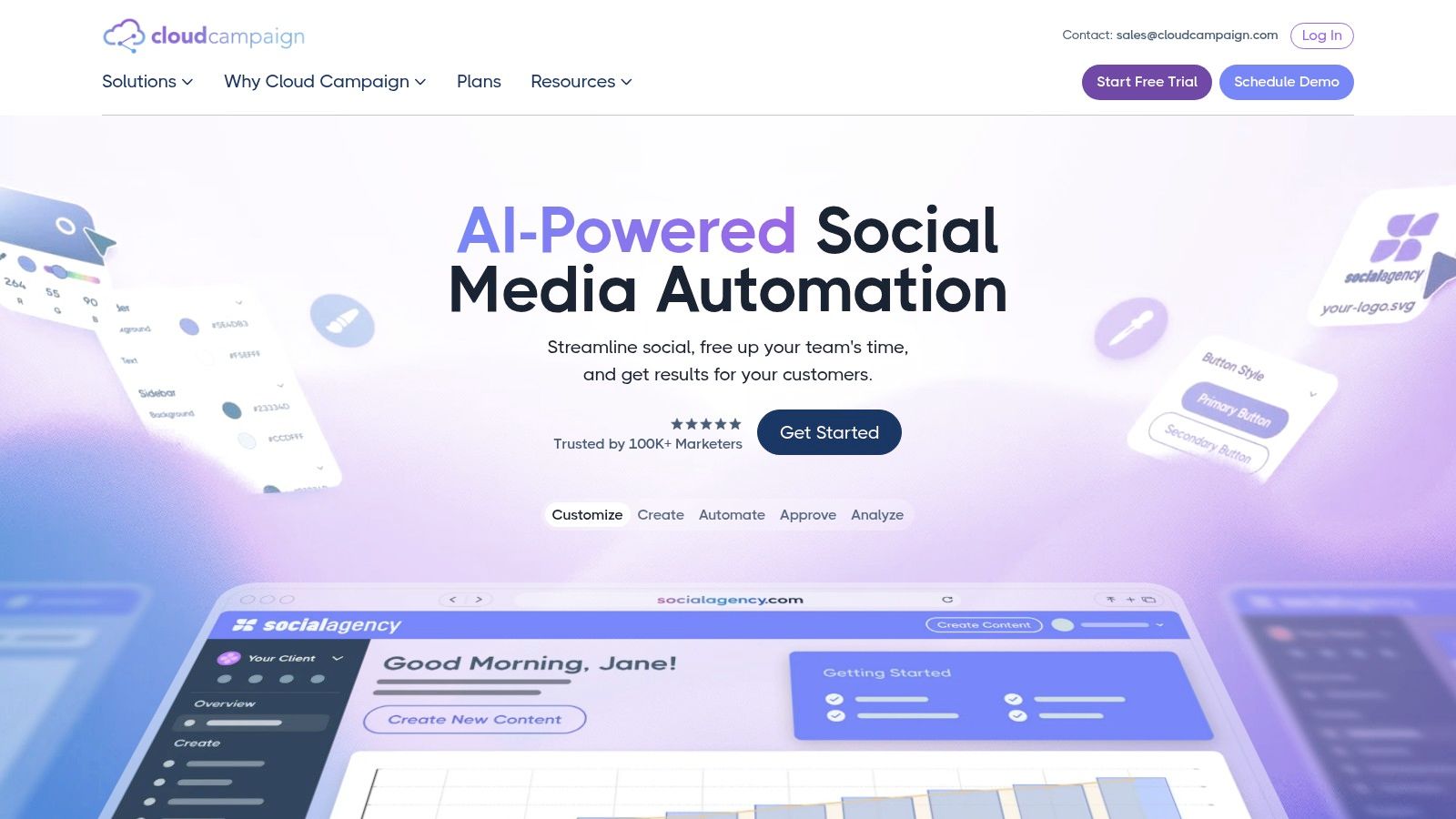
Cloud Campaign is a focused answer to a narrow agency problem: social delivery gets messy fast. Content calendars sprawl. Reviews stall. Assets scatter across folders. Clients want visibility, but they don't want to enter your internal systems. Cloud Campaign fixes that by staying close to the actual social production workflow.
The white-label portal is the headline feature, but its underlying value is operational order. Content planning, approvals, scheduling, asset libraries, and reporting all live in the same social-centric workspace.
Social operations focus
Cloud Campaign makes the most sense for agencies where social is a core service line, not a side task added to SEO or paid media retainers. In those businesses, every round of client review and every delayed approval affects margin.
The optional content production layer is also worth noting. Agencies that struggle to keep creative throughput stable can use that add-on to reduce production pressure without changing platforms.
- Best for recurring social management: Especially multi-client calendar work.
- Not a full-funnel platform: You'll still need CRM, ads, and broader attribution tools elsewhere.
- Strongest when process matters: Approval workflows and branded collaboration are the selling points.
This is software for social operations managers, not for agencies hunting a universal control panel.
8. Sprout Social (Agency Partner Program)
Sprout Social comes from the enterprise side of the market. That shows up in the product's publishing, engagement, listening, analytics, and support model. Agencies managing complex brand portfolios often prefer that maturity, even when it means accepting seat-based pricing.
The Agency Partner Program adds another layer. Training, co-marketing, and directory exposure can support agency visibility, not just delivery.
Enterprise social teams
Sprout Social is usually the better fit when your agency serves larger brands, regulated industries, or clients with multiple stakeholders across social governance. Those teams tend to care as much about process reliability and permissions as they do about scheduling posts.
This is not the cheapest route for social management. It doesn't try to be. It's a premium option for agencies that need social infrastructure clients will trust during procurement and scale reviews.
The common mistake is comparing Sprout solely on feature count. The more relevant comparison is whether your clients need enterprise-grade process discipline or just efficient publishing.
9. ActiveCampaign (for Agencies / Reseller Program)
ActiveCampaign for agencies is a practical choice when your agency's strongest service is lifecycle automation. Email campaigns, forms, automations, site tracking, lightweight CRM functions, and partner management tools make it a strong specialist platform inside a broader stack.
That specialization matters because adoption of marketing automation is already near-universal in enterprise B2B, with 95% of enterprise marketing teams and 78% of mid-market B2B organizations using at least one platform, and average ROI reported at $5.44 per dollar spent, according to Digital Applied's 2026 marketing automation statistics. For agencies, that means automation isn't a differentiator by itself anymore. The differentiator is how fast and cleanly you can deploy it across multiple clients.
Automation without a full platform switch
ActiveCampaign is often strongest when clients already have a website stack and CRM preference, but still need a capable automation layer. Agencies can manage multiple accounts with partner oversight and consolidated billing without forcing every client into the same all-in-one platform.
That flexibility is useful. It also means the platform won't replace everything.
- Best for email-led retention and nurture: Especially for agencies focused on lifecycle marketing.
- Useful in mixed stacks: It drops into e-commerce and CRM ecosystems well.
- Less suited for full consolidation: You may still need separate landing pages, sales pipelines, or reporting layers.
For many agencies, that's a feature, not a flaw.
10. Birdeye (Reseller/Agency Programs)
Birdeye is one of the clearest choices for agencies serving local businesses, franchise systems, clinics, service chains, and other multi-location brands. In those markets, reputation management and listings aren't side tasks. They are core revenue drivers.
The platform combines reviews, listings, social, messaging, surveys, and customer experience tooling in a model agencies can resell. That makes it especially relevant for agencies that need to standardize local presence management across many locations.
Local marketing and reputation
Birdeye is strongest when a client's physical footprint shapes marketing performance. Agencies that work with restaurants, healthcare, home services, automotive, or retail often need one place to monitor reviews, manage local listings, and centralize customer communication.
The tradeoff is cost structure. Per-location pricing can compound quickly as accounts scale, and some features may sit behind higher tiers.
If your clients win or lose based on map visibility, review quality, and location consistency, local reputation software isn't optional. It is part of the service outcome.
For agencies outside local marketing, Birdeye may feel too specialized. For local operators, that specialization is the point.
Top 10 Agency Marketing Software Comparison
| Product | Core features | UX / Quality (★) | Value & Pricing (💰) | Target audience (👥) | Unique selling points (✨) |
|---|---|---|---|---|---|
| 🏆 Double My Leads | WhatsApp team inbox, broadcasts, QR pairing, REST API, white-label workspaces | ★★★★★ real-time, high open rates | 💰 Flat monthly (Pro $297/mo; +$19/device), unlimited messaging | 👥 Agencies, SaaS resellers, creators, community managers | ✨ QR pairing (no Meta verification), Announcement Groups, resell + Stripe billing |
| HighLevel (GoHighLevel) | CRM, funnels, multi-channel automations, white-label sub-accounts | ★★★★☆ robust but steeper learning | 💰 Subscription + usage add-ons (telecom/AI) | 👥 Agencies wanting all-in-one stack | ✨ Consolidates funnels, SMS/voice, reseller workflows |
| Vendasta | Rebrandable portal, marketplace of rebrandable services, fulfillment | ★★★★ scalable for portfolio sellers | 💰 Wholesale catalog + plan minimums | 👥 Agencies reselling digital services to SMBs | ✨ Large marketplace + optional white-label fulfillment |
| SharpSpring by Constant Contact | Marketing automation, CRM, landing pages, rebrandable UI | ★★★★ agency-focused UX | 💰 Custom pricing (sales consult required) | 👥 Agencies needing automation + rebrandability | ✨ Rebrandable interface + multi-client console |
| AgencyAnalytics | Automated reports, portfolio dashboards, white-label portals | ★★★★☆ reporting-first, easy scale | 💰 Clear tiered pricing; trial + guarantee | 👥 Agencies needing centralized reporting | ✨ 85+ integrations, AI insights & roll-up dashboards |
| Semrush (for agencies) | SEO/SEM research, audits, backlink & content tools | ★★★★☆ industry-leading data depth | 💰 Modular toolkits; can get expensive | 👥 Agencies focused on SEO/paid search | ✨ Market & competitor intelligence for pitches/strategy |
| Cloud Campaign | Social scheduling, approval workflows, white-label portal | ★★★★ agency-friendly social UX | 💰 Subscription-based; add-ons for CloudStudio | 👥 Social teams & agencies outsourcing content | ✨ CloudStudio done-for-you content inside platform |
| Sprout Social (Agency Partner) | Social publishing, listening, analytics, unified inbox | ★★★★★ mature enterprise UX | 💰 Seat-based pricing; scales with users | 👥 Enterprise & multi-brand social teams | ✨ Agency Partner program: enablement, co-marketing, directory |
| ActiveCampaign (Agency/Reseller) | Email automation, lightweight CRM, partner portal | ★★★★ easy to deploy | 💰 Reseller discounts; partner-tier pricing | 👥 Agencies reselling email/automation | ✨ Central partner portal + consolidated billing |
| Birdeye (Reseller/Agency) | Reviews, listings, messaging, surveys, CX tools | ★★★★ strong local reputation UX | 💰 Per-location pricing; higher tiers for full features | 👥 Agencies serving multi-location & brick‑and‑mortar clients | ✨ Deep listings/reputation management and scaling tools |
Next Steps: Select, Migrate, and Launch
The best marketing software for agencies isn't the platform with the longest feature list. It's the stack that matches your delivery model, your margin structure, and your client expectations. Agencies often buy software as if they're buying optional productivity tools. In practice, they're buying workflow constraints. Every platform you adopt changes who on your team does what, how clients experience your service, and whether expansion adds profit or admin.
Start selection by narrowing the job each tool must perform. If you need one branded operating environment with CRM, automations, and resale mechanics, HighLevel or SharpSpring may fit. If your issue is reporting burden, AgencyAnalytics is the more disciplined choice. If social delivery is the margin leak, Cloud Campaign or Sprout Social is easier to justify than a broader suite. If you serve local businesses, Birdeye and Vendasta map more directly to what clients buy.
Migration is where good tool decisions usually fail. Agencies try to move everything at once, then confuse technical completion with operational adoption. A better path is staged migration.
- Audit current workflows: List your live tools, active client touchpoints, logins, templates, reports, and automations.
- Classify what must move first: Start with revenue-critical workflows, not edge cases.
- Pick one pilot client segment: Use a repeatable client type to test the new process before broad rollout.
- Document ownership: Decide who manages setup, who trains the team, and who handles client communication.
- Retire old tools intentionally: Don't keep dead systems alive “just in case” unless a real dependency remains.
When implementation succeeds, the visible difference is usually simple. Teams stop asking where things live. Clients get more consistent communication. Internal handoffs produce fewer surprises.
Double My Leads deserves a specific place in that rollout plan because WhatsApp is often treated as an afterthought, even though it can become a sellable service line. The practical way to integrate it is not to rebuild your whole stack around messaging. It's to add it where it creates new margin and better response speed.
A tactical rollout for Double My Leads usually looks like this:
- Choose one WhatsApp offer: Newsletter, lead follow-up, reactivation, appointment reminders, or community announcements.
- Create a branded workspace: Set your custom domain, colors, logo, and client billing flow before inviting clients in.
- Connect a number through QR pairing: Use the low-friction setup path first so the team can launch without API bottlenecks.
- Deploy acquisition points: Add chat widgets, QR codes, and tracked smart links to landing pages, emails, and ads.
- Set inbox rules: Use assignments, notes, tags, and quick replies to prevent owner-led inbox chaos.
- Launch broadcast carefully: Start with one announcement or newsletter flow, then layer in scheduling and auto-welcome sequences.
- Sync participants into your CRM process: Keep source attribution intact so WhatsApp doesn't become another silo.
- Only automate extensively after manual proof: Stable human workflows make cleaner automation than rushed integrations.
Agencies don't just need more channels. They need channels they can resell cleanly. The strongest insight across this category is that software choice is no longer only about features. It's about economic design. Flat-rate versus usage-based pricing, white-label control versus vendor-branded handoff, and fast onboarding versus compliance-heavy setup all shape whether a tool improves agency margins or compresses them.
Choose fewer tools with clearer jobs. Migrate in stages. Add WhatsApp where it can create a differentiated client offer, especially if predictable pricing is central to your business model. That's how agency software becomes a strategic advantage instead of overhead.
If your agency wants to launch a branded WhatsApp service without getting trapped in per-message pricing, Double My Leads is the most direct option in this list. It gives you white-label workspaces, QR-code onboarding, team inboxes, announcement-group broadcasts, and a pricing model that's easier to resell with confidence.


