
You're probably already doing parts of this by hand.
A lead fills out a form. Someone on your team exports the contact, tags it in a CRM, sends a follow-up email, pings sales in Slack, and then remembers two days later that nobody replied. Meanwhile, the client asks why lead quality feels inconsistent, why reporting takes so long, and why renewals get tense every quarter.
That's the trap a lot of agencies are in. They sell strategy, media, creative, or outbound. But the delivery layer still depends on people remembering what to do next. That hurts margins first, then performance, then retention.
Agency marketing automation fixes that, but not in the shallow “save time” sense. The primary shift is operational. You stop selling isolated campaigns and start selling systems that capture, qualify, route, follow up, and report with less manual effort and more consistency. The agencies that build this well don't just reduce admin work. They create stickier retainers, clearer ROI conversations, and a service line that's harder to replace.
Table of Contents
- Why Every Agency Needs a Marketing Automation Service in 2026
- Define and Position Your Automation Offering
- Building Your White-Label Automation Tech Stack
- Onboarding Clients and Launching Campaign Templates
- Structuring Profitable Pricing and Margin Models
- Measuring ROI and Scaling Your Automation Services
Why Every Agency Needs a Marketing Automation Service in 2026
Clients don't buy “automation” because it sounds modern. They buy it because they're tired of dropped leads, slow follow-up, fragmented reporting, and teams that can't execute consistently across channels.
That demand is already mainstream. One 2026 industry overview reports that 79% of marketers automate their customer journey, with 10% fully automated and 25% mostly automated, while 91% of organizations say demand for more automation is increasing, according to Email Vendor Selection's marketing automation statistics. For agencies, that means automation is no longer an add-on service for advanced clients. It's a baseline expectation.
If your agency doesn't offer it, clients will still pursue it. They'll buy software directly, hire a specialist freelancer, or move to another agency that can connect lead capture, follow-up, attribution, and reporting into one delivery model.
The business case is bigger than labor savings
The obvious win is efficiency. The more important win is service durability.
When you manage campaigns without automation, clients mostly see outputs. Ads launched. Emails written. Reports delivered. When you manage automated journeys, they see infrastructure. They see how leads move, where prospects stall, who gets assigned, which messages trigger, and how handoff works between marketing and sales.
That changes the retention conversation because the service becomes embedded in their operation.
Practical rule: If your agency's value disappears the moment ad spend pauses, your service is fragile. Automation gives clients something they keep even when budgets tighten.
What doesn't work
A lot of agencies respond by bolting on a few email sequences and calling it an automation offer. That usually fails for three reasons:
- It's too narrow: Email alone rarely solves response speed, routing, handoff, or conversational follow-up.
- It's tool-first: The team buys software before defining the business problem.
- It's hard to prove: If nobody sets baselines, the client sees “more setup work” instead of operational improvement.
Agency marketing automation works when you treat it as a packaged service with clear scope, measurable outcomes, and a delivery method your team can repeat.
Define and Position Your Automation Offering
The agencies that make money with automation don't sell “we can automate stuff.” They define a specific problem, attach it to a clear buyer, and package the outcome in language that a client can understand fast.
That matters because the market is large and still expanding. One industry estimate says the global marketing automation market was valued at $6.65 billion in 2024 and is projected to reach $15.58 billion by 2030, with a 15.3% CAGR, according to Emarsys marketing automation statistics. Opportunity is there, but generalist positioning gets buried.
Start with the client you can actually serve well
A usable ideal client profile for agency marketing automation isn't just industry, company size, or revenue band. It's operational behavior.
Look for clients with these traits:
- They generate leads already: Automation won't rescue a business with no demand.
- They have follow-up friction: Sales is slow, marketing and sales don't share one process, or inboxes are unmanaged.
- They feel tool fatigue: They've bought CRM or messaging software and still rely on manual work.
- They want visibility: They care about lead status, handoff, and attribution, not just campaign outputs.
Good prospects often sound like this in discovery: “We have leads, but they slip through.” Or, “Our reps reply inconsistently.” Or, “We've got forms, email, WhatsApp, and a CRM, but none of it works together.”
Those are delivery problems. Agencies can solve delivery problems.
Pick one positioning angle and stay disciplined
Most agencies should choose one of three angles.
Efficiency Engine
This works well for operationally minded clients. The value proposition is reduced manual work, cleaner routing, consistent follow-up, and fewer handoff errors.
Sell this when the client's pain sounds internal. Their team is busy, but the process is messy.
Growth Multiplier
This position fits clients who already understand demand generation and want faster lead response, stronger nurture, and better conversion from existing traffic.
The message is simple. You're not selling more software. You're selling a system that helps them convert more of the demand they already pay for.
Conversational Commerce
This is the most interesting position right now because it's less crowded. Instead of centering the offer on email drips, you build around interactive messaging, real-time follow-up, inbox workflow, media, and human handoff.
That creates a sharper niche for agencies serving local services, info products, communities, events, coaching, sales-led offers, and any client where direct conversation closes business faster than a long email sequence.
Don't position around features. Position around the broken moment you fix. Slow follow-up, missed handoffs, unmanaged inboxes, poor attendance, weak reactivation, or unclear attribution.
A simple internal test helps. If your offer statement could fit any agency website, it's too vague. If a prospect can read it and say, “That's exactly where we're losing money,” it's ready.
Building Your White-Label Automation Tech Stack
A white-label automation stack should make the agency money before it impresses anyone in a demo.
The failure pattern is familiar. An agency pieces together email tools, Zapier routes, a shared inbox, and a CRM because the team already knows them. The first client works. The third client exposes the problem. Setup takes too long, handoffs break, support tickets increase, and margins disappear because every account needs special handling.
If the goal is to build a repeatable service line, the stack has to support fast provisioning, controlled delivery, and clear ownership across both campaigns and conversations. That matters even more if the offer is built around WhatsApp, where response time, inbox workflow, and human takeover affect results as much as the automation logic.
Near the opening of that conversation, show the client what modern conversational operations can look like:
Email automation is crowded
Email still has a place. It handles nurture, onboarding, reminders, recaps, and long-form education well.
But email-first agency offers are hard to differentiate. Prospects have heard the same promise for years, and many already have basic sequences in place. The stronger opening in 2026 is conversational automation, especially for clients that close through direct back-and-forth instead of a long nurture path.
WhatsApp changes the service model. Agencies are no longer just building timed sends. They are setting up inboxes, routing conversations, assigning reps, storing notes, handling media, and deciding when automation should step aside for a human. Meta's messaging ecosystem operates at enormous scale, and SlickText's agency automation overview points to that volume as a sign of where customer communication already happens.
That shift creates a practical advantage. Fewer agencies are good at operational messaging than email automation, so the offer is easier to position and harder to compare line by line.
What to look for in a white-label platform
I evaluate platforms based on delivery risk first. Feature depth matters, but only after the basics protect margin.
Use this checklist:
- Client setup speed: New accounts should be provisioned quickly, without technical work that drags your ops team into every launch.
- Brand control: The platform should support your domain, your logo, and your billing structure so the client relationship stays with the agency.
- Inbox operations: Team assignments, notes, tags, and live collaboration are required if clients expect real conversation handling, not just outbound sends.
- Messaging flexibility: The channel should support text, images, documents, video, and voice messages inside the same workflow.
- Workflow extensibility: API access and CRM connections matter because routing, attribution, and reporting rarely stay inside one app.
- Cost predictability: Usage pricing has to remain workable as message volume grows and more users need inbox access.
If you want a broader framework for choosing the right tech stack, that breakdown is useful because it forces a systems view. Agencies that buy software one feature at a time usually create delivery problems for themselves.
A weak stack turns every client into a custom build. A good stack makes delivery boring, which is exactly what protects margin.
A practical stack for reselling SaaS
The cleanest setup usually has three layers.
Start with one system of record. That can be the client's CRM or a lightweight CRM inside the platform ecosystem. Pick one place where contact status, ownership, and pipeline stage live. If those fields exist in two places and drift apart, reporting becomes a weekly cleanup job.
Add one orchestration layer. This handles triggers, tags, routing rules, and cross-tool logic. Keep it narrow. Agencies lose money when automations are spread across too many tools because no one can diagnose failures quickly.
Then choose one or two execution channels with a clear point of view. Email can stay in the stack, but it should not be the whole offer. Agencies that pair email with WhatsApp conversation management can sell something more valuable than drip sequences. They can sell lead response, appointment recovery, reactivation, sales follow-up, and inbox operations in one service.
Double My Leads is one example of that model. It gives agencies a white-label WhatsApp product with QR-based number connection, a live inbox for messages and media, assignments, notes, tags, quick replies, broadcast workflows, CRM sync, API access, and agency branding with client billing under the agency's setup. That combination matters because it supports both automation and day-to-day conversation handling, which is where many agency systems break.
Later in the sales process, video helps clients understand the operational side faster than a feature list:
The key stack decision is operational, not theoretical. Choose tools that can run campaigns and absorb replies without creating manual cleanup for your team. If the platform handles outbound automation but fails once real conversations start, the agency ends up selling a service that looks efficient in screenshots and becomes expensive in delivery.
Onboarding Clients and Launching Campaign Templates
A client signs on Friday. By Monday, they want automation live. Their sales team is still using three spreadsheets, nobody agrees on lead stages, and the WhatsApp number is tied to a former employee's phone.
That is how agencies end up with rushed builds, confused handoffs, and low-margin support work.
Client onboarding has one job. Reduce delivery risk before the first campaign goes out. Agencies that treat onboarding as a production checklist usually over-customize too early. Agencies that treat it as a control system launch faster, protect margin, and get cleaner results from the first template.
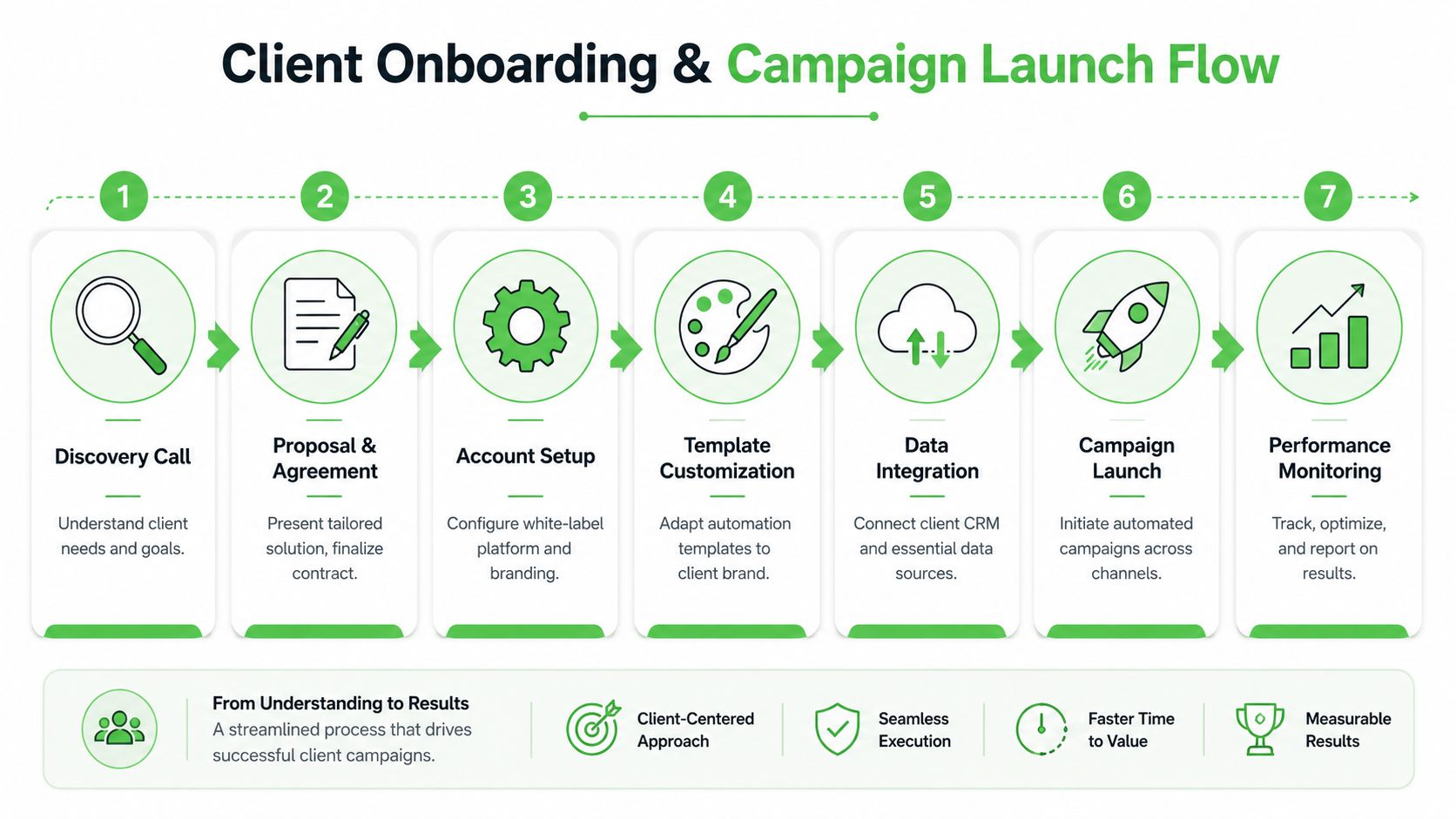
Run onboarding like a delivery system
For agency work, the first launch should stay narrow. One use case. One audience. One channel owner on the client side. If the offer includes conversational automation, start where speed matters and replies create revenue. Lead response, missed appointment recovery, quote follow-up, and reactivation usually beat broad nurture sequences because the client can see the operational gain fast.
Use a seven-step rollout:
Set the business outcome
Tie the project to a measurable operational target such as faster lead response, more booked appointments, fewer no-shows, or better sales follow-up coverage.Lock scope before buildout
Define what the first release includes. One workflow, one trigger set, one approval path, one reporting view. This keeps custom requests from eating setup margin.Secure access and ownership
Confirm platform access, messaging channel control, user roles, approval contacts, and escalation rules. For WhatsApp, verify who owns the number, who approves templates, and who handles live replies once conversations start.Customize proven templates
Start from a repeatable framework and adjust copy, timing, routing, and tags to fit the client's sales process. Building from zero makes agencies slower without improving outcomes in most accounts.Map the data properly
Match fields, tags, lead sources, lifecycle stages, and owner assignment rules before launch. If source attribution or handoff logic is wrong, the client stops trusting the system within days.Launch a pilot first
Send to a controlled segment and watch delivery, reply handling, routing, opt-outs, and staff response time. Early friction usually shows up in the inbox, not in the workflow builder.Tighten before scale
Revise message wording, timing windows, qualification paths, and handoff rules. Expand only after the first version is producing stable conversations.
Build templates around conversations, not just sends
Email onboarding templates still have a place, but they are rarely enough on their own. The more profitable service is built around the moment a lead replies.
That is why WhatsApp has become a strong agency entry point. It supports both automation and human follow-up in the same workflow. A client does not just get scheduled messages. They get a working response system.
A practical lead nurture template looks like this:
- Entry point: A lead submits a form, replies to an ad, or scans a QR code in-store.
- Immediate acknowledgment: The system confirms receipt and sets a response expectation.
- Qualification step: Quick replies sort the lead by service interest, location, urgency, or budget range.
- Routing rule: High-intent responses go to the right sales rep or location.
- Inbox handling: Staff continue the conversation with notes, tags, and saved replies so context stays intact.
- Re-engagement logic: If the lead stops replying, the system sends a timed follow-up with a clear next step.
This template works because it respects how buying decisions happen. Automation handles the repetitive first exchange. A person takes over once the conversation has real intent.
Strong conversational automation covers the first response, the qualification step, and the handoff. It does not try to script the entire sale.
If you are reselling a tool like Double My Leads, service delivery becomes easier. The platform setup matters, but its core value lies in giving the client one place to manage automated outreach and live WhatsApp replies without losing context between the two.
Template example event reminder and follow-up
A second strong template combines email and WhatsApp based on what each channel does well.
Email handles registration details, calendar information, and recap content. WhatsApp handles reminders, last-minute updates, and reply-driven follow-up. That split reduces missed events and gives the sales team a cleaner path into post-event conversations.
A simple version looks like this:
| Stage | Channel | Purpose |
|---|---|---|
| Registration confirmation | Deliver details and expectations | |
| Reminder before event | Prompt quick visibility and attendance | |
| Last-call update | Handle urgency or access instructions | |
| Post-event recap | Share summary, recording, or next step | |
| Sales or nurture follow-up | Route replies and continue conversation |
Clients usually approve these templates faster because they can see the workflow in plain terms. Agencies like them because delivery is more predictable, training is simpler, and support requests stay contained. That is the operational advantage of a template library. It shortens launch time without forcing every client into the same message flow.
Structuring Profitable Pricing and Margin Models
A client signs for automation because lead handling is messy, follow-up is slow, and sales reps are still chasing people manually. If your pricing is built around hours, the client sees software setup and message edits. If your pricing is built around response speed, booked meetings, and lower admin load, the client sees a revenue system.
That distinction affects margin more than any markup formula.
Agencies often underprice automation because they treat it like production work. They add the SaaS cost, estimate implementation time, add a service fee, and call it done. That approach creates a ceiling fast, especially once delivery gets more efficient. The better your templates, SOPs, and onboarding get, the harder it becomes to justify the same retainer on labor alone.
Conversational automation changes the pricing conversation. Email workflows are crowded and easier for clients to compare across vendors. WhatsApp automation is still less standardized, more operationally tied to sales, and closer to revenue. A client will argue over the price of a nurture sequence. The same client will pay to cut lead response time from hours to minutes through WhatsApp, route replies to the right rep, and keep conversations active after form submission or an event.
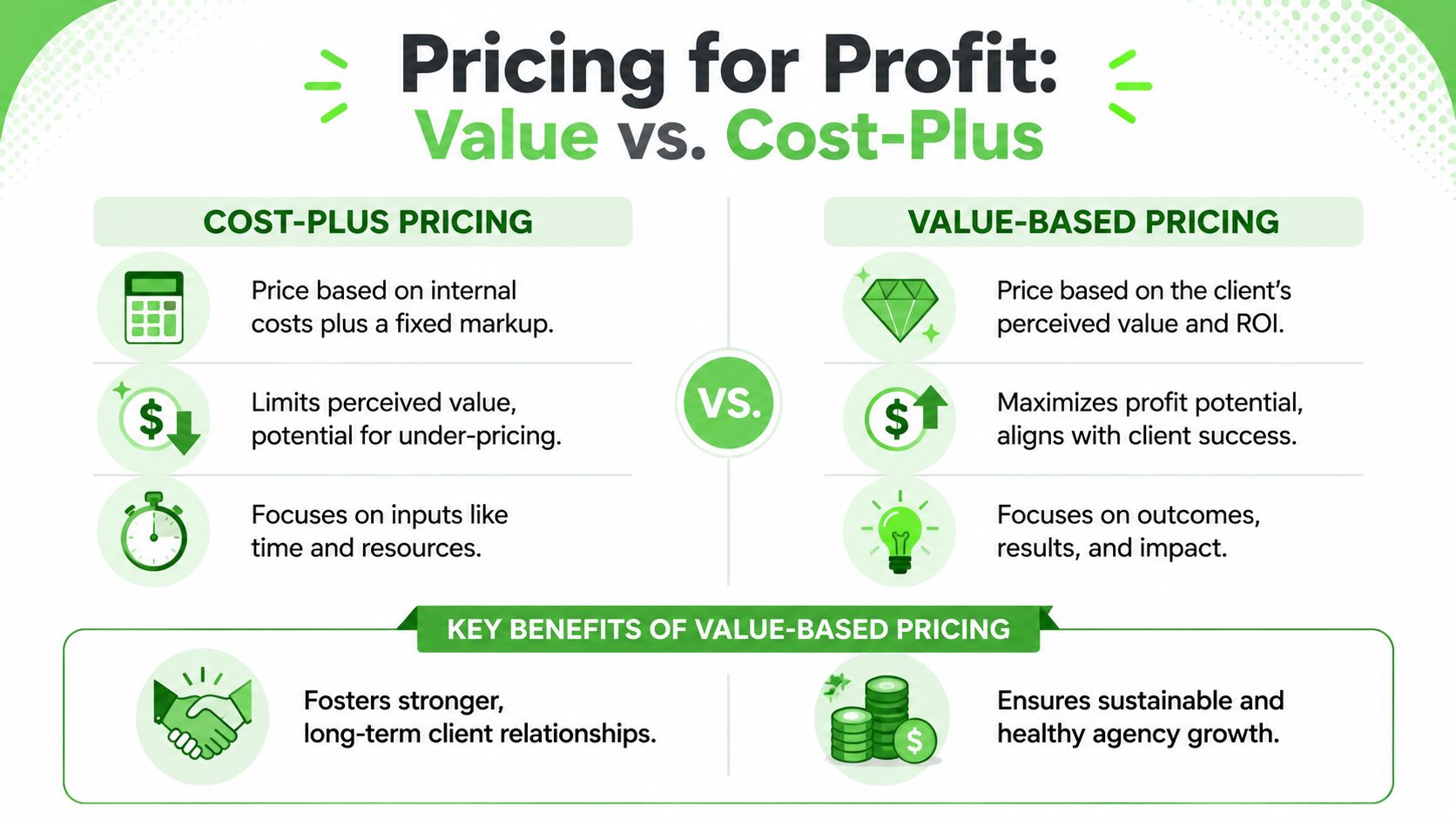
Why cost-plus pricing weakens this service
Cost-plus pricing rewards slower delivery and penalizes operational maturity. If your team can deploy a proven WhatsApp follow-up flow in two days because you already built the logic, prompts, routing rules, and approval process, your value did not drop. Your delivery improved.
Clients are not buying your internal hours. They are buying a working system that captures more conversations, reduces delay, and gives their team cleaner handoffs.
That is why I usually separate pricing into two parts. One fee covers build and launch. The second covers ongoing management, channel optimization, reporting, and controlled change requests. For agencies reselling a platform like Double My Leads, this structure protects margin because the software becomes part of a managed service, not a pass-through line item the client tries to negotiate down.
Agency Automation Pricing Models Compared
| Model | Best For | Pros | Cons |
|---|---|---|---|
| Flat-fee retainer | Ongoing management and optimization | Predictable revenue, easy to budget, supports recurring service | Scope can expand fast if requests and revisions are not capped |
| Tiered user or contact model | Clients with different sizes or workspace needs | Revenue grows with usage, packaging is easier to explain | Needs clear rules for support, setup, messaging volume, and overages |
| Performance-based model | Mature clients with strong data discipline | Supports premium pricing when attribution is trusted | Risk rises fast if tracking is weak or sales follow-up is inconsistent |
In practice, a hybrid model is usually the most profitable. Charge a setup fee for implementation. Add a monthly platform and service retainer. Then reserve performance upside for a narrow set of outcomes you can verify.
For example, a WhatsApp appointment-setting package might include platform access, one core lead-response workflow, inbox routing, reporting, and monthly optimization in the base fee. Extra branches, new campaign types, CRM cleanup, or additional regions become expansion work. That keeps the initial sale easier while preserving room to grow account value.
Protect margin with operational rules
Margin is usually lost after the contract is signed.
It disappears through extra revisions, poorly defined approvals, custom builds that should have been templated, and support requests that belong in a higher tier. Agencies that make money on automation run strict delivery rules, even when the service looks simple from the outside.
Use rules like these:
- One revenue objective per initial rollout: lead response, reactivation, appointment reminders, or event follow-up. Do not sell four outcomes in one launch.
- Template-first delivery: Start from proven WhatsApp and email flows, then customize only the parts tied to offer, audience, and compliance.
- Named approval owners: One client contact signs off on copy, routing logic, and escalation rules.
- Defined support limits: Set response windows, revision counts, and what qualifies as optimization versus new work.
- Channel-specific compliance process: Consent, opt-out handling, approved sending windows, and message policy checks need written SOPs.
Pricing also needs a margin floor. If the client's monthly fee cannot cover software, account management, light optimization, and a reasonable support buffer, the account will turn into a service desk ticket queue. This happens often with agencies that sell email automation cheaply, then try to bolt on WhatsApp support without changing scope or price.
A better approach is to package conversational automation as a higher-value service line. The client is paying for faster conversations, better sales follow-up, and tighter operational control. Price it that way.
As noted earlier, buyers often expect automation to show payback quickly. That makes scoping important. Promise a narrow operational result, deliver it fast, and expand from there. If you promise broad transformation in month one, your team absorbs the complexity before the account has enough margin to support it.
Measuring ROI and Scaling Your Automation Services
A client approves a WhatsApp automation pilot because missed leads are costing them revenue. Thirty days later, the agency report shows messages sent, open rates, and workflow counts. The client's next question is predictable. Did this improve response time, booked meetings, or closed revenue?
That question decides whether automation stays in the budget.
For agencies selling conversational automation, especially WhatsApp, ROI has to be tied to speed and handoff quality. Email reporting often stops at engagement metrics because the channel is mature and crowded. WhatsApp creates value closer to the sale. Faster first response, cleaner routing, fewer dropped conversations, more booked appointments, and better reactivation rates are the numbers clients care about.
A strong monthly report is usually short. Include an executive summary, workflow health notes, lead movement by stage, sales conversation volume, and the changes your team made during the month. Keep the reporting anchored to business KPIs such as response time, contact rate, appointment rate, pipeline created, and revenue attribution where the client can support it. If attribution is messy, use operational proxies the client already trusts, such as reduced no-show rates or more leads contacted within five minutes.
Report business outcomes not activity metrics
Clients do not retain an agency because six workflows are live. They retain an agency because sales follow-up gets faster, admin work drops, and more qualified conversations happen without adding headcount.
Track metrics like:
- First-response speed: How quickly does a new lead get a reply on WhatsApp or another active channel?
- Contact rate: How many inbound leads receive a real response instead of sitting untouched in the CRM?
- Booked outcome rate: How many automated conversations turn into appointments, demos, or qualified sales calls?
- Reactivation yield: How many old leads return to conversation after a reminder or offer sequence?
- Manual work removed: Which repetitive follow-ups, reminders, or routing tasks no longer need staff time?
Commentary matters as much as the dashboard. If booked calls rose but show rates fell, say that. If the automation is creating conversations outside business hours but handoff fails the next morning, say that too. Clients pay for judgment, not screenshots.
Here's the scaling lens agencies should keep in mind:
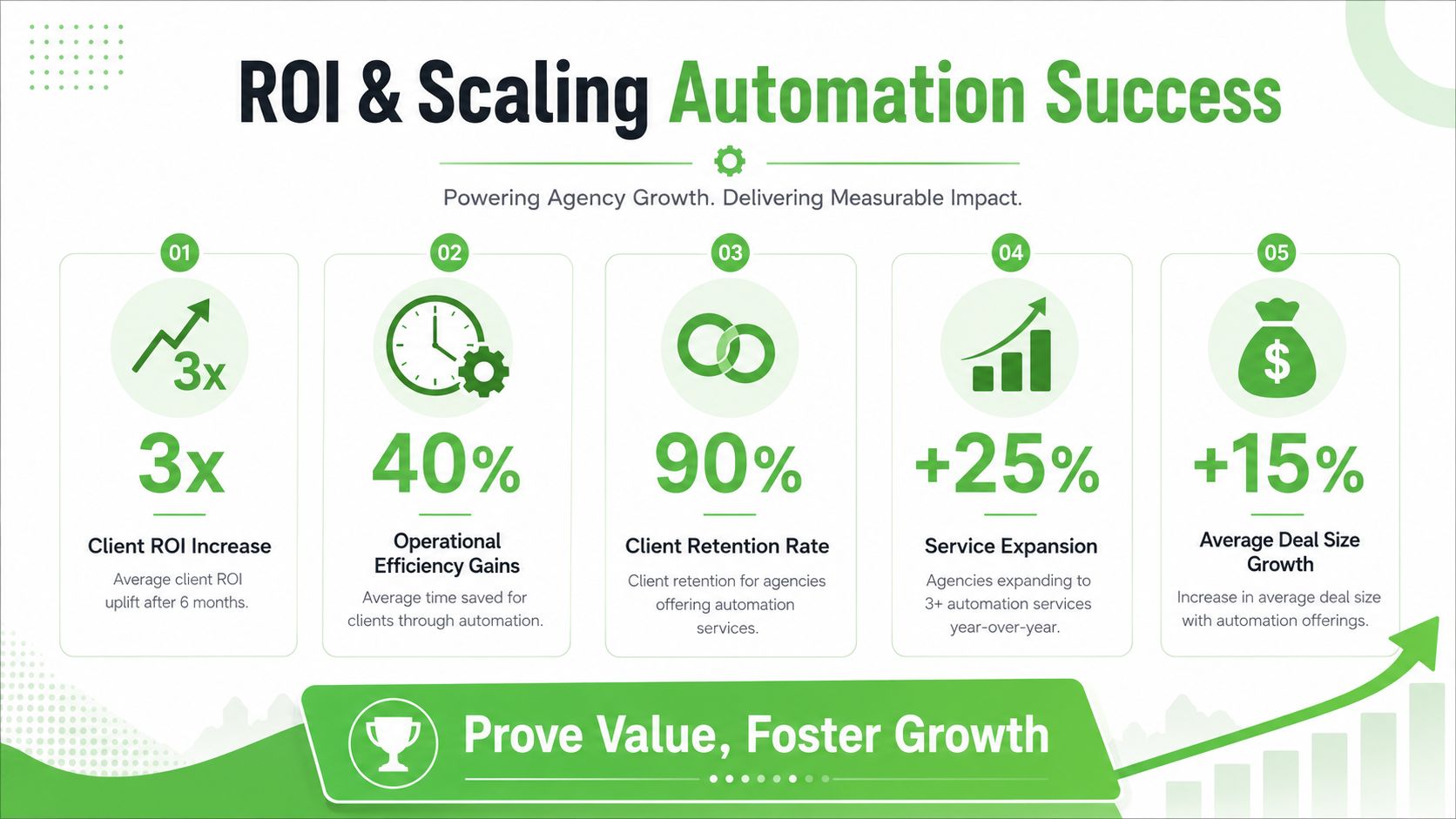
How to scale from one client to ten
The first scaling problem is rarely demand. It is delivery variance.
One account manager writes strong follow-up logic. Another improvises. One client gets clear reporting tied to booked revenue. Another gets a list of broadcasts sent. Margin disappears fast when every account is run differently.
Standardization fixes that.
- Document each automation by business function: Lead capture, qualification, appointment reminder, reactivation, post-purchase follow-up, escalation.
- Use one naming system across all client accounts: Campaign names, tags, pipeline stages, and owner labels should match your SOPs.
- Build reporting templates by service line: A WhatsApp lead-response package should not use the same scorecard as an email nurture package.
- Separate launch work from recurring optimization: Setup requires technical configuration and approvals. Monthly management requires monitoring, testing, and controlled iteration.
- Define expansion rules: After one workflow proves value, offer the next logical automation, such as missed-call text back, dormant lead reactivation, or no-show recovery.
Agencies that scale this well usually keep custom work under control. They productize the delivery model, then reserve custom logic for larger accounts with enough margin to support it. That matters even more in conversational automation, where inbox management, escalation rules, and response expectations can turn a profitable retainer into a support-heavy account.
A practical target is to prove one operational win first. For example, reduce inbound lead response time from hours to minutes, then expand into appointment reminders and reactivation. That sequencing is how agencies move beyond saturated email services and build a higher-value WhatsApp automation offer that clients keep.
The fastest way to scale this service is making delivery repeatable, measurable, and easy for the client to buy again.
When clients can see how conversations are being created, where handoffs succeed or fail, and what the next rollout will do, upsells get easier. Retention improves too. Automation stops looking like a campaign add-on and starts operating like part of the client's sales system.
If you want to add conversational automation to your agency without building custom infrastructure, Double My Leads gives you a white-labeled WhatsApp setup with client workspaces, inbox operations, broadcasts, QR-based onboarding, and predictable SaaS-style delivery you can package under your own brand.


