
Most advice on AI funnel builders is wrong in the one place that matters most. It treats the tool like a shortcut to strategy.
That's how agencies end up with polished funnels that still don't convert. The pages look better, the automation map looks smarter, and the AI assistant sounds impressive. But if the offer is weak, the path is confusing, or the lead source is poor, AI just helps you scale the wrong thing faster.
The profitable sequence is simpler than the hype suggests. Build the core funnel. Validate it with real traffic. Confirm where people move, where they stall, and where they buy. Then use AI to compress production time, personalize follow-up, and expand the system into channels most guides still ignore, especially WhatsApp.
Table of Contents
- Why AI Funnel Builders Matter for Your Agency Now
- Demystifying the AI Funnel Builder
- Core AI Features Driving Agency Growth
- A Practical Checklist for Choosing Your Tool
- Your Implementation Roadmap from Concept to Conversion
- Avoiding AI Pitfalls and Optimizing for Profit
Why AI Funnel Builders Matter for Your Agency Now
Agencies can't ignore this category anymore. The global funnel builder software market is valued at an estimated USD 3,950 million in 2025 and is projected to reach approximately USD 14,974.45 million by 2033, with a projected 18.5% CAGR, according to funnel builder software market data.
That growth matters because it signals a change in client expectations. Businesses don't just want landing pages and email follow-up anymore. They want faster launch cycles, tighter lead handling, smarter personalization, and clearer attribution across the full path from click to conversation to sale.
The mistake is assuming that demand for AI tools means strategy now comes second.
Practical rule: An AI funnel builder can accelerate execution, but it can't rescue a weak offer, fix bad positioning, or invent buyer intent where none exists.
That's the part a lot of agencies miss when they chase the prompt-to-launch fantasy. They buy the software, generate a funnel in minutes, connect a few automations, and call it a system. What they've built is an unproven machine with more moving parts.
The more useful view is the one behind AI's impact on digital marketing agencies. AI changes delivery. It doesn't remove the need for a strategist who understands traffic quality, message match, offer structure, and follow-up timing.
What matters now for agency profitability
Three shifts make AI funnel builders commercially important right now:
- Faster production cycles let teams move from concept to usable draft without tying up designers and copywriters in first-pass assembly.
- Improved operational efficiency helps agencies spend less time building standard assets and more time improving conversion paths.
- Broader channel expectations mean clients increasingly want funnels that don't stop at forms and email. They want chat, messaging, CRM updates, and sales handoff in one flow.
The contrarian position that actually holds up
The winning agencies won't be the ones with the most automation. They'll be the ones that apply automation in the right order.
Start with the simple version that can prove demand. Then bring in AI where it provides an advantage. That's how an AI funnel builder becomes a profit tool instead of another software line item your team has to defend.
Demystifying the AI Funnel Builder
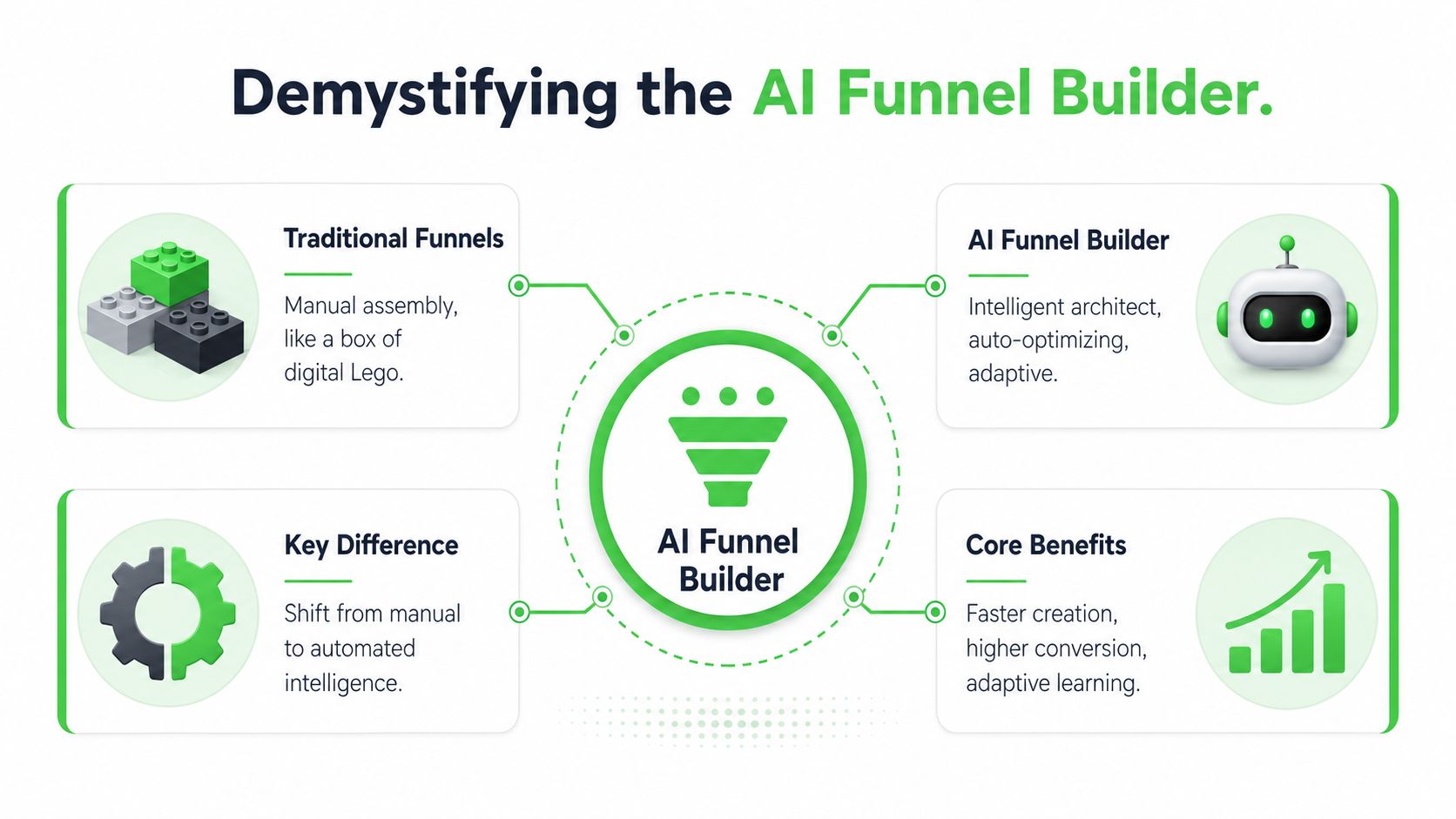
A traditional funnel builder is a construction kit. You still assemble the pages, write the copy, connect the forms, map the logic, and troubleshoot the journey by hand.
An AI Funnel Builder changes that starting point. Instead of acting like a bricklayer, it acts more like an architect. You give it the offer, audience, and goal, and it drafts the initial funnel structure for you.
AI funnel builders can generate complete multi-step funnel architectures, including copy, layout, and structural flow, from a single text prompt within 2 to 4 minutes, according to this overview of GoHighLevel AI funnel generation.
What the tool is actually doing
At a practical level, the platform takes a short input such as your service, target buyer, desired action, and tone. It then produces a working first draft of the funnel. That usually includes opt-in pages, sales pages, thank-you pages, calls to action, and the connective logic between them.
That changes the agency workflow in a meaningful way. The job shifts from manual assembly to controlled refinement.
Instead of asking a team to start from a blank screen, you ask them to improve what the model produced.
The biggest gain isn't that AI makes the final funnel perfect. It's that your team reaches a usable first version much faster.
Where agencies get the most value
The best use of an AI funnel builder isn't replacing strategic thinking. It's removing low-value production drag.
Here's where that tends to help most:
- First-draft copy creation gives strategists something concrete to improve rather than forcing them to write every headline from scratch.
- Initial page structure speeds up build time for standard lead generation and appointment funnels.
- Offer-based variation makes it easier to spin up multiple versions for different audiences or service lines.
- Iteration speed improves because edits happen on top of a live draft rather than inside a blank template.
That same shift is happening in adjacent creative workflows too. If you're also building media assets around funnels, this guide to generative video for creators is useful because it shows the same pattern: AI is strongest when it handles first-pass production and humans shape the final message.
What an AI funnel builder is not
It's not a buyer psychology engine you can trust blindly. It won't know your best proof points unless you feed them in. It won't understand objections unless you surface them. It won't spot a bad traffic source just because bounce behavior looks messy.
A good operator still decides:
| Decision area | Human role | AI role |
|---|---|---|
| Offer and positioning | Define it | Reflect it |
| Funnel logic | Approve the path | Draft the path |
| Messaging | Curate claims and proof | Generate options |
| Optimization | Judge what matters | Produce faster variants |
That distinction matters. If you understand it, an AI funnel builder becomes a serious production advantage. If you don't, it becomes a polished shortcut to mediocre work.
Core AI Features Driving Agency Growth
Most agencies first notice speed. The deeper value comes from adaptation.
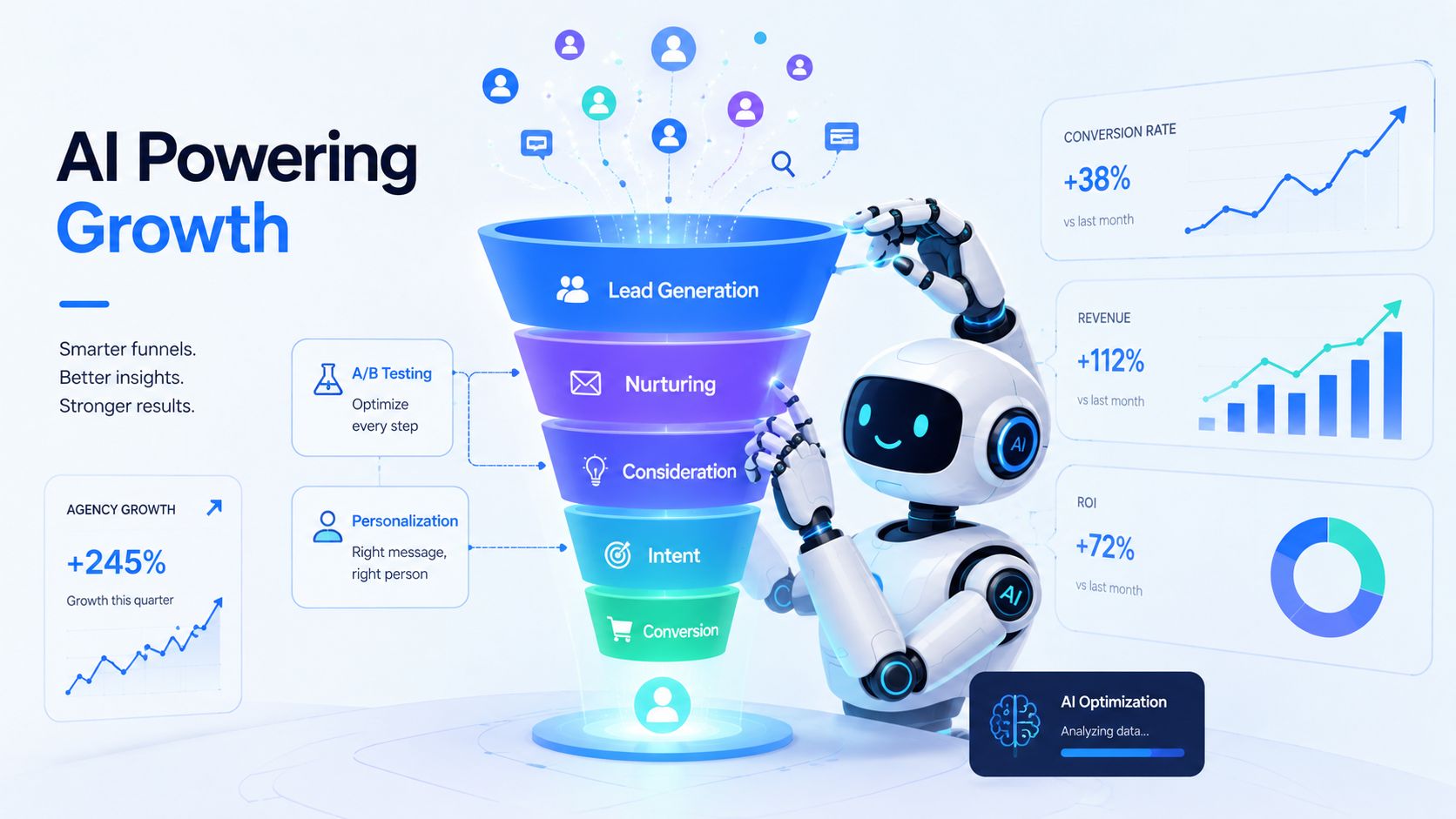
Modern AI funnel builders use machine learning algorithms and behavioral data analysis to dynamically adapt visitor journeys based on user context, preferences, and real-time interactions, rather than forcing everyone through one fixed path, as described in this guide to AI funnel builders.
Dynamic journeys beat static templates
Static funnels assume every lead should follow the same route. That works for simple campaigns, but it breaks down fast when buyer intent varies.
One prospect wants pricing. Another wants proof. A third has a technical question and won't book until they get an answer. A static page treats all three the same. An AI-driven funnel can change the sequence, surface different content, or continue the interaction in a more conversational way.
For agencies, that matters in two ways:
- Sales teams get better-shaped leads because the funnel can gather more context before handoff.
- Clients get more resilient systems because the path can respond to behavior instead of forcing rigid steps.
Better qualification reduces wasted effort
Lead generation isn't just about capturing contact details. It's about filtering signal from noise.
An AI funnel builder can help qualify intent before a human gets involved. It can ask structured questions, segment by need, and route the lead into the right follow-up path. For an agency, that means less time spent building broad nurture flows for people who were never a fit in the first place.
This is one of the clearest profit levers in service delivery. When the funnel does more of the sorting, account teams spend less time on manual triage and clients see cleaner pipeline movement.
Agencies make more money when they stop treating every lead the same and start designing follow-up around buying context.
Personalization works when it stays operational
“Personalization” is one of those terms that gets overused quickly. In practice, it only matters if your team can operate it consistently.
The useful version looks like this:
- Message variation by intent so cold traffic sees education while warm traffic sees a stronger ask.
- Content sequencing by behavior so users who stall get a different nudge than users who click through immediately.
- Channel-aware follow-up so the conversation continues where the lead is most likely to respond.
That last point is where agencies should pay attention. Most mainstream funnel setups still think in terms of page, form, email. That's too narrow for many local service, coaching, info, and community-led offers. Buyers often respond faster when the funnel opens a direct conversation channel instead of pushing them into another inbox.
Where WhatsApp changes the funnel model
This is the gap many AI funnel builder guides still miss. They explain web and email well enough, but they barely address messaging-first conversion paths.
In agency work, some of the strongest use cases aren't “visit page, join list, get drip.” They're “scan QR, enter conversation, receive guided follow-up, move into CRM, get nurtured through messaging.” That's especially relevant when campaigns rely on events, creators, communities, local businesses, or high-response direct outreach.
Agency growth comes from workflow redesign
The strongest agencies don't just use AI to make pages faster. They redesign delivery around what the system can now do well.
That usually means:
| Agency function | Old workflow | AI-supported workflow |
|---|---|---|
| Funnel build | Page-by-page assembly | Prompt, generate, refine |
| Lead qualification | Form plus manual review | Conversational capture plus routing |
| Nurture | Generic sequences | Adaptive follow-up paths |
| Optimization | Slow revision cycles | Faster test and update loops |
When that shift is handled well, the agency stops selling “a funnel build” and starts selling a managed conversion system.
A Practical Checklist for Choosing Your Tool
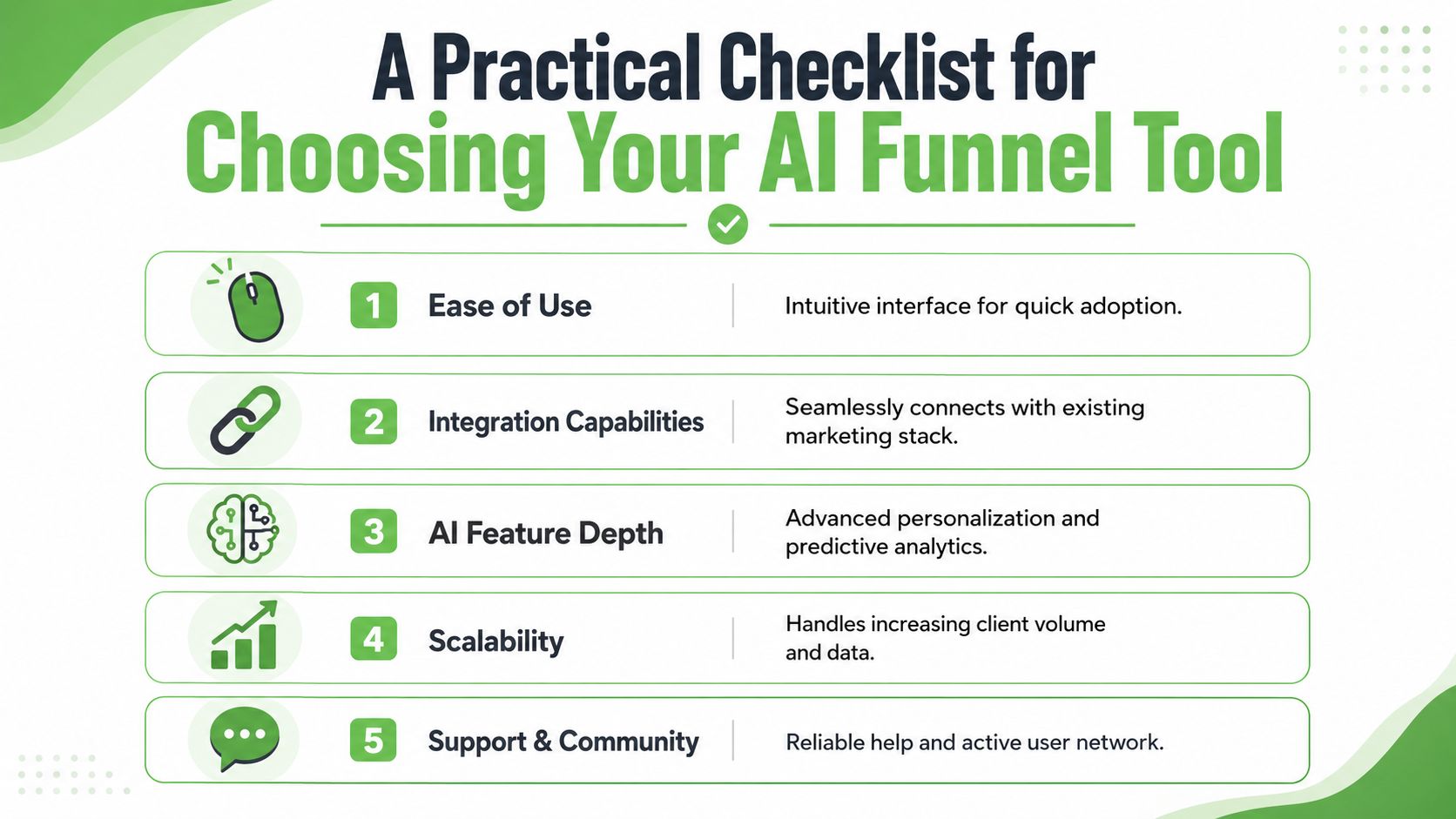
Choosing an AI funnel builder is less about feature volume and more about business fit. Plenty of platforms look strong in a demo. Far fewer hold up when your team has to deploy them across multiple clients, hand off reporting, connect CRMs, and preserve margin.
Pricing pressure is part of that decision. AI-powered sales funnels currently cost between $39 and $449 per month in 2025, with $129 identified as the optimal plan for most businesses, while 48% of marketers cite funnel inefficiency as a top barrier to growth in 2025, according to this breakdown of AI funnel pricing and funnel inefficiency.
Start with the agency model, not the feature list
A solo consultant can tolerate clunky workflows if the output is good enough. An agency can't. You need repeatability, speed, and predictable economics.
Use this checklist before you commit.
- Check build speed against edit control. Fast generation matters, but only if your team can quickly adjust layouts, copy, forms, and routing after the draft is created.
- Audit CRM depth early. Basic integrations aren't enough if client delivery depends on clean pipeline movement, notes, owner assignment, and source attribution.
- Review messaging support, not just email support. Many tools still assume the funnel ends in forms and inboxes. If your clients need direct-response workflows, messaging capability matters.
- Test white-label practicality. A platform may say it supports agencies, but that doesn't always mean branded workspaces, client-safe presentation, or operational separation across accounts.
- Question the billing model. If messaging or automation costs rise unpredictably, your margins get squeezed long before your clients notice the technical limitation.
Here's a short way to compare options during evaluation:
| Evaluation point | Strong fit for agencies | Weak fit for agencies |
|---|---|---|
| AI generation | Fast draft plus good editing | Fast draft but rigid editor |
| Integrations | CRM and messaging friendly | Limited stack compatibility |
| Resell readiness | White-label and account separation | Single-brand experience |
| Margin control | Predictable cost structure | Usage-based surprises |
A quick visual overview helps teams align before they buy.
The WhatsApp gap most reviews ignore
At this point, many buying guides become inadequate. They evaluate page generation, email sequences, AI copy, and basic CRM sync, then stop.
But many agencies now need funnels that support WhatsApp-first workflows. That means the tool decision should include questions most software comparisons never ask:
- Can the funnel continue in WhatsApp without awkward workarounds
- Can leads be attributed clearly when they enter through QR codes or smart links
- Can your team manage conversation-driven lead flow without relying on fragile add-ons
- Can the offer be resold under your own brand with pricing that stays predictable
A lot of “AI funnel builder” platforms still treat WhatsApp as a side integration, if they support it at all. For agencies serving local businesses, creators, educators, communities, and appointment-driven businesses, that's not a side issue. It changes response speed, handoff quality, and the shape of the entire follow-up sequence.
Questions worth asking on every demo
Don't ask “what can your AI do?” Ask questions that reveal operational reality.
Ask the vendor to show how a lead moves from first click to qualification to handoff inside the real workflow your agency sells.
Then ask these:
- How is source attribution handled across pages, forms, and messaging entry points
- What breaks when the client wants branded workspaces
- Which parts of the AI output are editable by the delivery team
- How does the system support messaging-led follow-up instead of email-only nurture
- What costs rise as conversation volume grows
The right tool won't just look modern. It will fit the way your agency gets paid.
Your Implementation Roadmap from Concept to Conversion
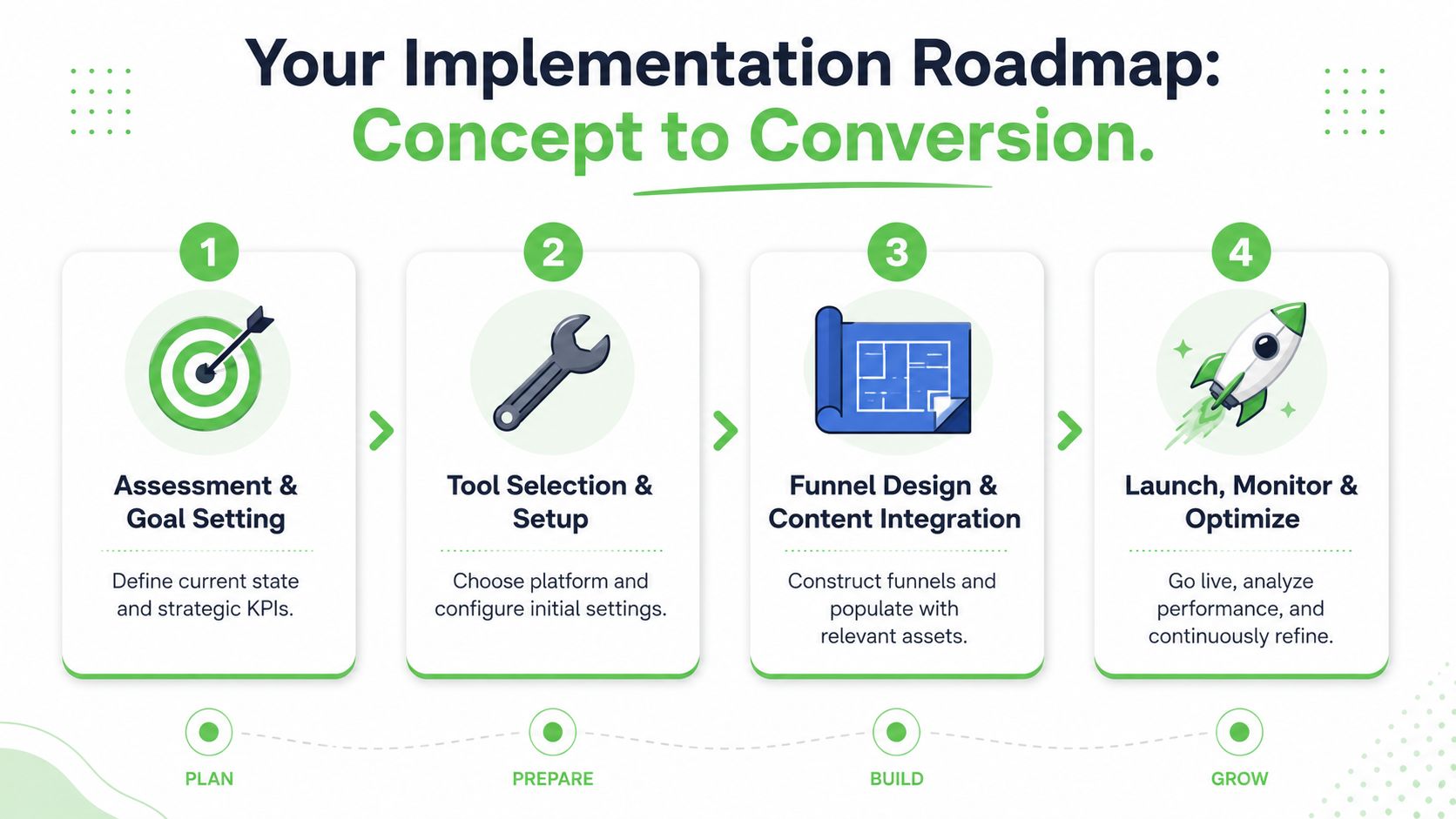
Most AI funnel projects fail before launch because the team starts with software instead of the buying journey. The tool comes later. First, define the path you want a qualified lead to take.
That keeps the funnel grounded in business logic rather than feature exploration.
Stage one builds the core path
Start small. For most agency clients, that means one offer, one audience, one primary action.
Map the simple route first:
- Traffic source enters through ad, search, referral, QR code, or direct outreach.
- Core page or conversation opens with one promise and one next step.
- Lead capture happens through form, chat, or messaging prompt.
- Follow-up starts in the CRM and the primary communication channel.
That basic path should be understandable without an automation diagram. If it takes a long explanation to describe the funnel, it's probably too complex for version one.
Stage two connects the minimum stack
It is common for teams to overbuild. They connect everything, tag everything, and automate everything before proving the path works.
A better implementation only connects what the funnel needs to operate:
- CRM connection for lead capture, ownership, notes, and status.
- Primary communication channel based on how the client closes business.
- Tracking layer that preserves source information.
- Calendar or sales handoff point if the conversion event involves booking.
For some offers, email remains the right default. For others, especially where speed and conversation quality matter, WhatsApp should be designed into the system from the beginning rather than tacked on after launch.
Stage three gives the AI useful context
An AI funnel builder performs well when the inputs are specific. Weak prompts produce generic output.
Give the platform the material your best strategist would ask for:
| Input | What to include |
|---|---|
| Offer | Service, promise, price framing, call to action |
| Audience | Buyer type, urgency, objections, language |
| Proof | Testimonials, outcomes, differentiators |
| Funnel goal | Lead capture, booking, purchase, qualification |
This is also where agencies separate themselves from DIY users. The tool can generate pages. Your team should still shape the claims, sequence, and objections based on what buyers need to see.
Stage four validates before scaling
Launch the simple version. Watch how real prospects move through it. Look for friction, not perfection.
A working funnel with clear drop-off points is more useful than an elaborate funnel no one has tested.
Once the team can see where users hesitate, abandon, or convert, then AI becomes much more valuable. At that point, it can help generate alternative copy, improve routing, personalize follow-up, and support a broader messaging flow.
If white-label delivery matters to your agency model, set that up from the start. Don't wait until after launch to clean up branding, account structure, and client-facing workflows. Operational polish is easier to build early than retrofit later.
Avoiding AI Pitfalls and Optimizing for Profit
The biggest misuse of an AI funnel builder is trying to automate a funnel that hasn't earned automation yet.
That happens when agencies mistake technical completeness for commercial readiness. The funnel has pages, triggers, assistant prompts, follow-up logic, and dashboard views. None of that proves the system can turn qualified attention into revenue.
The better rule comes from a contrarian insight that more teams should take seriously: AI is a multiplier, not a foundation; a 50% automated funnel running today doubles revenue more than a 100% perfect AI funnel never built, as noted in this AI-powered sales funnel guide.
Use the human-curate and AI-generate model
The practical sequence is straightforward:
- Build simple first. Create the shortest path that gives the buyer enough information to act.
- Run traffic through it. You need real behavior, not internal opinions.
- Get data from actual movement. See where leads engage, stall, reply, or disappear.
- Confirm the core funnel converts. Only then should you layer in more advanced automation.
- Add AI where friction is proven. Use it to improve follow-up, routing, qualification, and message variation.
This avoids the trap that causes half-finished builds. Teams try to launch the chatbot, dynamic personalization, branching nurture, CRM enrichment, and multi-channel logic all at once. Then they never reach a clean live version.
Track profit signals, not vanity outputs
Many agencies watch the wrong indicators. They focus on whether the AI wrote decent copy or whether the workflow looks advanced. Those are production metrics, not profit metrics.
Pay attention to operational outcomes such as:
- Conversion rate by stage so you know where the path breaks.
- Lead-to-customer time so you can see whether the funnel speeds up sales movement.
- Cost per acquisition so automation doesn't inadvertently become expensive complexity.
- Reply and handoff quality when the funnel includes messaging or chat.
If your nurture still depends on email, deliverability matters too. This resource on avoiding the spam folder is worth reviewing because a polished funnel still underperforms when follow-up never reaches the inbox.
Where agencies make the real margin
The profit isn't in saying you use AI. The profit comes from using it after the core funnel works.
That's why WhatsApp-centric funnels deserve more attention than they get. Once the simple funnel converts, messaging can become the next layer of influence. It improves speed, supports direct conversation, and often creates a cleaner bridge between lead capture and sales action than another email sequence ever will.
If your agency wants to turn WhatsApp into a resellable conversion channel, Double My Leads is built for that model. You can launch a white-labeled WhatsApp offering quickly, manage conversations at scale, support broadcasts and smart links, and keep pricing predictable instead of getting squeezed by per-message costs.


