
WhatsApp now sits much closer to revenue than support.
For agencies and SaaS resellers, that matters because response speed and conversation quality often decide whether a lead books, buys, or disappears. Email still has a role, but WhatsApp creates a faster path to action. Prospects reply in the same thread where they ask questions, review offers, and confirm next steps.
That makes a WhatsApp sales funnel more than a messaging tactic. It is a service you can package, price, and resell. With the right workflow, agencies can charge for funnel strategy, setup, automation, live chat handling, and monthly optimization, then fulfill it under their own brand with Double My Leads.
The opportunity is not just better engagement. It is a cleaner revenue model. Instead of selling one-off campaign work, you can turn WhatsApp into a high-margin recurring offer tied to booked calls, recovered leads, repeat purchases, and renewals.
Table of Contents
- Why Your Agency Needs a WhatsApp Sales Funnel Now
- What Exactly Is a WhatsApp Sales Funnel
- The Four Stages of a High Converting WhatsApp Funnel
- Essential Tactics and Tools for Each Funnel Stage
- Actionable WhatsApp Funnel Templates for Your Agency
- Measuring Success and Proving Client ROI
- The Agency Playbook for Reselling WhatsApp Funnels
Why Your Agency Needs a WhatsApp Sales Funnel Now
Your agency likely already sells traffic, landing pages, email nurture, and CRM cleanup. The margin problem is that clients do not buy those deliverables for their own sake. They buy them to create sales conversations, and they churn when handoffs break between lead capture and follow-up.
WhatsApp gives you a stronger position in that gap.
It shortens the distance between click and reply. A prospect can tap an ad, ask a question, send a document, confirm budget, and book the next step in one thread. That speed matters because intent decays fast, especially in local services, high-ticket info offers, and demo-led SaaS.
The agency opportunity is bigger than message automation. The core offer is a packaged conversion system you can deploy across accounts, then resell under your brand through Double My Leads. That changes the economics. Instead of billing for disconnected tasks, you sell a recurring service tied to response time, qualification, booking rate, and closed revenue.
Why agencies win with this offer
Agencies are already closest to the points where WhatsApp either makes money or gets ignored.
- You control the entry points. Paid traffic, organic CTAs, QR codes, widgets, forms, and remarketing flows are already part of your delivery.
- You can fix the handoff. Many clients still lose leads between ad click, form fill, rep follow-up, and calendar booking. WhatsApp gives you a direct thread to route, qualify, and follow up.
- You can standardize fulfillment. The same core workflow can be reused for clinics, home services, coaches, educators, SaaS companies, and ecommerce brands with only light changes to copy and routing rules.
- You can sell speed as a revenue lever. Clients understand missed calls and cold leads. They will pay for a system that replies faster and books more of the demand they already generate.
Practical rule: If a client already spends money to generate leads, selling a WhatsApp funnel is usually easier than pitching a new acquisition channel because you are improving conversion on spend they already approved.
There is a trade-off. This offer works best when the client can handle inbound conversations. If response ownership is unclear, sales staff ignore the channel, or compliance is loose, performance drops fast. That is why productizing the service matters. Double My Leads gives agencies a cleaner way to package setup, automation, routing, reporting, and white-labeled delivery into one offer clients can understand and keep paying for.
The result is a higher-margin service line with clearer ROI than generic funnel work. You are not selling "WhatsApp setup." You are selling a managed conversion layer between lead generation and revenue.
What Exactly Is a WhatsApp Sales Funnel
A WhatsApp sales funnel is a structured path that moves a prospect from first contact to purchase through a conversation, not a sequence of disconnected pages and delays.
The easiest way to explain it to clients is this. Email behaves like a mass-mailed catalog. It can create awareness, but it leaves the buyer to do the work. WhatsApp behaves more like a personal shopper. The business asks a question, the prospect replies, the next step changes based on intent, and the sale keeps moving.
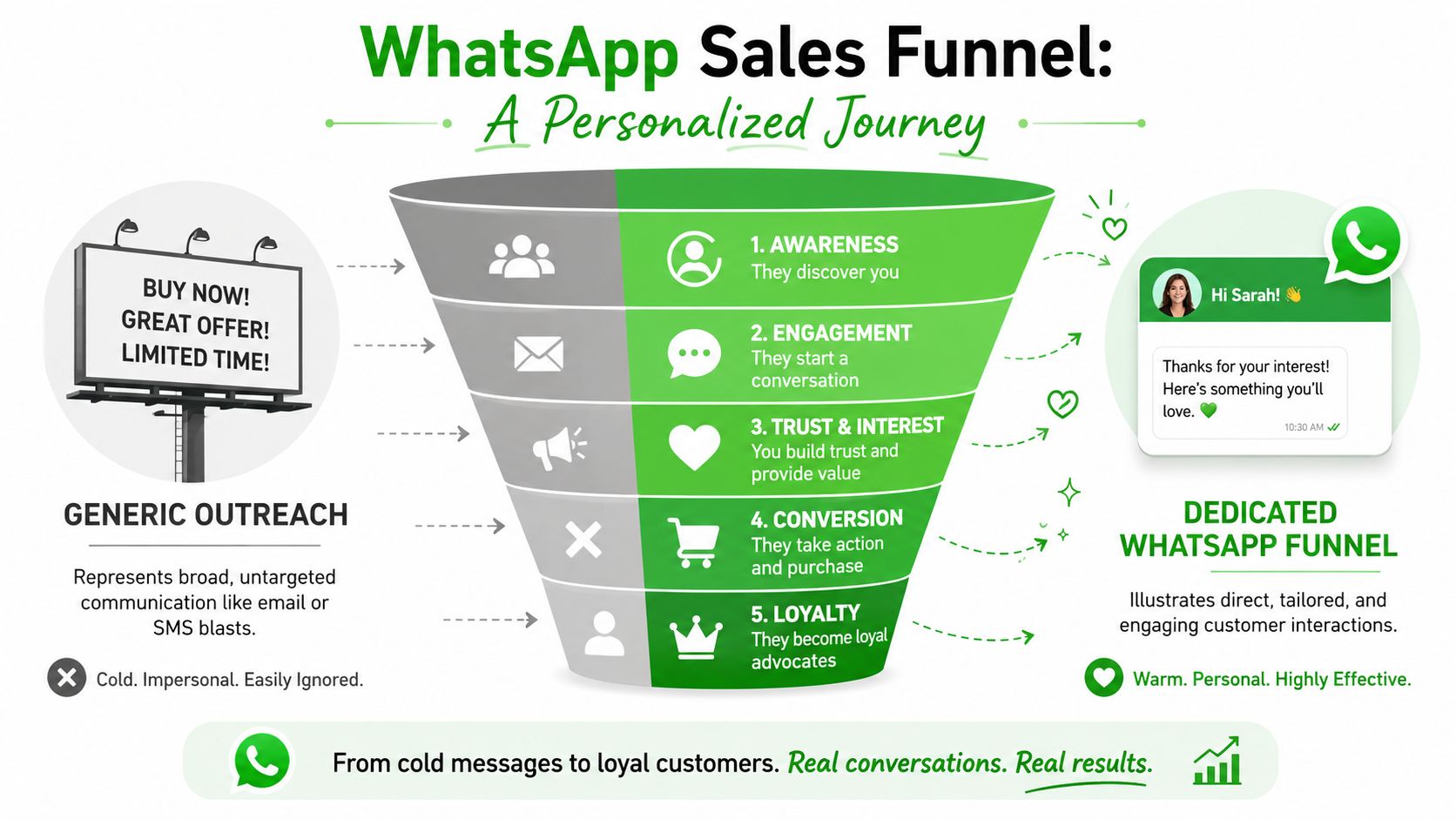
Why the channel behaves differently
The reason this funnel works isn't just convenience. It's the quality of the interaction.
Prospects can ask a real question the second they hesitate. Sales teams can answer with text, images, docs, voice notes, or payment links. That removes the dead air that kills intent in traditional funnels.
This also affects customer value after the first sale. Customers acquired through WhatsApp show a 134% higher LTV than those acquired through email, according to this WhatsApp business statistics breakdown. That makes WhatsApp useful not only for conversion, but for higher-quality customer relationships.
What makes it a funnel and not just chat
Random messaging isn't a funnel. A real funnel has defined stages, triggers, and outcomes.
A proper WhatsApp sales funnel usually includes:
- An entry point with intent. Click-to-chat links, QR codes, ad CTAs, or a site widget.
- An opening sequence. Welcome message, qualification question, route selection, or booking prompt.
- A sales path. Product details, objection handling, proposal sharing, or appointment confirmation.
- A post-sale path. Onboarding, reminders, reorders, renewals, support, or referral requests.
The key difference is that each reply changes what happens next. That's why WhatsApp often outperforms static lead forms for warm traffic. It doesn't force everyone through the same path.
The best WhatsApp funnels feel guided, not automated. The buyer should feel helped, not processed.
For agencies, this is important because you're not selling “messages.” You're selling a responsive buying experience that can be templated, deployed, and managed across multiple clients.
The Four Stages of a High Converting WhatsApp Funnel
A high-converting WhatsApp funnel is easiest to build when you map it to the same journey buyers already follow. They become aware, compare options, decide, and then either disappear or stay connected. WhatsApp keeps that journey contained within one conversation thread.
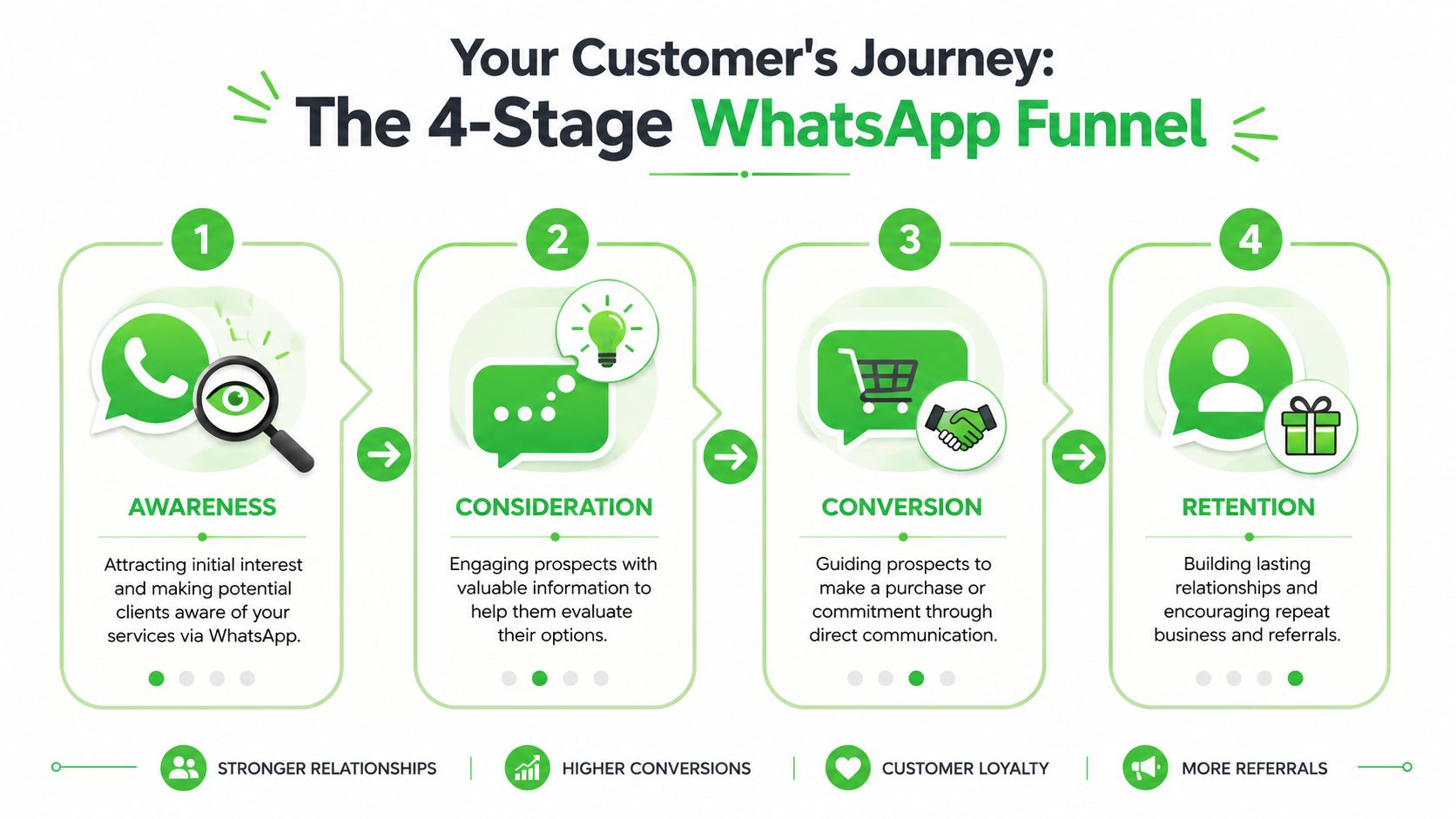
Awareness
At the top of the funnel, the goal isn't to explain everything. It's to make starting a chat feel easier than filling out a form.
Good awareness entry points include QR codes on printed materials, click-to-chat buttons on landing pages, ad creatives that promise a quote or demo inside WhatsApp, and smart links in social bios. The message must match the traffic source. Someone coming from a pricing page should not receive the same first message as someone scanning a QR code at an event.
What works here is low-friction intent capture. “Message us for pricing” is usually stronger than “submit your details and wait.”
Consideration
Most funnels either gain momentum or leak it here. The prospect has shown interest, but they still need context.
The right move is not a giant paragraph. It's a guided exchange with quick replies, a short explainer, maybe a document, maybe a voice note, and a clear branch based on what they need. If you're handling a more complex buying journey, it helps to borrow practical CRO tips that reduce friction, clarify the next step, and keep the value proposition obvious at each decision point.
A strong consideration flow usually does three things:
- Confirms intent with one simple question.
- Segments the lead by need, offer, or readiness.
- Moves fast to the next commitment such as booking, quoting, or reviewing an offer.
Conversion
The conversion stage should feel direct, not pushy. Buyers need clarity more than persuasion at this point.
In WhatsApp, that often means sending the exact asset that unblocks the sale. For one client, that's a price sheet. For another, it's a checkout link. For a service business, it's a calendar booking or a proposal PDF. For a consultant, it might be a voice note that handles the final objection better than three paragraphs of text.
Field note: If the prospect is asking detailed buying questions, stop feeding them generic nurture content. Move them to a human, answer precisely, and ask for the decision.
Retention
Most agencies stop at the sale. That's a mistake, because WhatsApp stays useful after payment.
Post-sale follow-up can include onboarding reminders, delivery updates, renewal prompts, support check-ins, and community-based engagement. In this context, WhatsApp Community Announcement Groups can produce 3–5x higher doc-view and payment-link click rates than traditional broadcast lists, based on this analysis of community-driven WhatsApp funnels. That matters for courses, memberships, coaching, and any client selling repeat engagement instead of one-off transactions.
A retention layer can include:
- Customer onboarding messages that reduce confusion right after purchase
- Announcement-only community updates for launches, renewals, and new drops
- Reactivation prompts tied to usage, support requests, or inactivity
- Referral asks after a positive service moment
Agencies that build retention into the funnel don't just improve results. They make their retainer harder to cancel.
Essential Tactics and Tools for Each Funnel Stage
You don't need a complicated stack to run a WhatsApp sales funnel well. You need a tight workflow, clear ownership, and tools that keep leads from falling between automation and a real salesperson.
Capture intent before the conversation starts
The funnel begins before the first message lands. Agencies often miss this and focus only on chatbot logic.
Use trackable smart links and QR codes for different sources so you know whether the conversation came from a landing page, ad set, email footer, event booth, creator bio, or printed flyer. That gives you cleaner attribution and makes message personalization easier from the first reply.
A practical setup looks like this:
- Landing page traffic goes to a dedicated WhatsApp link with a pricing or demo context.
- Organic social traffic gets a different link tied to a lighter qualification flow.
- Offline traffic uses QR codes with offer-specific entry points.
- Existing customers get separate support or reorder paths so sales chats don't become cluttered.
If a client wants to professionalize customer chats on WhatsApp, the operational side matters too. They need a business-grade number strategy, ownership rules, and separation between personal messaging and sales operations.
Automate the first reply but not the whole sale
The first reply should be immediate. The full conversation should not be fully robotic.
High-intent leads can stall if they don't get a human response within 2 minutes, and lead warmth can drop by 50% after that point, according to this guide on WhatsApp sales handoff friction. That's why welcome flows matter, but handoff design matters more.
A strong opening automation should:
- Acknowledge instantly so the lead knows the message was received
- Offer clear choices like pricing, demo, quote, support, or product help
- Collect one or two routing details instead of asking a giant intake form
- Assign the conversation to the right person or queue fast
What doesn't work is pretending a bot can close every deal. Once the buyer signals buying intent, context must transfer cleanly to a human rep. If the salesperson has to ask, “How can I help you?” after the bot already gathered the details, the funnel just lost momentum.
The handoff isn't a technical step. It's a trust test.
Here's a short walkthrough that shows the kind of workflow agencies should be aiming for:
Use rich media and shared ownership to close
Closing inside WhatsApp usually depends on message quality and team process, not hard-sell scripts.
Rich media helps because buyers often need a little proof or clarity before they commit. That can be a document, a short screen recording, a price breakdown image, a testimonial graphic, or a voice note from the rep handling the deal. Shared inboxes matter just as much. If multiple team members can assign, tag, note, and monitor conversations, the client isn't relying on one person with a phone.
Use a simple operating model:
| Funnel moment | Best tool | What the team should do |
|---|---|---|
| New inbound inquiry | Auto welcome flow | Route by intent and tag source |
| Qualified buying question | Shared inbox | Assign to a closer immediately |
| Objection or complexity | Voice note or document | Answer specifically, not generically |
| Ready to commit | Payment or booking link | Ask for the next action clearly |
| Post-sale transition | Notes and tags | Mark outcome and trigger follow-up |
Agencies that win with WhatsApp usually do one thing better than everyone else. They remove waiting.
Actionable WhatsApp Funnel Templates for Your Agency
Templates are where this becomes sellable. Clients don't want abstract funnel diagrams. They want to know what happens after a person clicks, messages, replies, and decides.
Template for SaaS demo booking
This template fits B2B software, local service software, and resellers selling a booked conversation as the main conversion event.
Start with a paid or organic traffic source that offers a direct benefit inside chat. The CTA should promise something specific, such as pricing clarity, a custom walkthrough, or a fast eligibility check.
The flow can look like this:
Entry trigger
Prospect clicks a WhatsApp link from a landing page, LinkedIn post, or retargeting ad.Instant welcome
Auto-reply confirms receipt and gives two or three options such as “See pricing,” “Book a demo,” or “Ask a question.”Qualification branch
If they choose demo, ask only the details the sales team needs. Role, company type, or use case is usually enough.Booking path
Send the booking link directly in chat, with one line that explains what they'll get on the call.Sales assist
If they hesitate, a rep jumps in with a short text or voice note to answer the specific blocker.No-show recovery
If they book but go quiet, follow up with a reminder and a short reason to keep the meeting.
This works because it keeps the prospect in one conversation thread. No extra tabs, no form fatigue, no “we'll get back to you.”
Template for info product or coaching launches
This one works well for coaches, educators, creators, membership brands, and community-led offers.
Instead of treating WhatsApp as one long chatbot, build the launch around an Announcement Group. Use the group for structured updates and use one-to-one chats for objections, payment, and onboarding.
A practical sequence:
- Pre-launch opt-in
Invite prospects into WhatsApp through a lead magnet, waitlist, or workshop registration. - Warm-up phase
Deliver short lessons, voice-note explainers, and reminders that prepare the audience for the offer. - Launch window
Share the offer details, payment path, deadline context, and FAQs through announcements. - One-to-one closing
When someone replies with a buying question, move the conversation into direct chat and close there. - Post-purchase onboarding
Send the next-step message immediately after purchase so buyers don't cool off.
Don't overbuild the logic. For info products, timing and clarity usually matter more than complex branching.
For agencies, these templates become reusable assets. Swap the offer, rewrite the copy, adjust the routing, and the service becomes fast to deliver without feeling generic.
Measuring Success and Proving Client ROI
If you can't show what the WhatsApp funnel produced, the client will treat it like a communication expense instead of a revenue channel.
The reporting model should stay simple. Track the movement from source to conversation, from conversation to qualified action, and from qualified action to revenue event. That gives clients a narrative they can understand without reading a dashboard for half an hour.
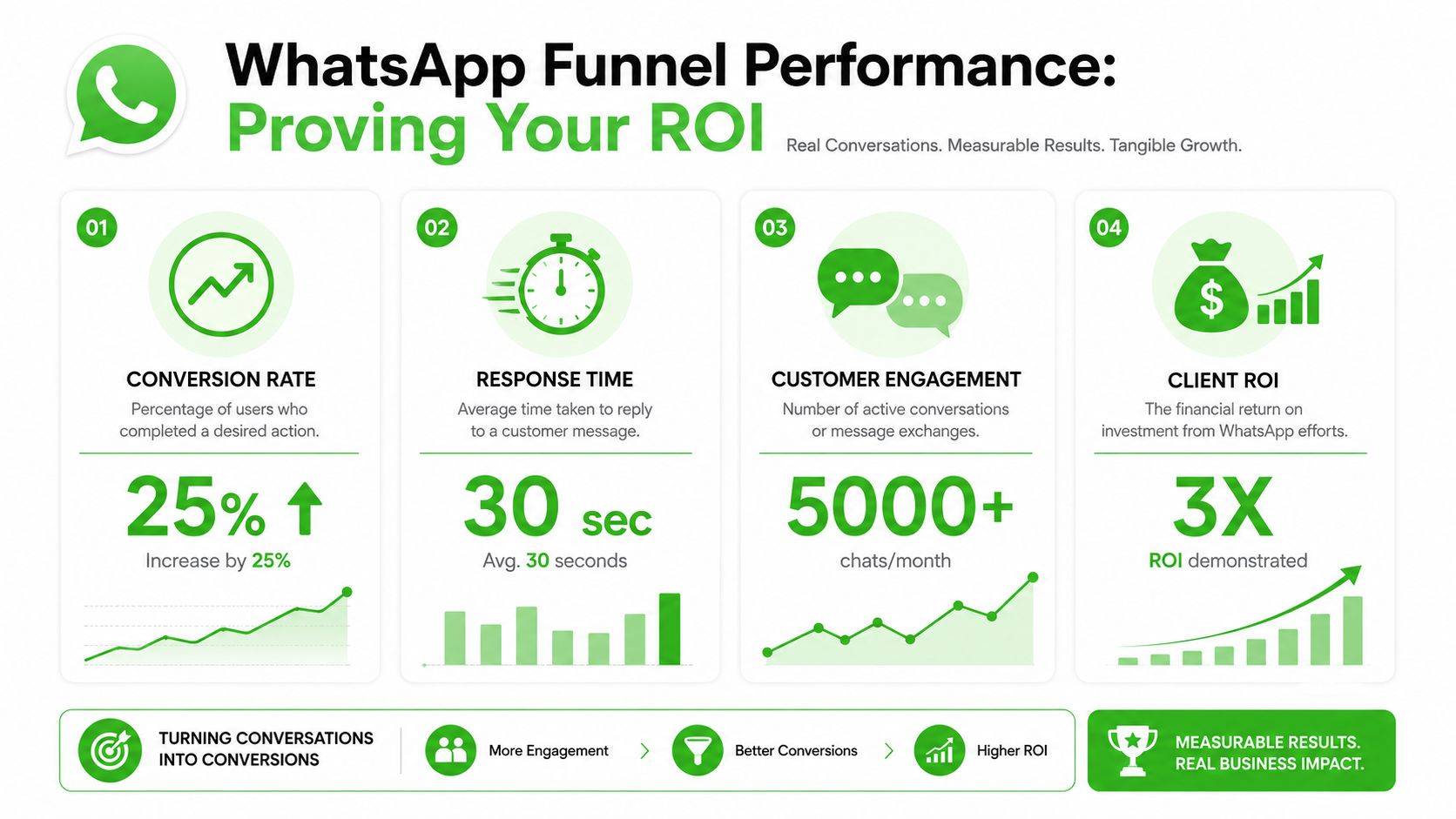
The metrics clients actually care about
Most clients say they want “engagement.” What they want is proof that more conversations are turning into sales activity.
A useful scorecard usually includes:
- Source-to-chat volume so they can see which links, QR codes, or campaigns started conversations
- Qualified conversation count based on the actions that matter for their business
- Response speed because slow handoff kills warm leads
- Booked outcomes such as demos, quotes sent, checkouts started, or support-to-upsell transitions
- Revenue-linked conversations where the team can tie the chat to an invoice, order, or deal stage
You don't need to flood the client with vanity metrics. They need visibility into where intent entered, where it stalled, and where it converted.
How to report attribution without hand-waving
The cleanest way to prove ROI is source attribution tied to tracked entry points. If the QR code on a brochure starts chats that later become booked appointments, that source should show up in the report. If one landing page sends high-quality leads and another sends low-intent conversations, the client should see that difference.
A simple monthly reporting format works well:
| Report section | What to include | Why it matters |
|---|---|---|
| Entry sources | Top links, QR codes, and campaigns driving chats | Shows where demand originates |
| Conversation quality | Qualified inquiries and common intent tags | Separates noise from pipeline |
| Sales actions | Bookings, payment attempts, quote requests, or closed outcomes | Connects chat to business results |
| Operational notes | Response delays, missed handoffs, or script issues | Explains performance changes |
Reporting advice: Always include one operational insight with each report. Clients stay longer when you don't just show data, but also show what you'll change next.
That final part matters. If replies slowed, say it. If a new source produced poor-fit leads, say it. Strong WhatsApp reporting isn't just a scorecard. It's an optimization plan.
The Agency Playbook for Reselling WhatsApp Funnels
The service then becomes a business line instead of a one-off implementation. The agencies that make real margin on WhatsApp don't sell “chat setup.” They sell a packaged funnel with onboarding, management, optimization, and compliance built in.
How to package the offer
Keep the offer narrow enough to sell and broad enough to produce recurring work.
A clean product ladder looks like this:
- Launch package
Entry points, funnel mapping, number setup, routing rules, welcome flow, tags, templates, and reporting baseline. - Managed funnel package
Weekly monitoring, handoff tuning, message updates, source tracking, team support, and monthly reporting. - Growth package
Multi-offer segmentation, broadcast planning, community structure, campaign testing, and deeper CRM workflows.
Position it around business outcomes. Faster lead response, fewer dropped conversations, more booked demos, better follow-up, cleaner attribution. Clients understand that immediately.
How to price for margin and retention
Use a one-time setup fee plus a monthly retainer. That's the cleanest structure for agencies and resellers because the client is paying for both implementation and ongoing performance management.
You can price by one of three models:
| Pricing model | Best for | Trade-off |
|---|---|---|
| Setup plus flat monthly retainer | Most agencies | Easiest to sell and forecast |
| Offer-based pricing | Clients with multiple funnels | Better alignment, more scoping work |
| Volume or workspace pricing | Resellers and SaaS partners | Strong for scale, needs clean boundaries |
Retainers stick when the service includes reporting, optimization, and team accountability. If you only install the funnel, the client sees it as a project. If you own performance and process, it becomes operational infrastructure.
For clients who need help understanding ROI conversations beyond chat data, a broader guide to measuring social impact can help frame how channel performance connects back to business outcomes and investment decisions.
Compliance is part of the product
If you ignore policy, you don't have a service. You have a liability.
WhatsApp's API uses a strict 24-Hour Window Rule. After 24 hours of user inactivity, businesses can only re-engage with pre-approved message templates. Ignoring that rule can cause a 60–80% drop in message delivery success and create suspension risk, according to this breakdown of WhatsApp automation and policy limits.
That has direct implications for how agencies build and sell the service:
- Opt-ins must be explicit. Don't let clients treat WhatsApp like a scraped outbound channel.
- Templates need a real re-engagement plan. Especially when the conversation window closes.
- CRM or inbox sync matters. Teams need message history and status visibility before handoff or follow-up.
- SLA ownership must be defined. If the client team responds too slowly, performance drops and your reporting should show it.
Resellers that treat compliance as part of onboarding sound more credible and keep accounts healthier over time.
If you want to turn WhatsApp into a white-labeled revenue stream instead of another custom service, Double My Leads is built for that model. Agencies and SaaS resellers can launch branded WhatsApp workspaces fast, manage unlimited messaging, run smart links and QR code funnels, sync attribution, and bill clients under their own brand with predictable margins.


