
Your agency probably already has clients asking for faster follow-up, better show-up rates, cleaner lead handoff, and a channel that customers notice. Email still has a role, but when a client needs a login code delivered now, a missed-call lead revived today, or a reminder seen before an appointment, inbox-first thinking starts to break down.
That's where A2P, or Application-to-Person, becomes useful. Not as a buzzword. As the delivery layer behind the messages businesses send automatically through software instead of by hand. If you've ever set up a two-factor code, an order alert, a reminder sequence, or a promotional text blast, you've already been near A2P. You just may not have labeled it correctly.
For agencies, the question isn't only what is A2P. The more important question is whether you understand it well enough to sell it without creating deliverability problems, compliance issues, or ugly margins. That matters even more now because modern client messaging doesn't stop at SMS. WhatsApp automation, platform-triggered alerts, and broadcast workflows all push you toward the same core decision: are you building a real messaging service, or are you patching together tools that carriers and platforms will eventually push back on?
Agencies that get this right can package automation, retention, reminders, lead response, and reactivation into a recurring service. Agencies that get it wrong usually run into blocked traffic, unclear consent, and pricing models that look good at low volume and fall apart once clients start sending at scale.
Table of Contents
- Introduction The Hidden Engine of Modern Client Communication
- A2P vs P2P A Fundamental Shift in Communication
- The Modern A2P Channels Beyond Just SMS
- Why A2P Is a Game-Changer for Agencies and Resellers
- Navigating The Critical World of A2P Compliance
- Choosing Your A2P Implementation Path
- Your Practical Plan for Launching A2P Services
Introduction The Hidden Engine of Modern Client Communication
A lead submits a form at 9:17 p.m. No one replies until the next morning. By then, the prospect has already booked with a competitor.
That failure usually has nothing to do with copy. It comes from response lag, inconsistent follow-up, and too many steps that still depend on staff remembering to send a message. Agencies hear clients ask for “better automation,” but the need is more specific: a delivery channel that reaches people fast and a system that can trigger the right message at the right moment.
Application-to-Person messaging solves that operational gap. In practice, it means software sends business messages to a user over channels such as SMS, not a staff member typing each message manually. This model is widely used for appointment reminders, one-time passwords, delivery updates, billing notices, and promotional campaigns, as explained in Twilio's guide to A2P messaging.
For an agency owner, that distinction matters because it changes the service you are selling. You are not selling basic texting. You are selling message infrastructure tied to revenue events.
The channel gets attention, which is why clients keep funding it. SMS messages are commonly reported to have much higher open and read rates than email, but the useful takeaway is operational, not theoretical: if a client needs a lead response, reminder, or payment prompt seen quickly, A2P usually outperforms the channels already sitting in their stack.
Practical rule: If software sends the message, the message supports a business workflow, and volume can grow beyond one-to-one manual texting, treat it as A2P from the start.
That mindset also keeps agencies from making an expensive mistake. A2P is no longer just an SMS conversation about short codes and carrier routes. Clients now expect the same automated behavior across WhatsApp, SMS, and other messaging channels, and each option comes with different setup choices, approval rules, delivery constraints, and margin profiles. If you plan to resell messaging, you need to know where you will make money, where compliance can stall an account, and when a WhatsApp QR gateway is a fast pilot versus when the Cloud API is the only serious option for a client with scale or risk exposure.
A2P vs P2P A Fundamental Shift in Communication
P2P is a phone call between two people. A2P is the announcement system.
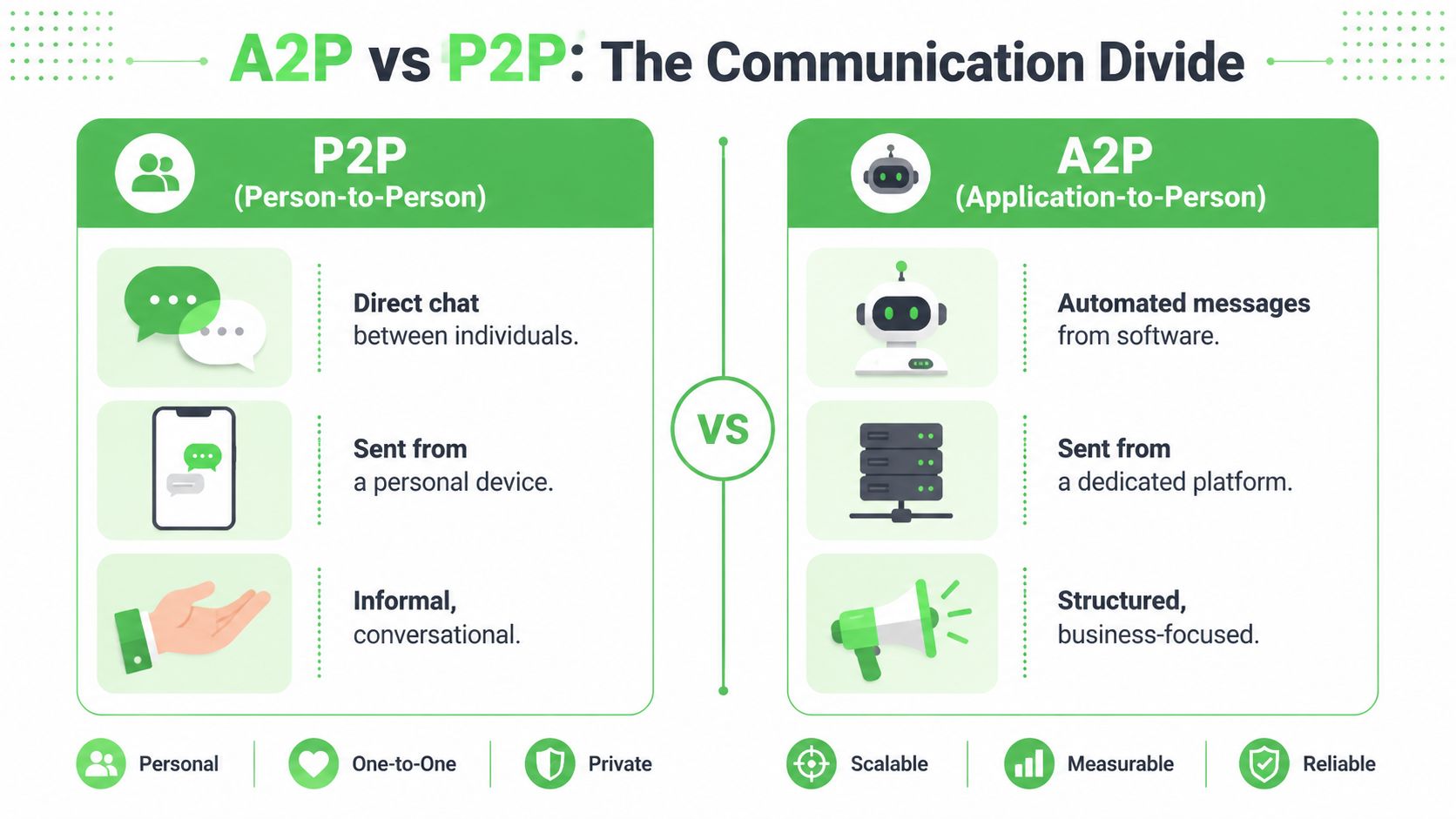
That's the cleanest way to understand it. P2P, or person-to-person messaging, is what happens when a human texts another human in a normal conversation. A2P, or application-to-person messaging, is what happens when software sends a business message automatically to a user. The source, intent, and traffic pattern are different, which is why carriers treat them differently.
The difference carriers actually care about
Arelion describes A2P as a one-directional, automated SMS or MMS technology where software applications send business-critical messages without expecting a reply, while P2P covers organic two-way communication between individuals. The same guide notes that this software-driven architecture routes messages through aggregators or CPaaS providers to mobile carriers and often produces open and read rates exceeding 90%. That framing is useful because it shows why A2P isn't just “bulk texting.” It's a separate operational class of traffic, as outlined in Arelion's guide to what A2P messaging is.
For agency work, three differences matter most:
- Sender origin: P2P starts with a person on a device. A2P starts with a platform, workflow, CRM, chatbot, or automation rule.
- Message purpose: P2P is conversational. A2P is usually informational, transactional, or promotional.
- Scale pattern: P2P stays human-sized. A2P is built for triggered and repeatable delivery.
If you build a reminder system for a dental group, that's A2P. If a salesperson manually texts one prospect from their own phone, that's P2P. If your platform sends follow-ups after a web form submission, that's A2P even if the client thinks of it as “just texting.”
The mistake agencies make is assuming a familiar-looking number means familiar rules. It doesn't. Carrier logic follows traffic behavior, not your internal label.
A2P vs P2P Messaging At a Glance
| Feature | P2P (Person-to-Person) | A2P (Application-to-Person) |
|---|---|---|
| Sender | Human on a phone | Software application or platform |
| Message style | Conversational and reactive | Automated and structured |
| Typical use | One-to-one chat | Alerts, reminders, promotions, codes |
| Direction | Usually two-way | Commonly one-way or limited reply |
| Volume pattern | Low and manual | Higher-volume and repeatable |
| Business fit | Ad hoc outreach | Operational messaging systems |
| Carrier treatment | Personal traffic | Registered business traffic |
The Modern A2P Channels Beyond Just SMS
A client asks for "text marketing," but the delivery decision itself is wider than SMS. If you build the service around the wrong channel, you create avoidable cost, approval delays, and support issues. A2P is the operating model behind all of it. The application sends the message, the customer receives it, and your job is to choose the channel that fits the workflow.
SMS still carries the bulk of business messaging
SMS remains the default starting point because customers do not need to install anything, learn a new interface, or change behavior. For agencies selling reminders, lead follow-up, review requests, and service updates, that matters.
In practice, North American A2P SMS usually runs through short codes, 10DLC, or toll-free numbers. CTIA's messaging guidance and carrier rules shape how those routes are approved and used, as outlined in the CTIA Messaging Principles and Best Practices. For many agency offers, 10DLC is the practical middle ground. It gives clients a local presence and supports standard business messaging, but only if registration, use case alignment, consent records, and message content are set up correctly.
That last part affects margins. If you sell SMS as a simple add-on and ignore setup requirements, your team ends up eating onboarding time, resubmissions, failed campaigns, and client frustration.
WhatsApp belongs in the same A2P conversation
WhatsApp is A2P when software sends the message on behalf of a business. The interface feels conversational, but the business model is still automation, templates, triggered workflows, routing logic, and compliance controls.
Agencies need clearer thinking, especially if they plan to resell messaging as a managed service. There are usually two implementation paths:
- QR gateway setups: Faster to launch, lighter operationally, and often easier for agencies testing demand or onboarding smaller clients quickly.
- Cloud API setups: Better for structured integrations, centralized governance, multi-client scaling, and clients that expect formal platform architecture.
The trade-off is straightforward. QR gateway models reduce friction at the start, but they can introduce account stability, support, and policy risk depending on how the setup is handled. Cloud API deployments usually take more planning and technical work up front, but they give you stronger control over templates, system integrations, permissions, and long-term account management.
That choice affects pricing more than many agency owners expect. A quick-launch WhatsApp offer can sell well, then become hard to support if every client setup is slightly different. A stricter Cloud API model can slow sales, but it is easier to standardize, document, and margin over time.
If you want to see how agencies package triggered messaging in a sellable format, SynaBot for text automation is a useful reference point.
RCS is promising, but not a default offer
RCS can give clients branded interactions, richer content, and a better presentation layer than plain SMS. That does not mean it belongs in every client proposal.
Agencies should treat RCS as a fit-based channel. Check device support, market availability, billing model, and whether the client's workflow benefits from richer message content. For a simple appointment reminder, SMS may still be the better business decision. For a branded customer journey with media and interactive prompts, RCS may justify the added complexity.
The profitable approach is to sell the workflow first, then match the channel to delivery, compliance, and unit economics. That is how you turn A2P from a feature into a service line.
Why A2P Is a Game-Changer for Agencies and Resellers
A2P turns messaging into a service line when you package it around a client workflow with a clear business outcome.
Agency owners see the shift fast once they stop talking about inboxes, templates, or dashboards. Clients pay for faster lead response, fewer missed appointments, cleaner follow-up, more repeat purchases, and better review volume. If you can connect messaging to one of those outcomes, you can price it as monthly revenue instead of a one-time setup.
That matters even more now that A2P is no longer just SMS. WhatsApp, SMS, and in some cases RCS can all support the same commercial goal, but the margin profile is different. A quick WhatsApp setup through a QR-based model may help you close smaller clients faster. A Cloud API deployment usually supports stronger standardization, clearer ownership, and cleaner long-term operations. Agencies that understand that difference can avoid underpricing the service they are about to support for the next 12 months.
Where agencies make money with A2P
Tata Communications describes A2P as the fastest-growing communication protocol and notes that while email engagement sits around 15–25%, A2P messaging can achieve open rates of 98%, with answer rates for A2P calling up to 90%, as covered in Tata Communications' CPaaS knowledge base on A2P messaging. For agencies, the useful point is simple. A channel that gets seen is easier to tie to booked jobs, recovered leads, and retained customers.
The strongest offers usually sit inside existing client operations, not as a separate marketing experiment:
- Lead response automation: New inquiries get an immediate acknowledgment, qualification message, or booking prompt.
- Appointment operations: Reminders, confirmations, and follow-up prompts help service businesses reduce scheduling gaps.
- Retention campaigns: Existing customers get renewal notices, win-back messages, and post-purchase touchpoints.
- Reputation programs: Review requests go out while the service experience is still fresh.
These offers sell because they fit work your agency may already manage through forms, CRM stages, call tracking, or booking flows.
What clients buy
A local business is not shopping for A2P infrastructure. They are trying to close the gap between a customer action and a business response.
In practice, medical, fitness, legal, and home-service clients usually buy one of these packaged outcomes:
| Offer format | What the client sees | What you're delivering |
|---|---|---|
| Missed lead recovery | Faster response to inbound leads | Triggered sequences and routing |
| Reminder system | Better attendance and fewer manual calls | Scheduled A2P messaging |
| Review engine | More reviews after completed service | Timed automation with opt-in logic |
| Reactivation campaign | Old contacts returning to the pipeline | Segmented outreach workflows |
I have found that agencies make better money when they sell the trigger, the workflow, and the reporting together. That keeps the offer tied to business results and gives you a better reason to charge a retainer.
Generic bulk messaging goes in the other direction. It attracts price shoppers, increases support load, and creates more risk if the client has weak consent records or unrealistic send expectations. A narrower offer is easier to implement, easier to document, and easier to margin.
If you want A2P to become a dependable revenue stream, build it around repeatable use cases, pick the right channel for the client, and price for the compliance and support work involved.
Navigating The Critical World of A2P Compliance
This is the part agencies skip until something gets blocked.
A2P isn't a loophole-filled growth channel. It's a regulated messaging environment with carrier rules, consent requirements, and platform-level enforcement. If your agency builds automation without understanding that, your “done for you” service can become a delivery problem fast.
The biggest agency mistake
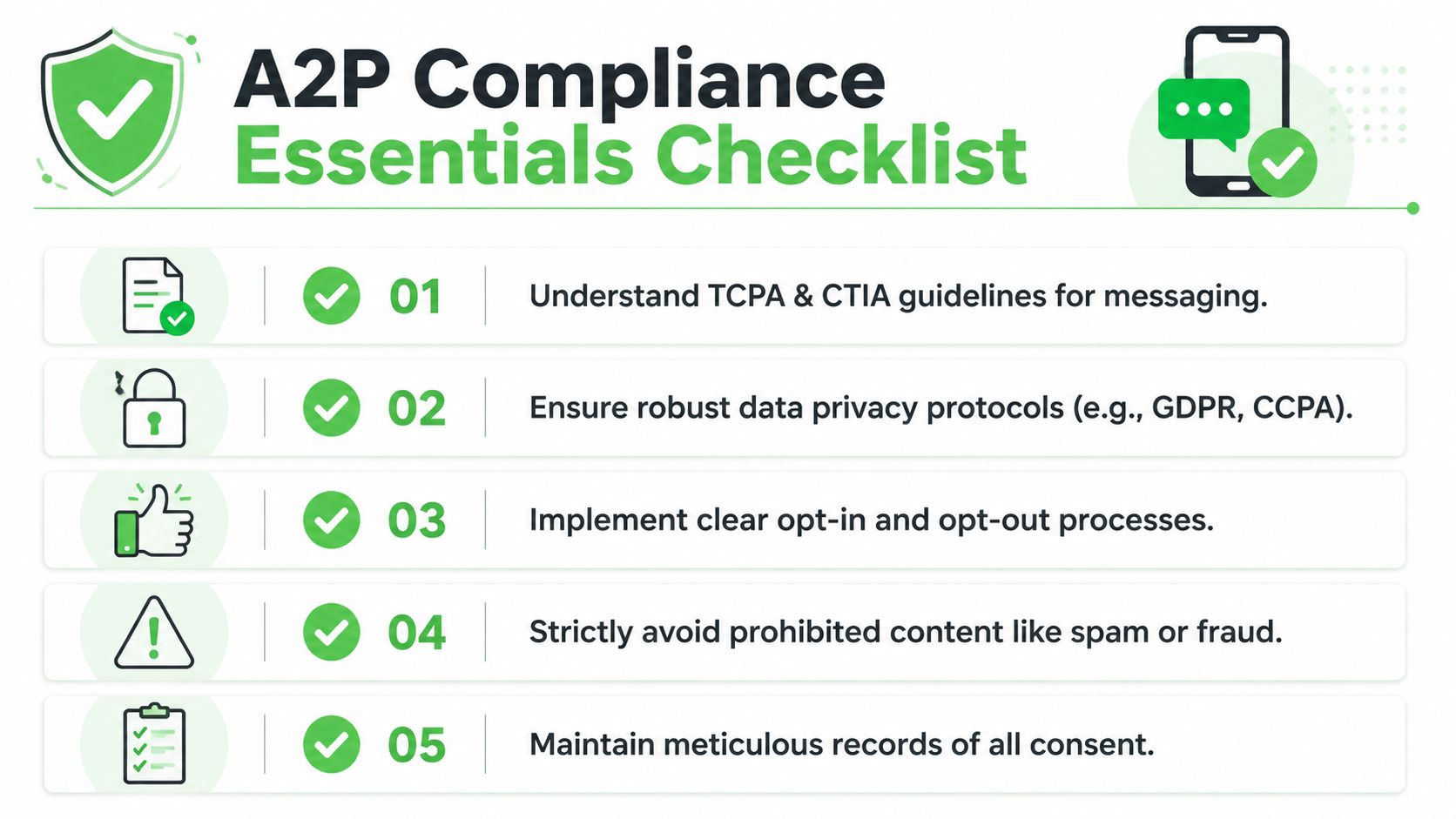
Twixor highlights a compliance gap agencies run into constantly: carriers now require TCR approval for all automated SMS traffic from 10-digit long codes, and agencies that assume automated WhatsApp or SMS activity can bypass this often find their messages blocked immediately. Twixor's explanation is useful because it reflects how carriers classify the traffic in practice, not how agencies prefer to describe it, as noted in Twixor's article on what A2P messaging means for automated business traffic.
That creates a hard operational rule. If you're sending automated SMS through a 10-digit long code in the US, you need to think in terms of brand registration, campaign registration, and provable consent before launch.
The second mistake is treating consent like a checkbox buried in a form builder. A2P frameworks require a higher standard than casual lead capture. The verified guidance distinguishes between general consent for account updates and express written consent for marketing messages. Agencies that mix those use cases under one vague opt-in create risk for themselves and their clients.
What compliant operations look like
A compliant agency setup usually has these pieces in place:
- Clear collection language: The contact knows what type of messages they're agreeing to receive.
- Channel-specific logic: Transactional and marketing workflows aren't lumped together carelessly.
- Stored consent records: Your team can show where the opt-in happened if a client or provider asks.
- Registered traffic paths: Especially for US 10DLC programs, registration is handled before campaigns go live.
Here's the practical lens I use. If your onboarding team can't answer “where did this person opt in?” in under a minute, the system isn't ready.
Compliance isn't the tax you pay after growth. It's part of the product you're selling.
That matters for WhatsApp-adjacent offers too. Agencies often pitch WhatsApp automation as if it lives outside the rules they already know from SMS. It doesn't. Different platforms have different mechanics, but once you're automating business communication, you need clean consent, message-policy discipline, and a launch process that won't collapse when a provider reviews the account.
Choosing Your A2P Implementation Path
You feel the implementation choice when a client asks a simple question: “Can you add WhatsApp, keep costs predictable, and have this live next week?” At that point, your margin depends less on message copy and more on the stack underneath it.
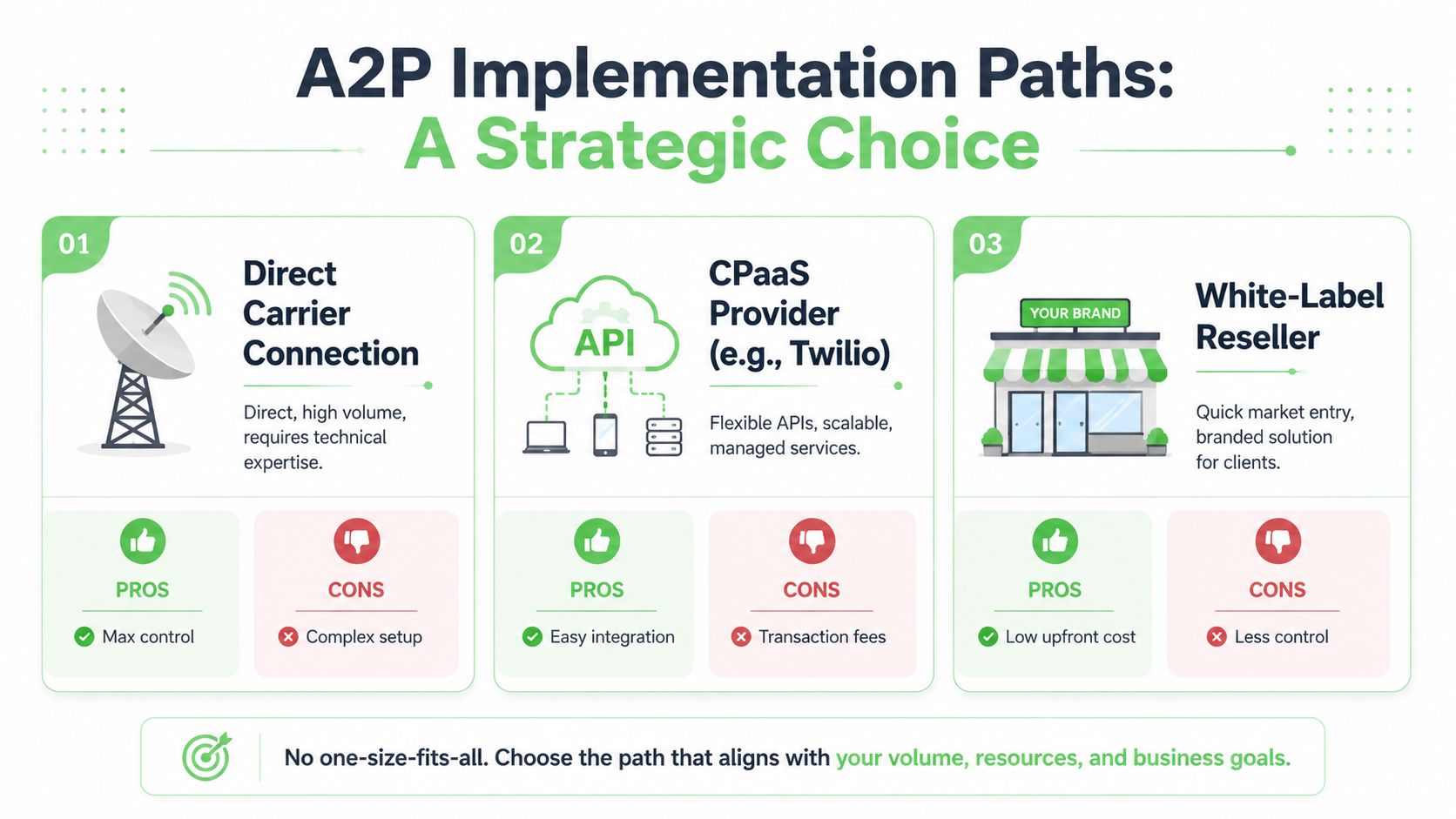
Agencies usually choose between three paths. Build close to the infrastructure with direct integrations. Use a CPaaS platform for programmable control. Or package a gateway or white-label product for speed. Each route can work. The mistake is choosing based on feature lists instead of delivery model, support load, and resale economics.
Direct integration gives control and puts more on your team
Going direct makes sense when messaging is becoming a real product line for your agency. You get more say over routing, number strategy, workflow design, and how tightly messaging connects to client systems.
You also take on the hard parts yourself. Provisioning, exception handling, registration workflows, delivery troubleshooting, and client-specific edge cases stop being someone else's problem. If your team does not already handle technical implementation well, this path turns a profitable service into an operations project.
For agency owners, the question is simple. Do you want to sell messaging, or do you want to run messaging infrastructure?
CPaaS gives flexibility, but margin discipline matters
CPaaS is often the middle ground. It gives your developers APIs, webhooks, and room to build custom flows without requiring you to own the full carrier relationship.
That flexibility helps when clients want more than basic reminders. It also helps when your roadmap includes multiple channels, custom triggers, or deeper CRM integration.
This model works well when you need:
- Developer control: Your team wants APIs, webhooks, and custom logic.
- Multi-channel options: You may add SMS, voice, or app-based messaging later.
- Custom delivery flows: Client requirements differ enough that templates alone will not hold up.
The trade-off is commercial, not technical. Usage pricing looks manageable on the first few accounts. Then you add registration fees, support time, failed delivery investigations, opt-out handling, and client requests for custom reporting. If you charge a flat monthly fee without modeling those variables, the account can stay busy and still lose money.
I have seen agencies underprice this layer because they focus on send cost and ignore labor. Labor is usually what hurts first.
Gateway and white-label models usually fit agencies selling packaged services
If your business wins on fast onboarding, repeatable fulfillment, and client-friendly packaging, gateway and white-label options are often the better choice.
That is especially true for WhatsApp offers. Many agencies do not need full custom API development on day one. They need a reliable way to get clients live, train staff quickly, and avoid technical delays that stall revenue. In practice, this often comes down to one key WhatsApp decision: a QR-based gateway or the official Cloud API.
A QR gateway is faster to launch and easier to sell into smaller businesses that want immediate access with lower setup friction. The downside is stability, scale, and policy risk. If the connection depends on a linked device session, support tickets follow. That may be acceptable for low-volume local service clients. It is a weak foundation for a serious multi-client program.
Cloud API takes more setup and usually more client education, but it is the better long-term option for agencies that want predictable delivery, cleaner account structure, and a service they can scale without constant intervention. It also forces better process discipline, which is good for margins even if it slows the first sale.
Use this comparison to match the path to your operating model:
| Decision factor | Direct carrier or deep API route | CPaaS model | Gateway or white-label model |
|---|---|---|---|
| Speed to launch | Slowest | Moderate | Fastest |
| Technical overhead | Highest | Medium | Lowest |
| Pricing predictability | Varies by contract | Often usage-based | Often simpler to package |
| Branding control | High | Medium | High for client-facing resale |
The best path is the one your team can sell, implement, support, and renew without rebuilding the process for every account. If you are planning a WhatsApp service, choose with resale economics in mind. Fast setup helps you close. Predictable support and pricing help you keep the revenue.
Your Practical Plan for Launching A2P Services
A client calls after hours. A lead form came in, nobody replied for 18 minutes, and the prospect booked with a competitor. That is the kind of problem A2P should solve first.
Start with one narrow offer
Start with a service tied to revenue or operational throughput. Lead acknowledgments, appointment reminders, missed-call text-back, and post-service review requests work well because the value is easy to explain and the result is easy to track.
This matters for agencies because broad messaging retainers are hard to sell early. A single workflow with a clear trigger, message, and business outcome is easier to price, launch, and renew. It also exposes delivery issues early, including consent gaps, bad CRM data, slow client approvals, and channel fit.
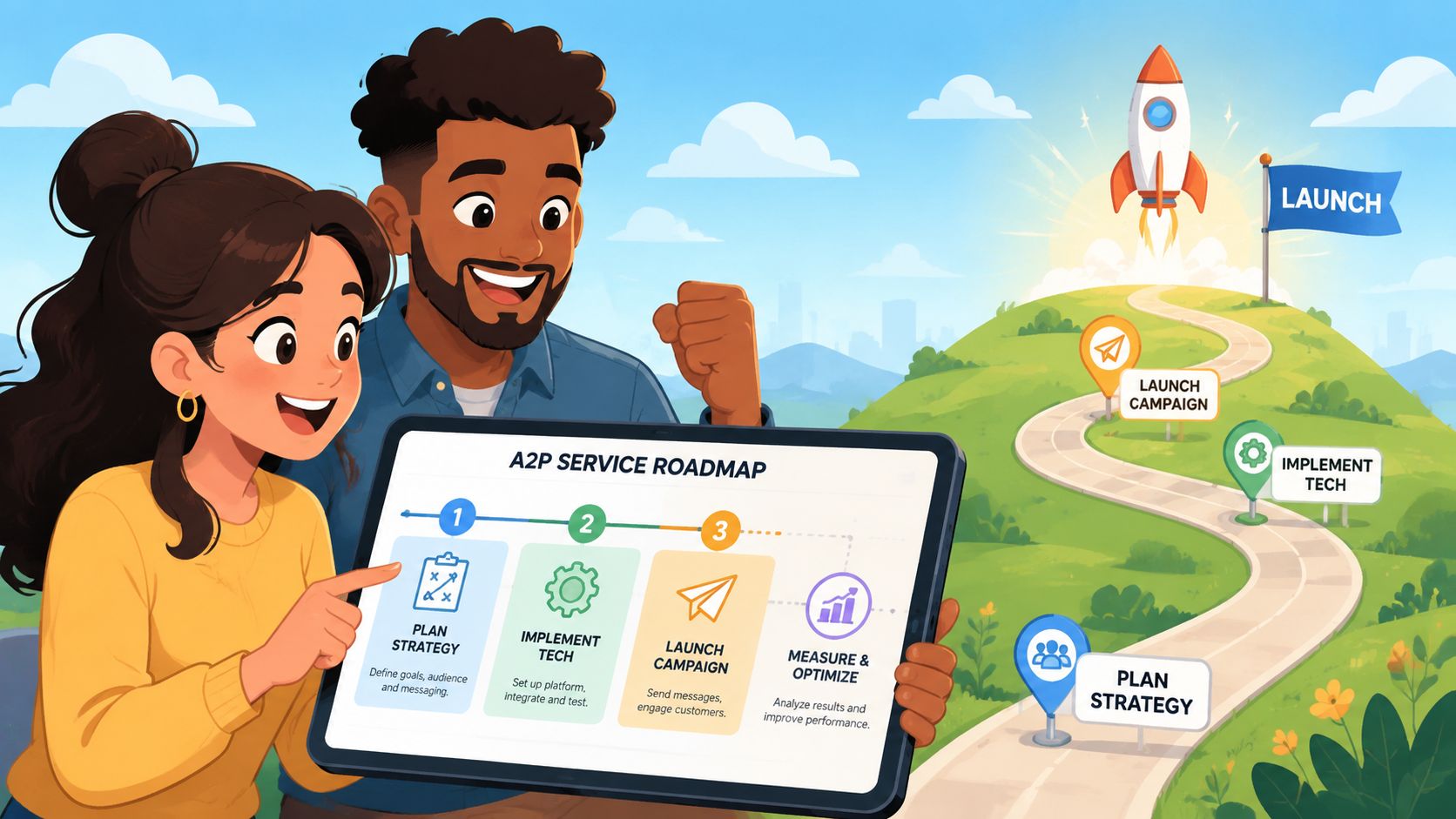
Use a simple launch sequence:
- Choose one trigger: form submission, booked appointment, completed job, or inbound call.
- Set one message goal: confirm, remind, prompt a reply, or recover the lead.
- Document consent: make sure the opt-in path is clear before any automation goes live.
- Track the business outcome: delivery, replies, clicks where relevant, and downstream conversion.
If you are packaging WhatsApp, sell the workflow, not just the number connection. Many clients assume setup is the product. It is not. The product is faster response time, fewer missed opportunities, and cleaner follow-up. If your team is building intake or support flows, this guide on how to set up WhatsApp chatbots is a useful companion resource.
Show the client what success looks like
Reporting needs to tie messaging to business events. Show booked appointments, recovered leads, response times, no-show reduction, and completed follow-ups. That is what gets a messaging service renewed.
I have seen agencies lose good accounts because they reported activity instead of outcomes. A client does not care that 2,400 messages were sent. They care that missed-call text-back produced 19 booked jobs, or that reminders reduced front-desk workload enough to avoid hiring.
After the first workflow is stable, use this walkthrough as a visual reference for explaining an automated messaging setup to non-technical clients:
Keep the offer narrow, but build the delivery model with scale in mind. If you start clients on a QR-based WhatsApp gateway, set expectations around support, session dependency, and upgrade paths. If you start with Cloud API, price for the longer onboarding cycle and make template approval part of your implementation checklist. Those choices affect margin more than most agencies expect.
Your agency does not need every channel on day one. You need one repeatable service, one compliant onboarding process, and one pricing model that still holds up when client usage grows.
If you want to launch a white-labeled WhatsApp offering without dragging your team into a long setup cycle, Double My Leads is built for that agency model. You can onboard clients quickly, connect numbers with a QR-based workflow, support Cloud API when needed, and resell under your own branding with more predictable margins than usage-heavy messaging stacks.


