
Conversational AI is no longer a side tool. It's a category agencies can package, resell, and build recurring revenue around. The market is projected to reach USD 16.09 billion in 2026 and expand at a 23.0% CAGR, reaching USD 68.52 billion by 2033 according to Coherent Market Insights on the conversational AI market.
That matters because WhatsApp has changed the economics of lead response. Prospects don't want a form submission and a delayed callback. They want an answer in the thread they already use, at the moment intent is highest. For an agency, that creates a very practical offer: deploy conversational AI agents that qualify leads, answer common objections, route conversations, and support clients without forcing a business to staff WhatsApp around the clock.
The agencies that win with this don't sell “AI” in the abstract. They sell outcomes. Faster lead capture. Cleaner qualification. Fewer missed inquiries. Better handoff to sales and support. If you work with local businesses, info product brands, SaaS, or community-led companies, WhatsApp is one of the easiest places to turn conversational AI into a productized service.
If you want a useful primer on the broader model behind these systems, Halo AI's guide on understanding autonomous agents for B2B SaaS is worth reading because it frames agents as operational workers, not just chat interfaces.
Table of Contents
- The Rise of Conversational AI Agents
- The Four Types of Conversational AI Agents Explained
- How Conversational AI Agents Actually Work
- Practical Use Cases for Agencies on WhatsApp
- Integrating and Deploying Your First AI Agent
- Measuring Success and Avoiding Common Pitfalls
- Your Agency's Next Revenue Stream
The Rise of Conversational AI Agents
Most agencies still treat chat automation like a nicer FAQ bot. That's too small.
A conversational AI agent is better thought of as a digital team member with a narrow job description. On WhatsApp, that job might be qualifying inbound leads, collecting project requirements, booking calls, answering service questions, or routing a conversation to the right human with context intact. The difference is important. A basic bot reacts. An agent manages a task across multiple turns.
Why agencies should care now
The opportunity isn't just technical. It's commercial. Agencies already know how to package communication, lead generation, nurture, and conversion support. Conversational AI fits directly into those offers because it sits where buyer intent shows up first: the conversation.
For client services, that changes positioning. Instead of selling “WhatsApp setup,” you can sell:
- Lead qualification workflows that screen fit before a sales rep joins
- Appointment booking flows that move prospects into calendars
- Support deflection for repetitive questions
- Post-click conversion handling from ads, QR codes, landing pages, and community funnels
Practical rule: If a client gets the same WhatsApp question every day, an agent should handle the first layer of that conversation.
What separates agents from old chatbots
The market has moved from static scripts to systems that can hold context, decide the next best action, and pull information from tools or knowledge sources when needed. That shift is why agencies should stop selling “chatbots” as a commodity and start selling managed conversational operations.
The key commercial insight is simple. You don't need an agent that does everything. You need one that reliably completes one profitable job. On WhatsApp, one profitable job can be enough to justify a monthly retainer, especially when the agency also owns the funnel, the messaging, and the reporting.
The Four Types of Conversational AI Agents Explained
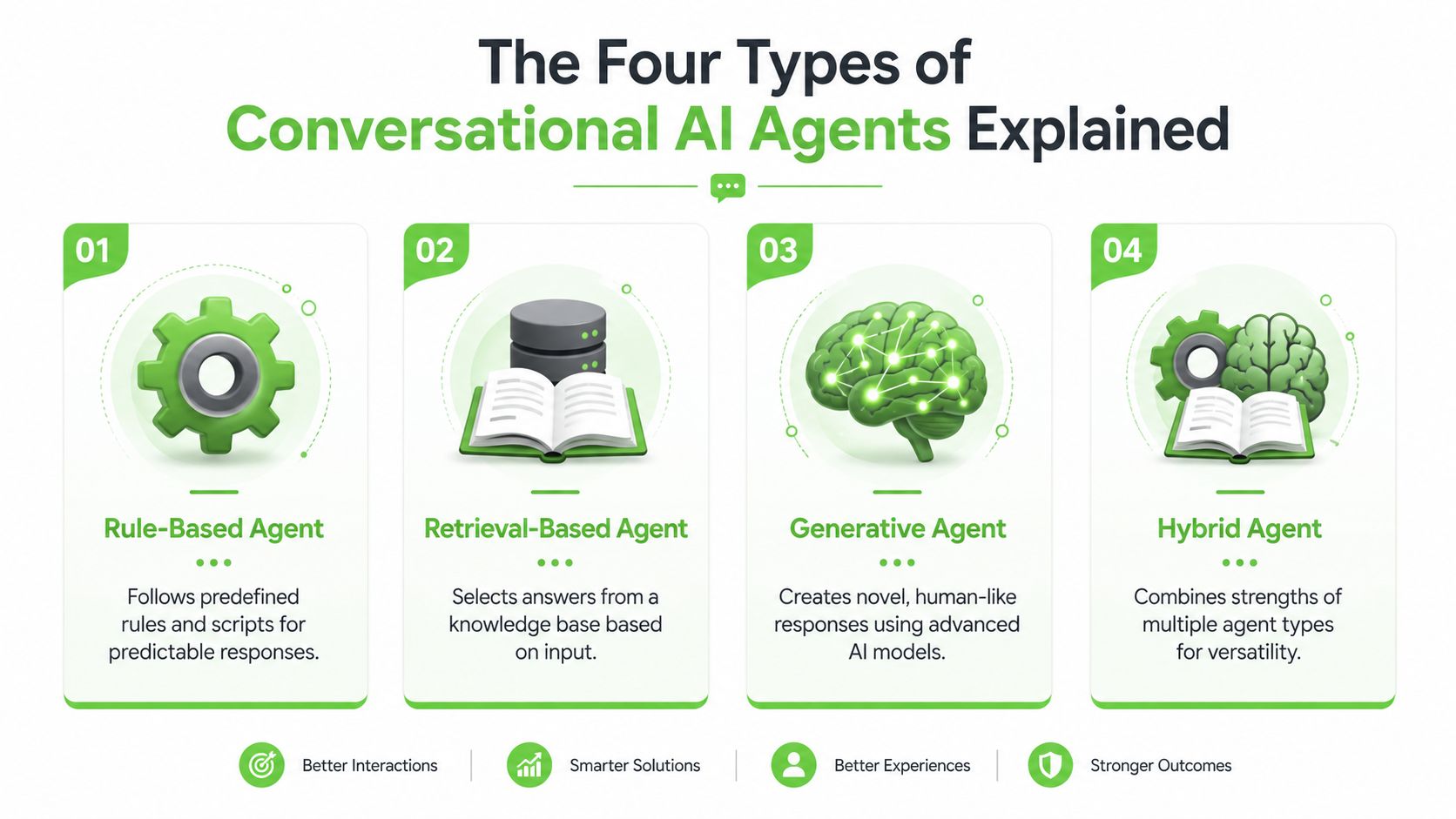
Agencies make better deployment decisions when they stop asking, “Do we need AI?” and start asking, “What kind of worker are we hiring?”
Think of agents like employees
A rule-based agent is like a junior assistant with a checklist. It follows paths you define. If a lead says they want pricing, the agent asks a prepared set of questions and routes them based on the answers. This is the best fit for narrow, predictable workflows.
A retrieval-based agent is like a librarian. It doesn't invent answers. It looks through approved information and returns the closest relevant response. This is useful when a client has a service manual, onboarding docs, policy answers, or a well-maintained knowledge base.
A generative agent is like a strategist who can draft custom responses on the fly. It's flexible and can handle less predictable questions, but it also needs stronger guardrails. Without those guardrails, it can become verbose, vague, or overly confident.
A hybrid agent is the experienced operator. It combines scripted flows, knowledge retrieval, and generative response layers. For most agency-grade WhatsApp deployments, this is the sweet spot because it balances control with flexibility.
The best-performing client builds usually aren't the most “intelligent.” They're the most constrained in the right places.
Comparing conversational AI agent types
| Agent Type | Core Function | Best For | Analogy |
|---|---|---|---|
| Rule-based | Follows predefined decision trees and scripts | FAQ routing, intake forms, simple qualification | Junior assistant |
| Retrieval-based | Pulls answers from approved content | Support docs, onboarding help, policy questions | Librarian |
| Generative | Creates original responses from model reasoning | Open-ended conversation, nuanced qualification, message drafting | Creative strategist |
| Hybrid | Combines rules, retrieval, and generation | Revenue workflows on WhatsApp, support plus escalation, more realistic sales conversations | Experienced manager |
Which one should an agency resell
For lead generation, start simpler than you think. A lot of agencies jump straight into generative agents because the demos look impressive. In practice, high-converting WhatsApp flows usually need controlled question order, clear qualification criteria, and reliable routing. That points to rule-based or hybrid systems.
For client service, retrieval and hybrid models tend to be safer because they keep answers tied to approved source material. That matters when a client wants brand consistency and fewer messy escalations.
A practical packaging model looks like this:
- Starter build: Rule-based lead capture and routing
- Growth build: Hybrid qualification with calendar booking and CRM sync
- Service build: Retrieval-based support plus human escalation
- Premium build: Hybrid sales and support agent with managed optimization
This framing helps clients buy based on business need, not model jargon.
How Conversational AI Agents Actually Work
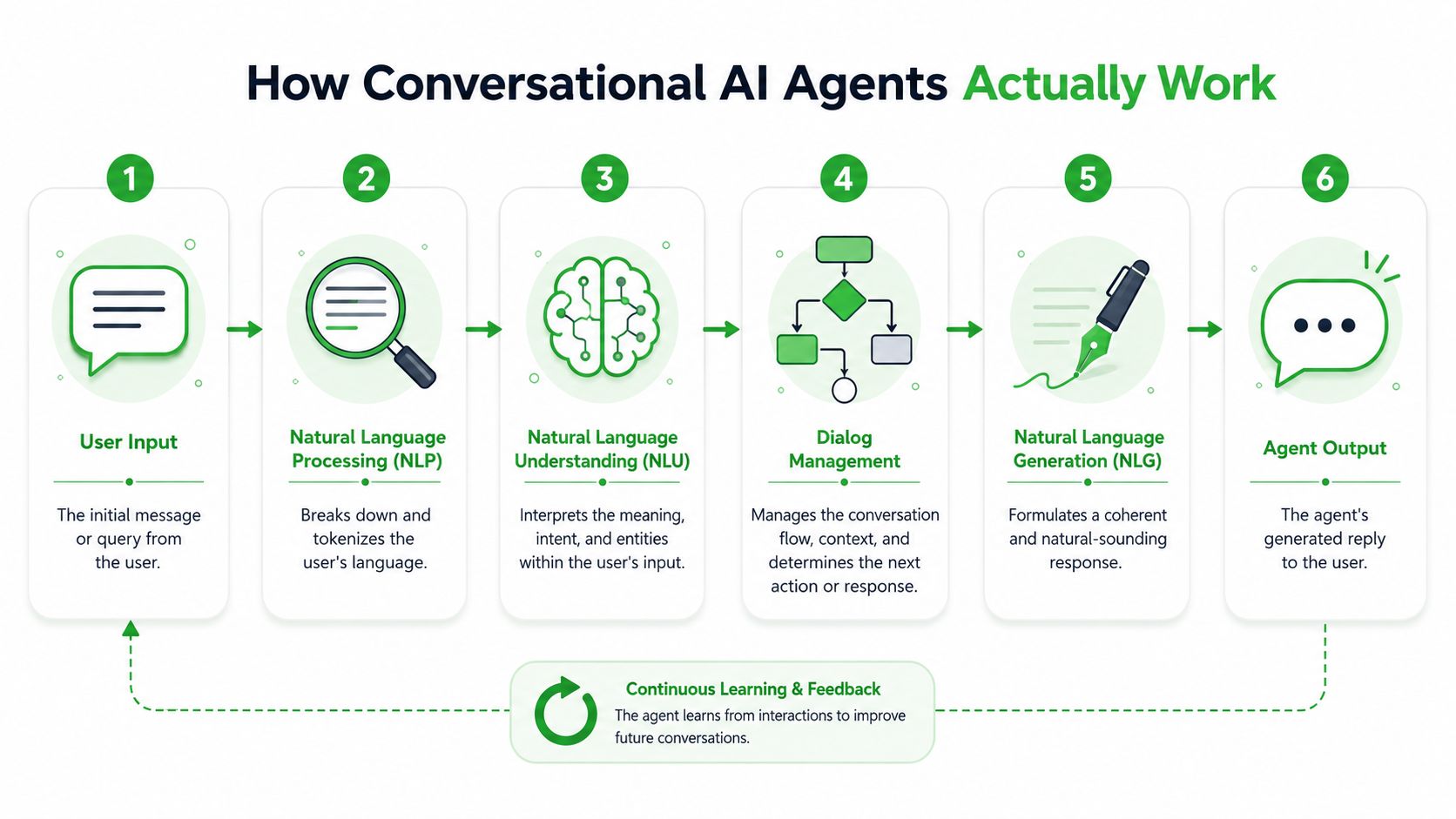
Most clients don't need a machine learning lecture. They need a clear explanation of why the agent answered correctly, why it failed, and when a human should step in.
The digital brain behind the chat
A useful mental model is to think of conversational AI agents as a digital brain with separate parts doing separate jobs.
NLP is the ear. It breaks the incoming message into parts the system can process.
NLU is the comprehension layer. It tries to identify intent, meaning, and important details. If a user says, “I run a dental clinic and need more booked consults,” this layer should catch business type, service intent, and likely lead-generation context.
The dialog manager is the operator. It decides what happens next. Ask another question? Pull a knowledge answer? Trigger a booking link? Escalate to a rep?
A vector database acts like long-term memory for documents and prior useful context. When the system needs to answer from stored material, this is often where the retrieval process starts.
The LLM is the response engine. It turns instructions, retrieved facts, and conversation context into a natural reply that sounds human enough for chat.
Where agencies oversell the technology
The current market trend is moving from simple bots to conversational agents with dynamic multi-turn interactions, but the important caveat is that these systems still struggle with complex goals when cultural context is missing, which is why human oversight remains essential, as noted by Enkrypt AI's discussion of conversational agents and their challenges.
That sentence should shape how you sell this service.
Don't tell clients the agent “understands people” in the human sense. It doesn't. It processes language patterns, remembers selected context, and follows instructions with varying reliability. That's powerful. It's also limited.
A clean agency explanation clients understand
When I explain this to agencies, I keep it operational:
- Input layer: The lead sends a WhatsApp message
- Interpretation layer: The system identifies likely intent
- Decision layer: The workflow decides the next action
- Knowledge layer: The agent pulls approved information if needed
- Response layer: The message is written and sent
- Escalation layer: A human takes over when confidence drops or stakes rise
That's enough detail to speak credibly without pretending the system has human judgment.
Practical Use Cases for Agencies on WhatsApp
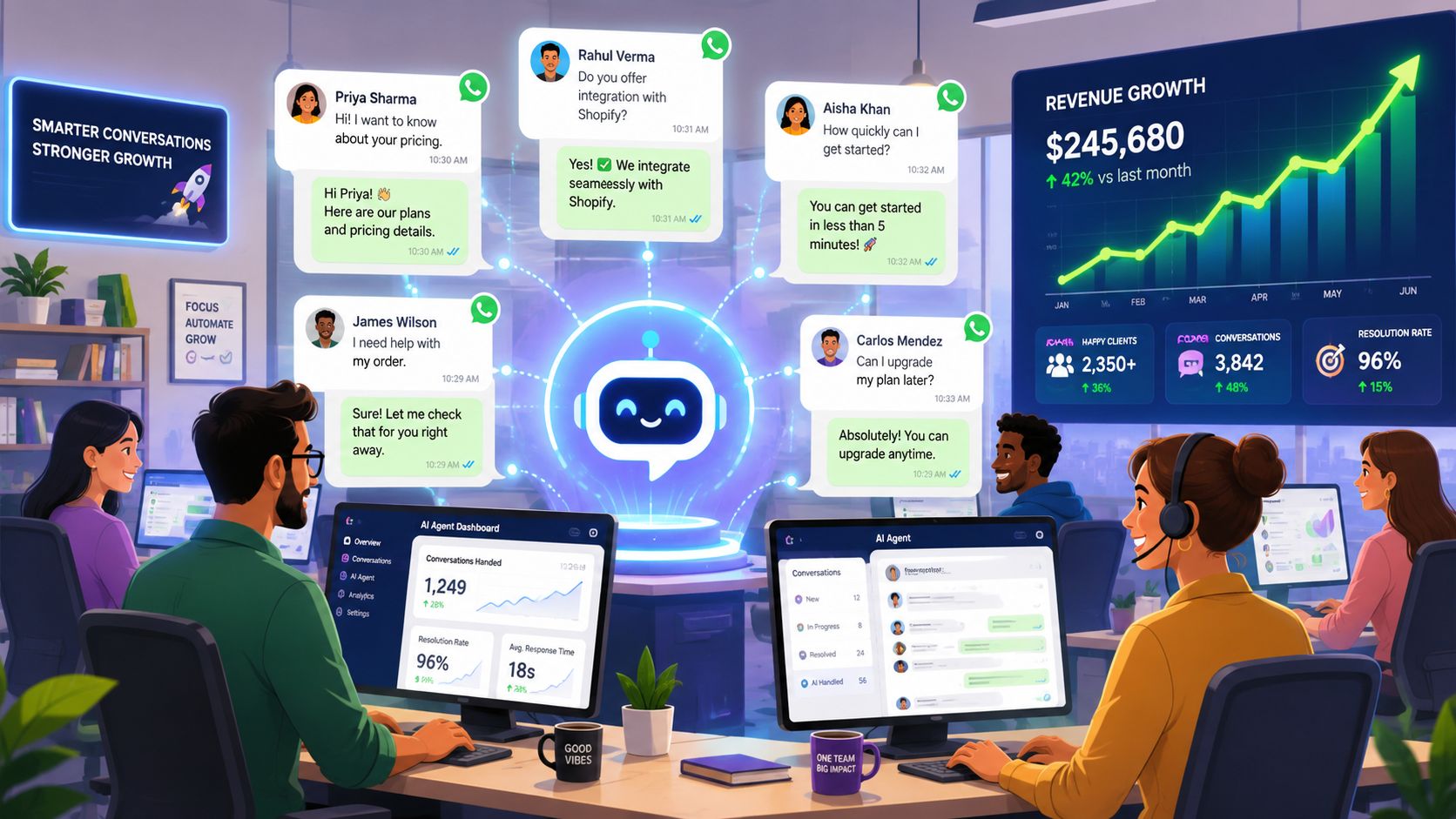
WhatsApp is where conversational AI agents stop sounding futuristic and start becoming billable.
Clients already use the app. Leads already reply there. Teams already check it all day. That means you don't need to teach a new behavior. You need to tighten the workflow.
User sentiment is moving in your favor too. 71% of customers are satisfied with AI-powered support, and 83% of customer service organizations already use AI-powered support bots, according to ControlHippo's AI agents trends overview.
Lead generation that doesn't stop after business hours
A common agency scenario looks like this. You run paid traffic for a client. The ad drives to a landing page with a WhatsApp CTA. A lead clicks at night, asks about pricing, service fit, or availability, and expects a response now, not tomorrow.
A well-built agent can handle that first touch:
- Qualify the lead: Ask business type, location, budget range, timing, or service need
- Answer the first objections: Clarify scope, process, or whether the offer is a fit
- Route correctly: Send hot leads to a calendar, medium-fit leads to nurture, and edge cases to a rep
- Capture attribution: Tag where the lead came from so the agency can report by source
For agencies doing outbound or audience research, good inputs matter. If you're enriching lead targeting from public creator or social data, ScrapeCreators' blog on scraping APIs is a practical resource for understanding how teams gather structured signals before the WhatsApp conversation even starts.
A WhatsApp agent doesn't need to close the deal alone. It needs to keep momentum until the right human step happens.
Client service offers agencies can resell
The second opportunity, service delivery, allows agencies to move from one-off implementation fees to ongoing retainers.
Good WhatsApp service offers include:
- Onboarding assistants for collecting missing information after a sale
- Appointment reminders that reduce no-show friction
- Support triage for repetitive requests before they hit a human queue
- Community support flows that answer routine member questions
- Reactivation campaigns that turn old leads back into active conversations
A useful example is local service businesses. The agent can collect inquiry details, confirm service area, answer simple pricing structure questions, and pass complete context to staff. The business responds faster without forcing the owner to live in WhatsApp.
Here's a walkthrough that shows the style of workflow many agencies now build into chat-led funnels:
What works best on WhatsApp is concise messaging, short decision trees, and clear escape hatches to a person. Long essays don't convert. Neither do agents that ask six questions before offering help.
Integrating and Deploying Your First AI Agent
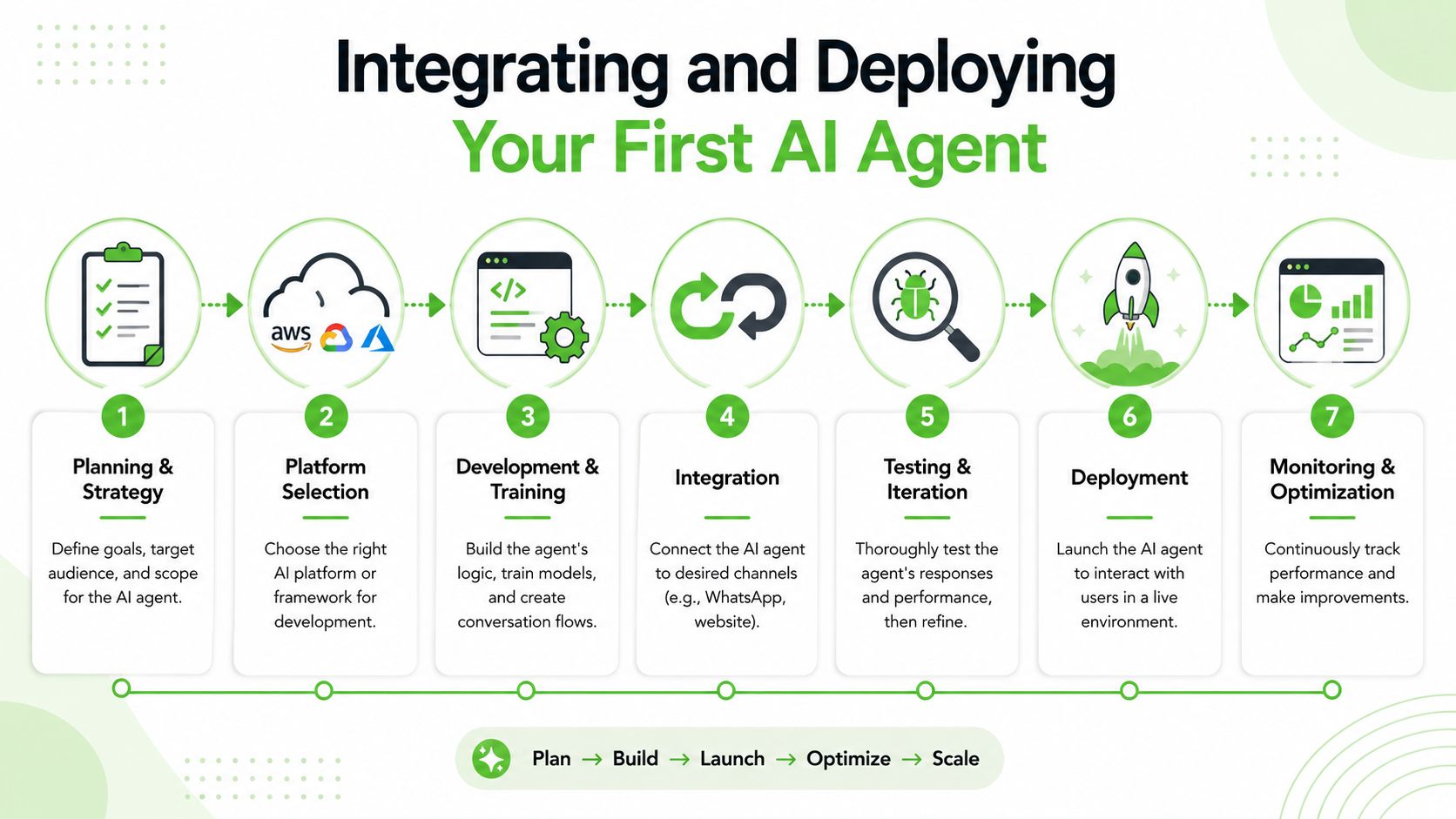
The build usually gets stuck because agencies start with tooling instead of workflow. Start with the job the agent must complete. Then choose the setup that matches that job.
Choose the deployment model first
There are usually two broad paths.
The first is a fast operational setup. This is ideal when you want to get a client live quickly, validate the flow, and prove there's demand. The main advantage is speed. Agency teams can focus on scripting, routing, and inbox management instead of spending their first week wrestling with infrastructure.
The second is a custom integration setup. This is the better fit when a client needs deeper CRM logic, custom backend actions, external tool triggers, or a more customized data model. It gives you more flexibility, but it also increases implementation complexity and testing overhead.
Neither path is universally better. The right choice depends on the client's risk tolerance, internal systems, and how custom the workflow really needs to be.
A simple launch checklist
Use this checklist before you deploy any client-facing agent on WhatsApp:
Define one job only
Start with a single outcome such as qualify a lead, book a call, or triage support.Map the first seven turns
Don't script everything. Script the opening, the likely branches, and the recovery path when a user goes off-script.Set escalation rules early
Decide which intents always go to a human, such as refunds, urgent complaints, or high-value sales conversations.Connect the minimum systems
Calendar, CRM, inbox, and approved knowledge are usually enough for version one.Test with messy inputs
Real users send voice notes, half sentences, slang, screenshots, and mixed questions. Test for that.Review brand voice
WhatsApp is personal. An agent that sounds stiff or corporate loses trust fast.Launch narrowly
Put the agent on one traffic source or one client workflow first. Expand after the team reviews transcripts.
Field note: A narrow agent that handles one conversation well is worth more than a broad agent that confuses people.
The agencies that deploy fastest aren't the ones with the fanciest stack. They're the ones that make clear decisions about scope.
Measuring Success and Avoiding Common Pitfalls
If you only track reply volume, you'll miss the full story.
A WhatsApp agent can generate lots of activity and still hurt revenue if it answers loosely, forgets what the user said, or hands off badly. The strongest evaluation frameworks go deeper than “did the bot respond.”
What to measure beyond reply volume
For conversational AI agents, the useful quality checks include Conversation Relevancy, Knowledge Retention, and Role Adherence. Those are the metrics that tell you whether the agent stayed on topic, remembered what the user already shared, and maintained the right persona across the conversation.
In practice, those metrics matter more than many dashboard vanity numbers because they map directly to sales and service outcomes. If a lead says they need help for a med spa in Miami and the agent later asks what type of business they run, that's a retention failure. If the agent drifts into generic advice instead of answering the question, that's a relevancy failure.
You should also watch two system-level checks closely:
- Tool Correctness: Did the agent use the right action, source, or connected system?
- Handoff Correctness: Did it escalate at the right moment with the right context?
According to Master of Code's analysis of AI agent evaluation, failures in Tool Correctness and Handoff Correctness degrade Conversation Completeness, reducing containment by up to 25% and lowering CSAT by 10 to 15 points in enterprise benchmarks.
The handoff is where most builds fail
This is the part too many agency demos ignore.
A human handoff isn't just “send to support.” The human must receive the conversation reason, the facts already collected, and the actions the agent already attempted. If that context disappears, the customer has to repeat themselves, and the whole experience feels broken.
The practical rule is simple:
- Preserve the reason for contact
- Pass the collected data
- Show what the agent already tried
- Make the transition visible to the user
If the client's staff opens the thread and asks, “How can I help you?” after ten prior messages, the automation didn't save time. It created friction.
There's also a governance side agencies shouldn't skip. WhatsApp workflows often touch personal data, support details, and sales intent. Keep access tight, define who can view threads, and avoid giving the agent open-ended permission to improvise on sensitive topics. Privacy mistakes are harder to repair than prompt mistakes.
Your Agency's Next Revenue Stream
Most agencies don't need another service that depends on constant custom creative work. They need offers that are easier to standardize, easier to retain, and directly tied to client response speed and conversion handling.
That's why conversational AI agents fit so well as an agency product. They sit at the intersection of lead generation, client service, and automation. They can be scoped into clear deliverables. They can be layered into monthly optimization retainers. And on WhatsApp, they live inside a channel clients already value because that's where real conversations happen.
The strongest positioning is straightforward. Don't sell an “AI bot.” Sell a managed WhatsApp revenue workflow. Sell lead qualification. Sell after-hours response. Sell booking and routing. Sell support triage with clean escalation. Those are services clients understand and keep paying for.
Agencies that do this well usually start small. One use case. One client segment. One repeatable workflow. Then they tighten scripts, improve handoffs, review transcripts, and turn the process into a standard offer.
There's still a lot of hype in this category. That creates noise, but it also creates room for agencies that can implement the boring parts properly. The winners won't be the ones with the flashiest demo. They'll be the ones whose agents answer clearly, route cleanly, and help clients capture more conversations that would otherwise go cold.
If you want to launch a white-labeled WhatsApp offer without turning setup into a development project, Double My Leads is built for agencies and SaaS teams that want to resell WhatsApp automation fast. You can connect numbers, manage client inboxes, deploy AI agents, and package the whole service under your own brand so you can start selling a real WhatsApp workflow offer instead of piecing one together from separate tools.


