
Most advice about Meta Business Agent starts from the wrong premise. It treats the tool like a finished, universal sales layer that agencies can roll out across client accounts with almost no downside.
That's not how agency implementation works.
For agencies, the pertinent question isn't whether Meta Business Agent can answer messages or book appointments. It can. Instead, the central question is whether the control model, data policy, rollout limitations, and ecosystem dependency fit the promises you make to clients. If you sell privacy, flexibility, and white-labeled infrastructure, the “free” story gets a lot less attractive.
The other problem is confusion about what this product is. If you need a sharper framing before evaluating tools like this, this explainer on what is an AI agent in business is useful because it separates agent marketing from the operational reality agencies have to manage.
Table of Contents
- Beyond the Hype What Is the Meta Business Agent
- The Core Mechanics of the Meta Business Agent
- Capabilities vs Critical Limitations for Agencies
- The Agency Dilemma Data Privacy and Platform Lock-In
- How Meta Business Agent Compares to Other Solutions
- A Better Path The White-Label Agency Model
- Frequently Asked Questions for Agencies
- Is Meta Business Agent a good fit for every agency client
- Can non-U.S. agencies standardize on it yet
- Is the setup actually hands-off
- Is the free tier really free for agencies
- Can agencies use it as a white-label client solution
- Can it work with external websites and broader workflows
- Should agencies ignore Meta Business Agent completely
Beyond the Hype What Is the Meta Business Agent
Meta wants agencies to see Business Agent as free automation inside its messaging apps. That framing is useful for Meta. It is incomplete for agencies.
A more accurate definition is a Meta-controlled AI layer for handling customer conversations across WhatsApp, Messenger, and Instagram. If you need a plain-language primer on the category itself, this guide on what is an AI agent in business is a good reference point. The agency question is narrower. What do you gain by using Meta's version, and what do you give up?
The answer depends less on the demo and more on your client mix, region, and risk tolerance.
What it is in practice
Meta Business Agent is best treated as an inbox automation feature inside Meta's own ecosystem. It can help businesses respond to repetitive inbound questions, qualify simple requests, and keep conversations moving after hours.
That sounds useful because it is useful, in a narrow band of cases.
The problem is that many write-ups blur the line between a channel-native assistant and a real agency-grade system. Those are not the same thing. Agencies usually need control over handoffs, data retention, audit trails, CRM sync quality, escalation rules, and cross-channel continuity. Meta's tool starts inside Meta's walls, and that design choice shapes everything that follows.
Where agencies get misled
The biggest blind spot is the word free.
Free software from a platform company usually means the platform gets stronger while your operating flexibility gets weaker. If an agency builds client communication flows, lead qualification habits, and reporting assumptions around Meta Business Agent, switching later gets harder. The cost shows up as migration work, process rewrites, retraining, and lost visibility into how customer data moves.
Privacy risk is the second issue that gets softened in launch coverage. Agencies serving healthcare, finance, legal, education, or multi-location brands cannot treat conversation data as a casual input. Before adoption, they need clear answers on what data is stored, how it is processed, what controls exist for deletion and retention, and how that setup fits the client's own compliance obligations. If those answers are vague, the tool is not ready for that account.
Regional access is another point many guides skip. U.S. agencies will see the broadest near-term fit. Non-U.S. businesses should be much more careful. Availability, feature depth, support, and rollout timing can vary sharply by market, which means an agency can end up pitching a workflow that the client cannot fully use or cannot scale with confidence.
For a local business that already lives inside Meta's apps, that trade-off may be acceptable. For agencies that sell strategic control, compliance discipline, and long-term ownership of the customer journey, Meta Business Agent is not just a productivity tool. It is a platform dependency decision.
The Core Mechanics of the Meta Business Agent
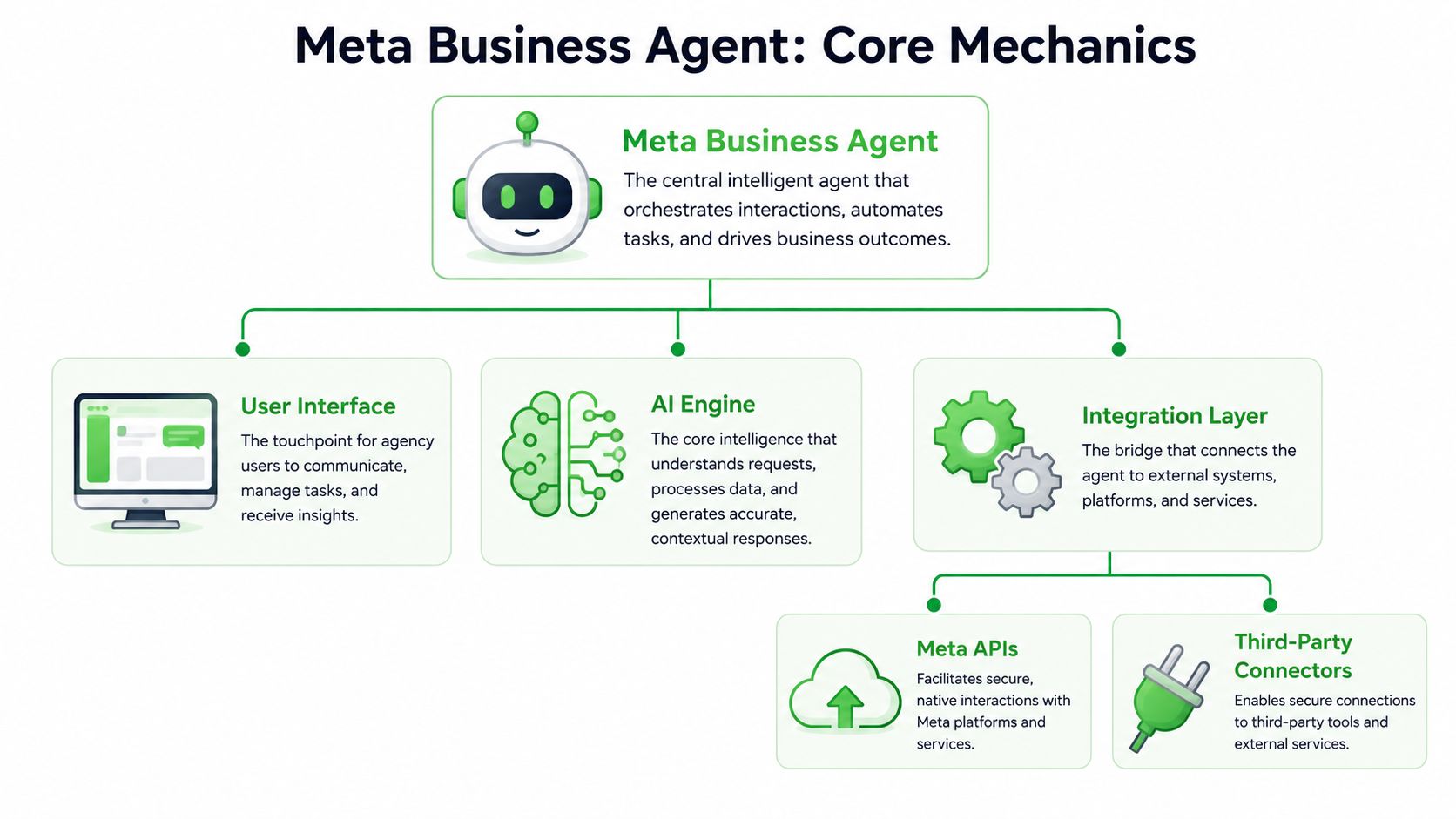
To understand Meta Business Agent's mechanics, view it as a business-trained responder inside Meta's messaging stack.
That distinction matters for agencies because the word "agent" suggests flexibility that the product does not fully deliver. In practice, Meta gives businesses a managed layer for handling inbound conversations across its own properties, using business-provided information as the main source of truth. The upside is speed. The downside is control.
It runs on bounded context, not broad autonomy
Agencies should treat Meta Business Agent as a constrained response system. It works from the material the business supplies, the rules Meta supports, and the conversation environment inside Meta's apps. If those inputs are tight, answers can be useful. If they are weak, old, or incomplete, the system exposes that weakness fast.
This is a narrower operating model than many teams expect.
A true custom agent setup usually gives an agency more say over logic, integrations, memory, escalation rules, and how data moves between systems. Meta Business Agent appears much closer to a guided assistant for common messaging tasks. That can be enough for a restaurant, clinic, or local service brand handling repeat questions. It is often not enough for accounts that need custom qualification paths, CRM sync discipline, or market-specific compliance controls.
The practical workflow
At a high level, the workflow is straightforward:
- A customer sends a message through a Meta channel such as WhatsApp, Messenger, or Instagram.
- The system interprets the message using the business context available to it.
- It replies or triggers a simple action based on that context.
- A human takes over when the request falls outside the supported scope or needs judgment.
The setup sounds simple because the front end is simple. The key variable is the quality of the business context behind the reply.
Where agencies get value, and where the mechanics break down
The strongest deployments are narrow. Agencies usually get better outcomes when they configure this tool for repetitive, well-documented requests instead of trying to stretch it into a full client communication layer.
A few patterns show up quickly in real use:
- Good inputs produce better replies: Clean FAQs, current service details, policies, pricing boundaries, and clear support answers give the system something usable to work from.
- Simple tasks hold up better: Hours, locations, appointment requests, basic objections, and first-pass lead filtering are more reliable than consultative sales or edge-case support.
- Escalation design still matters: If the client sells high-ticket services or operates in a regulated category, human review remains part of the process.
There is also a practical issue many guides skip. Agencies outside the U.S., or agencies serving non-U.S. clients, cannot assume the same setup, access, or support conditions. The mechanics may look identical in Meta's demos, but rollout reality can differ by market. That changes whether the system is even usable at the account level.
| Component | What it does | Agency implication |
|---|---|---|
| Messaging interface | Handles conversations inside Meta-owned channels | Best fit for clients whose inbound volume already sits inside those channels |
| AI response layer | Interprets and answers using the business context provided | Reply quality depends on documentation quality and Meta's operating limits |
| Action support | Supports basic tasks such as booking or lead capture | Useful for standard flows, less reliable for custom logic and multi-system workflows |
Operational view: Meta Business Agent works best as a contained messaging assistant inside Meta's environment. Agencies that need system-level control, flexible data handling, or consistent cross-market deployment should treat those limits as part of the product, not edge cases.
Capabilities vs Critical Limitations for Agencies
The feature story is easy to understand. The deployment story is where agencies run into friction.
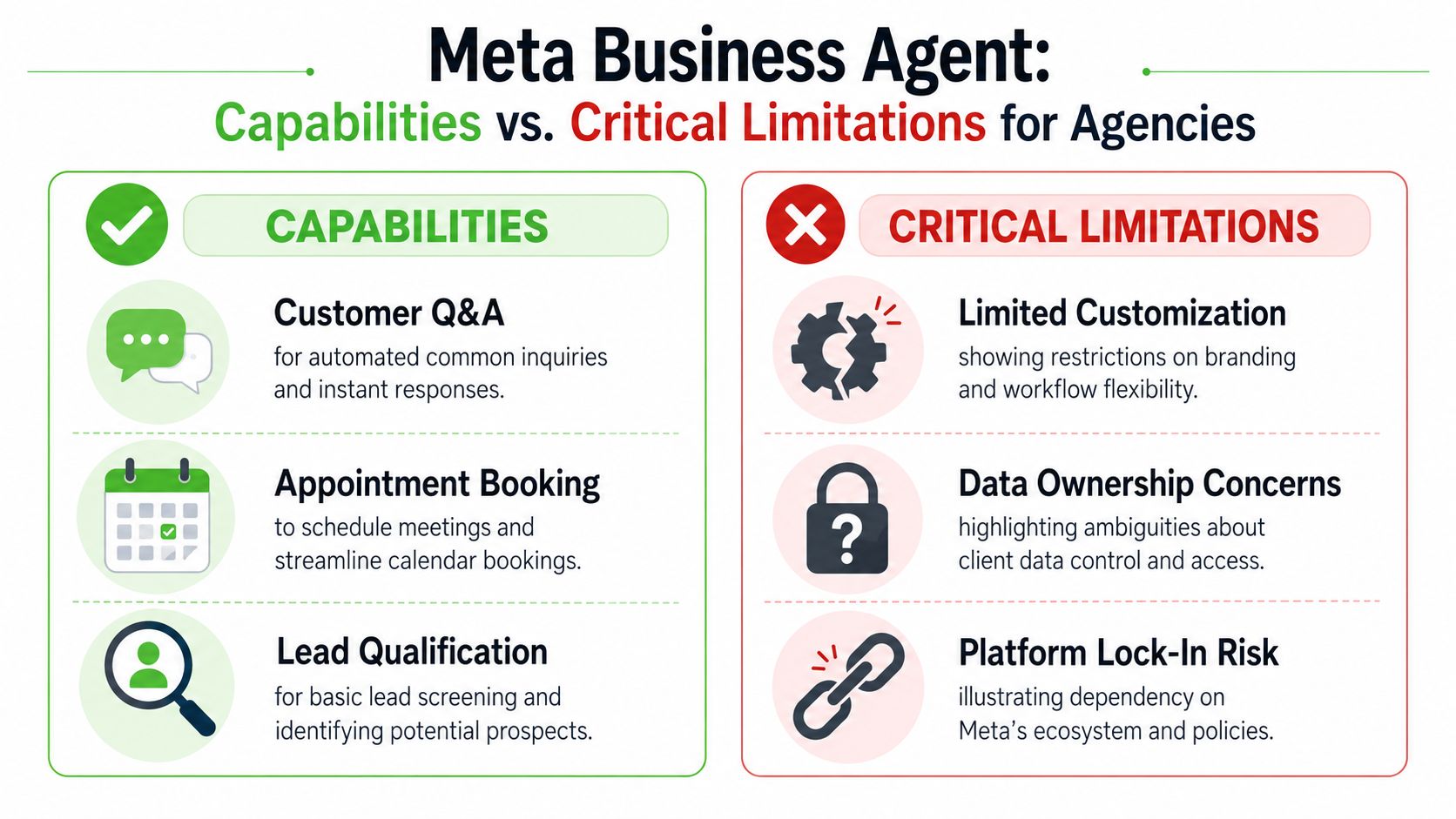
Meta's own rollout details matter more than the launch copy. According to Meta's announcement about Meta Business Agent, the tool was in an early stage, the free tier in 2025 was limited to select U.S. small and medium businesses, broader rollout was only planned for 2026, and businesses must upload specific FAQs and documents for the system to function accurately. Without that manual context injection, the agent defaults to “limited topics” or fails entirely.
What it can do well
For some client accounts, Meta Business Agent can cover the repetitive front line of messaging:
- Customer Q&A: It can answer common inbound questions when the business has already documented the right answers.
- Appointment handling: It can support booking-style interactions for straightforward service businesses.
- Basic lead qualification: It can filter obvious fits from low-intent inquiries before a human takes over.
Those are real use cases. Agencies shouldn't dismiss them.
Where the agency workload begins
The problem is that many guides describe the tool as if setup is the work. Setup is not the work. Context preparation is the work.
If a client has scattered sales docs, outdated policies, vague service descriptions, or multiple offer variants, someone has to clean that mess before the agent becomes reliable. In an agency setting, that “someone” usually becomes your team.
That changes the economics. A “free” tool that demands document curation, response testing, and exception handling isn't free in any meaningful operational sense.
The non-U.S. issue is bigger than most articles admit
If your agency serves India, Brazil, Europe, or mixed-market client portfolios, the availability limitations matter a lot. A tool can't be your standard delivery layer if access is uneven across your client base.
That also creates a bad pilot environment. Teams start designing services around a tool they can't consistently deploy, then burn time rebuilding around another stack when access or feature availability doesn't line up with client geography.
Agencies should treat Meta Business Agent as a channel-specific option, not a default service architecture.
When another route makes more sense
If your clients need broader system control, API-based logic, or multi-platform orchestration, agency teams are usually better served by tools built around flexible integrations. This overview of AI API integrations for agencies is helpful because it shows why many agencies still prefer modular infrastructure over a single closed ecosystem.
A simple internal decision filter helps:
| Agency scenario | Meta Business Agent fit |
|---|---|
| U.S. SMB client with simple inbound questions | Reasonable to test |
| Non-U.S. client needing immediate rollout | Poor fit |
| High-context sales process with multiple handoffs | Weak fit |
| Client expecting custom workflow ownership | Weak fit |
The Agency Dilemma Data Privacy and Platform Lock-In
For agencies, the biggest issue with Meta Business Agent isn't whether it can reply to a message. It's whether using it changes who effectively controls the customer conversation layer.
Starting December 16, 2025, Meta will use Business AI conversations to train their models and target ads, according to Calyptus' breakdown of Meta Business AI. The same source also notes that the free tier only works within Meta's ecosystem, and that website integration outside Meta requires paid plans at undisclosed pricing.

Why this is a client-data problem, not a settings problem
Many agencies manage sensitive conversational material. That can include lead qualification details, pricing objections, customer intent signals, internal offer language, and support context the client doesn't want flowing into a third-party training loop.
Even when the account isn't regulated, agencies still have a trust obligation. Clients often assume that a “free business AI tool” behaves like a neutral assistant. It doesn't. If the conversation layer is also a training input and ad-targeting input, the privacy discussion changes immediately.
This is especially uncomfortable for agencies serving SaaS, info products, consulting firms, or brands with high-value proprietary positioning. Their inbox isn't just a support queue. It's part of the business asset.
Lock-in starts with convenience
The second issue is platform dependency. The free version's value is tied to staying inside Meta's own environment. That creates a familiar trap.
At first, the setup feels efficient. Messages come in. The tool replies. The team gets used to the workflow. Then the client asks for a website widget, CRM-triggered branching, external reporting consistency, or a migration into another support stack. That's when “free” stops being the point and architecture starts being the point.
Practical rule: If an agency can't easily move the workflow, inspect the data, and control the downstream use of conversations, it doesn't own the service. It rents access to it.
White-label promises get weaker inside a closed ecosystem
Agencies that sell white-label communication services usually promise three things:
- Brand control: The client sees the agency's system, process, and operational structure.
- Data stewardship: The agency can explain where conversation data lives and how it's used.
- Stack flexibility: The client isn't trapped if requirements change.
Meta Business Agent weakens all three when it becomes the primary delivery layer. You're no longer just choosing a tool. You're accepting Meta's boundaries around data use, interface ownership, and expansion costs.
A lot of teams don't recognize the risk until procurement or legal asks basic questions they can't answer cleanly.
Here's a walkthrough that helps visualize the broader discussion around the product and why agencies are debating it so hard:
The real strategic question
The question isn't “Is Meta Business Agent powerful?”
It is powerful in a narrow sense.
The strategic question is whether your agency wants to build recurring service revenue on top of a messaging layer where the platform defines the boundaries, the data policy, and the off-platform expansion path. For some agencies, that trade is acceptable. For many, it cuts directly against the business model they're trying to build.
How Meta Business Agent Compares to Other Solutions
Meta Business Agent makes sense only when you compare it against the other ways agencies can already run messaging operations.
The mistake is evaluating it against manual inbox work alone. Agencies should evaluate it against the alternatives they would deploy: Meta's simpler native automation, direct WhatsApp Cloud API builds, and third-party systems built on top of those channels.
Option one versus basic Meta-native automations
If a client only needs auto-replies, basic prompts, and lightweight inbox support, the older Meta-native automation options may already cover the need with less complexity.
That matters because not every client needs an “agent.” Sometimes the right answer is a tighter rule-based setup with clear human handoff. Agencies often overcomplicate simple service businesses by introducing AI where a structured response flow would be easier to govern.
Option two versus WhatsApp Cloud API
The official WhatsApp Cloud API usually gives agencies more control, but it also asks for more technical work. That trade is familiar. You get more freedom over integrations, workflow design, and external system coordination, but you also take on implementation responsibility.
For agencies with technical partners or in-house builders, that can be the better long-term route. It supports more deliberate ownership of the client communication stack. The downside is complexity. You don't get the same fast-start experience that makes Meta Business Agent attractive at first glance.
Option three versus third-party agency platforms
Third-party platforms built around WhatsApp and related messaging channels usually sit in the middle. They reduce development effort without forcing the agency to surrender as much operational control to the platform owner.
That middle layer often matters more than feature checklists. Agencies usually care about questions like these:
- Can the team manage multiple client workspaces cleanly?
- Can conversations route to specific reps?
- Can the system support white-label delivery?
- Can data move into the rest of the client stack?
- Can the agency migrate later without rebuilding the service from scratch?
Those are agency questions, not product-demo questions.
| Option | Ease of setup | Customization | Data control | White-label fit | Best for |
|---|---|---|---|---|---|
| Meta Business Agent | High | Limited | Lower | Weak | Fast testing inside Meta |
| Basic Meta automations | High | Basic | Lower | Weak | Simple response flows |
| WhatsApp Cloud API | Low to medium | High | Higher | Stronger | Agencies with technical implementation capacity |
| Third-party agency platforms | Medium | Medium to high | Usually stronger | Strong | Resellable messaging services |
The best choice depends less on AI quality and more on who needs to own the workflow when the client inevitably asks for something custom.
Where Meta Business Agent fits
Meta Business Agent fits best when the client's world already revolves around Meta channels and the agency is comfortable with Meta defining the operating environment.
It fits poorly when the agency's product is built around portability, data control, and branded service delivery. In those cases, the convenience is real, but the constraints are the actual product.
A Better Path The White-Label Agency Model
Agencies that want to build a WhatsApp offering usually don't need the most hyped tool. They need the most controllable one.
That changes the selection criteria fast. Instead of asking whether a platform can answer messages, the better questions are whether the agency owns the workspace, whether client data stays inside the service model the agency promises, and whether the system can support resale without turning every client request into a workaround.

Why the white-label model is structurally better
A white-label agency model solves a different problem than Meta Business Agent.
Meta's tool is designed to extend Meta's messaging ecosystem. A white-label platform is designed to help an agency package messaging as its own service. That difference affects almost everything, from onboarding to reporting to account retention.
For agencies, the strongest advantages usually look like this:
- Brand ownership: The client experiences the service as part of the agency's offer, not as a borrowed layer inside another company's ecosystem.
- Operational control: Teams can shape inbox rules, handoffs, and service workflows around the agency's process.
- Commercial clarity: The pricing model is easier to explain when it aligns with the way the agency sells retainers or software access.
What agencies should prioritize instead of hype
The practical checklist is simple.
Look for a platform that gives you a multi-user inbox, support for workflow automation, CRM connectivity, room for client-specific logic, and a service model you can package under your own brand. If the platform can't support those basics, it won't hold up once your client roster gets more complex.
A strong agency tool should also make migration and account expansion feel normal, not exceptional. You shouldn't have to apologize every time a client wants to connect another part of their stack.
The bigger shift
Opportunity in WhatsApp growth isn't access to one flashy AI layer. It's building a repeatable offer around messaging that your agency can control, price, and extend over time.
That's why many experienced operators don't chase the newest “free” feature first. They start with infrastructure. Once the infrastructure is right, automation becomes useful. When the infrastructure is wrong, automation just makes the lock-in arrive sooner.
Frequently Asked Questions for Agencies
Is Meta Business Agent a good fit for every agency client
No. It's a narrower fit than most launch coverage suggests. It's most useful for clients who already rely heavily on Meta-owned channels and have relatively simple inbound conversation needs.
Can non-U.S. agencies standardize on it yet
That's risky. Availability and rollout limitations make it a weak foundation for agencies serving broad international client portfolios.
Is the setup actually hands-off
No. The tool depends on business-provided FAQs and documents. If the source material is weak, the output will be weak too. Agencies should expect content prep, testing, and exception handling.
Is the free tier really free for agencies
Not in the strategic sense. Even if software access looks free, the hidden costs show up in implementation time, platform dependency, and the limits around off-platform use.
Can agencies use it as a white-label client solution
Not cleanly. If your agency sells control, branded delivery, and flexibility, a Meta-owned conversation layer creates tension with that promise.
Can it work with external websites and broader workflows
Potentially, but that's exactly where the lock-in problem starts to matter. The free experience is centered inside Meta's own ecosystem, so agencies should review any expansion requirement before they build a service around it.
Should agencies ignore Meta Business Agent completely
No. It can be useful in the right scenario. But it should be treated as a tactical option, not an agency-wide default.
If you want to launch a WhatsApp offer without giving up control of branding, workflows, and client relationships, Double My Leads gives agencies a cleaner path. You can roll out a white-labeled WhatsApp workspace, manage conversations across clients, and build your own service model instead of renting one inside someone else's ecosystem.


