
WhatsApp stopped being a side channel a while ago. By early 2026, it had over 3 billion monthly active users worldwide, and business messaging on the platform was reported to have an average 98% open rate, far above typical email open rates of about 20% according to Jesty CRM's WhatsApp marketing statistics roundup. For agencies, that changes the conversation. This isn't just another campaign add-on. It's a service line that can sit close to revenue, support, retention, and sales ops.
The bigger opportunity isn't sending more messages. It's packaging WhatsApp automation as a repeatable system clients keep paying for because it plugs into lead response, follow-up, reminders, and reactivation. Agencies that productize it well don't just run campaigns. They become part of the client's operating stack.
Table of Contents
- What Is WhatsApp Marketing Automation
- Strategic Value for Agencies and SaaS Resellers
- Building Automation on a Foundation of Trust
- Key Automation Workflows and Templates
- Implementation Models and Integration Strategy
- Measuring Success with the Right KPIs
- How to Build and Resell Your WhatsApp Service
What Is WhatsApp Marketing Automation
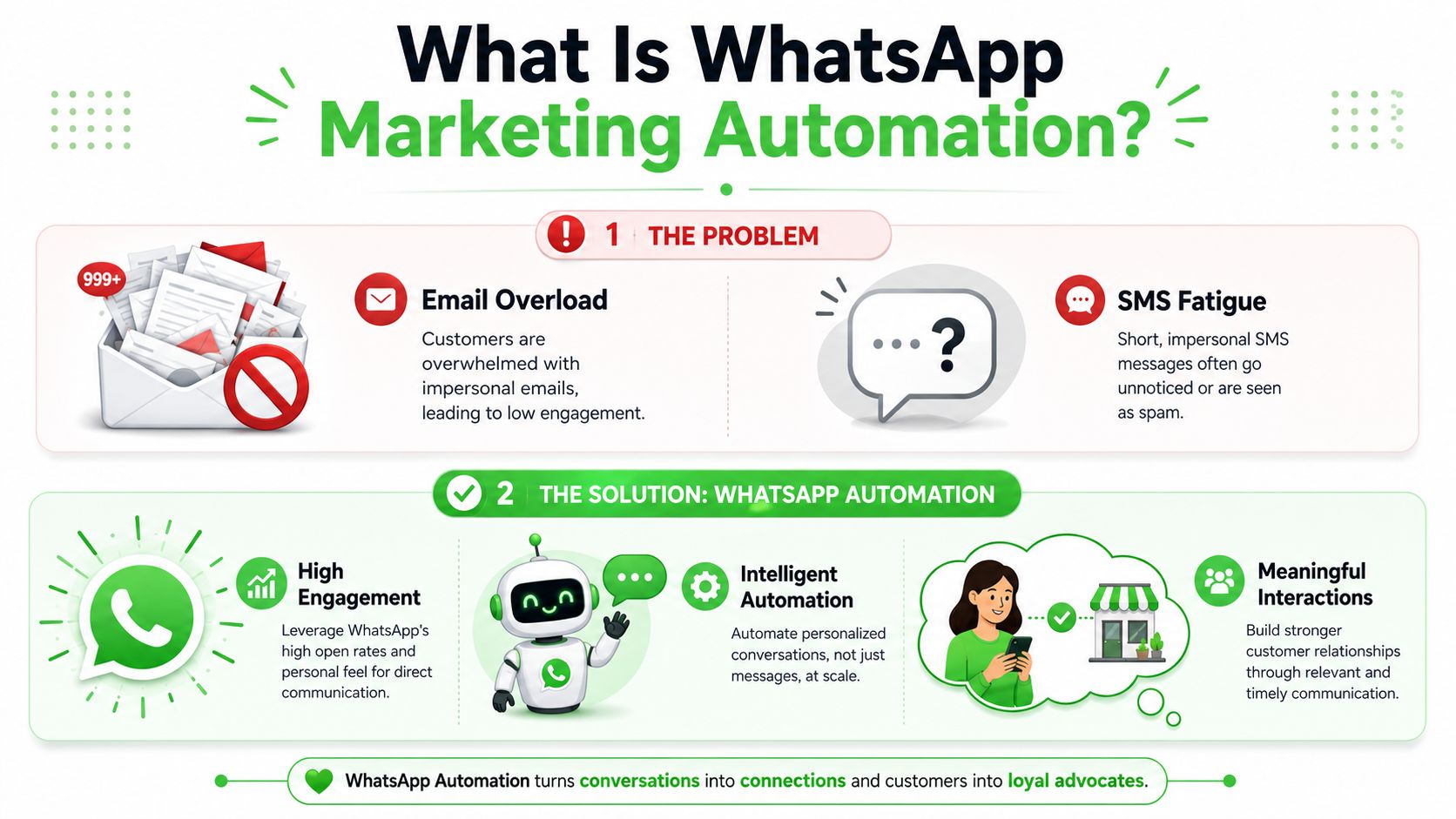
WhatsApp marketing automation is the operational layer that turns a messaging app into a conversion system. It uses customer actions, CRM data, and approved outbound templates to trigger relevant conversations instead of manual one-off replies.
That distinction matters. Most agencies first think of WhatsApp as a broadcast channel. In practice, the better model is conversational orchestration. A lead opts in, asks a question, clicks an ad, views a pricing page, abandons a cart, or books a call. The system responds instantly, routes intent, and moves qualified conversations to a human when needed.
Why it behaves differently from email and SMS
Email works well for depth. SMS works well for urgency. WhatsApp sits in a more valuable middle ground for many businesses. It's immediate, but it also supports real back-and-forth conversation.
Automation functions like assigning every inbound lead a responsive sales rep who never forgets to follow up. The rep greets the lead, asks the right qualification question, shares the next relevant asset, and only loops in a closer when there's a real buying signal. That's what good automation does. It reduces lag and cuts down on wasted manual handling.
Practical rule: If the workflow can't branch based on user behavior or reply intent, it's not really automation. It's just scheduled messaging.
The underlying idea is familiar to agencies already working with workflow tools, CRM triggers, and product events. If your team has been building systems around CI/CD and AI integration for dev teams, the logic is similar. Event in, action out, fallback path, human review where stakes are high.
What agencies should sell, not just explain
Clients rarely buy “automation” in the abstract. They buy faster lead response, fewer missed follow-ups, smoother reminders, and cleaner handoff from marketing to sales. WhatsApp is the front-end channel where those processes become visible to the buyer.
That's why the strongest offers don't start with templates. They start with one business problem. Speed-to-lead. Cart abandonment. Appointment no-shows. Support triage. Once the agency frames WhatsApp around one of those outcomes, the service becomes much easier to close and retain.
Strategic Value for Agencies and SaaS Resellers
Agencies don't need another low-margin execution service. They need offers that clients keep because removing them would break part of the client's funnel. WhatsApp automation fits that model well when it's sold as infrastructure, not content production.
Why this is a stronger revenue stream than campaign work
Project work ends. Embedded systems stay. Once WhatsApp is tied into a client's lead forms, CRM stages, support queues, calendars, or ecommerce events, the agency is no longer just delivering assets. It's maintaining a response engine.
That creates several business advantages:
- Recurring management revenue: Clients need workflow updates, template maintenance, routing changes, reporting, and ongoing optimization.
- Higher switching costs: Replacing the agency means rebuilding message logic, handoffs, CRM mappings, and operational habits.
- Broader account expansion: WhatsApp often opens the door to CRM cleanup, pipeline tracking, call center deflection, and retention campaigns.
- Cleaner productization: You can package setup, monthly management, and add-ons much more clearly than custom strategy retainers.
Where resellers get leverage
Resellers and SaaS operators get even more upside because WhatsApp can be white-labeled and standardized. Instead of selling custom builds every time, you can define a narrow set of repeatable plays by niche.
A dental agency can sell reminders, recalls, and missed-call follow-up. A home services agency can sell quote response and appointment confirmation. An ecommerce consultancy can sell cart recovery and post-purchase support. The delivery model changes less than most agency owners assume.
Clients stay longer when your system is tied to response time, lead qualification, and booked revenue, not just published content.
For publishers and creators, there's also a monetization angle beyond traditional lead gen. Refact's piece on Drive growth with Whatsapp newsletters is useful because it shows how WhatsApp can support audience distribution and subscriber engagement, not only direct-response campaigns.
The positioning mistake agencies keep making
Many agencies pitch WhatsApp as “higher open rates.” That gets attention, but it doesn't close serious retainers. The stronger pitch is operational.
Use language like this instead:
| Weak pitch | Strong pitch |
|---|---|
| We'll send promotions on WhatsApp | We'll automate lead response and booked-call follow-up |
| We'll add another messaging channel | We'll shorten response time and route high-intent chats to sales |
| We'll help with broadcasts | We'll install a repeatable conversation system your team can manage |
This is the difference between selling a tactic and selling a business function.
Building Automation on a Foundation of Trust
Most WhatsApp automation problems aren't technical. They're governance problems. The agency gets excited about reach, sends too broadly, uses weak opt-in language, and trains the client to treat WhatsApp like email. That's where performance degrades and account health gets shaky.
Recent independent guidance stresses consent recording, opt-out management, and behavioral triggers as core safeguards. It also emphasizes triggering automation from actions such as page views rather than fixed broadcast schedules to preserve reply quality at scale, as discussed by Wapikit's analysis of WhatsApp marketing mistakes.
Do this, not that
A useful way to train your team is to set rules that are operational, not abstract.
- Record consent clearly: Store where the opt-in happened, what the person expected to receive, and when they subscribed.
- Make opt-out easy: Don't bury unsubscribe language in policy pages. Build it into the experience.
- Trigger from behavior: Send based on a form submission, cart event, stage change, or support action.
- Route replies intentionally: Every inbound response should have a destination, whether that's automation, support, or sales.
Now the opposite.
- Don't import cold lists: If the contact didn't explicitly opt in for WhatsApp communication, don't force the channel.
- Don't blast on a fixed cadence: Scheduled sends without context train users to ignore or block the business.
- Don't automate high-friction disputes end to end: Billing issues, complaints, and high-value sales objections often need a human quickly.
- Don't hide responsibility: If the client sends poor messages, your agency still owns part of the operational risk.
Templates matter because quality matters
For agencies, message templates aren't red tape. They're a forcing function. They push teams to define the message purpose, write more clearly, and avoid spammy improvisation.
The practical split is simple:
| Conversation type | Operational implication |
|---|---|
| User-initiated | The business can respond in an ongoing thread with more flexibility |
| Business-initiated | The business needs approved template structure and stronger discipline |
That structure is healthy. It keeps the agency from turning a trust-based channel into a noisy one.
A good WhatsApp workflow feels timely and relevant. A bad one feels like a shortcut the customer didn't ask for.
Build trust into the workflow design
The cleanest way to protect deliverability and brand trust is to design every automation around three checkpoints:
- Why did this person hear from us right now?
- What action can they take immediately?
- How do they reach a person if the automation isn't enough?
If you can't answer those three questions, the workflow probably shouldn't go live yet.
Agencies that follow this tend to get better long-term outcomes because the channel stays conversational. Agencies that chase volume usually create friction fast.
Key Automation Workflows and Templates
The WhatsApp Business API or Platform is what makes serious automation possible because it supports event-triggered outbound messaging, conversation workflows, and proactive template-based messaging that the standard app can't do at scale. That capability leads to lower response latency and less manual triage, as outlined in ActiveCampaign's breakdown of WhatsApp automation.
Start with workflows clients already understand. Don't start with an abstract chatbot pitch. Start with a missed revenue moment they already feel.
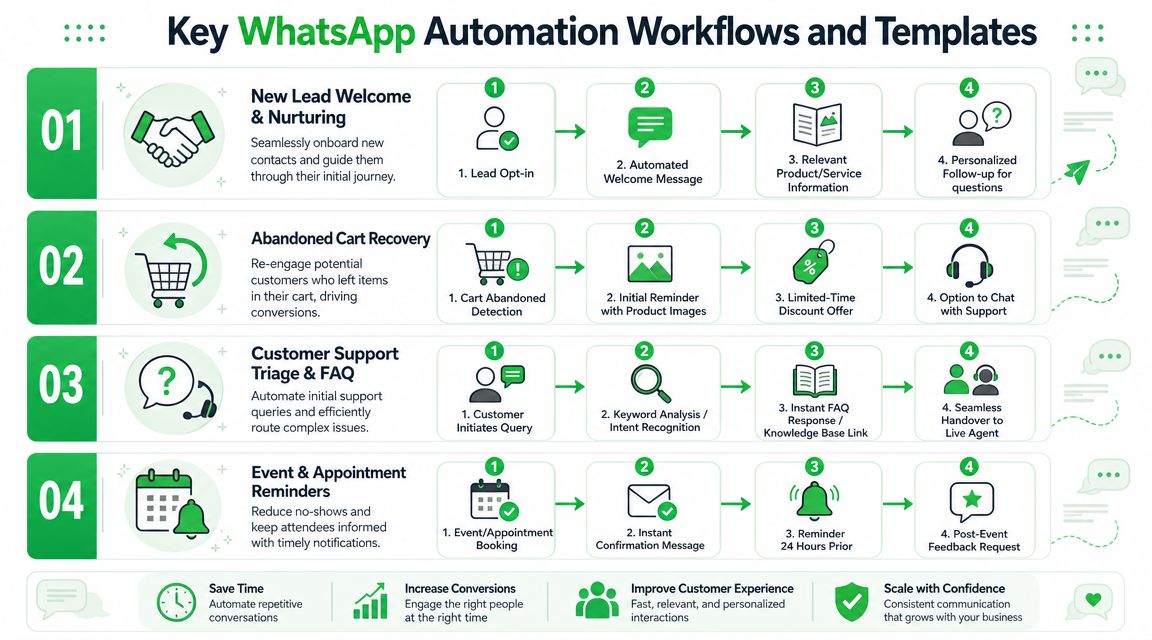
Lead response and qualification
This is the fastest sale for most agencies because every client complains about slow follow-up.
Trigger: Form submission, click-to-WhatsApp ad, chat widget opt-in, or inbound inquiry.
Template example:
“Hi {{first_name}}, thanks for reaching out to {{brand_name}}. Are you looking for {{option_1}} or {{option_2}}? Reply with the best fit and we'll point you in the right direction.”
What happens next:
- If the contact selects a known option, send a short follow-up with the relevant offer or booking link.
- If the reply contains a high-intent keyword, assign it to sales.
- If there's no reply, send a gentle follow-up tied to the original inquiry.
Agency value: This workflow is easy to explain, easy to demo, and easy to tie to booked calls or qualified leads.
Don't automate for the sake of automation. Automate the first response so humans can spend time where intent is already clear.
A short walkthrough can help clients visualize what they're buying.
Cart recovery without sounding robotic
Ecommerce clients usually overcomplicate this. The best flows are brief and helpful.
Trigger: Cart abandonment after opt-in.
Template example:
“Hi {{first_name}}, you left {{product_name}} in your cart. If you've got a question before checking out, reply here and our team can help.”
The key is the support path. Many brands send reminders as if the only issue is forgetfulness. Often the buyer has a sizing question, shipping concern, or payment hesitation. WhatsApp works because it can resolve those objections inside the conversation.
A useful three-step sequence looks like this:
- Reminder with product context.
- Follow-up that offers help, not just urgency.
- Human takeover if the user replies with a purchase obstacle.
Appointment reminders and confirmations
Service businesses, clinics, consultants, and local operators all benefit from this because reminders reduce friction for both staff and customers.
Trigger: Booking created or appointment rescheduled.
Template example:
“Hi {{first_name}}, your appointment with {{business_name}} is booked for {{date_time}}. Reply CONFIRM to keep it, or reply RESCHEDULE if you need a different time.”
This workflow works best when the agency also maps status changes back to the CRM or calendar. That way, confirmations and reschedule requests don't sit in a disconnected inbox.
Business goal: Fewer manual reminder calls, better attendance, cleaner scheduling operations.
Post-purchase follow-up and support triage
Agencies can expand from lead gen into retention.
Trigger: Order delivered, onboarding completed, or service marked finished.
Template example:
“Hi {{first_name}}, checking in after your recent {{purchase_or_service}} from {{brand_name}}. Need help, want to reorder, or willing to share feedback?”
This can branch several ways:
| Reply type | Next action |
|---|---|
| Support request | Route to inbox or support agent |
| Positive response | Ask for review or testimonial |
| Reorder intent | Send product or booking path |
| No response | End sequence without forcing more messages |
The workflow feels simple, but it creates account expansion opportunities for the agency. Once you own follow-up, you can also own review generation, support routing, replenishment reminders, and customer success check-ins.
Implementation Models and Integration Strategy
Most agencies don't fail at WhatsApp because the channel is hard. They fail because they choose the wrong implementation model for how they sell and support clients.
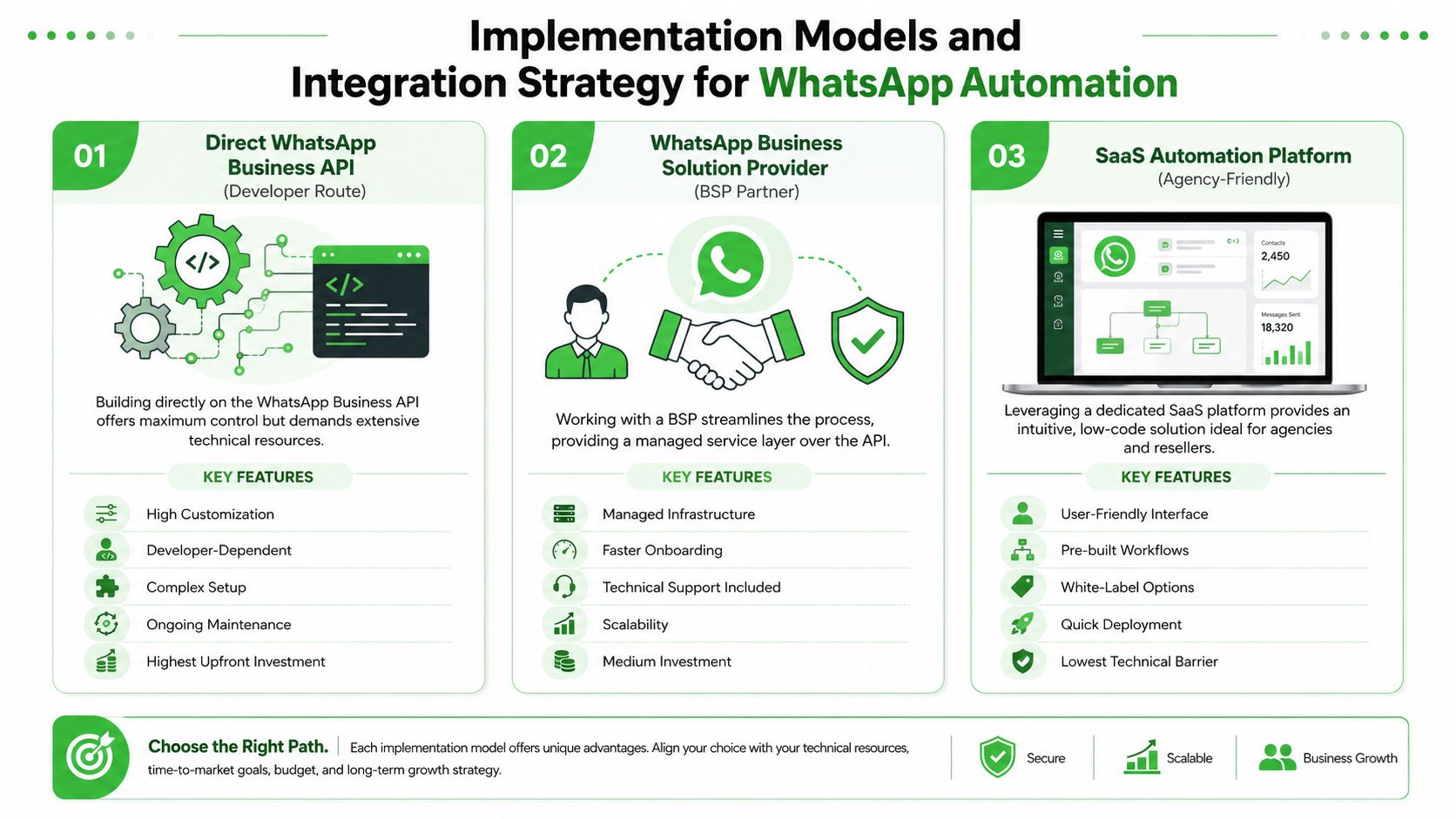
Three ways agencies usually implement it
The first route is direct API work. This gives maximum control, but it also introduces more build time, more technical maintenance, and more operational dependency on engineering. That model makes sense when your agency already sells custom platform work.
The second route is through a business solution provider or managed partner. This reduces some infrastructure burden and usually speeds onboarding. It's often a good middle ground for agencies that want stronger support without building every layer themselves.
The third route is an agency-friendly SaaS layer. That's usually the best fit when speed-to-market matters more than deep custom engineering, especially if you want white-label delivery and repeatable onboarding.
Here's the simplest comparison:
| Model | Best for | Trade-off |
|---|---|---|
| Direct API | Technical teams with custom requirements | Slower setup and more maintenance |
| BSP partner | Agencies needing managed infrastructure | Less control than direct build |
| SaaS platform | Productized service delivery | Platform limits may shape the workflow design |
For example, Double My Leads is one option in the agency-friendly category. It offers white-label WhatsApp workspaces, QR-code number connection, inbox management, broadcasts, automation, and API access, which fits agencies that want a branded service layer without leading with custom development.
What to connect first
Agencies often try to connect everything on day one. That slows deployment and confuses clients. A better sequence is to connect the systems that make reporting and routing work first.
Start with these:
- CRM contact sync: So the team knows who the contact is and where they came from.
- Lead source attribution: So paid traffic, referral traffic, and organic inquiries don't get mixed together.
- Pipeline stages: So messages can trigger from actual buying milestones.
- Shared inbox ownership: So sales and support know who owns the next response.
Then add the second layer:
- Calendar or booking system
- Ecommerce events
- Knowledge base or FAQ content
- Internal notifications for takeover moments
The integration strategy should follow one rule. Connect whatever reduces response time or improves attribution first. Leave “nice to have” integrations for later.
Agencies that follow this sequence launch faster and can show value sooner.
Measuring Success with the Right KPIs
The weak way to report WhatsApp performance is to show sends, delivered messages, and a few screenshots of replies. Clients don't keep paying for activity. They keep paying for movement in pipeline, conversions, and retention.
Measurement and attribution remain an underserved part of WhatsApp marketing. Proving revenue impact requires pairing WhatsApp with CRM logging and measuring closed revenue contribution, not just message volume, as noted in Spotler's discussion of common WhatsApp marketing mistakes.
What to track beyond sends
The best KPI stack depends on the client's model, but most agency reports should include a mix of input, response, and revenue indicators.
- Opt-in quality: Where the contact came from and what promise they opted into.
- Reply rate by workflow: Which automations start real conversations.
- Click activity: Which links pull contacts into bookings, checkouts, or support actions.
- Stage progression: Whether WhatsApp-touched leads move faster through the pipeline.
- Closed revenue contribution: Whether contacts who engaged on WhatsApp later became customers.
If your team needs a broader framework for structuring executive-friendly reporting, this practical guide to measuring SaaS KPIs is a useful reference. The logic applies well to messaging services because it forces you to distinguish activity metrics from business metrics.
How to report it to clients
Don't dump channel data in a dashboard and call it attribution. Build the report around decisions.
A simple monthly report should answer:
- Which workflows generated the most qualified conversations?
- Which lead sources produced the highest-value WhatsApp interactions?
- Where did human takeover happen most often?
- Which conversations influenced bookings, purchases, or retention events?
A compact reporting table works well:
| KPI group | Question it answers |
|---|---|
| Acquisition | Are the right people opting in? |
| Engagement | Are messages starting conversations? |
| Conversion | Are conversations moving toward revenue? |
| Retention | Is WhatsApp reducing churn or support friction? |
The agency that can tie WhatsApp to pipeline wins. The agency that reports message volume gets replaced.
How to Build and Resell Your WhatsApp Service
By 2026, one industry source estimated that about 5 million businesses use the WhatsApp Business API for automation, and that WhatsApp chatbots could save 7 billion business hours annually, generating $11 billion in annual value according to WizMessage's WhatsApp Business statistics. That matters for agencies because it shows the market is established enough to package, price, and resell confidently.
The cleanest offer is usually productized into tiers. Setup fee for implementation. Monthly fee for inbox access, workflow management, reporting, and optimization. Add-ons for extra brands, extra workflows, AI agents, CRM integrations, or managed support coverage.
Keep the packaging simple:
- Starter: One number, core inbox, one or two automations, monthly reporting.
- Growth: More workflows, CRM syncing, pipeline reporting, team routing.
- Pro or white-label: Multi-client management, branding, billing control, advanced integrations.
Avoid pricing the offer like a custom dev project unless the client needs custom engineering. Most agencies do better with predictable flat-fee retainers because clients understand them and margins are easier to protect.
Position the service around one sentence: your agency helps clients respond faster, convert more qualified conversations, and keep the channel governed. That's a better sales story than “we do WhatsApp campaigns.”
The practical rollout is straightforward. Choose a platform model that matches your support capacity. Build one niche-specific package first. Standardize onboarding, templates, routing rules, and reporting. Then resell it under your brand with a service wrapper clients can understand in one call.
If you want to launch this as a branded agency offer instead of stitching tools together, Double My Leads is built for that model. It lets agencies and SaaS teams stand up a white-labeled WhatsApp service quickly, connect numbers, manage conversations, run automations, and resell under their own brand with a predictable monthly structure.


