
Most advice about buying a toll free phone number is too shallow. It treats the number like a commodity. Pick a prefix, pay a fee, forward calls, done.
That's not how agencies should think about it.
When you procure a toll-free number for a client, you're not just buying a line. You're securing a brand asset that has to survive provider changes, route cleanly to the right team, support campaign attribution, and fit into a broader contact strategy that may include voice, SMS, and WhatsApp. If you skip those questions, you can end up with a nice-looking number that creates operational friction the first time the client scales, changes vendors, or launches a real lead gen push.
The teams that get value from a toll-free number usually aren't chasing nostalgia for an 800 line. They're using it as a deployable communication layer. One number for paid media. One for national support. One for partner referrals. One for overflow routing when a local office closes. That's where the decision starts to matter.
Table of Contents
- Why a Toll-Free Number Is Still a Strategic Asset in 2026
- Vanity Numbers vs Standard Prefixes What to Choose
- A Vetting Checklist for Toll-Free Number Providers
- Securing and Provisioning Your Number
- Activating SMS and WhatsApp for Multi-Channel Leads
- Finalizing Your Strategy and Next Steps
Why a Toll-Free Number Is Still a Strategic Asset in 2026
A lot of marketers assume toll-free numbers lost relevance once local presence, mobile calling, and web chat became standard. That's the wrong lens. The caller's cost is no longer the main story. The strategic value now is credibility, centralized routing, and campaign control.
For a client that serves multiple markets, a toll-free number still solves a simple problem cleanly. It gives the business one public-facing identity that isn't tied to a single city, rep, or office. That matters when sales is distributed, support is remote, and traffic comes from paid search, offline ads, landing pages, and referral campaigns at the same time.

What the number signals now
The strongest argument against “toll-free is outdated” is that large brands still use it. A study of Fortune 500 companies found that 74.8% use a toll-free number, and 50.9% use a true 800 number, according to Fortune 500 toll-free number stats. That doesn't prove every client needs one, but it does show the format still carries weight with established companies.
In practice, the number signals a few things immediately:
- National reach: The business doesn't look confined to one neighborhood or branch office.
- Operational maturity: Callers expect routing, departments, and follow-up processes behind the line.
- Brand stability: A single main number feels more durable than rotating personal mobiles or ad hoc local lines.
Practical rule: If a client wants to look bigger than their footprint, a toll-free number usually helps. If they need to look hyperlocal, it usually doesn't.
That's why I rarely frame the decision as toll-free versus modern tools. The better comparison is toll-free plus modern tools versus a messy pile of disconnected numbers.
Where it fits in a modern stack
For agencies, the most useful toll-free deployments sit inside a broader routing plan. The number becomes the front door, while the stack behind it handles distribution and tracking. A paid ad can point to the toll-free line. Calls can route by time of day, campaign intent, or department. Missed calls can trigger follow-up workflows. Support can keep a stable public number even when staffing changes.
This is also why buying the number without a use case usually leads nowhere. A toll-free line won't rescue weak offer positioning, poor ad targeting, or slow response times. What it does well is remove friction once someone decides to make contact.
A good agency brief for a toll-free number usually sounds like this:
- Sales use case: National inquiries need one memorable number with clear routing.
- Support use case: The client needs a stable service line that survives staffing changes.
- Campaign use case: Different numbers or extensions need to map to different channels and teams.
- Separation use case: The business needs to keep personal devices out of customer-facing workflows.
A toll-free number is often more valuable as a routing and identity layer than as a direct-response miracle.
That distinction matters. If the client expects the number itself to generate demand, they'll be disappointed. If they use it to capture, distribute, and manage demand more cleanly, it becomes a strong operational asset.
Vanity Numbers vs Standard Prefixes What to Choose
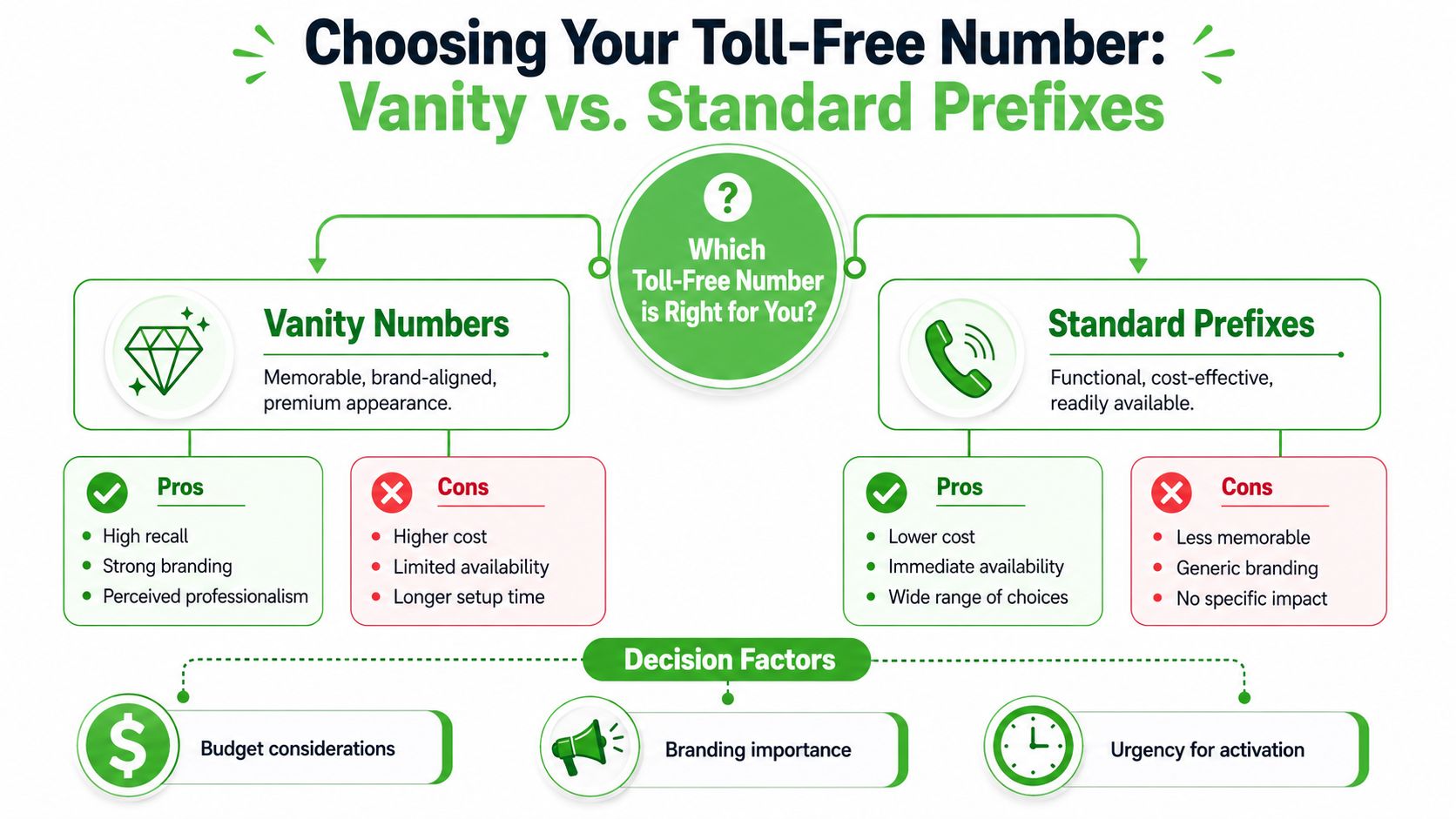
This decision gets overcomplicated. Most clients don't need a philosophical debate about 800 branding. They need a clear answer to one question: should they pay for memorability, or should they prioritize speed and flexibility?
The North American Numbering Plan includes over 40 million toll-free numbers across 800, 888, 877, 866, 855, 844, and 833, according to this toll-free number overview. That's useful because it tells you two things. First, there's plenty of inventory beyond 800. Second, the original 800 prefix still has recognition, but it's no longer the only practical choice.
When vanity is worth the effort
A vanity number makes sense when recall matters outside the click. Think radio, podcast reads, direct mail, vehicle wraps, event signage, or any campaign where the user hears or briefly sees the number and has to remember it.
Good fits include:
- Offline-heavy campaigns: If the client runs channels where people can't easily tap to call, memorability matters more.
- Brand-led businesses: A simple word or phrase can reinforce the offer and reduce confusion.
- High-trust categories: If the number itself can make the business feel polished, it may support conversion quality.
Vanity also helps agencies when the client wants a single number repeated across creative. A short, branded line is easier for reps, partners, and media buyers to use consistently.
Later in the buying process, this walkthrough may help your team visualize the trade-offs:
When standard wins
A standard toll-free number is usually the better choice when the number's job is functional, not promotional. Support desks, routing lines, overflow queues, and internal campaign tracking rarely need a premium phrase.
Standard also wins when:
- The launch is time-sensitive: Availability is usually better across the newer prefixes.
- The client needs multiple numbers: One polished vanity line plus several standard lines is often smarter than trying to vanity-brand everything.
- The business already has strong branded channels: If the website, paid media, and CRM are doing the heavy lifting, the number can just do its operational job.
The mistake isn't choosing a standard number. The mistake is paying vanity pricing for a line nobody will ever need to remember.
A simple decision table
| Situation | Better choice | Why |
|---|---|---|
| Radio, print, podcast, signage | Vanity | Recall matters |
| National support line | Standard | Function beats branding |
| Fast campaign launch | Standard | Easier to secure and activate |
| Long-term flagship brand number | Vanity | Stronger public identity |
| Multi-number routing setup | Standard | Easier to scale and assign |
If you want the short version, buy a toll free phone number with a vanity pattern when the number itself carries marketing weight. Buy a standard one when value sits in routing, attribution, and team operations.
A Vetting Checklist for Toll-Free Number Providers
Provider selection is where junior teams make expensive mistakes. They compare headline monthly fees, skim feature lists, and miss the terms that matter once the client wants to scale or leave.
The first issue is language. Some providers talk like you're “owning” the number. Others clearly frame it as a service relationship. What matters operationally is who controls routing and how easy it is to move the number later. As NumberBarn's toll-free guidance explains, the Responsible Organization, or RespOrg, controls the number's routing, and buyers need to verify that the provider allows porting away if they switch services.
Questions to ask before you buy
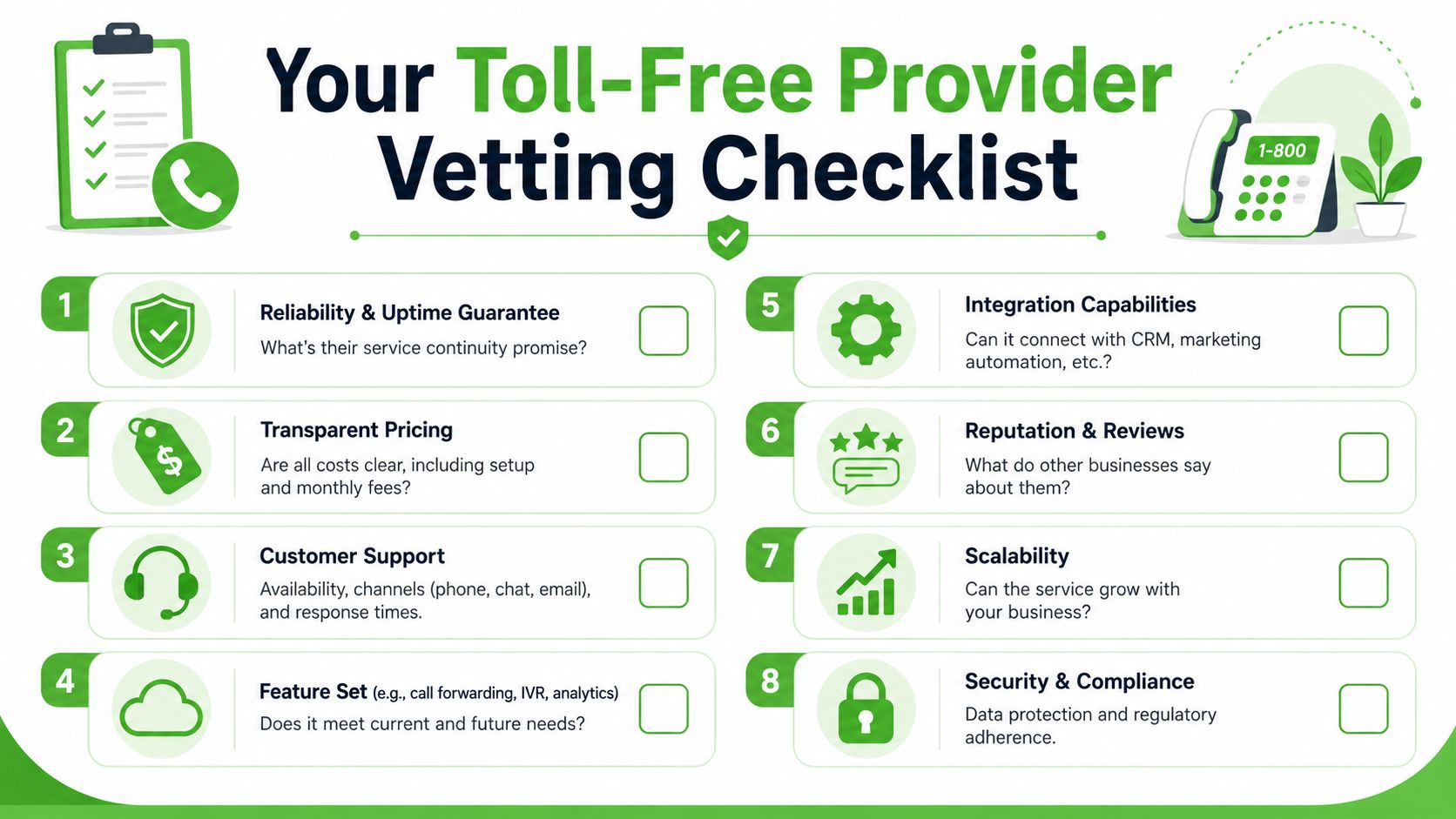
Use this checklist before you commit a client number to any platform.
- Can we port the number out later? If the answer is vague, treat that as a warning.
- Who acts as the RespOrg? You need clarity on who controls routing and what the release process looks like.
- Is this framed as a lease, license, or ownership-style offer? Marketing language can blur the actual arrangement.
- What's included beyond the number itself? Call forwarding, IVR, reporting, voicemail handling, and admin controls matter.
- Is messaging supported? If the client may want SMS or channel expansion later, confirm compatibility early.
- How does user and team management work? Agencies need clean handoff and permission structures.
- What does support look like during provisioning and porting? You don't want ticket-only support during a live migration.
For clients with a custom phone environment, your voice stack matters too. If the toll-free line needs to connect cleanly into a broader call infrastructure, a review of best SIP trunk providers can help your team evaluate upstream telephony options before locking the number into the wrong setup.
What agencies should care about more than price
Price matters, but not as much as mobility and deployment control. A cheap number becomes expensive when the client can't move it, can't assign it cleanly, or can't integrate it into the tools they already use.
Here's the practical lens I use:
| Evaluation area | What good looks like | What usually goes wrong |
|---|---|---|
| Portability | Clear release process | Delays, restrictions, vague ownership talk |
| Admin controls | Easy reassignment and permissions | One login shared across teams |
| Feature depth | Routing, menus, reporting, forwarding | Basic forwarding only |
| Messaging path | Expansion is possible | Voice-only dead end |
| Support quality | Real help during migration | Slow tickets during launch week |
Agency note: If a client may outgrow the provider, portability isn't a nice-to-have. It's the entire risk model.
The wrong provider traps the asset. The right provider makes the number reusable across campaigns, departments, and future platforms.
Securing and Provisioning Your Number
Once strategy is clear, the purchase itself is straightforward. The workflow usually breaks into four steps: define the type of number you want, search availability, compare providers, and complete checkout with setup. According to Vida's toll-free buying guide, providers commonly charge a one-time setup fee of about $15 to $35 plus monthly recurring fees, so the biggest early mistake is forgetting the upfront cost while comparing plans.
The purchase workflow that actually works
Start by writing a one-page internal brief before anyone searches inventory. It should answer:
- Is this vanity or standard?
- What's the primary use case? Sales, support, campaign tracking, or overflow.
- Who owns the client relationship? Someone needs final approval on the number.
- Where will calls route on day one? Main queue, rep group, answering service, or existing phone system.
Then search more broadly than the original idea. If the exact vanity pattern is gone, the best alternative may be a different toll-free prefix or a simpler keyword. Teams lose time when they lock emotionally onto one perfect number instead of securing one that works.
What happens after checkout
Provisioning is the behind-the-scenes process that gets the number assigned and routed. For the buyer, that usually means choosing forwarding destinations, business hours, menus, voicemail behavior, and any basic call handling rules.
RespOrg comes into play here too. You don't need to become a telecom specialist, but you do need to know that the number's routing sits under administrative control inside the toll-free system. That's why recordkeeping matters. Save the order details, account owner info, support contacts, and any documents tied to future changes.
A simple handoff checklist keeps the launch clean:
- Save credentials securely: Don't leave the number tied to a freelancer's inbox.
- Document routing: Note exactly where calls go by default and after hours.
- Test every path: Main line, menu options, voicemail, forwarding, and missed-call handling.
- Assign ownership: One person on the client side should approve future changes.
Buy a toll free phone number only after the destination workflow is ready. Otherwise, you're activating a front door that opens into confusion.
Activating SMS and WhatsApp for Multi-Channel Leads
A voice-only toll-free setup is often underbuilt for how buyers behave. Some leads want to call. Some want to text a question. Some want an asynchronous conversation they can return to later. If the number only accepts calls, the client loses flexibility right where intent is highest.
That's why I treat a toll-free number as a candidate for multi-channel use, not just voice. The line can become the public contact identity, while different channels handle different stages of the buyer journey. Calls work well for urgency. SMS works well for quick qualification and follow-up. WhatsApp can work well for ongoing conversations, media sharing, and team-managed messaging in markets where customers already prefer it.
Why voice-only is usually a missed opportunity
A lot of provider content still sells toll-free numbers on image alone. But the harder business question is whether the number helps the client capture and route demand better than the alternatives. In practice, that often comes down to channel fit.
Here's the operating logic:
- Calls are best when the lead needs immediate interaction.
- SMS is strong for missed-call recovery, reminders, light qualification, and quick replies.
- WhatsApp can support richer back-and-forth conversations, especially when teams share an inbox.
If your agency is building workflows around SMS capture and follow-up, this guide to text message lead generation is a useful reference for mapping text-based intake into a broader conversion flow.
A toll-free number becomes more useful when the client promotes it as “call or text” instead of forcing every lead into a live call.
A practical rollout model for agencies
The cleanest rollout usually happens in layers.
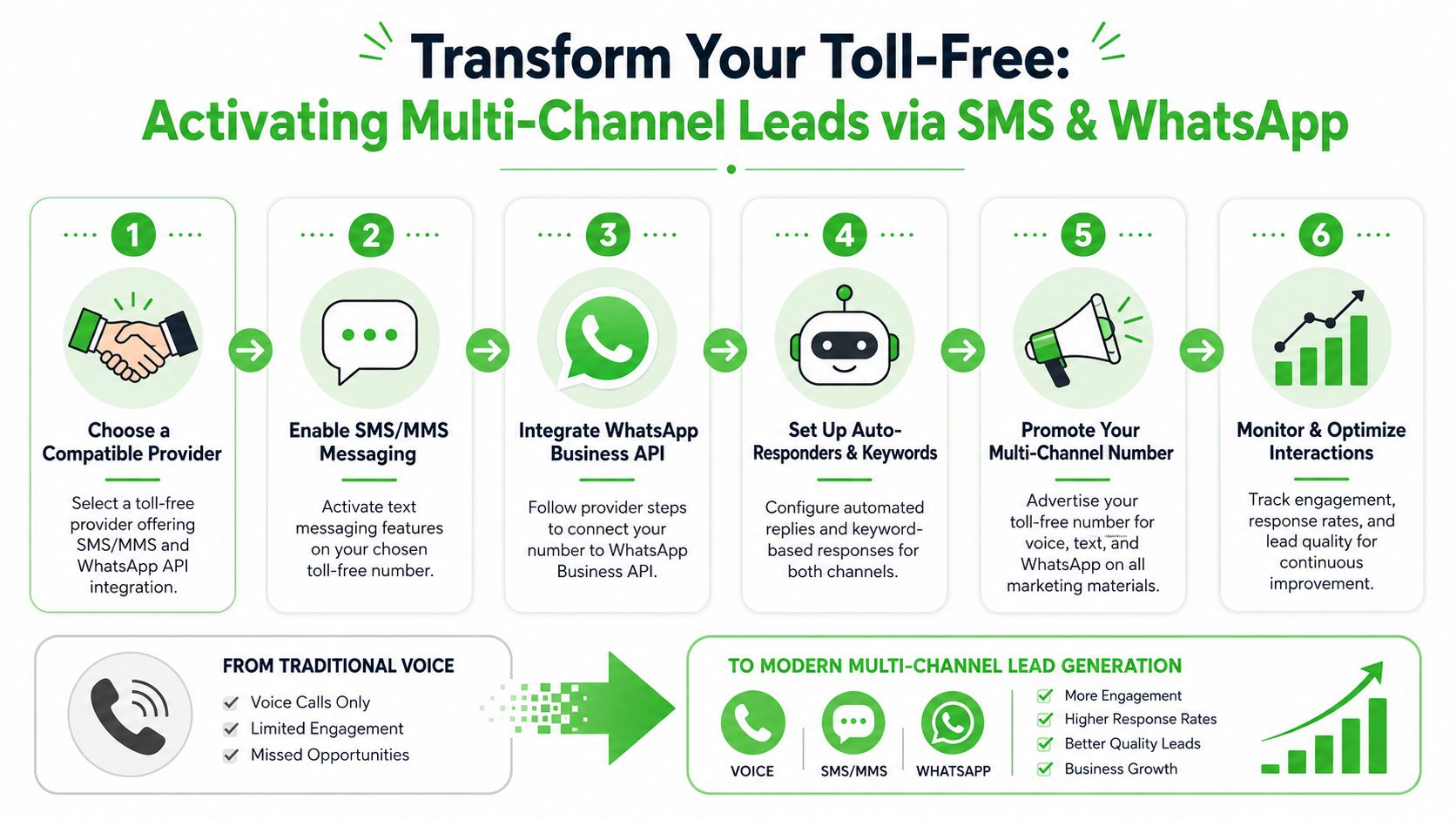
First, activate voice routing so the line works as a real business number from day one. Then add messaging capabilities where the provider and downstream tools support them. After that, connect the number to the workflows that determine revenue impact: lead capture, assignment, reminders, qualification, support triage, and reactivation.
I'd structure deployment like this:
- Phase one: Publish the number on site, ads, and profiles with clear call handling.
- Phase two: Enable SMS for replies, missed-call follow-up, and rep outreach where appropriate.
- Phase three: Add WhatsApp if the client's audience uses it and the operational model supports it.
- Phase four: Train the team on inbox ownership, response standards, and escalation paths.
What doesn't work is bolting channels on with no governance. If the client adds SMS and WhatsApp but nobody owns response times, tagging, or handoff rules, the number creates more noise than value.
A strong deployment standard includes:
- One published promise: “Call or message us” only if both are monitored.
- Channel-specific playbooks: Sales, support, and after-hours handling shouldn't all look the same.
- Shared reporting logic: Leads need source tracking even when the conversation changes channels.
- Conversation ownership: Every inbound message should have a clear next action and an assigned person.
The number is only the asset. The workflow is what turns it into revenue.
Finalizing Your Strategy and Next Steps
By the time you're ready to buy a toll free phone number, most of the essential work should already be done. You should know whether the number is a branding asset, a routing asset, or both. You should know whether vanity has a real job or is just a preference. And you should know how the number fits into voice, support, and messaging operations before a client ever sees it on a landing page.
Your final provider shortlist
Before approving any purchase, make sure the shortlist answers these questions clearly:
- Can this number move later if the client changes providers?
- Who controls the routing relationship and how is that documented?
- Does the platform fit the client's actual use case, not just today's basic setup?
- Can the team manage assignments, forwarding, and business continuity without workarounds?
- If messaging is needed later, is there a credible path to support it?
If one provider is cheaper but weak on portability or admin control, I'd usually pass. Clients forget the monthly savings fast when the number becomes hard to manage.
High-level questions teams ask after launch
How do I track ROI from a toll-free number?
Track it through attribution and workflow outcomes, not vanity metrics. Use distinct numbers or routing logic for different campaigns when needed, map calls and messages to lead sources in the CRM, and review whether the number is improving response handling for channels that already generate demand.
What's the best way to promote a new toll-free number?
Use it where consistency matters. Site header, landing pages, profiles, ad extensions, sales collateral, support pages, and any offline assets should all present the same public contact path unless you intentionally need campaign-specific tracking.
Should a business replace local numbers with one toll-free line?
Usually no. For many clients, the best setup is a mix. Keep local numbers where local trust matters. Use toll-free where national identity, central routing, or department-level handling matters more.
The best toll-free deployments don't replace strategy. They make good strategy easier to execute.
If you keep that principle in view, the number stops being a phone purchase and starts acting like what it really is: a reusable communications asset that supports lead gen, support, and growth.
If your agency wants to turn business messaging into a resellable service instead of juggling disconnected tools, Double My Leads gives you a practical way to launch a white-labeled WhatsApp offering with shared inboxes, broadcasts, automations, and CRM-friendly workflows. It's built for teams that want to deploy client communication systems fast and keep them under one operational roof.


