
Leads are coming in. Some from ads. Some from your site. Some from a QR code on a flyer. Some from a referral who sends a late-night WhatsApp message that nobody answers until the next morning. Then the trail goes cold.
That's primarily why agency owners ask what are funnels used for. Not because they need another diagram. They need a system that stops interest from leaking out between first contact and signed client.
A funnel gives that system shape. It creates a defined path from attention to action, and it gives you a way to see where people stall, hesitate, or disappear. If you sell services, resell software, or run client acquisition for local businesses, that matters more than the theory. Revenue problems usually aren't interest problems. They're handoff problems, follow-up problems, and qualification problems.
Good funnel work also overlaps with conversion rate optimization. If you want a useful refresher on how small changes in user flow affect outcomes, these Otter A/B conversion optimization insights are worth reading before you redesign anything. The lesson applies directly to WhatsApp. Don't just send more messages. Fix the step where buyers stop moving.
Table of Contents
- The Anatomy of a Modern Marketing Funnel
- Beyond Sales Key Funnel Use Cases for Agencies
- Building High-Converting WhatsApp Funnels
- Choosing the Right Funnel Strategy for Your Goal
- Measuring Success Funnel KPIs You Must Track
- Conclusion From Funnels to Flywheels
The Anatomy of a Modern Marketing Funnel
A prospect clicks your ad, opens your site, hesitates, then taps the WhatsApp button instead of filling out a form. If your funnel is built only for pageviews and form submissions, you lose visibility right when buying intent gets stronger. Modern funnels have to account for that shift.
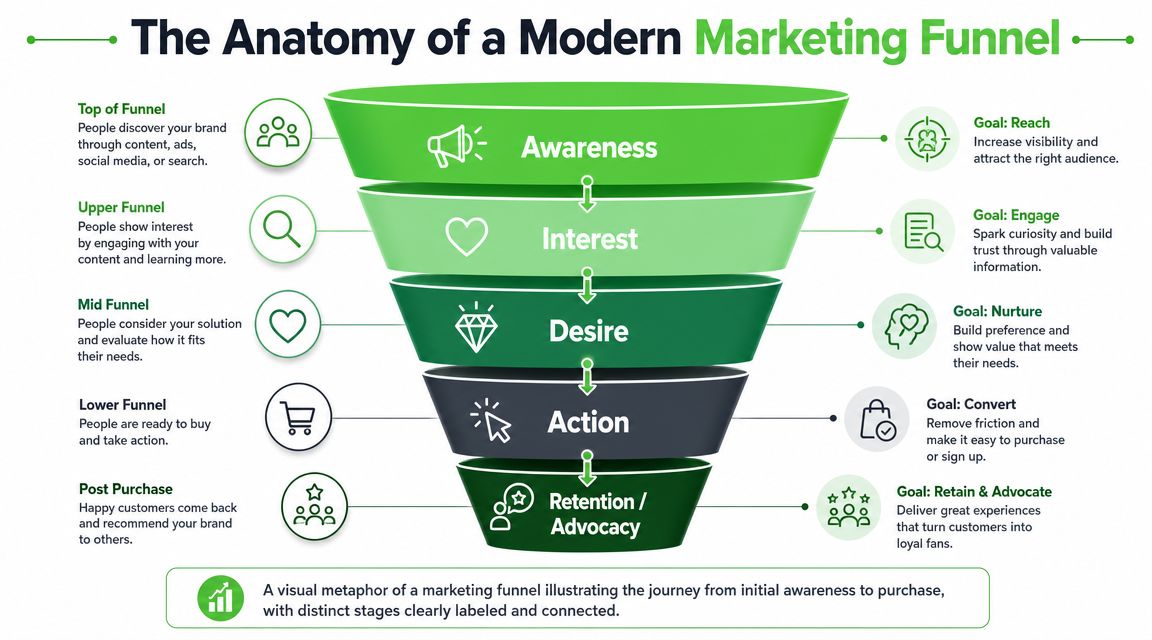
At the simplest level, a marketing funnel is a guided path. You decide the sequence of actions that moves a prospect from first interest to a clear next step, and you track where that movement slows down.
In analytics, funnels are used to measure how people progress through a conversion path and where they drop off. That matters because weak points usually sit between steps, not at the top. Amplitude's explanation of funnel analysis is useful here because it frames funnels as a way to diagnose friction in the journey, whether that friction comes from the offer, the message, or the user experience.
The classic structure still matters
The standard three-stage model still gives agencies a useful planning frame.
- Top of funnel creates awareness. Paid ads, organic content, referrals, local SEO, and outbound campaigns all start here.
- Middle of funnel builds consideration. Prospects compare options, ask better questions, and decide whether your offer fits their problem.
- Bottom of funnel drives action. Demo requests, proposal reviews, checkout steps, and signed agreements happen here.
That structure still works because buyer intent changes as people move closer to a decision. A cold lead needs context. A warm lead needs clarity. A sales-ready lead needs a fast path to action. Agencies lose conversions when they send the same generic follow-up to all three.
One rule keeps this clean. Each step should move the prospect to one next action. If a WhatsApp message tries to educate, qualify, handle objections, and close at once, response rates usually drop.
Why the linear view breaks down
Real buying behavior is messier than the classic diagram suggests.
A lead might discover your client through an Instagram ad, leave the landing page, come back through branded search, start a WhatsApp chat from a mobile CTA, go quiet for two days, then re-engage after an automated follow-up. Another lead may skip most of the education because they already want pricing and only need qualification and routing.
That changes how agencies should build funnels. The job is no longer limited to page design and email sequencing. The job is to control response speed, conversation flow, qualification logic, handoff timing, and follow-up across channels, especially inside WhatsApp where intent is often higher and delay is expensive.
Today, funnels are used for the following:
| Funnel layer | What it does |
|---|---|
| Attention layer | Gets the prospect to raise a hand |
| Qualification layer | Sorts good-fit from poor-fit leads |
| Conversion layer | Moves the qualified lead to call, payment, or signup |
| Expansion layer | Keeps clients active and opens upsell paths |
For agencies reselling WhatsApp automation, this structure matters because the money is rarely in lead capture alone. The margin comes from building the full path after the click. That includes automated replies, qualification questions, routing rules, reminders, no-show recovery, and reactivation sequences managed inside tools such as Double My Leads.
If your agency only owns the attention layer, you help clients get leads. If you own the conversational funnel, you help clients close more of them. That is a much stronger service to sell.
Beyond Sales Key Funnel Use Cases for Agencies
The mistake most agencies make is treating funnels as sales-only assets. In practice, they're operating systems for repeated client interactions. Once you see that, your offer becomes bigger than lead gen.
Lead generation and qualification
This is the most obvious use case. You attract attention, capture the inquiry, ask a few qualifying questions, and route the lead to the right salesperson, calendar, or offer.
For agencies, this solves three common problems:
- Slow follow-up: Leads sit in a form inbox instead of entering an active conversation.
- Low lead quality: Everyone books time, including poor-fit prospects.
- No source clarity: Sales teams can't tell whether the lead came from ads, local SEO, referral traffic, or a QR campaign.
A good lead funnel doesn't just collect contact details. It creates enough context to decide what happens next.
Onboarding and activation
Many agencies win a client and immediately lose momentum. The sale closes, then the buyer waits for next steps, login instructions, documents, kickoff details, or implementation guidance.
That gap creates doubt. Doubt creates churn risk.
An onboarding funnel fixes the handoff by turning “we'll be in touch” into a sequence. Welcome message, intake form, kickoff scheduling, asset requests, and progress check-ins all happen in a controlled order. The client knows what's expected, and your team doesn't chase the same basics manually every time.
A strong onboarding funnel often does more for retention than another round of top-of-funnel spend.
Support and feedback loops
Support is another funnel, even if people don't label it that way. A customer reports an issue, chooses a category, gets routed, receives updates, and closes the loop with confirmation or feedback.
Agencies can package this as a service for clients with appointment-heavy or inquiry-heavy businesses. Clinics, home services, education brands, and community-led offers all benefit from faster sorting and cleaner escalation.
The gain isn't just efficiency. Better support flow protects revenue because unresolved friction damages renewals, referrals, and reviews.
Retention and upsell
The easiest client to sell is often the one who already trusts you. Yet many agencies put all their effort into acquisition and almost none into reactivation or expansion.
Retention funnels handle the messages that keep relationships alive:
- Check-in sequences after service delivery
- Renewal reminders before contracts lapse
- Reactivation campaigns for quiet accounts
- Upsell prompts based on service usage or expressed interest
These aren't “nice to have” automations. They create recurring income and make your client results look more stable.
Here's the agency angle that matters. Each of these four funnel types can be sold separately, but they become more valuable when bundled. Lead generation without onboarding leaves money on the table. Onboarding without retention fixes the start but ignores lifetime value. Agencies that understand what are funnels used for in practice usually stop selling one-off campaigns and start selling process infrastructure.
Building High-Converting WhatsApp Funnels
A lead clicks your ad, opens WhatsApp, and sends a message. That moment is where funnel quality shows up fast. If the reply is slow, generic, or unclear, the prospect leaves. If the next prompt is specific and the route is obvious, the conversation keeps moving toward a sale.
This defines the core change with WhatsApp funnels. Agencies are not just building awareness paths or email sequences. They are building conversational systems that qualify intent, reduce handoff friction, and create revenue opportunities inside the chat itself. For agencies reselling WhatsApp automation, that difference matters because clients do not pay for funnel diagrams. They pay for booked calls, faster response, cleaner onboarding, and more retained accounts.
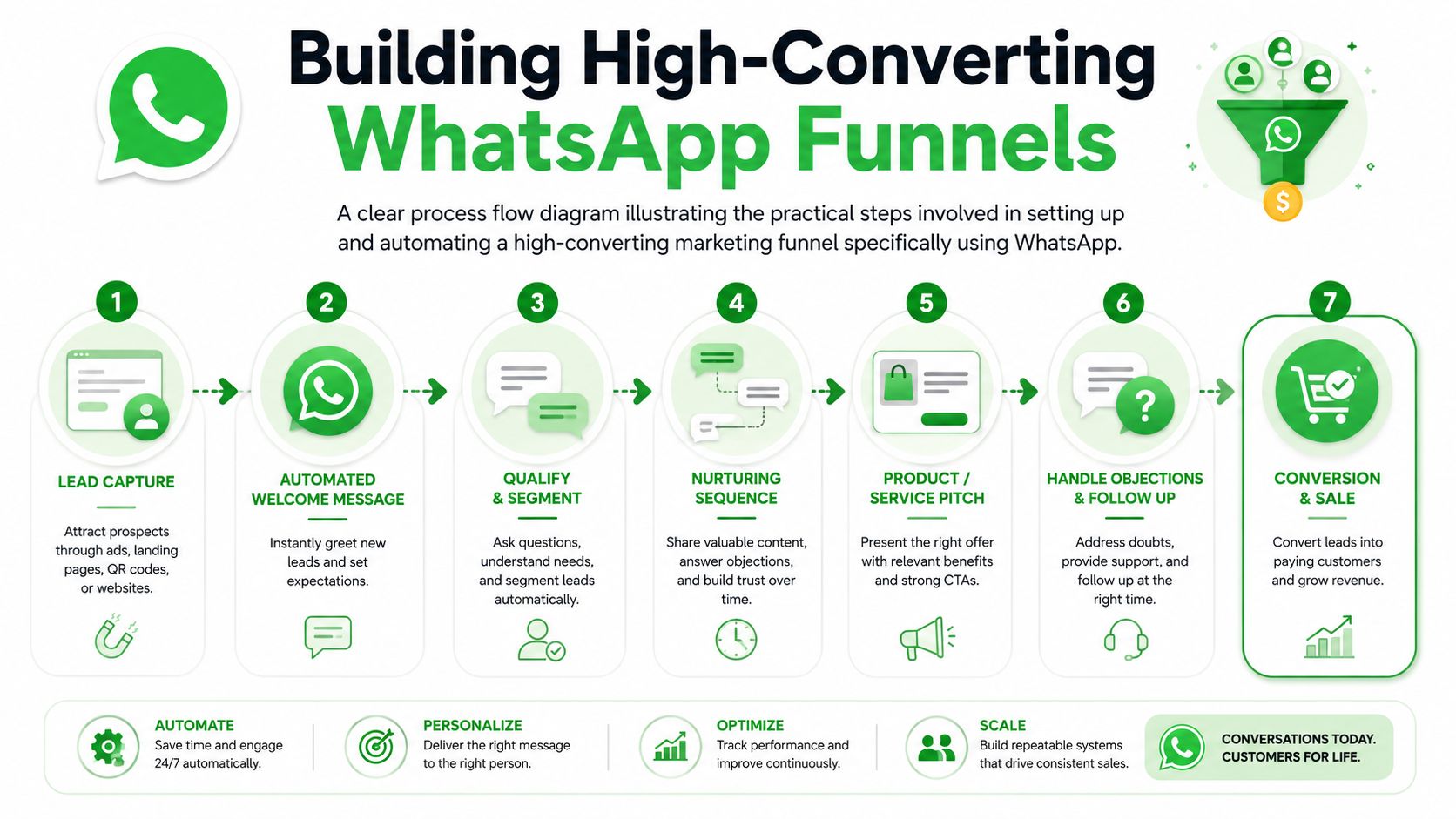
A strong WhatsApp funnel usually follows a simple rule. One step, one decision. Ask. Route. Confirm. Remind. Close.
Lead capture funnel
Start with entry intent, not with the automation tool.
A click-to-chat ad, QR code, website button, or community post can all work. The better question is what the prospect expects to happen next. If someone opens WhatsApp from a service page, the first message should confirm context and move them into qualification. If someone scans a QR code from an offline flyer, the first message should explain what they are opting into before you ask anything else.
A simple lead capture flow looks like this:
- Entry trigger from QR code, click-to-chat link, or landing page button.
- Auto-welcome message that confirms they reached the right business or offer.
- Qualification prompt with one or two high-value questions.
- Routing step to a rep, a booking link, or a segmented follow-up sequence.
Example opening script:
Hi, thanks for reaching out. To point you to the right option, are you looking for lead generation, WhatsApp automation, or white-label SaaS setup?
That message does two jobs well. It reassures the lead and narrows intent without forcing a long form. For agencies, that means fewer low-fit conversations hitting the sales team and more context before a human steps in.
A platform like Double My Leads can support this flow with QR-based number connection, auto-welcome messages, tags, quick replies, source attribution, and white-labeled workspaces for agency resale. Those details matter when you manage multiple client accounts and need to keep brand, source, and pipeline data separated.
The trade-off is speed versus depth. Ask too little and sales wastes time on weak leads. Ask too much and response rates drop. In practice, two qualification questions are usually enough at the top of the funnel. Save the rest for the rep or the booking page.
A walkthrough helps if you want to see chat automation in action:
Onboarding funnel
Agencies lose momentum after the sale when the client has to ask what happens next.
WhatsApp is useful here because it shortens the gap between purchase and first action. A good onboarding funnel removes avoidable back-and-forth, gets assets collected faster, and sets communication rules before confusion starts. That protects delivery margins and reduces the chance that a new client feels ignored in week one.
A practical onboarding flow looks like this:
- Welcome message sent right after payment or agreement
- Document request for assets, brand files, or account access
- Kickoff scheduling with a direct booking option
- Milestone check-ins so the client sees progress
- Expectation-setting message that explains response times and communication norms
Example:
- Message one: “Welcome aboard. Your kickoff is the next step. Reply with your preferred day or use this booking link.”
- Message two: “Before kickoff, please send your logo files, access list, and primary contact details.”
- Message three: “Quick check-in. We've received your assets and are preparing the setup.”
The goal is simple. Remove dead time.
If you sell implementation, CRM setup, lead handling, or white-label automation, this funnel is often where churn starts or gets prevented. Clients who know what is happening stay calmer, reply faster, and are easier to upsell later.
Support funnel
Support on WhatsApp needs structure or it becomes an expensive inbox.
A support funnel should classify requests early, attach context to the conversation, and send the issue to the right person without making the customer repeat themselves. That is what separates a support system from a message pile.
Use keyword triggers and quick replies to sort common requests:
- Billing
- Technical issue
- Appointment
- General question
Then assign each path internally based on queue, role, or urgency. If the first exchange cannot identify the request type, your team ends up doing manual triage all day, which cuts into account management time and response speed.
Close resolved conversations with a short confirmation prompt. If the issue is not solved, route it back into the queue with the original context attached. That one step improves client experience and gives agencies cleaner reporting on unresolved cases.
Retention funnel
Retention is where WhatsApp automation becomes easier to resell because the ROI is easier for clients to feel.
A client who already bought from you or your customer usually needs timing, reminders, and relevant prompts, not more persuasion. WhatsApp works well here because the messages are direct and tied to existing behavior. The mistake is sending the same sequence to everyone.
Use tags or CRM sync to build segments such as:
| Segment | Example message focus |
|---|---|
| New clients | Education and next steps |
| Active clients | Usage reminders and progress updates |
| Quiet accounts | Reactivation and check-ins |
| Warm expansion prospects | Upsell or additional service offers |
Message examples should sound helpful and specific.
- Reactivation: “Checking in to see whether you still want help with follow-up automation. If timing changed, reply later and we'll revisit this next month.”
- Upsell: “You're already using WhatsApp for lead response. If you want, we can add onboarding and renewal messaging to the same workflow.”
This is the practical application of funnels when you sell WhatsApp automation. They help agencies reduce response lag, qualify faster, onboard clients with less confusion, run support with less manual sorting, and increase revenue from the same account.
If you want broader channel ideas outside chat automation, these digital marketing tips for growth can help you connect funnel design with offer positioning and demand generation.
Choosing the Right Funnel Strategy for Your Goal
Most agencies shouldn't build four funnels at once. They should fix the constraint that's hurting revenue now.
Start with the business constraint
If lead volume is weak, start with acquisition and qualification. If new clients sign but go quiet, onboarding deserves attention first. If renewals are unstable, retention is the better investment.
This sounds obvious, but agency owners often choose the most exciting build instead of the most necessary one. They launch a complex nurture setup while ignoring the fact that inbound leads still wait too long for a first reply.
Use these decision prompts:
- Need more opportunities: Build a lead generation funnel.
- Need smoother delivery: Build an onboarding funnel.
- Need less service chaos: Build a support funnel.
- Need more lifetime value: Build a retention funnel.
If you also want broader channel ideas outside chat automation, these digital marketing tips for growth can help you think through how funnel strategy connects with content, visibility, and offer positioning.
Funnel Strategy Comparison
| Funnel Type | Primary Goal | Key WhatsApp Tactics | Core KPI |
|---|---|---|---|
| Lead Generation | Capture and qualify new prospects | Smart links, QR codes, auto-welcome, qualification prompts | Lead-to-conversation rate |
| Onboarding | Create a clean first client experience | Scheduled messages, file requests, kickoff reminders | Client activation rate |
| Support | Route issues and reduce manual back-and-forth | Keyword triggers, quick replies, assignments, notes | Resolution completion rate |
| Retention | Keep clients engaged and open upsell paths | Tags, segmented broadcasts, check-ins, renewal reminders | Repeat purchase or renewal rate |
A few trade-offs matter when choosing.
- Lead funnels move fastest because they're tied directly to visible pipeline activity. They also fail fast when the offer or response speed is weak.
- Onboarding funnels are less flashy but often improve client confidence immediately.
- Support funnels save team time and reduce mess, but they require discipline in routing logic.
- Retention funnels provide an advantage because they work on existing trust, though they depend on solid segmentation.
Pick the funnel you can operationalize well, not the one that looks most advanced in a sales pitch.
Measuring Success Funnel KPIs You Must Track
A funnel only earns its keep if you can tell where movement stops. Otherwise you're left with opinions. “The leads were bad.” “The offer felt off.” “People weren't serious.” Those are guesses.
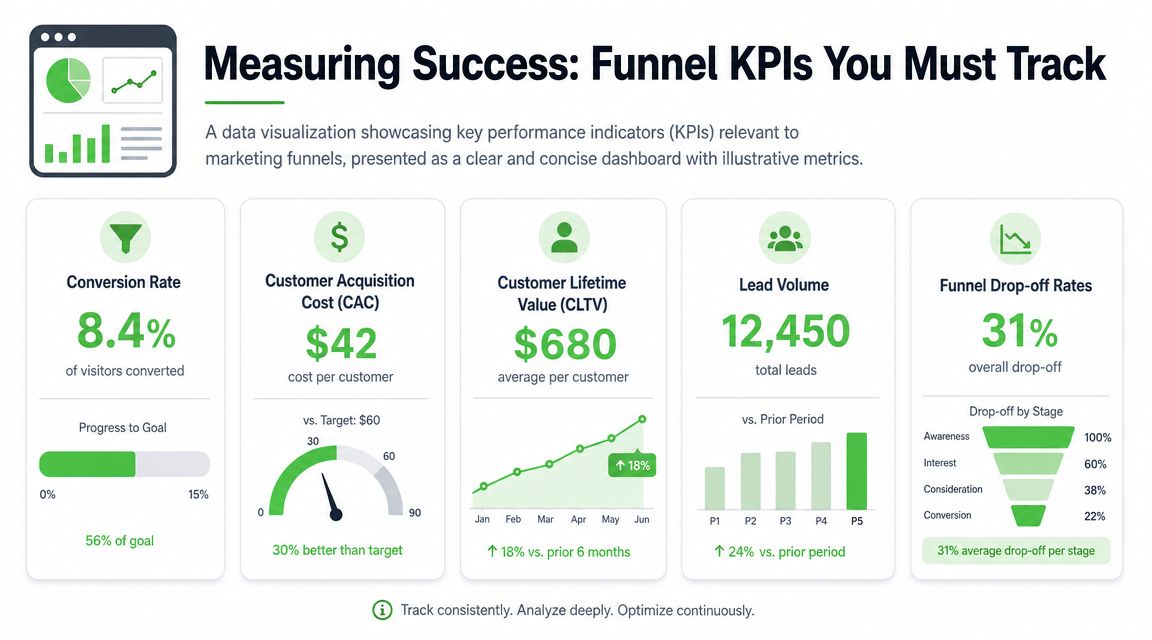
In product analytics, a funnel is a step-ordered sequence of events that measures how many unique customers complete each stage in the defined order, not total event occurrences. That's what makes funnels useful for diagnosing conversion drop-off and bottlenecks between steps, as explained in Bloomreach's funnel technical reference.
Track movement between steps
For agencies, the first useful KPI is step conversion rate. Not overall campaign performance. Step-by-step movement.
If your flow is ad click to WhatsApp message to qualification reply to booked call, measure each handoff. That tells you whether the issue is the ad promise, the welcome message, the qualification friction, or the booking step.
The next KPI is drop-off point. Where do people stop?
- Before first reply: Your opener may be weak or mistimed.
- After qualification question: You may be asking too much too early.
- Before booking: The prospect may still have unresolved objections.
- After booking: Your reminders or confirmation flow may be thin.
Don't optimize the whole funnel at once. Fix the narrowest point first, then measure again.
Two more business-facing metrics matter.
- Cost per acquisition tells you whether the funnel is economically sustainable once ad spend and labor are considered.
- Time to conversion shows how long it takes to move a prospect from first contact to decision. Long delays often signal unclear routing or too many steps.
If you want a practical set of ideas for tightening weak handoffs, this guide on how to improve sales conversion rates is useful as a companion to your funnel review.
WhatsApp metrics that actually help
WhatsApp creates the temptation to obsess over activity. Don't. Message volume alone tells you very little.
The more useful WhatsApp-specific indicators are:
- Open rate, which helps you judge whether your messages are being seen
- Reply rate, which tells you whether the message invites action
- Qualified conversation rate, which separates casual inquiries from real opportunities
- Booked outcome rate, which shows how many active chats become the next meaningful business event
A simple diagnostic framework works well:
| Symptom | Likely issue |
|---|---|
| Opens but no replies | Message is visible but weak |
| Replies but no booking | Qualification or offer handoff is unclear |
| Bookings but no close | Sales process after the funnel needs work |
| Support chats pile up | Routing or ownership is broken |
Agencies that get strong results from conversational funnels usually aren't doing magic. They're watching the handoffs carefully and making small changes in sequence, message clarity, and routing.
That's the difference between using WhatsApp as a chat app and using it as a conversion system.
Conclusion From Funnels to Flywheels
Funnels give agencies control over what usually feels random. They turn scattered inquiries into a sequence, and they make the weak points visible. That's why the question isn't just what are funnels used for in theory. It's how they help you capture intent, qualify faster, onboard cleanly, support better, and retain clients longer.
For agencies reselling WhatsApp automation, conversational funnels are especially practical because they operate where buyer intent is already active. The lead has clicked, scanned, replied, or asked. The job is no longer to hope they come back. The job is to move them forward without confusion.
The bigger payoff comes when these funnels start reinforcing each other. A smoother onboarding experience reduces churn. Better support protects trust. Retention campaigns reopen conversations with existing buyers. Satisfied clients refer new ones. At that point, the funnel starts behaving more like a flywheel.
Build one funnel first. Make it reliable. Then connect the next one to it until your agency has a repeatable growth engine instead of a collection of disconnected tactics.
If you want to turn WhatsApp into a resellable client acquisition and follow-up system, Double My Leads gives agencies a way to launch white-labeled WhatsApp workflows with inbox management, tags, QR-based number connection, broadcast features, and automation without building everything from scratch.


