
Agencies that focus on traffic alone leave a large share of revenue on the table. Conversion rates are usually constrained by friction in the handoff between click, form, follow-up, and close, especially when leads shift from a landing page into chat.
CRO works best as a packaged service, not a one-off fix. Agencies can audit the journey, remove high-friction steps, test changes in a controlled way, and show clients where conversion loss is happening. That matters even more in WhatsApp-led funnels, where slow replies, poor lead routing, and weak attribution can erase paid media gains before sales teams ever make contact.
The opportunity is not just higher on-site conversion. It is a better operating model for lead handling across page, form, CRM, and WhatsApp, with reporting an agency can resell confidently. For teams building that offer, this ecommerce conversion playbook is a useful reference point.
Table of Contents
- The Agency Imperative Why CRO Is Your Next High-Value Service
- Audit and Diagnose Your Conversion Bottlenecks
- Prioritize Hypotheses and Design Valid Tests
- Optimize Key Touchpoints from Landing Page to Checkout
- Use WhatsApp Automation for Higher Conversions
- Packaging and Reselling CRO as an Agency Service
- Frequently Asked Questions for Agencies
The Agency Imperative Why CRO Is Your Next High-Value Service
A small lift in conversion rate often produces more profit than another month of media spend. Agencies that can prove that gain move out of the commodity bucket fast.
Traffic is easy for clients to see because clicks, impressions, and CPC show up in every dashboard. Revenue friction is harder to spot, which is why it gets ignored for too long. A weak landing page, a slow form, poor follow-up timing, or a messy handoff into WhatsApp can waste demand the client already paid to generate.
That is why CRO deserves a larger place in the agency offer. It improves the output of paid media, SEO, email, and outbound without requiring a bigger acquisition budget. It also gives agencies a stronger position in the room because the conversation shifts from channel performance to business performance.
For agencies using WhatsApp as part of the funnel, the opportunity is even larger. Standard CRO work improves pages and forms. WhatsApp-focused CRO also reduces messaging friction after the click, captures intent that would otherwise go cold, and closes the attribution gap between ad spend and booked conversations. That combination is easier to sell because clients can see both the website improvements and the downstream lead handling changes.
What agencies should actually sell
A credible CRO service is a system, not a collection of design edits. The offer should include four parts:
- Diagnosis: Identify where users drop, hesitate, or switch channels without converting.
- Test planning: Turn observed issues into hypotheses with a clear expected outcome.
- Execution: Update pages, forms, checkout steps, routing, and message flows.
- Measurement: Track what changed, what won, and what should be rolled out account-wide.
That structure works across service businesses, SaaS, lead gen, and ecommerce. The friction points differ, but the commercial logic stays the same. Better message match, lower effort, stronger trust, and faster follow-up usually improve results.
Practical rule: If the agency cannot show where conversion intent is being lost across the page, form, CRM, and WhatsApp handoff, it is selling opinions, not CRO.
For ecommerce clients, train the team on practical teardown patterns before building a service line. Tagada's ecommerce conversion playbook is a good reference because it focuses attention on intent, trust, friction, and completion behavior instead of surface-level redesign work.
Why this service holds margin
Paid media management gets compared line by line. CRO is harder to replace because judgment matters. Someone has to decide which friction deserves attention first, which tests are worth running, and how to connect website behavior with sales outcomes inside the CRM and messaging stack.
Clients keep buying when the service is framed around yield, not activity. They are not paying for button tests. They are paying for a repeatable method to get more revenue from the traffic and conversations they already have.
Audit and Diagnose Your Conversion Bottlenecks
Most low-converting funnels aren't mysterious. Teams just skip the diagnosis and start changing headlines.
Start with evidence. Pull data from Google Analytics 4, heatmaps, session recordings, form analytics, support logs, and CRM notes. Then build a single view of the path from first click to completed action. If a lead gen client uses a booking page, audit that path. If an ecommerce client relies on checkout completion, audit that flow instead.
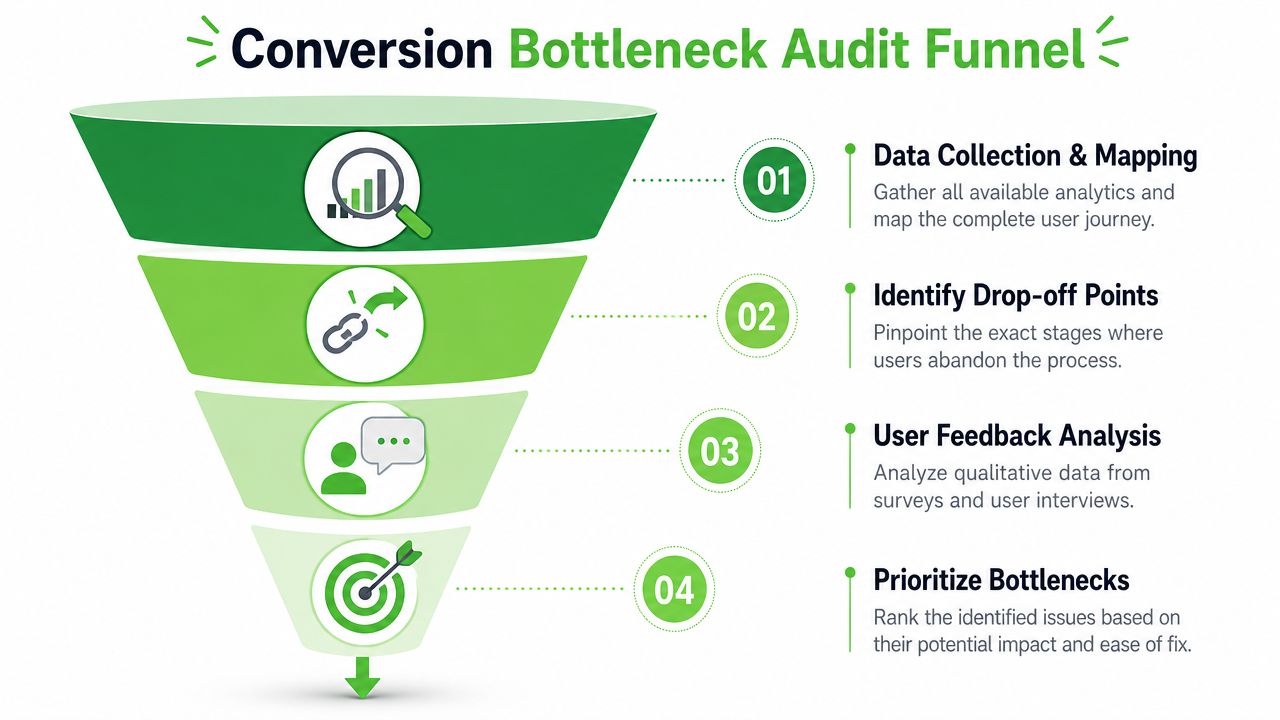
Map the real funnel first
Don't map the funnel you think exists. Map the one users take.
A typical audit starts with these checkpoints:
- Entry pages: Which landing pages attract intent-rich visitors and which attract low-fit traffic.
- Decision pages: Product pages, pricing pages, service pages, webinar pages, and lead forms.
- Commitment steps: Add to cart, quote request, booking initiation, checkout start, trial signup.
- Completion points: Thank-you pages, purchases, booked calls, or confirmed applications.
If you're trying to improve conversion rates for clients with multiple traffic channels, segment early. Organic visitors often behave differently from paid search visitors. Mobile users often hit different friction than desktop users. Returning visitors usually need less explanation and more reassurance.
Pair behavior data with user evidence
Quantitative data tells you where the drop happens. Qualitative evidence tells you why.
Use this split:
| Signal type | What to look for | Useful tools |
|---|---|---|
| Analytics | High exit pages, funnel drop-offs, weak page-to-page progression | Google Analytics 4 |
| Attention data | Missed CTAs, low scroll depth, clicks on non-clickable items | Hotjar, Microsoft Clarity |
| Session review | Hesitation, repeated clicks, form confusion, backtracking | Hotjar, FullStory, Clarity |
| User voice | Objections, mistrust, unanswered questions | On-page surveys, sales calls, support tickets |
A good audit usually reveals patterns like these:
- Message mismatch: Ad promise says one thing. Landing page headline says another.
- Visual distraction: Navigation, popups, or secondary offers pull attention from the primary action.
- Form friction: Too many fields, unclear labels, poor mobile usability, weak error handling.
- Trust gap: No reviews, no proof, no process explanation, no reassurance near commitment points.
For teams that want a second tactical reference on the process, AdCrafty's guide on improve conversion rates is useful because it complements the standard analytics view with creative and message-level fixes.
Watch abandoned sessions with a notebook open. The repeated problems matter more than the loudest opinion in the Slack channel.
Turn findings into a ranked issue list
An audit isn't complete when you've gathered screenshots and charts. It's complete when you've produced a short ranked list of bottlenecks tied to business impact.
Use a simple structure for every issue:
- Observed problem: Users stall on the pricing page before clicking the CTA.
- Evidence: Heatmaps show low interaction with the CTA. Session recordings show repeated returns to FAQ sections.
- Likely cause: Offer details and implementation process aren't clear enough.
- Affected segment: New paid traffic on mobile.
- Suggested response: Test a tighter value proposition, process summary, and trust proof near the CTA.
That format keeps the team from jumping straight into cosmetic changes. It also makes client reporting stronger because you're not saying "we think the page needs work." You're saying, "here is the friction, here is the evidence, and here is the likely fix."
Prioritize Hypotheses and Design Valid Tests
A backlog of ideas isn't a CRO program. It becomes one when each idea turns into a hypothesis that can be tested cleanly.
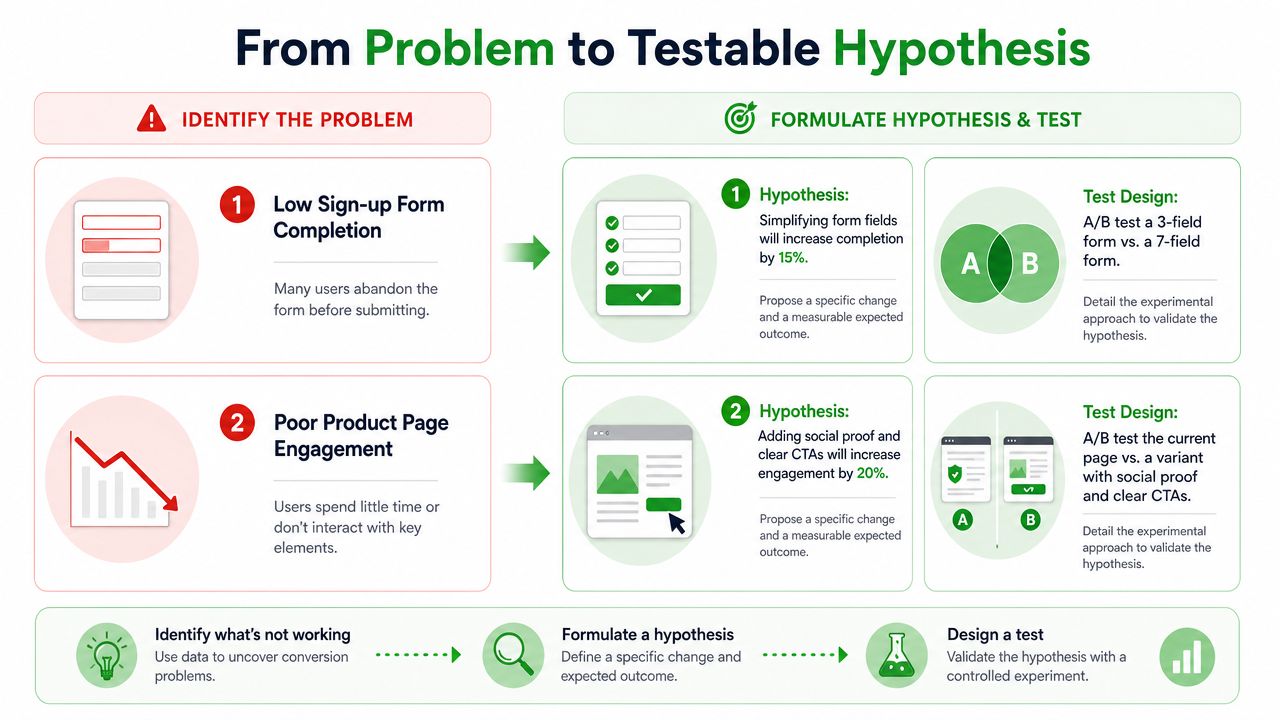
Write hypotheses that can survive review
Weak hypothesis: "Let's make the page look better."
Useful hypothesis: "If we replace generic headline copy with a benefit-led headline and move the CTA higher on the page, more qualified visitors will start the form because they will understand the offer faster."
That structure matters because it forces three decisions:
- What will change
- What outcome should move
- Why that change should affect behavior
Good agencies also define one primary metric per test. If you test a landing page for form starts, don't declare victory because time on page increased. Pick the metric that matches the business goal.
Use a simple prioritization model
The easiest model to operationalize is ICE: impact, confidence, ease.
Score each proposed test internally, then compare them side by side:
| Hypothesis | Impact | Confidence | Ease | Priority |
|---|---|---|---|---|
| Rewrite headline and CTA on service page | High | High | High | Start here |
| Redesign full page layout | Medium | Low | Low | Later |
| Remove unnecessary form fields | High | Medium | Medium | Early |
| Add pricing calculator | Medium | Low | Low | Backlog |
This isn't scientific scoring. That's fine. The value comes from forcing the team to separate likely winners from pet ideas.
Protect test quality
Most agencies don't struggle with generating ideas. They struggle with test discipline.
According to CXL, properly executed A/B tests on landing pages yield median improvements of 15-20%. The same source notes that 40% of tests with insufficient sample sizes, under 1,000 visitors per variant, lead to false positives. That highlights the necessity of statistical validity.
Use these rules:
- Change one variable at a time: If you rewrite the headline, CTA, and layout at once, you won't know what caused the result.
- Wait for enough data: Calling a winner too early creates bad client advice.
- Run through a full cycle: CXL notes a minimum run duration of 7-14 days to capture full-week behavior patterns.
- Segment where it matters: Device type and location can distort results if you lump everything together.
- Avoid overlapping tests: Running multiple experiments on the same page can contaminate outcomes.
A test that produces a clean loss is still useful. It removes a bad idea from the roadmap and protects the client from rolling it out everywhere.
The agencies that get traction with CRO don't promise constant wins. They promise a reliable decision process. Clients trust that far more than flashy language about "hacks."
Optimize Key Touchpoints from Landing Page to Checkout
Most funnels don't fail because every page is bad. They fail because one or two touchpoints create enough doubt that buyers stop moving.
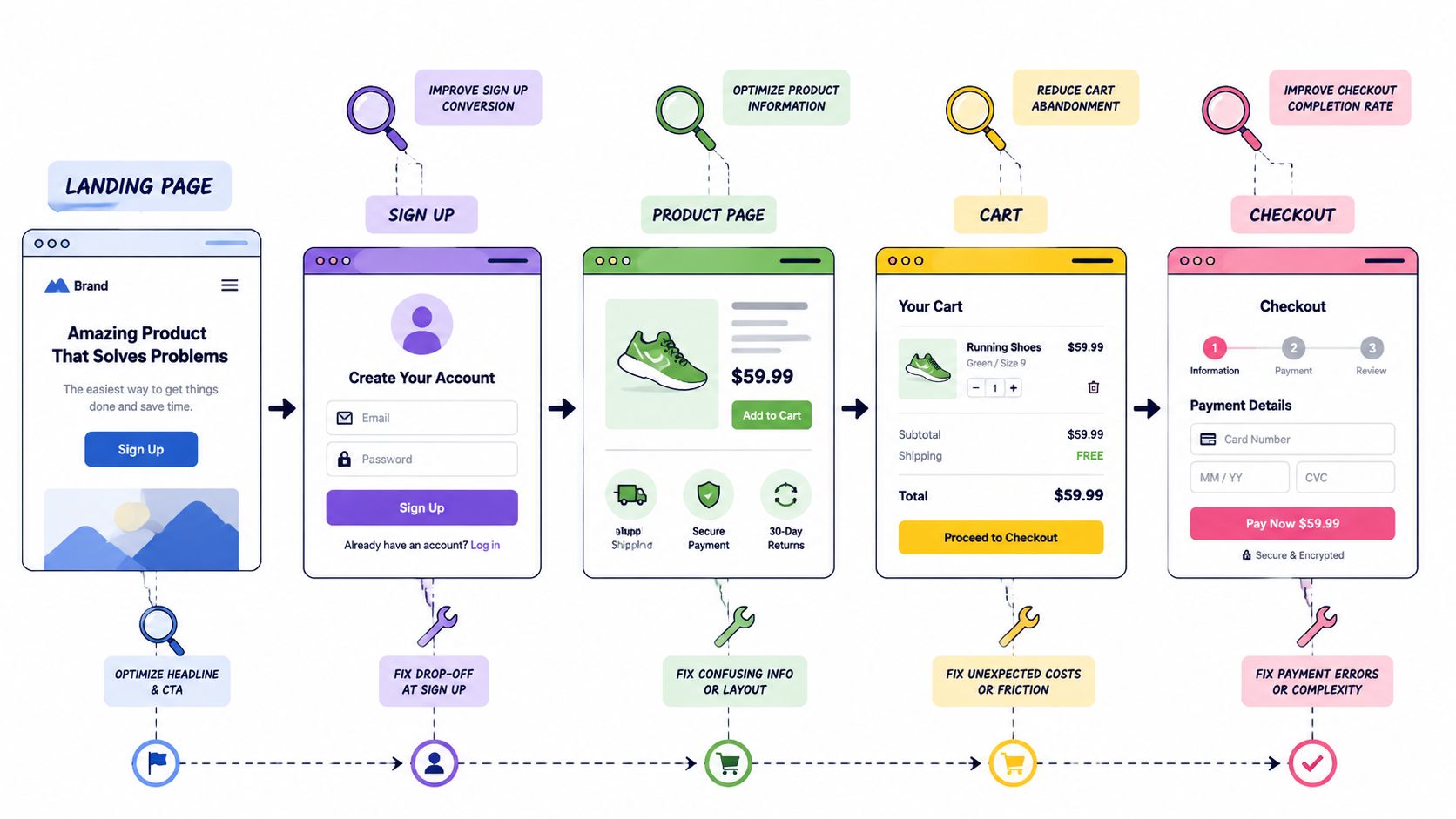
Fix the message before the design
Design can support conversion. It rarely rescues weak positioning.
When teams ask how to improve conversion rates, I usually start with four questions:
- What is the offer?
- Who is it for?
- Why should this person care now?
- What happens after they click?
If the first screen of a landing page doesn't answer those clearly, the rest of the page works harder than it should. Good conversion pages reduce interpretation. They don't ask visitors to decode brand language.
Use a sharper message structure:
- Lead with the primary benefit.
- Support it with a plain-language explanation.
- Add a CTA that names the outcome, not the mechanics.
- Remove competing actions that don't help the main conversion goal.
Use trust signals where decisions happen
Social proof works best when it appears at the moment of hesitation, not buried on a testimonials page.
According to Matomo's conversion rate optimisation statistics, 85% of consumers are more likely to make a purchase when a business has positive reviews, and integrating user-generated content like testimonials and ratings can improve conversion rates by 20-30%.
That doesn't mean you should dump logos and quotes everywhere. Place proof where risk spikes:
- Near pricing: Add reviews that address value and outcomes.
- Near forms: Show short testimonials that reduce fear of spam or wasted time.
- On product pages: Use ratings, review snippets, and customer photos where available.
- At checkout: Reinforce security, delivery expectations, and return clarity.
Buyers don't need more praise. They need evidence that someone like them made the same decision and didn't regret it.
A short walkthrough on CRO fundamentals can help junior team members align around these basics before implementation starts:
Reduce form and checkout friction
A lot of conversion leakage comes from asking for too much too early.
Tighten forms and checkout flows with practical changes:
- Delete fields first: If sales doesn't use the field, remove it.
- Make labels explicit: "Work email" is clearer than "Email."
- Use progressive capture: Ask for the minimum needed to move the lead forward.
- Keep mobile in mind: Short fields, clear keyboards, and visible CTAs matter.
- Reassure at the point of action: Explain what happens after submission, who responds, and how fast.
For ecommerce, checkout should feel like confirmation, not another sales page. For lead gen, the submit step should feel low-risk and specific. "Book my strategy call" generally creates better clarity than "Submit."
Use WhatsApp Automation for Higher Conversions
Private messaging changes how conversion paths work. For many agency clients, the highest-intent action is not a form fill or an add-to-cart. It is the moment a prospect clicks into WhatsApp and starts a sales conversation.
Treat WhatsApp like a conversion touchpoint
Teams that measure CRO only on the site miss a large part of buying behavior. A prospect may click an ad, skim a landing page, leave, reopen the offer from WhatsApp, ask a pricing question, then convert after a rep replies. If the agency tracks only page sessions and form submissions, that path disappears.
That creates an attribution gap and a decision gap. The client sees leads coming in, but cannot explain which message entry points produced qualified conversations or revenue.
A better operating model looks like this:
| Narrow CRO model | Agency CRO model with WhatsApp |
|---|---|
| Conversion starts on-site | Conversion can start from a tracked message click |
| Form submit is the main success event | Qualified conversation can be an earlier success event |
| Sales follow-up sits outside optimization | Reply speed, routing, and message quality affect conversion rate |
| Analytics owns attribution | Analytics, CRM, and messaging events all need to connect |
Agencies can sell something stronger than page edits. You are improving the whole path from click to conversation to closed revenue.
Remove friction inside the chat flow
Messaging friction is harder to spot because it happens out of public view. The landing page may be solid, but the WhatsApp experience still kills intent if the first reply is slow, generic, or disconnected from the offer that drove the click.
I usually audit three points first:
- Entry context: The message flow should reflect the ad, offer, or page that sent the user there.
- Intent routing: Pricing questions, demo requests, and support requests need different paths.
- Speed to human help: Automation should qualify and guide, not trap a ready buyer in a loop.
Poor routing is expensive. A prospect who clicks from a webinar campaign should not receive the same opening reply as someone asking for post-purchase support. Context mismatch lowers trust fast.
Rich media can help, but only when it removes confusion. A short product clip, annotated screenshot, or voice note often works better than a long paragraph. Use it to answer a specific question, not to add noise.
Build attribution before increasing volume
Many agencies start broadcasts, collect replies, and try to sort out reporting later. That usually ends with underreported revenue and weak client confidence.
Set up the tracking first. At minimum, connect these five records:
- Campaign or broadcast source
- Tracked WhatsApp entry point or smart link
- Contact record in the CRM
- Sales outcome, such as booked call, qualified lead, or purchase
- Revenue event tied back to the original message source
Perfection is not required at the start. Consistency is.
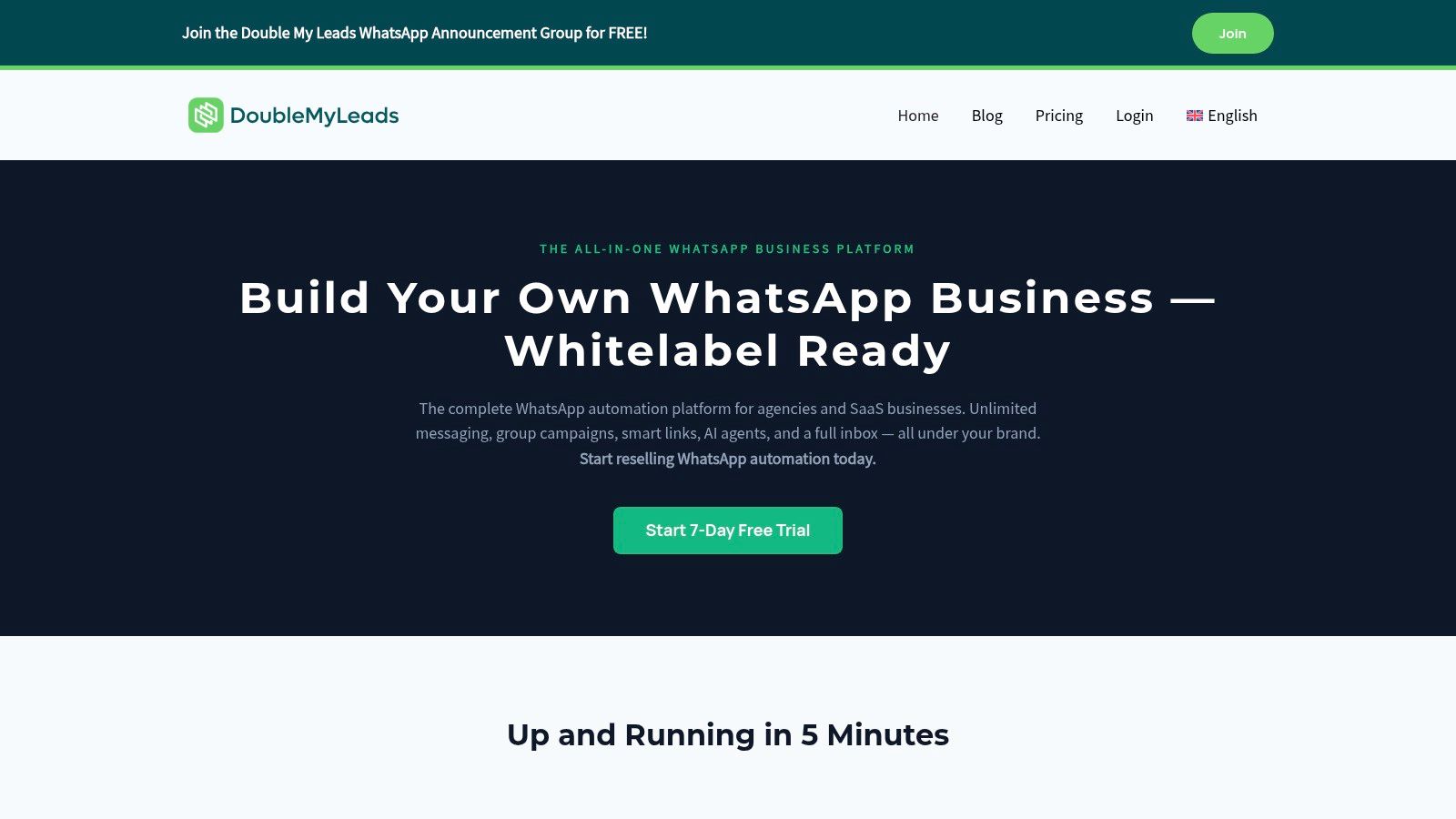
If a client asks which WhatsApp campaign drove booked appointments, the agency should be able to show the path from click to conversation to outcome. That can be done with tagged links, custom fields, CRM updates, webhook events, and a platform that keeps message-source data intact. This is one reason agencies using systems like Double My Leads can package WhatsApp CRO as a measurable service instead of an untracked add-on.
A lead should not end up labeled "direct" because the reporting setup broke after the message click.
Automate the first response, not the whole sale
The strongest WhatsApp automations do three jobs well. They acknowledge intent fast, collect just enough detail to route correctly, and hand the conversation to a human when purchase intent is clear.
That trade-off matters. More automation reduces manual load, but too much automation lowers conversion quality when buyers need reassurance, pricing nuance, or a quick exception handled by a person. Agencies that understand that balance tend to outperform teams that treat chat automation like a support bot.
Used well, WhatsApp gives agencies a practical way to close the gap between classic CRO and real buyer behavior. The page still matters. The message thread often decides the sale.
Packaging and Reselling CRO as an Agency Service
If you want clients to buy CRO consistently, package it as an operating system, not a loose set of tasks.
Package the work into clear deliverables
A clean offer is easier to sell than "ongoing optimization support." Keep the package concrete.
A practical agency package usually includes:
- Initial audit: Funnel review, analytics review, session review, and issue prioritization.
- Testing roadmap: Ranked hypotheses with expected business relevance.
- Implementation cycle: Copy changes, page edits, form improvements, checkout fixes, and messaging updates.
- Reporting cadence: Decision logs, test outcomes, and next actions.
- WhatsApp layer where relevant: Entry-point tracking, message-flow review, routing logic, and attribution setup.
Present this in phases rather than a giant retainer menu. Clients buy faster when they can see what happens first, what happens next, and what they get at each stage.
Report on decisions not just metrics
Most agencies lose authority in reporting because they dump dashboards on clients without interpretation.
A better report answers five questions:
| Reporting question | What the client needs to know |
|---|---|
| What did you find | The most important friction points |
| What did you change | Specific tests or fixes shipped |
| Why did you choose that | Evidence and reasoning |
| What happened | Outcome, win or loss |
| What happens next | Next test, next fix, next priority |
That structure protects your value even when a test doesn't win. Clients can see that the agency is learning systematically, not guessing expensively.
There's also a pricing advantage here. Traffic management often gets compared line by line against cheaper vendors. A well-framed CRO and conversational conversion offer is harder to commoditize because it combines analysis, experimentation, implementation, and attribution.
Frequently Asked Questions for Agencies
How do I sell CRO if a client only asks for leads?
Translate conversion work into wasted budget recovery. If the funnel leaks, more lead volume alone won't solve the underlying problem. Show the client where intent is being lost and position CRO as the work that makes acquisition spend more productive.
What should I audit first on a new account?
Start with the highest-intent path. For lead gen, that's usually landing page to form to booked call. For ecommerce, it is usually product page to cart to checkout completion. Don't begin with homepage opinions.
Should I test design changes or copy changes first?
Usually copy and offer clarity first. If users don't understand the value proposition, layout refinements won't fix the underlying issue. Structural design changes make more sense after message friction is under control.
How do I handle clients who want fast wins?
Give them two lanes. One lane is quick implementation fixes such as cleaner forms, clearer CTAs, or better proof placement. The second lane is controlled testing for bigger decisions. That keeps momentum without sacrificing rigor.
Where does WhatsApp fit in a CRO retainer?
For many clients, it belongs in the middle and bottom of the funnel. It can capture responses, answer objections, route conversations, and support follow-up after a click. For some businesses, it also becomes the first meaningful conversion touchpoint before the website visit is complete.
What if attribution is messy across web and messaging?
Assume it will be messy at first and document your logic. Define source tags, tracked links, CRM fields, and conversion events before campaigns go live. A consistent attribution model beats a perfect model that never gets implemented.
If you're building a CRO offer that extends into WhatsApp, Double My Leads gives agencies a practical way to launch and resell a white-labeled WhatsApp workflow with tracked entry points, broadcasts, inbox management, CRM sync, and automation without the usual setup drag.


