
Every agency has lived this: the dashboard is full of leads, sales is asking which ones to call first, and someone on the team is still eyeballing forms in a spreadsheet while the hottest inquiries cool off in the inbox. The problem usually isn't a lack of leads, it's a lack of decision logic. Lead scoring automation turns that chaos into a system, but only if the score drives routing, follow-up, and CRM action.
Table of Contents
- What Lead Scoring Automation Actually Changes for Your Agency
- Rule-Based versus Predictive Lead Scoring for Agencies
- Building Your Lead Scoring Model Step by Step
- Connecting Lead Scoring to WhatsApp and CRM Workflows
- Testing, Monitoring, and Optimizing Your Scoring System
- Agency Templates and White-Label Playbook for Resale
What Lead Scoring Automation Actually Changes for Your Agency
The shift usually starts with a painful, familiar pattern. A sales rep opens a list of “warm” leads, but half of them are stale, a few are bad-fit students or job seekers, and the only people replying are the ones who got answered first, not necessarily the right ones. Manual qualification burns agency time because the team is acting like a decision engine without the rules.
Lead scoring automation replaces that guessing with a structured ranking system. Leads get points from behavioral, demographic, and firmographic signals, then the platform routes them into the next action, sales, nurture, or escalation, without waiting for someone to review every record. That makes the score more than a number, it becomes a trigger for workflow.
Practical rule: if a score doesn't change what happens next, it's decoration, not automation.
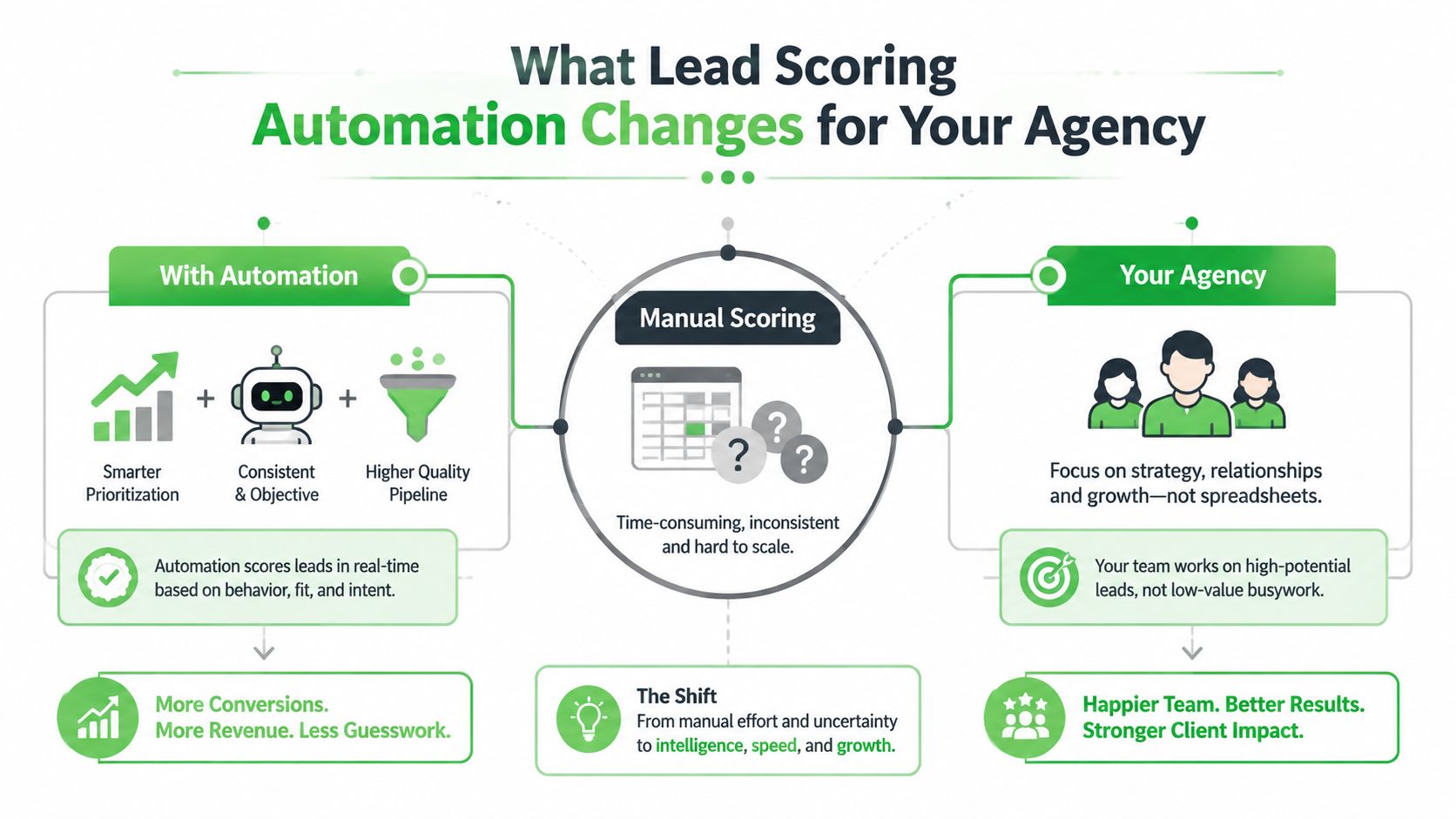
Difference shows up after the score is assigned. Agencies that combine scoring with nurture workflows see 30% to 50% higher MQL-to-SQL conversion rates than batch-and-blast email teams, with a reported median lift of 38% and a lift up to 62% when AI intent signals are layered on top of behavior, according to the 2026 compilation in the brief (Digital Applied). That doesn't mean the model itself is magical, it means the follow-up path is finally aligned with buyer intent.
Why the operational layer matters more than the model
A lot of agencies obsess over point values and ignore response design. That's where the money leaks out. A strong score with a weak handoff still leaves leads waiting, and waiting is usually where intent dies.
The better framing is simple. The score identifies who should move, the workflow defines where they go, and the team defines how fast they respond. If your client's inbox, CRM, and WhatsApp are not part of that same motion, scoring stays abstract.
The business case for getting this right is long established. Industry research cited in the brief shows companies implementing lead scoring achieve 138% ROI on lead generation versus 78% for companies that don't score leads, and B2B organizations specifically see a 77% increase in lead generation ROI (Landbase). That's the strongest argument for treating scoring as an operating system, not a campaign tactic.
Rule-Based versus Predictive Lead Scoring for Agencies
The first decision is not “Should we score leads?” It's “What kind of model can we support without creating another broken workflow?” Most agencies should start by being honest about their data, their client maturity, and how quickly their sales team can act on a score.
Rule-Based
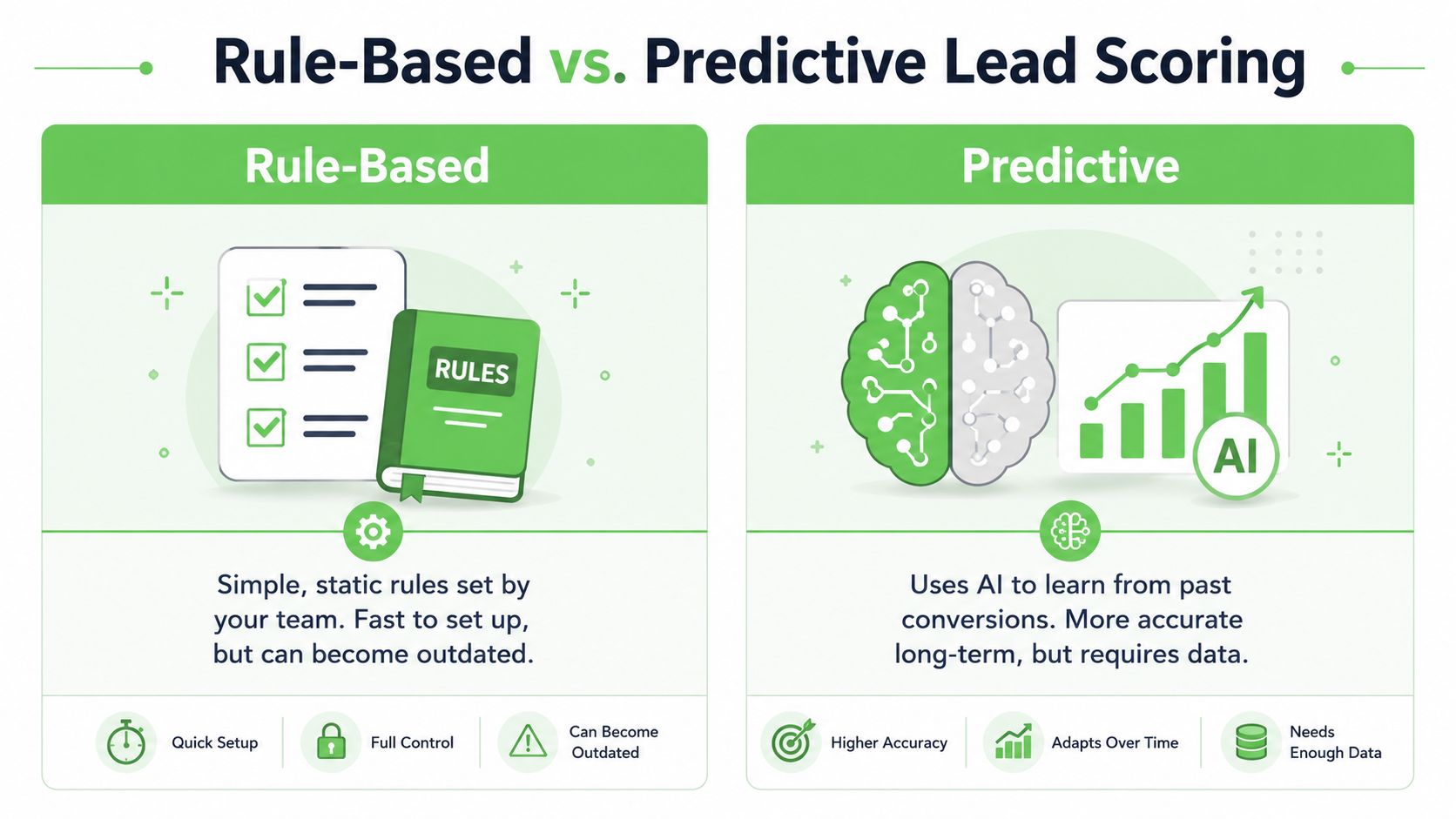
Rule-based scoring is the most direct version. You assign points for explicit signals, job title, company size, page visits, form fills, demo requests, or webinar attendance, then use those points to sort leads. It works because the logic is visible, easy to explain to clients, and fast to adjust when the offer changes.
That visibility matters in agency work. Clients want to know why a lead is “hot,” and sales teams want to understand why one form fill routed instantly while another got nurtured. When a model is rule-based, you can defend each threshold without needing a data science team.
Predictive
Predictive scoring uses machine learning to learn from past conversions and infer patterns that humans miss. It can outperform static rules over time, but it also needs enough historical data, clean CRM records, and tighter technical setup. Without that foundation, predictive scoring becomes a black box that no one trusts.
The practical trade-off is simple. Rule-based models are easier to launch and easier to explain, while predictive models can become more accurate as data accumulates. For many agencies, the best path is hybrid, start with clear rules, prove that the workflow moves leads correctly, then graduate to predictive logic once the client's data quality and volume justify it.
If the client can't describe a reliable handoff process, predictive scoring won't save them. It'll only hide a bad process behind better math.
A useful companion resource for the operational side is the sales workflow automation guide. It fits well with scoring work because the challenge is rarely the score itself, it's making sure the right person sees the right lead at the right moment.
Choosing the model by agency maturity
Early-stage agencies usually benefit from rule-based scoring because it creates a shared language with the client. Mid-maturity teams often keep the rules but add more careful normalization, so behavior, fit, and sales activity don't get mixed together into one vague number. More advanced teams move toward predictive systems once the CRM has enough outcome history to train on.
The wrong move is forcing predictive logic onto a client that still has messy lifecycle stages. If contacts are mislabeled, if sales notes live in private inboxes, or if WhatsApp conversations never make it back to the CRM, the model learns the wrong story. That's not an AI problem, it's a data governance problem.
Building Your Lead Scoring Model Step by Step
The cleanest workflows start before the first score is ever assigned. Experts recommend a specific sequence, define the ICP and lead-ready criteria, ingest and normalize demographic, behavioral, and firmographic data from CRM and tracking sources, calculate the score, then trigger routing or nurture actions at the right thresholds. They also recommend validating the model against historical conversion data before scaling and monitoring conversion rates over time to refine the rules (Jottler).
Start with fit, then add intent
A scoring model fails when it rewards activity from the wrong audience. A student who clicks three blog posts is not more valuable than a decision-maker from the right company who requests a demo. That's why the sequence starts with fit, not behavior.
A practical setup usually begins by defining the client's target profile, then assigning weight to the traits that matter most. From there, add engagement events that indicate movement, not just curiosity. The goal is to separate “interested” from “worth a sales response.”
Here's a usable framework agencies can adapt.
| Category | Criteria Examples | Points |
|---|---|---|
| Demographic fit | Title matches target buyer, correct seniority | 30 |
| Role fit | Decision-maker, manager, evaluator | 20 |
| Behavioral engagement | Pricing page visit, demo request, repeated site activity | 35 |
| Sales activity | Reply, meeting booked, WhatsApp response | 15 |
That structure mirrors how many practitioners think about scoring, with explicit weighting across fit and engagement. The main thing is consistency. If your team keeps changing what counts as “high intent,” the model will never stabilize.
Use data sources the team can trust
Pull from the CRM, site tracking, form submissions, and sales activity. Then normalize the fields so the same lead isn't treated like three different people because one system stores the job title and another stores the company size. Dirty records create fake confidence.
A sensible formula is straightforward, total score equals fit points plus engagement points plus sales activity points, minus decay for inactivity. That decay matters because a lead that was hot sixty days ago isn't necessarily hot now. The workflow guide in the brief recommends score decay automation on 30/60/90-day inactivity windows and immediate or 5-minute data sync to avoid stale scores and delayed routing (Digital Applied).
Operational truth: stale scores don't just hurt reporting, they send the wrong lead to the wrong rep at the wrong time.
Validate before you scale
Validation is where agencies either prove the model or expose its weakness. Compare the score against historical conversion outcomes, then look for obvious mismatches. If low-scoring leads keep closing and high-scoring leads keep stalling, the criteria need work.
Don't wait for perfection before launch. Start with a readable model, deploy it, then improve the rules after you see how the client's actual pipeline behaves. The point is to create a system the team will use, not a scorecard that only looks clever in a workshop.
Connecting Lead Scoring to WhatsApp and CRM Workflows
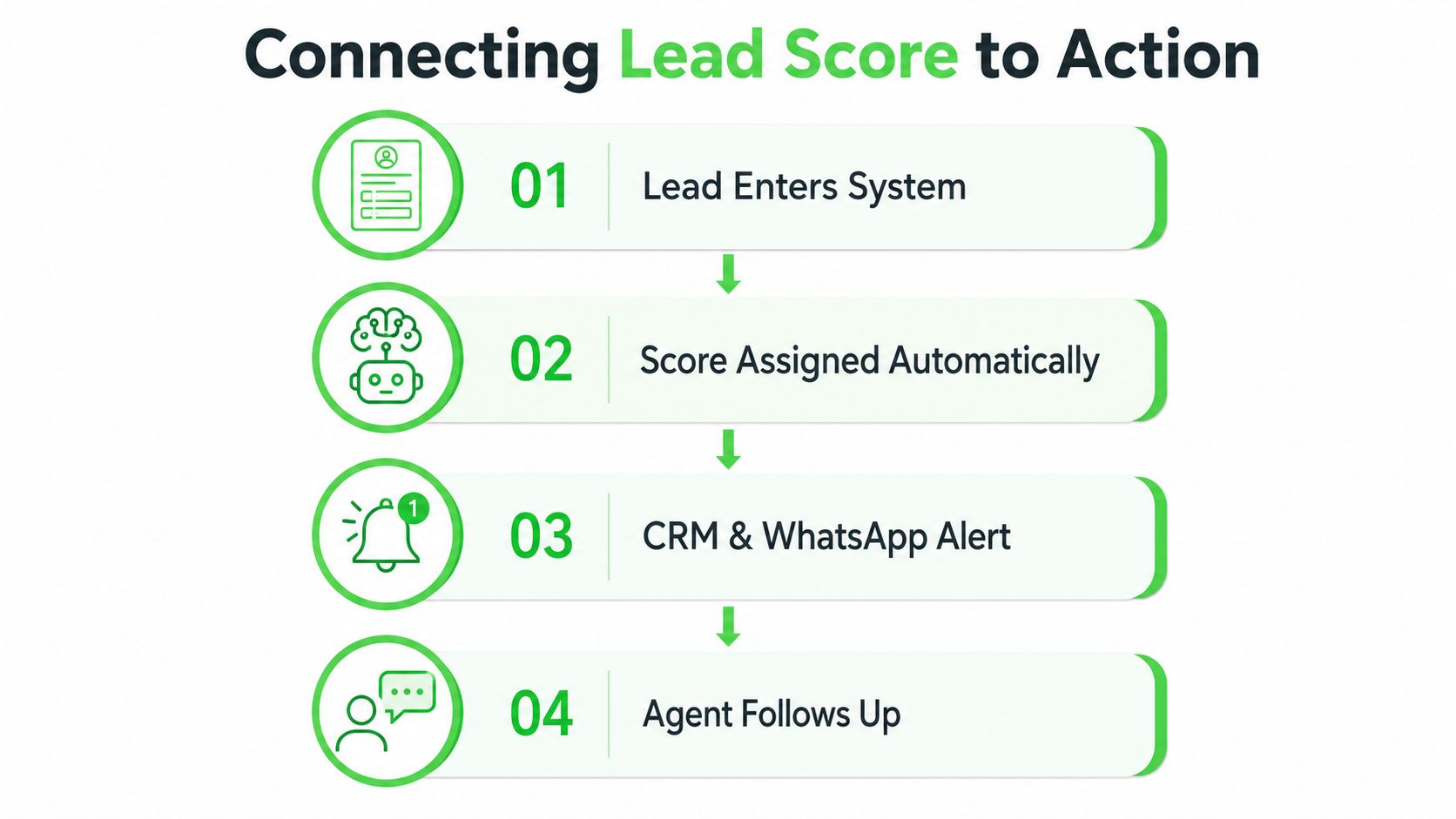
A score matters only when it changes the next action. That's the part most agencies underbuild. The strongest implementation pattern is to define the outcome first, set at least two thresholds, then map each threshold to a specific workflow, sales routing, WhatsApp broadcast enrollment, sequence activation, or missed-SLA escalation.
Build the decision engine first
Start by deciding what each score bucket means operationally. A low score might stay in nurture. A mid score might trigger a WhatsApp follow-up sequence. A high score should jump into the sales queue immediately, along with a notification in the CRM.
The stack has to behave like one system. If the CRM says one thing, WhatsApp says another, and the sales inbox shows nothing, the handoff breaks. Agencies using platforms like Go High Level often need cleaner assignment logic than they think, especially once multiple reps or client workspaces are involved.
The practical move is to map every threshold to a visible action. Don't leave a “hot lead” as a label. Route it, notify it, and time-box it.
Make WhatsApp part of the response path
WhatsApp is useful because it collapses the gap between intent and reply. If a lead crosses the threshold, a CRM rule can push the contact into the right inbox, tag them for a follow-up, or enroll them in a message sequence. That's where scoring becomes operational instead of theoretical.
One real-world option for agencies building that layer is Double My Leads, which is a WhatsApp automation platform with shared inbox, assignments, tags, quick replies, broadcasts, and CRM sync. Used properly, it acts as the response layer after the score has already qualified the contact, which is the right place for it in a revenue workflow.
The contrarian lesson is that teams often optimize model precision while their actual bottleneck is slow follow-up. If a rep responds late, even a perfect score can't recover the lost moment. That's why score design and response design need to be built together.
Map thresholds to real actions
Use simple, explicit rules.
- Low score: keep in nurture, no sales interruption, light educational messages.
- Mid score: add to a WhatsApp or CRM sequence, notify the assigned owner, watch for reply behavior.
- High score: route to sales instantly, raise an SLA alert if nobody acts, and log the handoff in the CRM.
You don't need ten buckets. You need clear outcomes. Two or three thresholds are usually enough to make the workflow readable for the sales team and useful for the client.
Testing, Monitoring, and Optimizing Your Scoring System
A scoring model is never really finished. Once it's live, the job shifts to proving that it predicts the right outcome and then tightening the system where it drifts. The useful metrics are the ones that show movement through the funnel, especially lead-to-opportunity conversion and opportunity-to-customer conversion, because they tell you whether the score is helping revenue.
Review the model against real outcomes
The first test is basic. Compare score bands against historical wins and losses, then inspect where the model overestimates or underestimates value. If the highest bucket produces poor pipeline quality, the threshold is too loose or the weighting is off.
Don't just watch raw lead volume. High volume can mask weak qualification. The better question is whether the leads the model surfaces are the ones that move through the pipeline with less friction.
Watch for workflow drift
Model drift usually shows up in the handoff, not the dashboard. Sales may start ignoring certain alerts, replies may slow down, or the same score may route to different owners because the assignment logic changed. Those are operational signals, and they matter more than cosmetic score changes.
For agencies that want a broader benchmark against other automation and GEO workflows, GEO Agency is useful context because it keeps the focus on implementation quality, not just tools. The lesson carries over here, the system only performs when the workflow is disciplined.
Optimize the right layer
There's a common trap here. Teams keep adjusting individual points because it feels productive, while the bigger problem is that no one answered the lead fast enough. Score accuracy matters, but response speed and follow-up design can matter more.
A good monitoring cadence asks three questions. Did the score predict the right outcome, did the threshold trigger the right workflow, and did the team respond in time? If any one of those is weak, the model still isn't ready for scale.
Agency Templates and White-Label Playbook for Resale
The cleanest agency offer isn't “lead scoring” by itself. It's a packaged qualification system with a scorecard, a threshold map, and a response workflow the client can run. That's the asset you can white-label, because it's concrete, repeatable, and easy to explain during onboarding.
Package the deliverables, not the buzzwords
A usable template set usually includes three pieces. First, a scoring framework document that lists fit, intent, and decay rules. Second, a threshold mapping sheet that tells the client what happens at each score band. Third, a workflow recipe for CRM and WhatsApp routing so the team knows exactly where the lead goes next.
That combination is what clients really buy. They don't want a discussion about scoring theory, they want a system that tells sales who to contact, when to contact them, and what message to send.
Position it inside a service stack
If you already sell WhatsApp or CRM automation, scoring fits as the qualification layer in front of those services. If you sell broader multichannel outreach, the multichannel outreach solutions resource from Lead Printer is a useful reference point for how agencies package outreach infrastructure alongside qualification logic. Scoring makes those channels smarter because it tells the team which contacts deserve the fastest response.
The best resale pitch is operational, not abstract. You're reducing manual qualification, improving routing discipline, and making the client's follow-up process easier to manage under one branded workspace.
Keep onboarding tight
The onboarding flow should stay simple. Define the ICP, connect the CRM, agree on thresholds, map the WhatsApp or inbox actions, and test the handoff on real leads before going live. If the client can't explain what happens when a score crosses the line, the setup isn't finished.
That's also where the service becomes recurring. The model needs periodic review, the thresholds need adjustment as the pipeline changes, and the workflow needs maintenance as sales behavior evolves. Agencies that sell that operating layer, not just the score, tend to keep the account longer.
If you want a working lead scoring and WhatsApp follow-up setup without building the inbox, routing, and white-label layer from scratch, visit Double My Leads. It gives agencies a practical way to connect scored leads to real conversations, assignments, and CRM workflows. If your team is ready to turn qualification into a revenue process instead of a spreadsheet task, start there.


