
Up to 40% of B2B buying discussions now happen in private messaging apps like WhatsApp, which means a large share of buyer intent never appears in the open web signals most agencies rely on for targeting, according to Foundry Co. That should change how you think about intent-based targeting.
Most agencies still build outreach around list quality, channel mix, and creative testing. Those matter. But they don't solve the bigger problem: you can run a polished campaign and still aim it at accounts that aren't ready to buy. Intent-based targeting fixes that by shifting attention from static fit to present buying motion.
The missed opportunity is even bigger in WhatsApp. Third-party intent tools can tell you which accounts are researching a topic across the web. They can't tell you which prospect replied to a WhatsApp message with a pricing question, clicked a comparison link inside a broadcast, or joined a niche announcement group after seeing a competitor-focused asset. That is first-party intent, and agencies that capture it have an edge most competitors still don't see.
Table of Contents
- Why Your Agency's Targeting Is Already Outdated
- What Intent-Based Targeting Really Is
- First-Party and Third-Party Intent Data Sources
- Capturing Intent from WhatsApp The Untapped Advantage
- An Agency Playbook for WhatsApp-Led Intent Targeting
- How to Measure Success and Prove ROI
- Frequently Asked Questions
Why Your Agency's Targeting Is Already Outdated
Intent-led campaigns aren't a minor optimization. They perform differently enough to force a change in strategy. Intentsify reports a 93% increase in conversion rates and 220% higher click-through rates compared to traditional approaches in its overview of intent data for digital advertising.
That gap explains why many agency pipelines feel harder than they should. You can have the right ICP, solid media buying, sharp landing pages, and a capable SDR team, yet still lose time on accounts that look qualified on paper but aren't in-market. The result is familiar: weak lead quality, long follow-up cycles, and pressure to discount because timing was wrong from the start.
Intent-based targeting changes the starting point. Instead of asking, “Who matches the profile?”, it asks, “Who is showing evidence of active research right now?” That sounds simple, but it changes campaign structure, handoff timing, messaging, and the channels you prioritize.
Agencies usually don't have a targeting problem. They have a timing problem disguised as a targeting problem.
The old agency playbook still leans too heavily on broad paid audiences, scraped lists, and generic nurture. That was workable when buyers engaged sales earlier. It breaks when people research independently, compare vendors privately, and only surface after they've narrowed options.
That shift also affects search strategy. If your clients are adapting content for AI discovery, this guide on how to prepare your store for AI search is useful because intent now shows up across more surfaces than standard search results alone.
The agencies winning with intent aren't blasting more messages. They're entering live buying cycles earlier, with more relevance, and with better triggers.
What Intent-Based Targeting Really Is
Intent-based targeting is the practice of using observable buying signals to decide who should see an ad, enter a nurture sequence, or receive outreach from sales. The signal matters more than the broad audience bucket.
The simplest way to think about it
A good analogy is retail. A smart store clerk doesn't interrupt every person who walks through the door. They watch for signals. Someone comparing two boxes, reading specifications, and checking price labels is different from someone casually browsing. The first shopper needs useful help. The second probably doesn't.
B2B buying works the same way. A defining characteristic of intent-based targeting is that it reveals behavior during the early stage of the journey, where buyers complete approximately 60% of their journey before engaging a seller, according to Martal's overview of intent-based marketing.
That means agencies need to act before a form fill, not after it.
Common intent signals include:
- Website behavior like repeated visits to product, pricing, or comparison pages
- Content actions such as downloading implementation guides or decision-stage assets
- Email engagement when a contact clicks a topic-specific resource more than once
- Competitive research including interest around alternatives or comparison themes
- Conversation cues like direct questions about integrations, onboarding, timing, or fit
What matters is the combination. One isolated signal can be noise. Multiple signals around one topic usually indicate movement.
Targeting methods compared
| Method | Core Principle | Data Focus | Example |
|---|---|---|---|
| Traditional targeting | Reach people who match a predefined audience | Demographics, firmographics, job titles | Target operations leaders at mid-market SaaS companies |
| Behavioral targeting | React to past interactions | On-site actions, ad engagement, browsing history | Retarget people who visited a landing page |
| Intent-based targeting | Prioritize people or accounts showing current buying motion | Research behavior, active topic interest, high-value engagement signals | Target companies researching competitor alternatives and engaging pricing content |
A lot of confusion comes from lumping behavioral targeting and intent-based targeting together. They're related, but not the same. Behavioral targeting often says, "This person did something in the past." Intent-based targeting says, "This person is likely trying to solve this problem now."
Practical rule: Don't score every interaction equally. A visit to a careers page is not the same as repeated engagement with pricing, competitor comparisons, or implementation content.
This is also why intent-based targeting works well with ABM. ABM tells you which accounts matter strategically. Intent tells you which of those accounts deserve attention this week.
First-Party and Third-Party Intent Data Sources
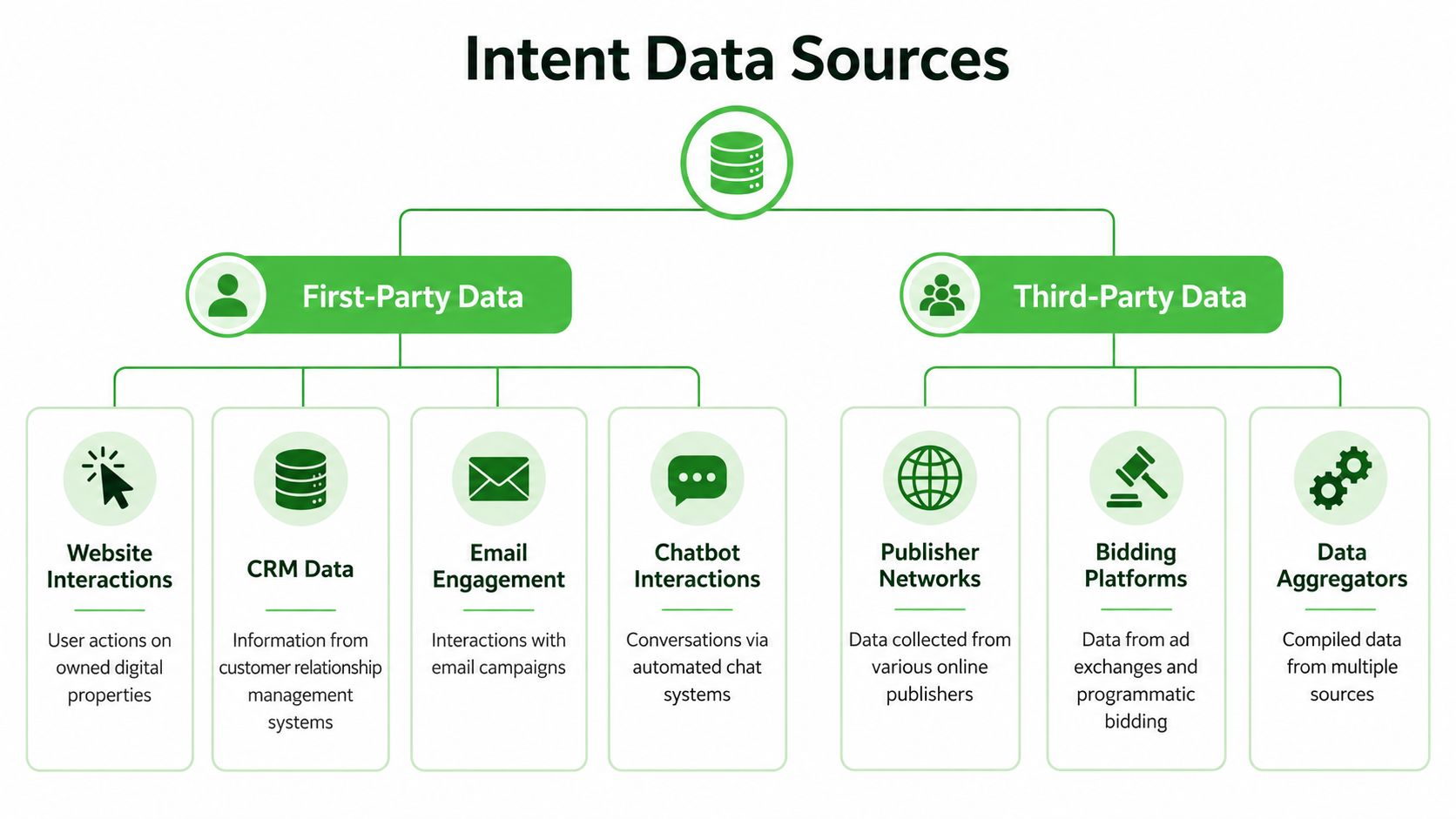
Intent-based targeting only works if your data model is realistic. Most agency setups lean too far in one direction. Some depend heavily on third-party platforms and ignore owned-channel behavior. Others obsess over website analytics and miss the broader market signals that show when an account is heating up before it ever lands on the site.
The practical answer is integration. Demandbase notes that successful implementation depends on integrating first-party data with third-party intent data, then feeding this into CRMs to orchestrate multi-channel campaigns in its intent-based marketing FAQ.
A clean visual helps here:
What third-party data does well
Third-party intent data is how you spot demand beyond your owned channels. Tools like Bombora, 6sense, and Demandbase aggregate topic-level research behavior across publisher networks and related sources. Agencies use that data to identify accounts showing rising interest around a category, competitor, or pain point.
That gives you three practical advantages:
- Account discovery because you can find in-market companies before they convert on your site
- Topic visibility because you see what they're researching, not just that they exist
- Campaign timing because outreach can start when research is active instead of after a lead form arrives
Third-party data is strong at the top of the funnel. It's weaker when you need person-level context or channel-specific nuance.
If you're also refining how search intelligence and market signals connect to demand generation, this piece on mastering AI-driven SEO is worth reading because search visibility and intent intelligence are becoming increasingly connected.
Why first-party data closes the gap
First-party intent data comes from assets you control. Website visits, CRM notes, email engagement, chat interactions, and product usage all belong here. These signals are usually more actionable because they connect to known contacts, real conversations, and messages you can personalize.
The problem is that most agencies treat first-party data too narrowly. They stop at pageviews, forms, and email clicks. They ignore conversation channels, especially messaging platforms.
That creates a blind spot. If a prospect asks a detailed question in chat, replies to a WhatsApp sequence, or repeatedly clicks resources sent through a direct messaging workflow, those are not soft engagement signals. They are often stronger than what you get from open-web browsing.
A healthy intent stack usually works like this:
- Third-party data finds the account
- First-party data identifies the contact behavior
- The CRM combines both into usable context
- The campaign logic changes based on what happened
When agencies skip step two, personalization becomes shallow. They know the account is researching, but they don't know what the person engaged with inside owned channels.
Capturing Intent from WhatsApp The Untapped Advantage
A large share of B2B buying conversation now happens in private threads, not on trackable web pages. Agencies that rely on site analytics, form fills, and third-party intent feeds miss a meaningful part of buyer consideration because WhatsApp sits inside that blind spot.
Why dark social breaks most intent programs
The gap is not awareness. It is visibility into active evaluation.
A prospect can visit a pricing page in public, then move the actual buying conversation into WhatsApp. They ask a colleague whether your client's onboarding is painful. They forward a comparison guide to a decision-maker. They reply to a campaign message with a specific implementation question. None of that shows up cleanly in ad platforms or standard website reporting, yet it often signals stronger purchase intent than another anonymous pageview.
That is why WhatsApp should be treated as a first-party intent capture layer, not just a send channel. For agencies, this creates a service opportunity with clear commercial value. You are no longer limited to buying the same external intent signals every other shop can access. You can help clients collect proprietary conversation data, score it, and feed it back into campaign and sales workflows.
The trade-off is operational discipline. More signal is only useful if your team can distinguish casual engagement from buying motion.
Here are the WhatsApp signals worth tracking:
- Reply depth. Short acknowledgments have limited value. Questions about pricing, setup, integrations, compliance, rollout timing, or migration risk usually deserve higher weight.
- Asset clicks by topic. Clicks to comparison pages, calculators, case studies, demo resources, or onboarding content tell you far more than clicks to broad top-of-funnel articles.
- Conversation progression. A contact who moves from reading to clicking to asking direct questions is showing momentum. That change should affect score and follow-up.
- Re-engagement after a targeted prompt. If an inactive lead responds after a competitor comparison, feature breakdown, or use-case message, interest has likely sharpened.
- Group or broadcast engagement tied to a specific offer. Continued interaction around one product line or problem area often signals active research.
Private-message behavior often sits closer to the buying decision than the signals agencies pull from ad platforms or anonymous web traffic.
The WhatsApp Signals That Matter
Agencies get this wrong in two ways. Some ignore WhatsApp because it feels hard to structure. Others score every delivery, open, and tap, then hand sales a queue full of noise.
A better model assigns weight based on commercial meaning, not message activity alone.
| Signal Type | How to Treat It | Why It Matters |
|---|---|---|
| Message delivered | Low weight | Confirms reach, not interest |
| Message opened or viewed when available | Low to medium weight | Helpful for campaign tuning, weak as a sales trigger |
| Click on a resource link | Medium weight | Shows topic-level curiosity |
| Reply with a qualifying question | High weight | Indicates active evaluation |
| Request for a human conversation | Very high weight | Clear handoff signal |
| Join and engage in a focused group | Medium to high weight | Suggests ongoing interest in a defined problem |
The competitive advantage is straightforward. Competing agencies can buy similar third-party intent data. They usually cannot access a client's WhatsApp reply history, content clicks, conversation themes, and engagement patterns. That data is first-party, specific, and much harder to copy.
For agencies, that matters because proprietary intent signals are easier to turn into recurring revenue. You can package setup, scoring logic, CRM syncing, campaign automation, and sales handoff rules as an ongoing service instead of a one-time targeting project.
An Agency Playbook for WhatsApp-Led Intent Targeting
Good intent-based targeting needs operating discipline. Without it, agencies end up with disconnected dashboards, one-off automations, and sales teams that no longer trust lead scores.
The cleanest model is to let third-party intent identify the account, then use WhatsApp as the first-party capture layer that confirms or weakens the hypothesis.
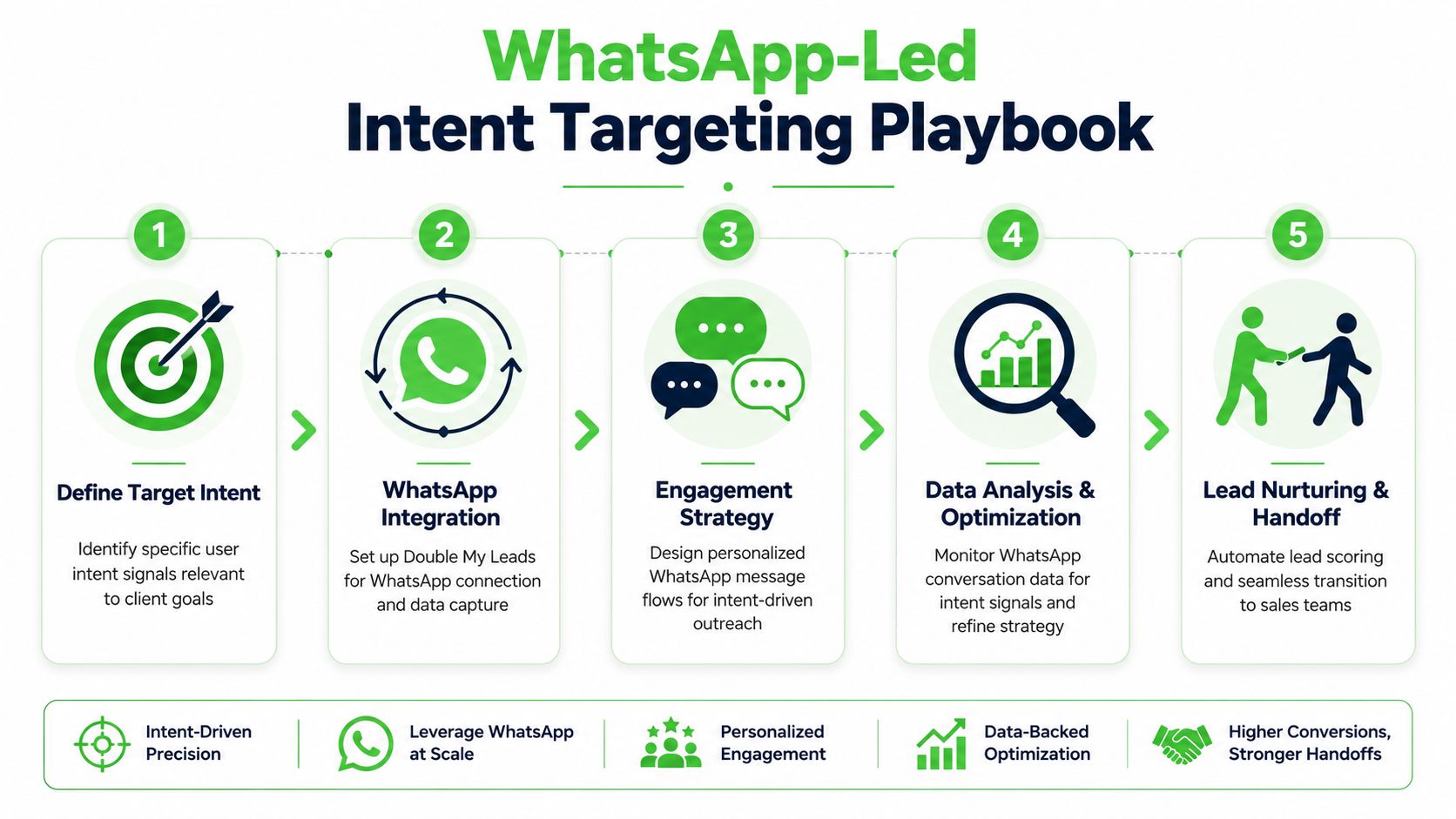
A simple operating model
Artisan notes that automated lead intent scoring models can weigh digital signals and trigger sales automations when accounts exceed a defined threshold such as 70/100, which has been shown to correlate with closed-won deals in its guide to intent-based targeting.
That gives agencies a practical framework:
Identify the trigger
Start with a third-party signal or a high-value first-party event. An account might be researching a competitor category, consuming comparison content, or showing repeated topic interest.Send a relevant WhatsApp touch
Don't open with a hard pitch. Send the most useful next asset for the signal. If the trigger is competitor research, share a concise comparison guide. If the trigger suggests early-stage investigation, send an implementation checklist or category explainer.Capture engagement in the CRM
Track who clicked, who replied, what topic they engaged with, and whether the message led to a deeper question. Use tags, notes, and source fields so the response isn't lost inside a generic inbox.Adjust the score based on action quality
A click might raise the score modestly. A reply about timing, migration, or internal stakeholders should raise it more. A direct request for a call can trigger immediate routing.Alert the right person fast
Once the account or contact crosses the threshold, notify sales or the account strategist with context. The alert should include the original intent topic, the WhatsApp content sent, and the exact engagement that pushed the lead over the line.
The handoff should answer three questions for sales: why now, about what, and based on which action.
A simple webhook pattern is often enough. Your intent provider sends an account-level event into your automation layer. That workflow maps the account to a contact or campaign segment, sends a WhatsApp message, writes back any engagement data, and updates the CRM score. The point isn't technical elegance. It's dependable execution.
How to score WhatsApp intent without overcomplicating it
Agencies often build scoring models that collapse under their own complexity. Keep it simple enough that account managers can explain it and sales can trust it.
Use a tiered logic:
Discovery signals
These include broad content clicks, passive responses, and light engagement. They belong in nurture.Evaluation signals
These include visits to decision-stage assets from WhatsApp, competitor-related clicks, and direct problem-specific replies. These deserve closer monitoring and often a higher-touch sequence.Decision signals
These include requests for a meeting, procurement questions, implementation concerns, or direct buying committee involvement. These should trigger human follow-up.
What doesn't work is treating every message interaction as proof of readiness. Agencies that do this burn rep time quickly. Another common mistake is failing to feed WhatsApp intent back into a shared system. If chat signals live in one tool and sales activity lives in another, the agency ends up reporting activity instead of progress.
The best version of this service offering is not "we do WhatsApp outreach." It's "we combine market intent with private-channel engagement data to identify when a real buying conversation starts."
How to Measure Success and Prove ROI
Agencies lose this sale when reporting stays stuck at message activity. Clients do not buy WhatsApp intent programs for reply counts. They buy them for better timing, cleaner handoffs, faster pipeline movement, and more revenue from accounts that were already showing buying motion.
That measurement standard matters even more with WhatsApp because a large share of commercial intent now develops in private conversations that never appears in web analytics. If your reporting ignores that dark social layer, you understate the program's value and make the service look easier to cut than it is.
Measure revenue movement tied to intent signals
A useful scorecard starts in the CRM, not in the messaging dashboard. The question is simple: did intent data, including WhatsApp conversation signals, improve who sales spoke to, when they spoke to them, and what happened next?
Track the outcomes that clients already care about:
- Lead-to-opportunity rate for records influenced by intent signals
- Sales cycle length for opportunities with meaningful WhatsApp engagement
- Pipeline velocity by account segment, offer, or intent theme
- Average deal quality by source, so intent-assisted leads can be compared with standard paid, outbound, or organic acquisition
- Sales acceptance rate to show whether handoffs are getting sharper
- Disqualification reasons to prove the scoring model is filtering weak demand instead of flooding sales with noise
Agencies often make or lose credibility through their approach to intent. If every WhatsApp click gets counted as intent, reported performance looks good for a month and falls apart once sales pushes back. Strong reporting separates light engagement from buying movement.
Show the path from signal to pipeline
Clients need to see cause and effect clearly.
A strong report does not dump screenshots from five platforms. It connects a starting signal to a commercial outcome. In practice, that usually means showing four things in sequence:
- The initial trigger, such as a third-party topic spike, a form fill, a site revisit, or a WhatsApp reactivation
- The conversation evidence, including the reply, question, or asset click that changed the lead score
- The sales action, such as SDR follow-up, account executive outreach, or nurture suppression
- The CRM result, whether that record became a meeting, opportunity, stalled deal, or disqualification
That structure is especially effective for proving the value of dark social signals. Open-web intent tells you an account may be researching. WhatsApp replies often tell you what the buyer cares about, who is involved, and whether urgency is real. That is a stronger story than channel reporting alone.
Add efficiency metrics for paid media clients
Some clients will also want proof that intent targeting reduced waste upstream. That is a fair ask.
If you run paid acquisition alongside this service, include metrics like lower spend on low-intent terms, better conversion rates from high-intent segments, and fewer sales conversations wasted on poor-fit traffic. The use cases behind NotFair for Google Ads budget are a useful example of how tighter exclusions can support the same goal: spend less on noise and more on accounts showing real purchase intent.
Build reporting around decisions, not dashboards
The best client reports answer operational questions. Which intent topics produce qualified meetings? Which WhatsApp sequences create replies but not pipeline? Which signals deserve immediate human follow-up, and which belong in nurture?
Answer those well and the service becomes easier to retain and expand.
That is the commercial advantage agencies should emphasize. Third-party intent data helps you find demand. First-party WhatsApp signals help you confirm it inside a private channel where buying conversations increasingly happen. When reporting captures both, ROI becomes much easier to defend.
Frequently Asked Questions
| Question | Answer |
|---|---|
| Is intent-based targeting just another name for retargeting? | No. Retargeting reacts to prior visits or ad engagement. Intent-based targeting prioritizes signals that suggest someone is actively evaluating a solution now. |
| Can an agency start without a large data stack? | Yes. You can start with owned-channel signals, CRM data, and conversation behavior. Third-party intent data improves discovery, but the operating model matters more than tool sprawl. |
| Why use WhatsApp in an intent program? | Because private-channel engagement can reveal buying movement that never appears in open-web analytics. It adds first-party context many agencies miss. |
| What WhatsApp actions should increase lead score? | Focus on actions tied to buying motion, such as clicks on decision-stage assets, replies with qualifying questions, requests for human follow-up, and repeated engagement around a specific problem. |
| Should every WhatsApp reply trigger sales outreach? | No. Some replies belong in nurture. Sales should be alerted when the content of the reply indicates evaluation or decision-stage intent, not just activity. |
| How should agencies package this as a service? | Position it as an intent intelligence and activation layer. The value is not sending messages alone. The value is combining account-level market signals with private-channel first-party engagement to improve timing, relevance, and handoff quality. |
Agencies that add WhatsApp-based intent capture to their service mix can create a stronger, harder-to-replace revenue stream than standard automation retainers. Double My Leads gives agencies a practical way to launch that offer with white-labeled WhatsApp workspaces, tracked smart links, CRM sync, tagging, notes, broadcast workflows, and AI agents, so you can turn private-channel engagement into usable first-party intent data instead of leaving it invisible.


