
Most agencies hit the same wall. You sell strategy, campaigns, funnels, or automation work, then every month starts at zero again because delivery eats the margin you thought you had. A few clients pause, one project slips, and suddenly the team is busy but cash flow still feels fragile.
That's usually when the idea of becoming a white label SaaS reseller starts looking less like a side offer and more like a business model shift. Instead of billing only for labor, you add a product under your own brand, keep control of the client relationship, and build recurring revenue that doesn't reset every time a retainer ends. If you're already helping clients with lead generation, CRM setup, messaging, or workflow automation, the move is often more operational than technical.
The agencies that make this work don't win because they found a magical platform. They win because they treat reseller SaaS like an operating system. They choose partners carefully, protect margins early, tighten onboarding, and avoid support chaos. If you want a useful reference for how automation fits into the broader agency model, The AI CMO on agency marketing automation is worth reading alongside this.
Table of Contents
- From Agency Grind to Recurring Revenue
- Foundations of the White-Label Reseller Model
- Selecting Your White-Label SaaS Partner
- Technical Setup and Platform Branding
- Pricing Billing and Legal Essentials
- Crafting Client Onboarding and Support Processes
- Go-to-Market Sales and Marketing Playbooks
From Agency Grind to Recurring Revenue
Service revenue looks strong from the outside. Inside the business, it often behaves badly. Delivery expands to fill the team's time, custom work keeps sneaking into scope, and account managers become part consultant, part firefighter.
That's why a white label SaaS reseller model works best for agencies that are already tired of selling hours. You're not abandoning services. You're putting a product layer underneath them so clients keep paying for access, not just implementation.
What usually breaks first
The first thing that usually stops scaling isn't lead flow. It's operational efficiency. If every client needs a custom setup, a custom report, and a custom support path, the agency turns into a patchwork of exceptions.
A branded software offer fixes that when it does three things well:
- Standardizes delivery so clients start from the same core setup
- Shifts value perception from “the team doing work” to “the platform powering results”
- Creates retention hooks because clients log in, depend on workflows, and build habits inside your system
Agencies don't become more durable by adding more services. They become more durable by packaging what they already know how to deliver.
What the shift actually looks like
In practice, the playbook is straightforward. Pick a category where clients already ask for help. Choose a partner with strong reseller infrastructure. Brand the platform under your domain. Price it so support and usage don't wreck margin. Then onboard clients into a repeatable experience.
That's the part many guides miss. Becoming a white label SaaS reseller isn't mostly about software selection. It's about building a productized operating model around software you don't have to develop yourself.
Foundations of the White-Label Reseller Model
A white-label SaaS reseller sells software under their own brand, not the vendor's. The provider supplies the underlying application, infrastructure, maintenance, and often deeper technical support. The reseller controls branding, pricing, packaging, and the customer relationship.
That distinction matters because it changes the asset you're building. You're not sending leads to someone else's product and hoping for a commission. You're building your own recurring revenue line with your own positioning.
What it is and what it isn't
Affiliate marketing is a referral model. You make the introduction, and the relationship largely belongs to the software company after the sale.
White-label reselling is different. The software appears under your domain and logo, and you sell access as your own offer. According to SipTrunk's breakdown of white-label SaaS reseller economics, the global SaaS market is projected to reach approximately $887 billion by 2030, and that broader expansion is one reason agencies keep moving toward reseller models instead of pure services or affiliate deals. The same source describes the standard setup clearly: resellers buy unbranded software from a provider, rebrand it, and resell it at retail prices that typically range between $97 and $297 per month per account.
Here's the simpler comparison:
| Model | Brand the client sees | Who owns pricing | Who owns customer relationship | Long-term asset value |
|---|---|---|---|---|
| Affiliate | Vendor | Vendor | Mostly vendor | Low |
| Standard SaaS reseller | Vendor | Limited or shared | Mixed | Moderate |
| White-label SaaS reseller | Reseller | Reseller | Reseller | High |
Why margin structure matters
The core financial mechanic is simple. You buy at a wholesale cost and sell at a retail price. If the vendor uses a fixed account-based cost with no revenue share, your margin is easier to model. If the vendor introduces metering, hidden overages, or channel conflict, your margin gets unstable fast.
That's why mature operators care less about shiny features and more about these questions:
- Can I set my own retail price?
- Is the wholesale cost predictable?
- Can I remove the vendor's brand completely?
- Who handles platform maintenance and technical issues?
- Will this still work operationally when I have many client accounts to manage?
Practical rule: If you can't explain your gross margin in one sentence, you don't have a reseller business yet. You have a pricing risk.
Why this model sticks better than services alone
Clients cancel services more easily than they remove systems they use every day. When your offer becomes part of how they manage leads, conversations, follow-up, or reporting, the relationship gets harder to replace.
That's the core appeal. A white-label SaaS reseller doesn't just add monthly revenue. It gives the agency a more defensible seat inside the client's workflow.
Selecting Your White-Label SaaS Partner
Most reseller failures start here. Agencies choose the platform they'd like as an end user instead of the platform they can operate profitably as a partner.
That's the wrong lens. Your clients won't experience the vendor's roadmap deck or partner promises. They'll experience support quality, reliability, branding consistency, and billing clarity. If any of those break, your agency takes the blame.
Evaluate the business model before the feature list
A lot of vendors demo well. Fewer support resellers well.
The first screen I use is commercial, not technical. According to Elfsight's white-label SaaS analysis, acquired clients in this model typically remain active for approximately 2 to 2.5 years. That means your partner decision has a long tail. You're not choosing a tool for a quick campaign. You're choosing an operational dependency your clients may stay on for years.
If a vendor is weak on contracts, support boundaries, billing logic, or account management, that weakness compounds over the full client life cycle.
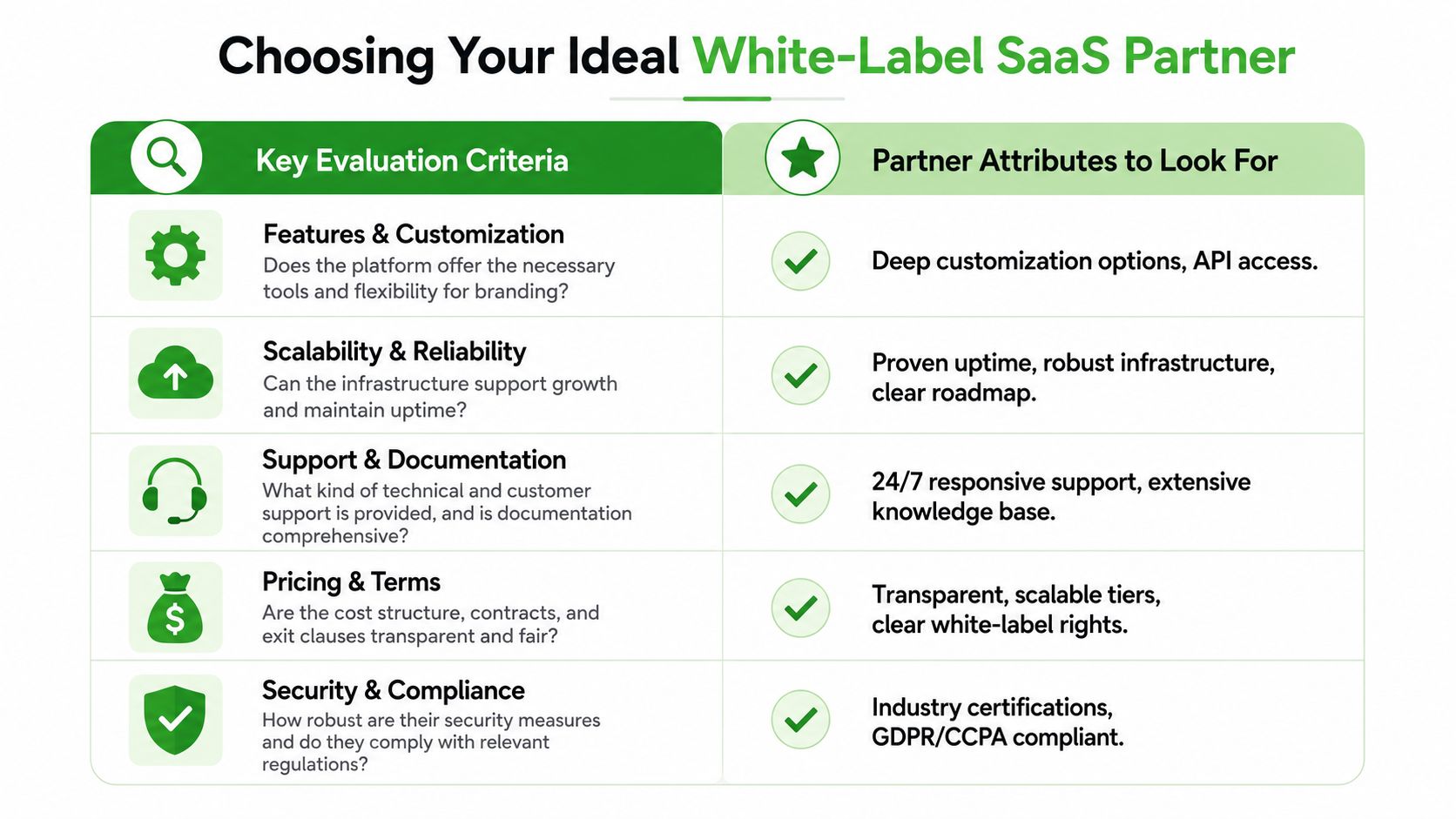
The partner scorecard I'd actually use
Here's a practical filter for comparing vendors side by side:
Brand control
You want full domain, logo, color, and email-branding control. If the provider leaves their brand all over the interface, you're renting credibility from them instead of building your own.Wholesale structure
Fixed account pricing is easier to package than messy per-user or hidden usage pricing. Predictability matters more than getting the cheapest entry point.Partner support path
Ask whether resellers get a dedicated support queue, documented escalation process, and onboarding help. If you're dumped into the same queue as end users, you're not in a serious partner program.Multi-client management
You need a way to manage multiple client accounts without logging in and out of separate silos all day. Otherwise your team burns time on admin work.Channel alignment
Ask whether the vendor sells direct into the same market you serve. If they do, you need to know how they handle inbound demand that overlaps with your niche.
Questions that expose weak vendors fast
Don't ask, “Is the platform white-label?” Every vendor says yes. Ask sharper questions:
- Who handles tier-two technical issues?
- What happens if a client exceeds normal usage patterns?
- Can we keep our branding on notifications, portal access, and login flows?
- What does offboarding look like if we ever leave?
- How are reseller accounts billed when clients pause or churn?
- Are there any carrier, API, or infrastructure charges outside the base plan?
Those questions usually tell you more than the sales demo.
The best reseller partner isn't the one with the longest feature list. It's the one that helps you keep margin, protect reputation, and support clients without chaos.
What works and what usually doesn't
What works is a vendor that treats resellers like operators. You get clear terms, stable pricing logic, real support, and enough control to package the software as your own.
What doesn't work is the halfway model. That's where the provider offers a logo upload, calls it white-label, then keeps core brand elements visible, limits support access, and adds usage costs that weren't obvious during sales. Agencies often discover the problem only after they've already sold accounts.
If you're going to build a serious white label SaaS reseller offer, choose the partner like you're choosing an operations team, not an app.
Technical Setup and Platform Branding
The good news is that modern white-label setup usually isn't hard. The bad news is that a sloppy setup makes the product feel rented, not owned. Clients notice when branding is inconsistent, login paths feel stitched together, or emails come from the wrong identity.
A clean launch starts with getting the experience coherent from the first touch.
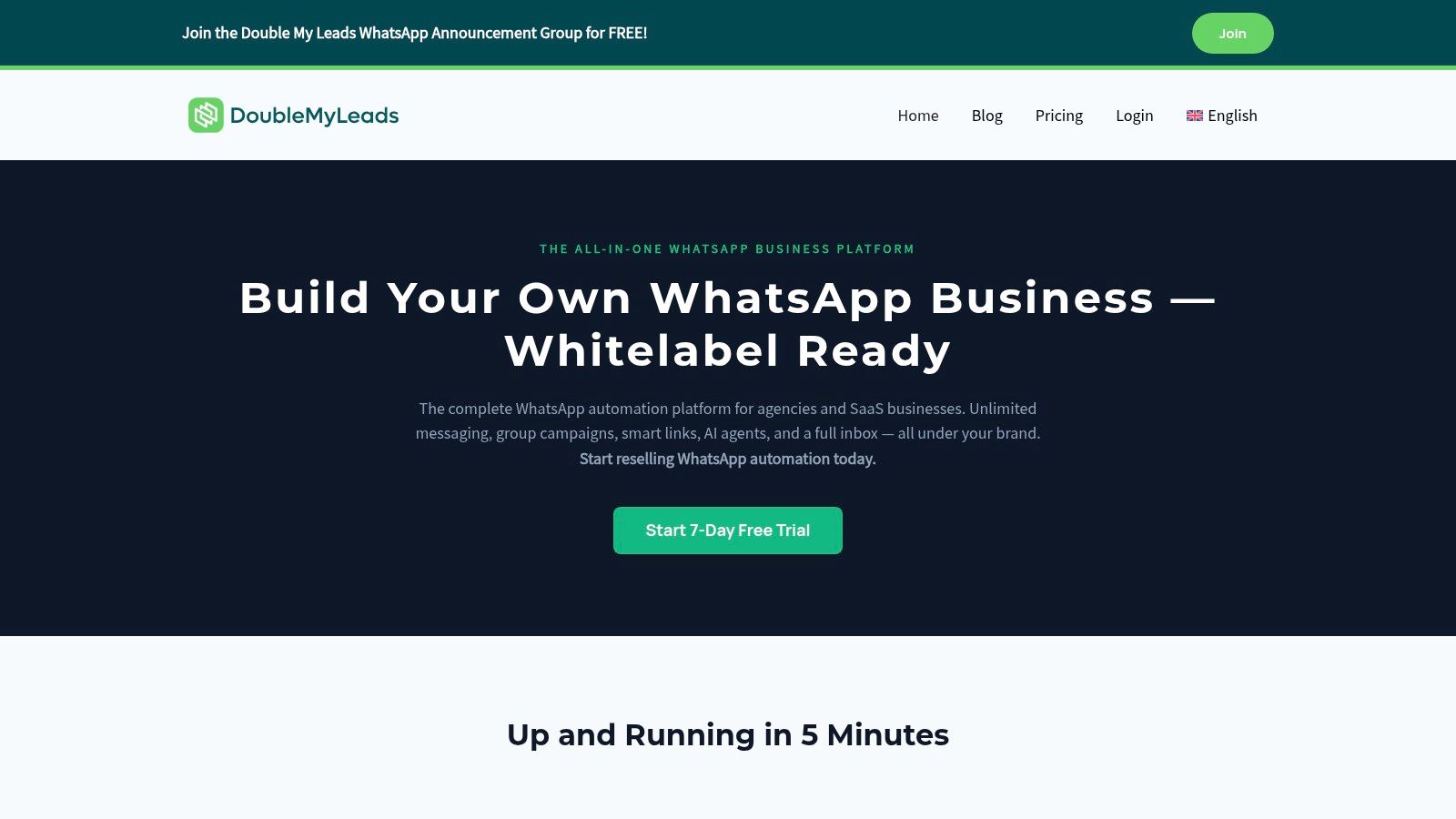
Start with the client-facing surface area
Before you worry about advanced automation, lock in the basics your clients will see every day:
- Custom domain so the platform lives under your brand
- Login screen branding with your logo, colors, and support contact
- Notification templates so system emails don't reveal the upstream vendor
- Workspace naming that matches your product language
- Help resources that point users to your docs, not the provider's public knowledge base
That part shapes trust. Clients don't need to believe you coded the platform from scratch. They do need to feel like they bought a coherent product from one company.
Brand the workflows, not just the interface
A lot of agencies stop at logo replacement. That's not enough. The experience has to sound like your product too.
Use your own names for plans, automations, onboarding flows, and support touchpoints. If the platform says one thing, your sales deck says another, and your invoice says a third, clients feel the mismatch immediately.
A tighter setup usually includes:
- Branded onboarding emails
- A custom welcome checklist
- Template campaigns or prebuilt workflows
- Short explainer videos recorded by your team
- Internal naming conventions your support staff follows consistently
Clients forgive a simple interface. They don't forgive a confusing one.
Launch with a narrow configuration first
Don't expose every feature on day one unless the client needs them. The cleaner move is to configure the platform around one obvious use case, then expand later.
For example, if you sell into agencies, coaches, or local businesses, the first milestone might be simple: connect the channel, route inbound conversations, and get the first automated follow-up live. That first success matters more than showing the whole dashboard.
A short walkthrough helps if your vendor provides one. Here's a visual example of the kind of setup flow many resellers look for:
The handoff standard to aim for
Before you mark a client account as ready, check four things:
| Area | Good standard |
|---|---|
| Access | Client can log in without seeing vendor branding |
| Messaging | All automated emails match your brand voice |
| Support | Contact path leads to your team first |
| First task | Client knows exactly what to do after login |
That's the difference between a white-label account and a branded product. One is technically functional. The other is ready to sell.
Pricing Billing and Legal Essentials
Profit isn't something you discover later. You design it in the pricing model, the billing rules, and the contract terms from the start.
A lot of agencies get this backward. They choose a platform, copy a few competitor price points, and assume the gap between wholesale and retail is margin. It isn't. Real margin has to absorb onboarding time, support load, failed payments, and any usage costs that show up after launch.
Price for operational reality
The simplest way to structure a reseller offer is to start with a base subscription and decide what's included versus what triggers an upgrade or custom package. If I were setting a floor offer in this model, I'd keep it easy to explain and close. For example, we priced our base tier at $97/mo when the offer was intentionally narrow and easy to support. The point wasn't to maximize revenue per client on day one. The point was to get clean adoption and room to upsell once clients were using the product.
That approach usually works better than dumping every feature into one giant plan.
Use a basic margin formula:
True monthly margin = retail subscription revenue – wholesale platform cost – support cost – onboarding labor – payment processing and admin overhead – usage-based charges
If one part of that formula is unknown, your price is a guess.
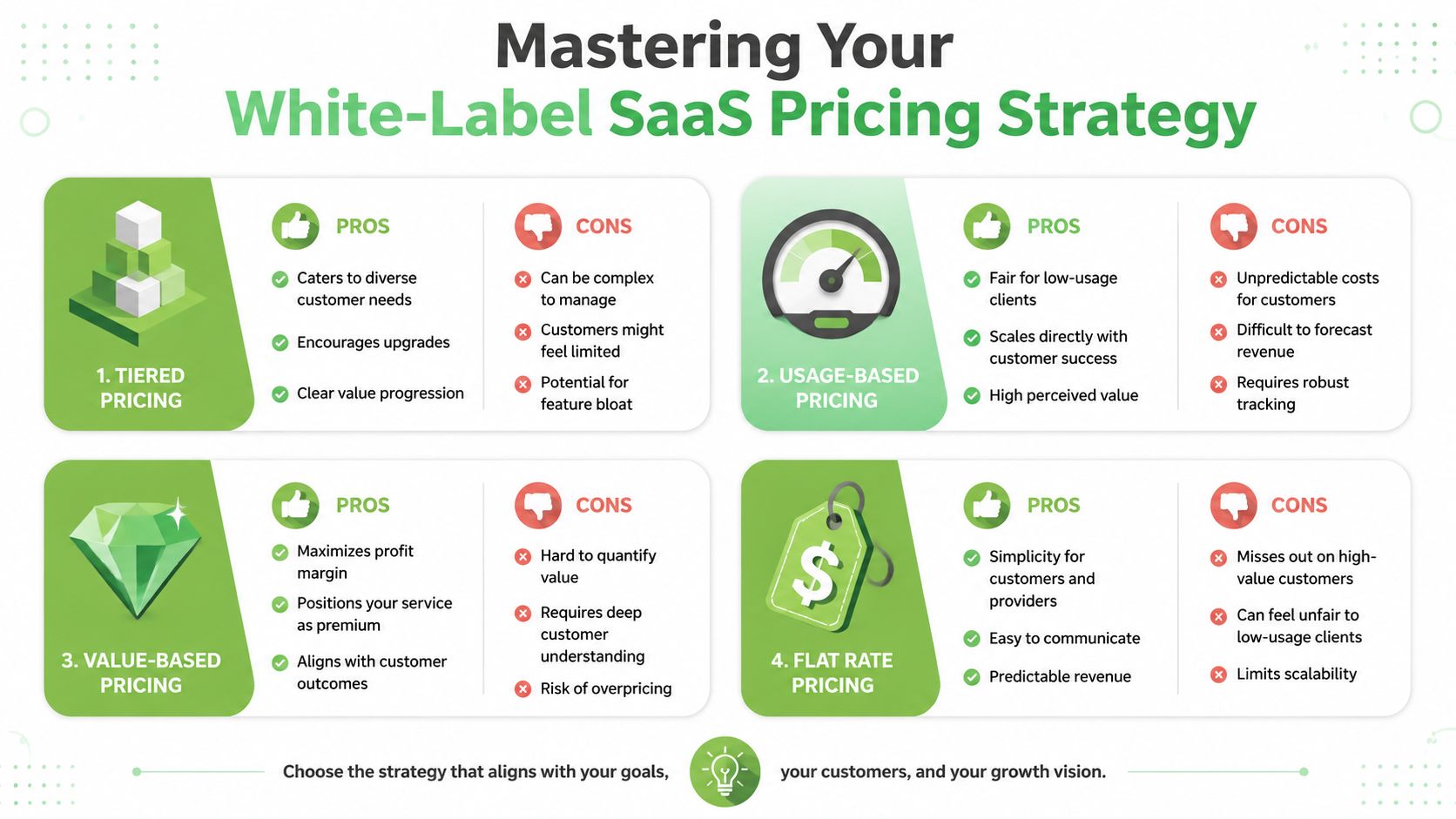
Why usage-based reseller math breaks so often
Many agencies face an unforeseen challenge. According to PayPro Global's white-label SaaS guide, existing coverage often fails to address per-usage margin erosion in high-volume WhatsApp and SMS reselling models. The problem is straightforward. Flat-fee promises can still hide API overages or carrier surcharges, especially during broadcast activity, which makes supposedly predictable accounts suddenly expensive.
That doesn't mean usage-based pricing is always bad. It means you need to know exactly where usage risk sits.
I see it this way:
- Flat rate works best when the vendor's own costs are predictable and clearly disclosed
- Usage-based can work when your client demand varies a lot and tracking is transparent
- Hybrid pricing is dangerous when the sales pitch sounds flat-fee but the contract leaves room for variable charges
If a reseller agreement says “unlimited” in marketing and “subject to carrier or infrastructure charges” in the terms, treat that as a pricing warning, not a feature.
Billing setup that doesn't create support debt
Stripe is usually the cleanest option for subscription billing because it handles recurring charges, card updates, invoices, and failed payment workflows without custom engineering. But the tool isn't the hard part. The billing rules are.
Set these before you onboard clients:
- Trial policy with a clear start and end point
- Renewal timing so clients know when charges hit
- Upgrade and downgrade logic that support can explain quickly
- Late payment handling including what happens to account access
- Refund policy that sales can't casually override
When these rules are vague, support inherits the mess.
Legal basics you need in place
Even a lean reseller offer needs professional paperwork. At minimum, have:
- Terms of Service that define acceptable use, account ownership, payment obligations, and termination rights
- Privacy Policy that explains how customer data is handled
- Reseller-facing vendor agreement review so you understand your obligations upstream
- Client order form or proposal language that matches the actual plan being sold
Keep the documents plain. Clients don't need legal theater. They need clarity about what they're buying, how billing works, and who to contact when there's a problem.
Crafting Client Onboarding and Support Processes
The sale gets attention. Retention builds the business. If onboarding is messy, clients hesitate, usage drops, and your support inbox fills with questions that should've been prevented.
The best reseller operations make the first week feel guided, not improvised.
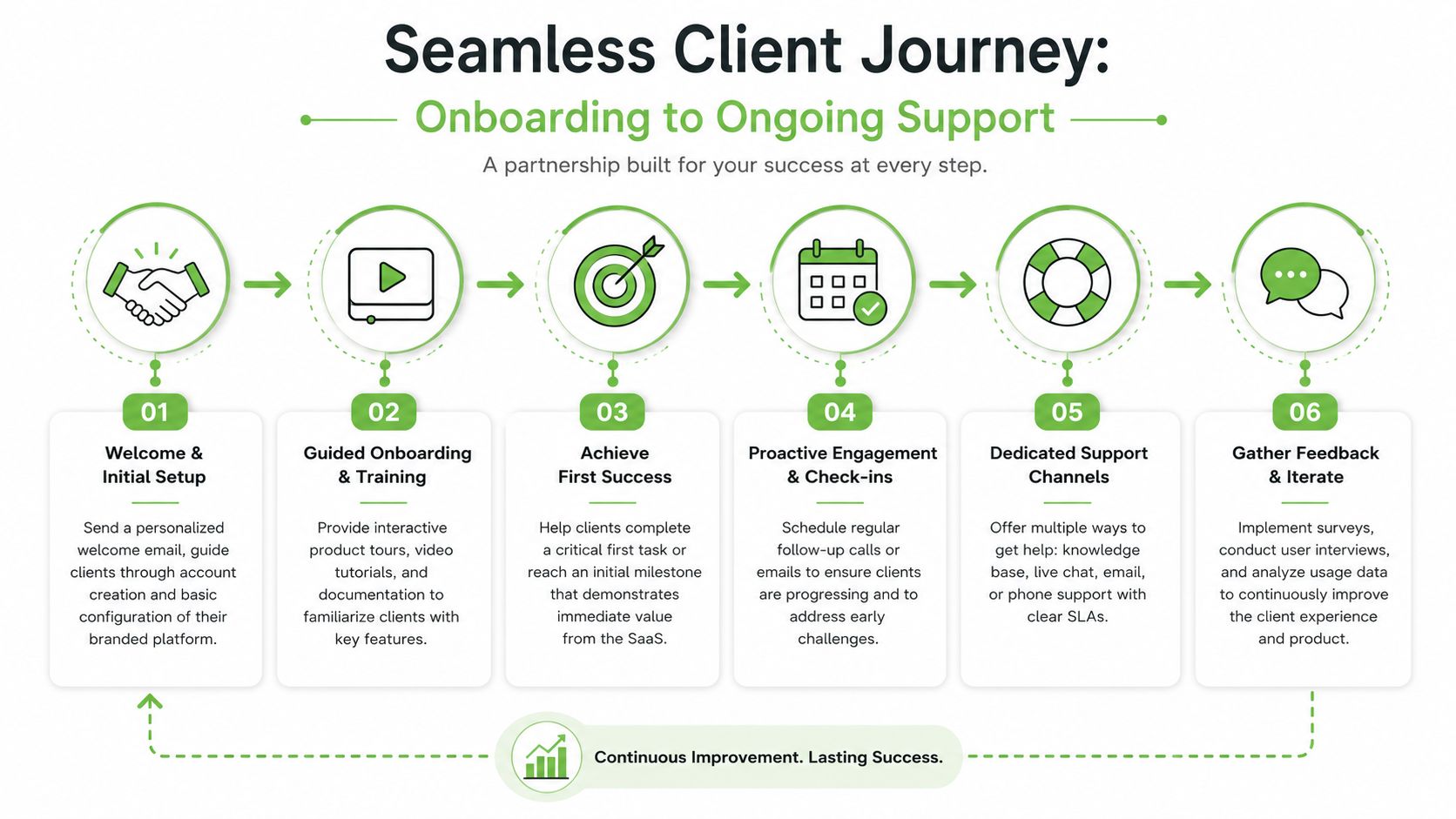
Build onboarding around the first win
Don't train clients on everything. Train them on the action that proves value fast.
For a messaging or automation product, that might be connecting a channel, assigning a conversation, launching a simple workflow, or sending the first campaign. Once that happens, adoption gets easier because the client has seen the product work in their own environment.
A solid onboarding sequence usually includes:
- Welcome email with login details and one clear next action
- Short training video designed for the client's use case
- Setup checklist that removes ambiguity
- First live session focused on one outcome, not a full feature tour
- Follow-up check-in after early usage begins
Separate tier-one from tier-two support
This is one of the biggest operational shifts in a white label SaaS reseller business. Your team should handle tier-one support. That means login help, how-to questions, configuration guidance, and basic troubleshooting. The vendor should handle tier-two support, which includes bugs, outages, infrastructure issues, and deeper technical failures.
If that line isn't defined, your team becomes a relay service for problems you don't control.
A simple support split looks like this:
| Support type | Owner |
|---|---|
| Password and login confusion | Your team |
| “How do I set this up?” questions | Your team |
| Broken feature or platform bug | Vendor |
| Service outage or backend issue | Vendor |
Good support isn't answering faster. It's routing the issue to the right owner with less friction.
A practical SOP for common tickets
Use a lightweight SOP so anyone on the team can respond consistently.
- Confirm the client account and affected workspace.
- Reproduce the issue if it's a workflow or configuration question.
- Check whether the issue is user error, setup confusion, or likely platform-side.
- If it's tier one, send the fix and update your help doc if the question is recurring.
- If it's tier two, escalate to the vendor with clear notes, screenshots, and the exact steps that triggered the issue.
- Close the loop with the client in plain language. Don't forward raw vendor replies unless they're already client-friendly.
That process keeps support from becoming personality-driven. It turns it into a system.
Go-to-Market Sales and Marketing Playbooks
Most agencies don't need a complicated launch plan. They need a fast path to the first customers, then a repeatable sales motion that doesn't depend on founder heroics.
The fastest path is your existing client base. They already trust you, they already buy outcomes from you, and they usually already have the pain the software solves.
Start with the clients already asking for the thing
The easiest early sale is usually an upgrade, not a cold acquisition.
If you run lead generation, CRM, media buying, or automation services, look for clients who already ask for one of these:
- missed lead follow-up
- scattered conversations across channels
- slow sales response
- manual campaign operations
- no clear handoff between marketing and sales
Don't pitch “software.” Pitch a narrower operational fix. For example, instead of “We launched a new platform,” sell “We can give your team a branded messaging workspace with automation and a cleaner follow-up process.”
That framing lands better because it sounds like problem-solving, not product dumping.
The first plays I'd run
Play one is the client upgrade motion. Pull a list of active clients who fit the use case. Send a short message offering a new productized add-on that solves a problem you already see in their account. Then book a live walkthrough and position the platform as part of a cleaner delivery stack.
Play two is the niche landing page. Build one page per use case, not one generic reseller page. “WhatsApp automation for local service businesses” is stronger than “all-in-one communication software.” Narrow offers convert more cleanly because buyers recognize themselves.
Play three is the operational demo. Don't show a grand platform tour. Show the exact workflow the buyer cares about. In a messaging product, that might be inbound lead capture, routing, follow-up, and broadcast.
When to add outbound help
Founders often handle early sales well enough, but outbound gets messy once follow-up volume grows. If you plan to add appointment setting or prospecting support, it helps to know how to evaluate external help before hiring fast. This guide on vetting and hiring outsourced sales is useful because it focuses on process fit, not just promises.
What the messaging should sound like
Keep your positioning tight:
“We've turned the workflow we already run for clients into a platform under our brand, so your team gets the system without waiting on custom build work.”
That works better than feature-heavy language because it makes the offer feel operational and immediate.
For new-market acquisition, content tends to work when it's tied to a specific pain point. Publish teardown-style articles, short videos, and demos around actual workflow problems. Use sales calls to validate which ones get repeated most often, then build more around those.
The agencies that grow this model usually don't market it as “white-label SaaS.” They market the outcome the platform enables, then use the reseller structure behind the scenes to keep control and margin.
If you want to launch a branded WhatsApp offer without building the infrastructure yourself, Double My Leads is built for that reseller model. You can white-label the platform under your own domain, keep predictable pricing, and get to market quickly with a product clients can use.


