
98% open rates change the economics of agency services. When a client can put a message in a channel people regularly check, the conversation shifts from “can you send campaigns?” to “can you build and run a revenue channel?” WhatsApp also has over 3.3 billion monthly active users globally, 2.3 billion daily active users, and processes more than 150 billion messages per day, according to Chatarmin's WhatsApp statistics roundup. That scale matters because it means you're not selling an experimental tactic. You're selling access to a habit.
For agencies, the bigger opportunity isn't just campaign management. It's packaging a WhatsApp newsletter as a white-label service that clients can understand quickly, adopt without friction, and keep paying for because it's tied to direct communication, repeat purchases, reminders, launches, and lead follow-up. Most competitors still position WhatsApp as either a support inbox or a complex API project. That leaves room for agencies that can simplify the offer.
Table of Contents
- Why Your Agency Needs a WhatsApp Newsletter Service
- Choosing Your WhatsApp Newsletter Setup
- Nailing Consent and WhatsApp Policy
- Building Your Subscriber List from Scratch
- Content Strategy and Campaign Execution
- Automation Analytics and Optimization
- How to White-Label and Monetize Your WhatsApp Service
Why Your Agency Needs a WhatsApp Newsletter Service
Agencies looking for a new recurring revenue line should pay attention to one number already established earlier in this article. WhatsApp usage is massive. The scale means you are not pitching an experimental channel. You are packaging a faster, more direct distribution layer that clients already use every day.
That changes the sales conversation.
A WhatsApp newsletter is easier to position than another email retainer or another batch of social content because the value is immediate. Clients can see the use case in minutes. Send a limited-time offer. Fill empty appointment slots. push launch updates. Re-engage dormant leads. Prompt replies from high-intent prospects who ignore email until Friday.
Why agencies can sell this faster than a typical channel add-on
Clients do not care about the channel itself. They care about whether it produces revenue, retention, or faster response times.
WhatsApp fits well when the message is short, timely, and tied to an action:
- Flash promotions for ecommerce brands
- Booking reminders for service businesses
- Launch alerts for creators and coaches
- Lead follow-up for local businesses
- Client communications for B2B firms that need quicker reply cycles
The commercial upside for an agency is not just campaign management. It is control over the system behind the campaigns. If you handle list growth, consent collection, message planning, sending workflows, and reporting, replacing your team becomes inconvenient for the client. That is a stronger position than being the agency that only writes copy or schedules posts.
The white-label gap is still open
Plenty of businesses want to use WhatsApp. Very few want to deal with Meta approvals, API setup, template reviews, webhook logic, and per-message cost surprises.
Agencies can step in with a cleaner model.
The strongest version of this offer is not a custom technical build for every client. It is a repeatable, white-label service that gets clients live quickly, often with QR-code based opt-in flows and managed sending tools instead of a heavy direct API implementation on day one. That approach reduces setup friction, avoids unnecessary engineering work, and protects margin, especially for SMB clients that need results more than infrastructure.
Operationally, this also works better for account teams. A central agency dashboard gives managers one place to oversee launches, approvals, schedules, and client performance without stitching together five different tools.
The business case is straightforward. WhatsApp newsletters are easier to justify than many legacy retainers, faster to demonstrate, and simpler to package as a premium service when the delivery model is built for resale. Agencies that standardize the offer early can charge for strategy and execution, while keeping fulfillment lean through smarter tooling instead of custom setup work.
Choosing Your WhatsApp Newsletter Setup
The wrong setup kills momentum. Agencies lose weeks in procurement, verification, approvals, and handoffs when the client just wanted to start collecting opt-ins and sending broadcasts. The right setup depends on volume, complexity, and how much control the client needs.
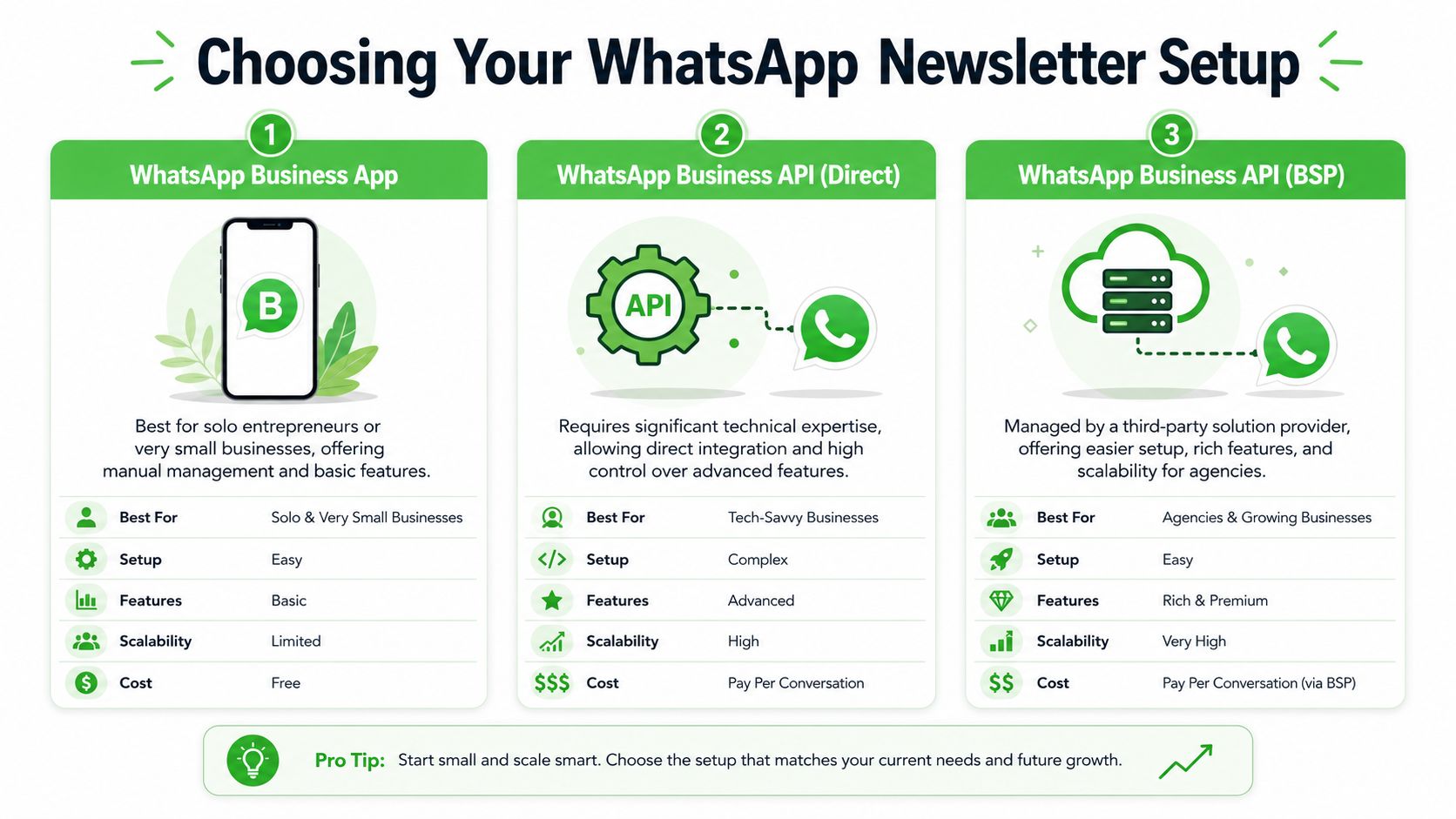
WhatsApp newsletter setup methods compared
| Method | Subscriber Limit | Setup Complexity | Ideal For | Key Limitation |
|---|---|---|---|---|
| WhatsApp Business App broadcast lists | Limited by the app workflow and manual broadcast constraints | Low | Solo operators, local shops, test campaigns | Manual work, restricted scale, weaker agency repeatability |
| Community Announcement Groups | Better suited to structured broadcast-style communication | Medium | Agencies managing newsletters for creators, communities, local brands | Not as flexible as a full API stack for advanced automation |
| WhatsApp Business API direct | High scale | High | Enterprises with in-house technical resources | Technical setup, template management, verification work |
| WhatsApp Business API through a BSP | High scale with managed tooling | Medium to high | Agencies serving serious senders across several clients | Still tied to policy, templates, and vendor workflow |
| QR-code based white-label systems | Designed for fast opt-in and practical rollout | Low to medium | Agencies that want speed, simplicity, and resale margins | Feature depth varies by platform |
Broadcast lists
Broadcast lists are where many small businesses start. They're familiar, cheap, and easy to explain. For a single-location business with a modest contact base, they can work for basic announcements.
They also break quickly in agency environments. Teams end up depending on the client's phone, the client's contact hygiene, and manual send processes. That's not a scalable service. It's a glorified assistant task.
A more serious issue is compliance and deliverability behavior. Chatarmin's analysis of WhatsApp newsletter examples notes that explicit consent is now required before broadcasts can be sent to non-contact-list users under WhatsApp's 2024 policy updates, and it points out that many guides still push manual copy-paste broadcasting even though that collides with anti-spam rules. The same analysis says recent enforcement of template approval rules has caused 30%+ broadcast failures for non-compliant businesses in major markets.
Community announcement groups
Announcement-style groups sit in a useful middle ground. They're especially practical for agencies that want a newsletter feel without forcing every client into a heavyweight API rollout. For education businesses, local membership brands, creators, and community-led offers, this structure feels natural.
The upside is operational. The client can understand it. The audience can join through a link or QR flow. The agency can manage messaging cadence, onboarding, and segmentation with less technical dependency.
A lot of agencies don't need maximum technical sophistication. They need a setup they can launch this week, sell next week, and support next month.
Cloud API and BSP routes
If the client needs deep automation, CRM triggers, event-based messaging, and large-scale personalization, the API route is the right answer. There's no point pretending otherwise. This is the proper setup for larger programs where WhatsApp sits inside a broader customer journey.
There are two ways to approach it:
- Direct API access when the client has technical resources and wants more control
- BSP-managed access when the client wants a supported platform layer
The trade-off is speed versus flexibility. API setups offer more depth, but they also bring more dependencies. Agencies often underestimate how much time gets spent on approvals, templates, verification, and account coordination.
Why QR-code systems are winning for agencies
The most underused model right now is the QR-code based WhatsApp newsletter setup. It's practical because it fits how agencies conduct sales. You can place the QR code on packaging, receipts, event materials, counter cards, websites, landing pages, and client social content. That means list building starts before a deep technical integration is even necessary.
This is especially attractive when the platform removes API keys, Meta verification hurdles, or per-message pricing complexity. For an agency, that changes the business model. Instead of charging for technical setup hours that clients hate, you can charge for launch, growth, content, and optimization.
If the client later outgrows the simpler setup, you can move them upstream into a BSP or API-based structure. But most agencies should start with the model that reduces friction and gets the first subscriber flow live fast.
Nailing Consent and WhatsApp Policy
Most account problems don't start with bad content. They start with weak consent records, sloppy sending habits, and teams treating WhatsApp like email. That approach gets people into trouble fast.
A WhatsApp newsletter works because the subscriber has opted in. That's not a formality. It's the foundation of the whole channel. Spurnow's WhatsApp newsletter guide ties the 98% open rate to WhatsApp's permission-based opt-in model, where users actively send “ON” to subscribe. The same guide notes that scalable delivery requires the WhatsApp Business Platform through a valid BSP to move beyond the 256-person manual broadcast limit in the standard WhatsApp Business App.
What consent actually looks like
Consent needs to be explicit, provable, and stored. If your client can't show when and how the user opted in, the agency is operating on borrowed time.
Use simple rules:
- Collect consent through a clear action such as a QR code flow, a chat widget, a landing page, or a Click-to-WhatsApp ad.
- Store the opt-in source and timestamp in the contact record.
- Set expectations at signup so users know what they'll receive.
- Make opt-out simple by instructing users to reply with a clear unsubscribe word.
Compliance reality: If you can't show the source and timestamp of the opt-in, you don't have a system. You have a risk.
Templates frequency and operational discipline
Marketing messages on the API side must use Meta-approved templates, and Spurnow notes those templates are generally reviewed within 1 to 24 hours. That means agencies should build approval time into their production workflow instead of promising instant campaign launches.
Frequency matters too. Spurnow recommends a strict cap of 1 to 2 promotional sends per week to avoid fatigue and protect quality ratings. It also warns that unmanaged frequency can lead to a potential 2% opt-out rate per send.
That changes how you package the service. Don't sell WhatsApp as “daily promotional blasting.” Sell it as a high-attention channel that rewards selectivity.
The fastest way to wreck a WhatsApp newsletter is to treat it like a cheap bulk channel.
A compliance checklist agencies can use
Before a campaign goes live, check these items:
- Verified consent trail with opt-in source and timestamp attached to each subscriber
- Clear unsubscribe handling so the team suppresses opted-out contacts immediately
- Approved template library for promotions, reminders, content drops, and follow-ups
- Send cadence rules documented per client, especially when several teams touch the same list
- Suppression of inactive contacts so low-quality segments don't drag down account health
- Named owner inside the agency who approves copy, audience selection, and send timing
A small process document solves a lot of future pain. Agencies that skip this usually end up doing emergency cleanup after a client asks why messages stopped landing.
Building Your Subscriber List from Scratch
A WhatsApp newsletter is only valuable if the list is built intentionally. Buying numbers, importing random contacts, or scraping old customer data is the wrong move. The best agency setups build opt-ins from places where attention already exists.
Start with visuals the client can deploy everywhere.
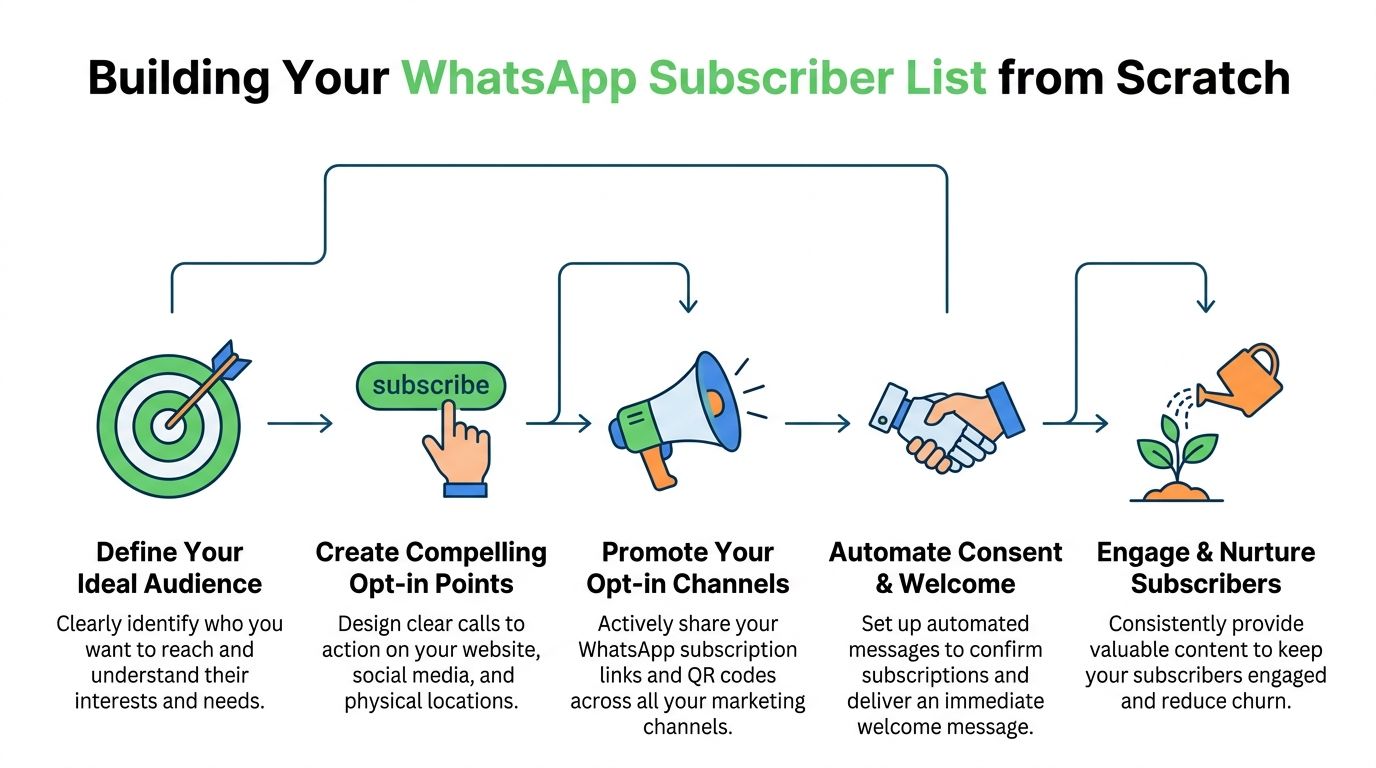
Infobip's WhatsApp newsletter guide recommends beginning with a clear goal such as sales, retention, or education, then using a multi-channel opt-in strategy built around QR codes on packaging and receipts plus Click-to-WhatsApp Ads. It also recommends segmenting the audience by CLTV and purchase history, and structuring campaigns around a single clear CTA button and one reply prompt.
A restaurant offer that builds a list fast
A restaurant doesn't need a complicated funnel. It needs a reason to subscribe that fits how customers already behave.
Place a QR code in three places:
- At the counter with a reason to join, such as weekly specials or limited bookings
- On printed receipts so every purchase becomes a subscription opportunity
- On table signage for dine-in customers who are already engaged
When someone joins, send a welcome message with one simple prompt. Ask whether they want lunch specials, event nights, or general updates. That reply becomes the first segmentation signal.
Later, the restaurant can send short messages tied to actual business moments. Weekend availability. Holiday menus. Event reminders. The list grows from existing foot traffic instead of relying on another paid social campaign.
A practical explainer can help team members and clients understand the flow before launch:
An online coach using content and replies
A coach or info-product business should use WhatsApp differently. The pitch isn't “discounts.” It's access, reminders, and concise value.
A simple list-building flow looks like this:
- Offer a resource on Instagram or a landing page.
- Route people into WhatsApp through a smart opt-in.
- Deliver the resource in chat.
- Ask one qualifying question.
- Tag the subscriber based on the reply.
This works because it feels conversational, not like form-fill marketing. The reply itself starts the relationship. Agencies can then build segments for webinar registrants, active buyers, past buyers, and warm leads who haven't booked yet.
A one-reply welcome prompt does two jobs at once. It confirms engagement and creates the first useful segmentation layer.
A B2B agency using smart links and qualification
For B2B clients, the list usually grows more slowly, but each subscriber can be more valuable. Here, the opt-in asset might be a teardown, audit offer, event reminder, or founder update stream.
The strongest placements tend to be:
- Website chat widgets on service pages
- LinkedIn profile and company page links
- Email signatures for sales and leadership
- Webinar registration follow-up pages
- Conference QR codes on booth materials
The goal isn't to force every lead into WhatsApp. It's to give high-intent prospects a faster route into conversation. For agencies, that creates a cleaner service story: list growth isn't separate from lead handling. It's part of the same system.
Content Strategy and Campaign Execution
Once the list is live, content quality decides whether the WhatsApp newsletter becomes a durable asset or just another channel that burns out subscribers. Good campaigns feel concise, timely, and useful. Weak ones read like recycled email copy crammed into a chat window.
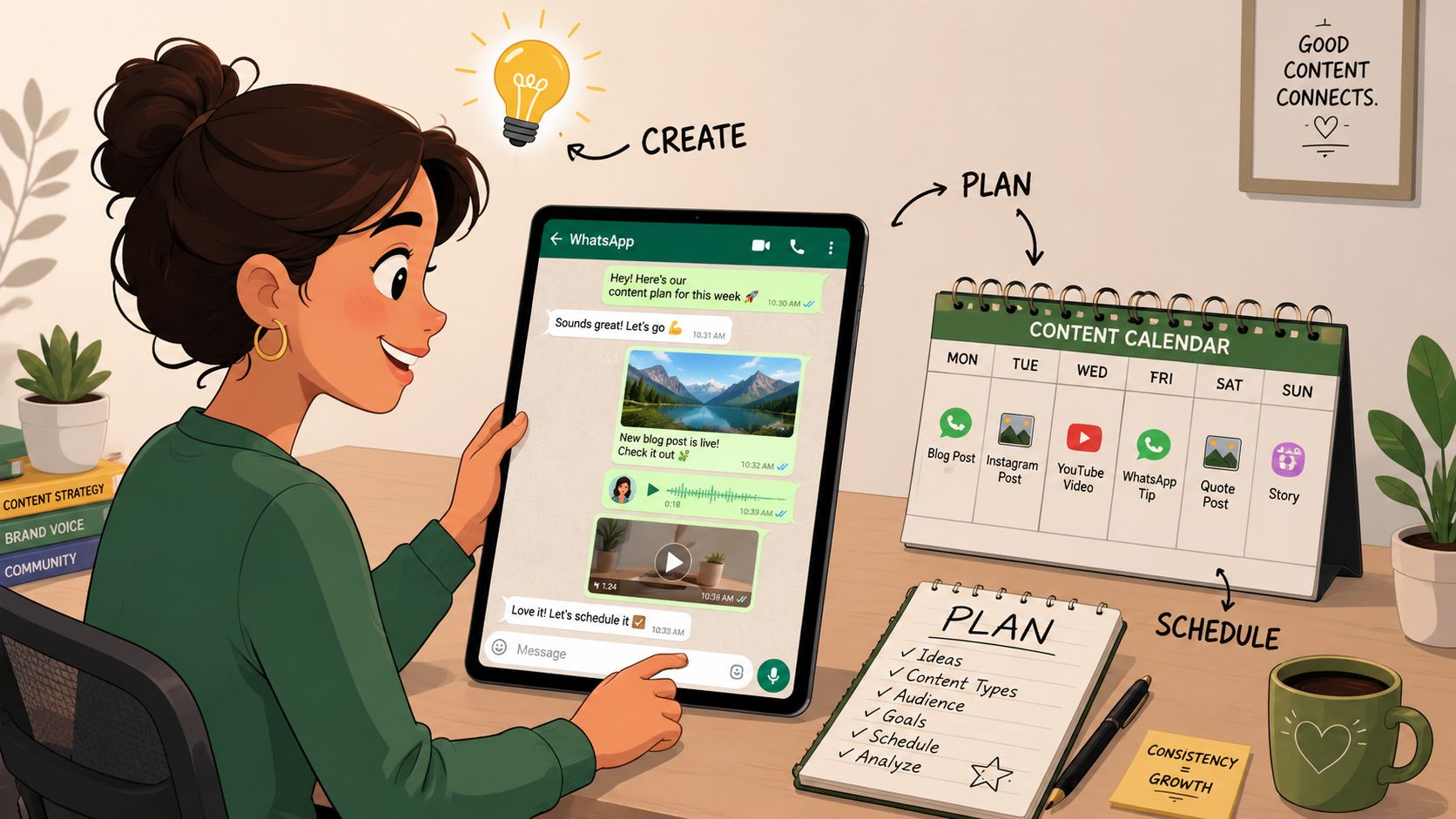
What good WhatsApp newsletter content looks like
The best-performing messages usually share a few traits:
- One topic only so the subscriber understands the message instantly
- One action instead of multiple links competing for attention
- Natural conversational tone rather than polished corporate copy
- Clear timing relevance such as today, this week, or before a deadline
- A reply path so the message can become a conversation
Here's a solid structure for most campaigns:
- Short opening line
- One clear value statement
- Supporting media if it helps
- One CTA button or one link
- One reply prompt
This isn't the place for giant paragraphs. If the client wants long-form education, send the full story by email and use WhatsApp to distribute the sharpest angle and the fastest path to action.
A simple four-week calendar
A client doesn't need endless content. They need rhythm. A four-week cadence is usually enough to stay present without becoming intrusive.
| Week | Message type | Example angle |
|---|---|---|
| Week 1 | Value-first | Quick tip, short update, useful resource |
| Week 2 | Offer-driven | Promotion, booking slot, launch alert |
| Week 3 | Social proof or education | FAQ answer, before-and-after, mini case insight |
| Week 4 | Engagement prompt | Poll, reply question, preference update |
For agencies, this makes production easier. The client approves a monthly theme, then your team turns it into short WhatsApp-native messages instead of writing from scratch every time.
If you need raw inputs from product pages, competitor pages, reviews, or public FAQs to help shape those messages, a solid web scraping api can speed up research and help your team turn scattered public information into campaign-ready angles.
Rich media beats generic blasts
A plain text message can work when urgency is high. But most clients benefit from richer formats like images, short videos, PDFs, voice notes, or simple carousels. The format should match the job.
Use examples like these:
- Ecommerce brand: Product image, short copy, single “Shop now” button
- Consultant: Voice note plus booking link
- Fitness coach: Short video clip and one reply prompt
- Real estate team: Property image, one CTA, one keyword response option
What doesn't work is dumping an email newsletter into WhatsApp. Long intros, too many links, and formal brand language reduce clarity fast.
Send the message your subscriber can understand in one screen without scrolling. If it needs more room than that, tighten the angle.
Automation Analytics and Optimization
A WhatsApp newsletter becomes an agency product when it runs on systems, not heroics. That means automating welcome flows, centralizing reporting, and using attribution data to make better decisions instead of just showing screenshots of opens.
The broader trend already points there. Dept's analysis of WhatsApp newsletters says 68% of newsletter publishers now send content across email, in-app notifications, and WhatsApp, while 42% of creators in North America and Europe use AI to auto-summarize WhatsApp group conversations into newsletter snippets. The same analysis argues that WhatsApp's 98% open rate, compared with email's 20 to 30%, makes unified attribution and synchronized delivery more important.
The reporting stack clients actually care about
Most clients don't want a wall of channel metrics. They want to know whether the WhatsApp newsletter is healthy, whether people act on it, and whether the agency can trace results.
Report on metrics like these:
- Delivery rate to spot sending or list-quality issues
- Open or read behavior where your tool supports it
- Click-through rate for campaign engagement
- Reply rate for conversational intent
- Source attribution so the client knows where subscribers came from
- Revenue per recipient if ecommerce or conversion tracking is available
That last metric matters more than vanity engagement. A campaign with fewer clicks but stronger buyer intent can outperform a broadly clicked message that doesn't convert.
Where automation improves margins
Automation isn't just a client benefit. It protects agency margin.
Use it for the repetitive parts:
- Welcome messages that confirm the opt-in and set expectations
- Tagging flows based on a first reply
- Follow-up nudges after key actions or non-actions
- CRM sync so sales and service teams can see the subscriber context
- Scheduling to avoid manual sends and missed windows
Agencies that layer WhatsApp into broader cross-channel operations should also evaluate tooling around adjacent publishing workflows. If your team is coordinating campaigns across platforms, guides covering top social media automation platforms can help you tighten content operations without relying on copy-paste habits.
The best WhatsApp retainers don't depend on someone remembering to send every campaign by hand.
How to optimize without overcomplicating it
Optimization should stay practical. Don't build a lab. Build a routine.
A simple monthly process works:
- Review top and bottom campaigns.
- Compare send windows by segment.
- Check which opt-in sources produce better subscribers.
- Look at reply patterns, not just clicks.
- Refine the next month's content mix.
When possible, test send timing and message framing in a controlled way. Small changes in timing, CTA clarity, and audience segment often matter more than wholesale creative reinvention.
The agency value is in interpretation. Clients can see a click number themselves. They pay you to explain why one cohort engaged, why another didn't, and what should change next.
How to White-Label and Monetize Your WhatsApp Service
The easiest way to undersell a WhatsApp newsletter is to position it as a cheap add-on. The stronger move is to package it as a branded communication system the client can keep using every month. That's where white-label delivery becomes valuable.
Clients want simplicity. They want their own branding, their own number, clear approvals, straightforward reporting, and predictable billing. They do not want to become experts in Meta policy, inbox operations, or message infrastructure.
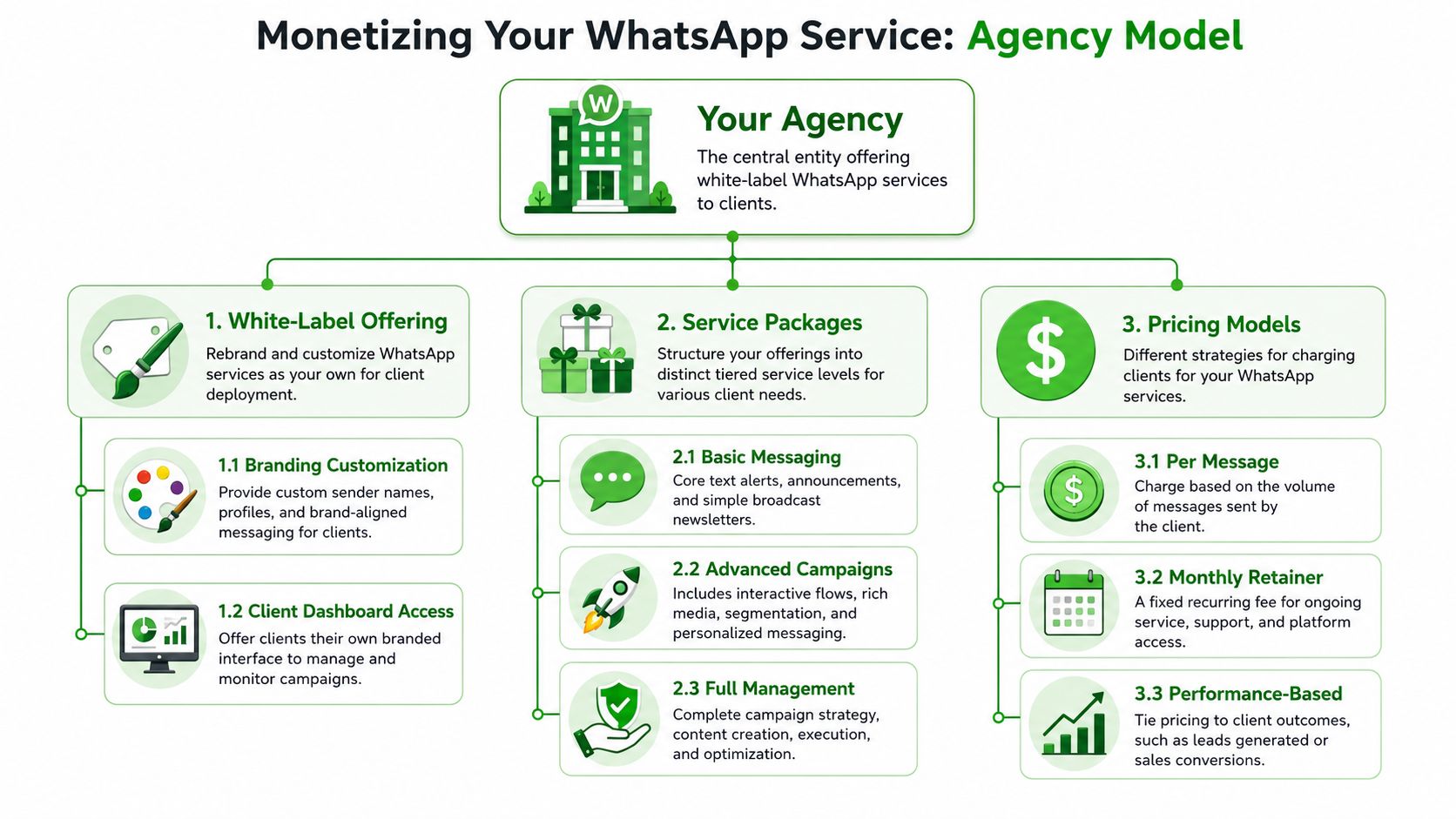
The service model that agencies can sell cleanly
A good white-label offer usually includes four layers:
- Launch setup with opt-in assets, onboarding flow, and list structure
- Monthly campaign management covering copy, creative, scheduling, and sends
- Performance reporting with attribution and recommendations
- Operational support for inbox handling, tags, and team process
That structure works because it maps to how agencies already sell retainers. It also gives you room to separate strategy from execution. Smaller clients can buy a lean version. More mature clients can buy a managed program.
Three package structures that are easy to pitch
You don't need complicated pricing logic. A clean flat-fee model is usually easier to sell and easier to deliver.
Starter package
Best for local businesses and first-time senders. Include core setup, QR-code list building, a welcome flow, and a small monthly campaign cadence. Keep approvals simple.
Growth package
Built for ecommerce brands, coaches, and service businesses that need segmentation and regular campaigns. Add richer media, list tagging, calendar planning, and reporting.
Managed premium package
Designed for brands that want the agency to own the full motion. Include strategy, campaign production, inbox workflows, CRM coordination, and optimization reviews.
Some agencies also add performance components where it makes sense. That can work, but only if attribution is strong and the client understands what the agency controls versus what the offer, landing page, or sales team controls.
What makes this service high margin
The margin comes from operational scaling.
You build the templates once. You standardize opt-in flows. You reuse onboarding materials. You create repeatable review cycles. You resell the same core capability across multiple niches with light adaptation.
The strongest resale model uses a platform that supports white-label branding, flat monthly software economics, and faster setup through QR-code onboarding rather than forcing every client into an API-heavy implementation. That gives you a productized service instead of a custom technical project every time.
Sell the outcome as owned audience access and managed communication, not as “we send WhatsApp messages.”
The clients who stay longest are usually the ones who treat the WhatsApp newsletter as infrastructure. It becomes part of launches, reminders, follow-up, retention, and support handoff. Once that happens, it stops being experimental budget and starts becoming operating budget.
If you want to launch this as a branded agency offer without getting buried in API setup, Double My Leads is built for that model. It lets agencies roll out white-label WhatsApp workspaces quickly, connect numbers by QR code, manage broadcasts and inbox workflows, and resell the service under their own brand with predictable monthly margins.


