
You already know the pattern. A client asks for “your platform,” but what they really want is a reliable service with your brand on it, clear billing, and fast support when something breaks. You want recurring revenue, but you don't want to fund a full product team, chase API changes, or explain to clients why your margins disappeared after a heavy messaging month.
That's where a white label platform becomes practical, not theoretical. For agencies, it isn't just a shortcut to a new offer. It's a way to package infrastructure, keep the client relationship, and turn delivery into something that scales better than custom service work.
Table of Contents
- What Is a White Label Platform Really
- The Business Case for Your Agency
- How to Choose the Right White Label Vendor
- Your Agency Implementation Roadmap
- Use Cases and Profitable ROI Models
- Avoiding Lock-In and Future-Proofing Your Offer
- Launch Your New Revenue Stream
What Is a White Label Platform Really
A white label platform is a ready-built product that another company lets you brand and sell as your own. The simplest way to think about it is a bakery using premium unbranded cake mix. The bakery didn't mill the flour or formulate the recipe, but the finished cake carries the bakery's presentation, packaging, and reputation.
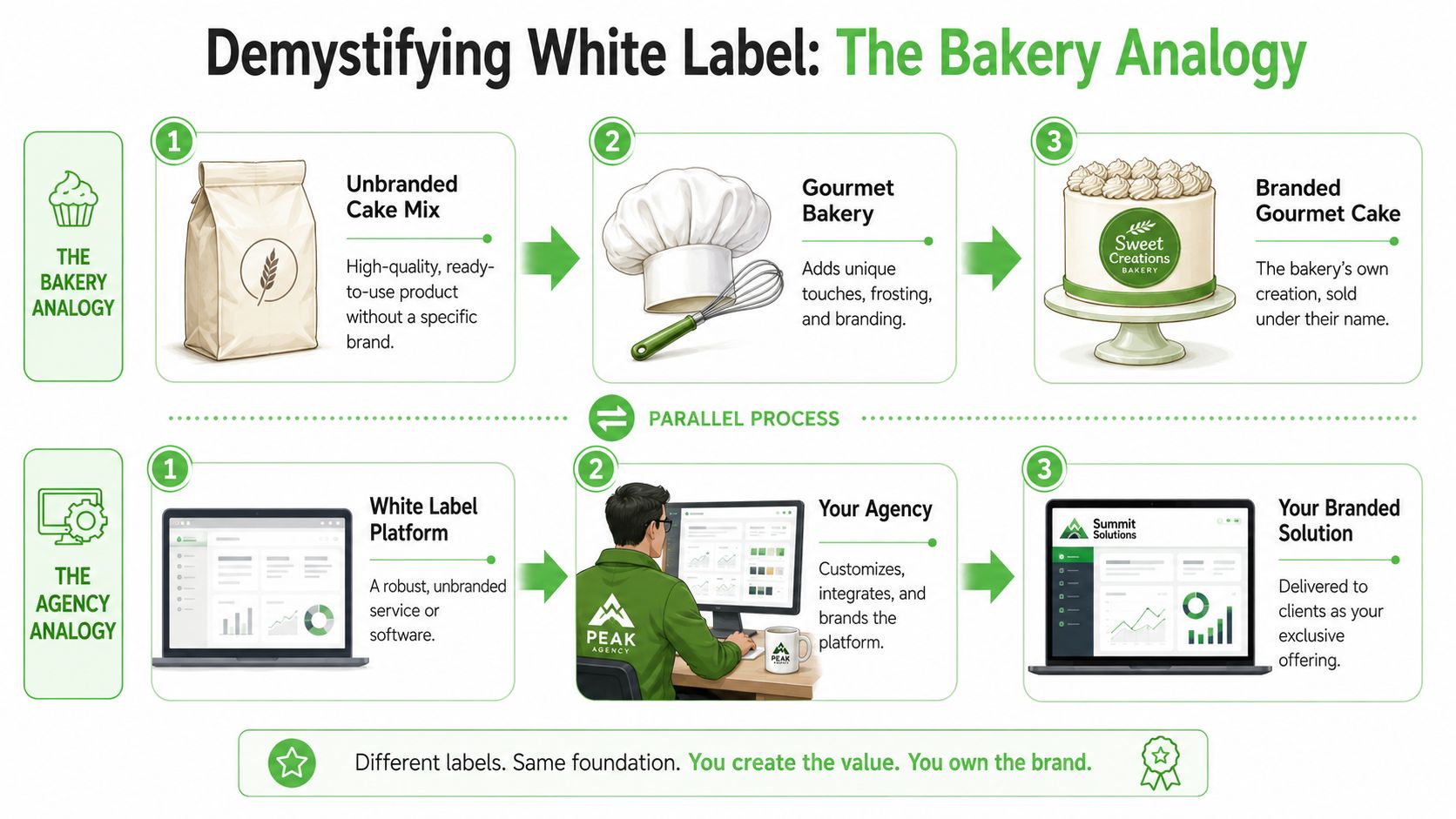
The simple definition that actually matters
For agencies, the important part isn't the textbook definition. It's the operating model. You get the software engine. Your clients see your logo, your colors, your domain, your onboarding, your invoices, and your support process.
That distinction matters because clients buy outcomes from the brand they trust. They usually don't care who manages the infrastructure underneath, as long as the service works and accountability stays with you.
In WhatsApp-based services, the model has matured to the point where providers can connect partners directly to the official WhatsApp Business API and still allow full dashboard rebranding with the partner's logo, domain, and color scheme, which has removed the need for agencies to hire separate developer teams according to Leminai's white-label WhatsApp Business API overview.
Practical rule: If the platform gives you branding but not commercial control, it's not a serious white label offer for an agency.
White label versus reseller versus affiliate
People mix these up. They shouldn't.
| Model | What the client sees | What you control | Best fit |
|---|---|---|---|
| Affiliate | The provider's brand | Referral only | Lightweight lead monetization |
| Reseller | Usually the provider's product identity is still visible somewhere | Limited packaging and pricing flexibility | Add-on revenue |
| White label | Your brand | Pricing, packaging, client relationship, positioning | Agencies building a repeatable service line |
A real white label platform usually sits on multi-tenant architecture. That means the vendor runs one underlying system while keeping agency accounts and client data separated inside it. In practice, that lets you create client workspaces, manage access, and operate a branded environment without building the core platform yourself.
What works is using white labeling for services that are already close to your agency's delivery model. What doesn't work is slapping your logo onto a tool that your team can't explain, support, or package clearly. White label only becomes valuable when the platform fits your offer tightly enough that clients experience it as part of your service, not as bolted-on software.
The Business Case for Your Agency
The case for a white label platform gets stronger when you look at buyer behavior and agency economics together. You need client demand, but you also need a delivery model that doesn't expand your payroll every time you add accounts.
Why agencies move to this model
The opportunity is clear in messaging. The global WhatsApp Business Messaging Platform market was valued at $4.8 billion in 2025 and is projected to reach $19.6 billion by 2034, growing at a 17.0% CAGR over 2026 to 2034, according to DataIntelo's market report. That projection matters because white label offers often sit on top of this infrastructure layer.
At the same time, usage behavior is already entrenched in many markets. A 2024 industry report cited by Oyelabs' white-label WhatsApp CRM analysis states that over 80% of SMBs in emerging markets rely exclusively on WhatsApp to manage customer interactions. For an agency, that changes the sales conversation. You're not pushing a new channel that clients have to learn from scratch. You're organizing a channel they already depend on.
That's why agencies adopt this model for operational reasons, not just branding reasons:
- Speed to market: You can launch a service line quickly because the infrastructure already exists.
- Better use of team time: Your staff can focus on sales, onboarding, campaigns, and retention instead of backend engineering.
- Recurring revenue structure: You're not limited to one-off project fees when the platform becomes part of an ongoing service package.
The strongest white label offers solve an existing client habit. They don't require a behavior change to make the business work.
Where the risks show up
The upside is real, but so are the trade-offs.
The first risk is provider dependence. If the vendor controls product direction, support quality, and release timing, your client experience depends on a roadmap you don't own. The second risk is commercial mismatch. Some platforms look cheap until usage grows, then hidden costs or confusing billing make the offer harder to sell profitably.
The third risk is positioning. Agencies sometimes buy a platform first and figure out the offer later. That usually leads to weak packaging and churn. The better approach is the reverse. Start with a problem you already solve. Then choose a white label platform that helps you deliver it more consistently.
A white label platform works best when it becomes part of your agency's operating system. It works poorly when it's treated like a side tool with no owner, no pricing logic, and no clear support process.
How to Choose the Right White Label Vendor
A vendor demo can look polished and still be a bad agency decision. The key question is whether the platform leaves you with a margin you can defend, support load your team can handle, and enough control to adapt the product as client demands get more specific.
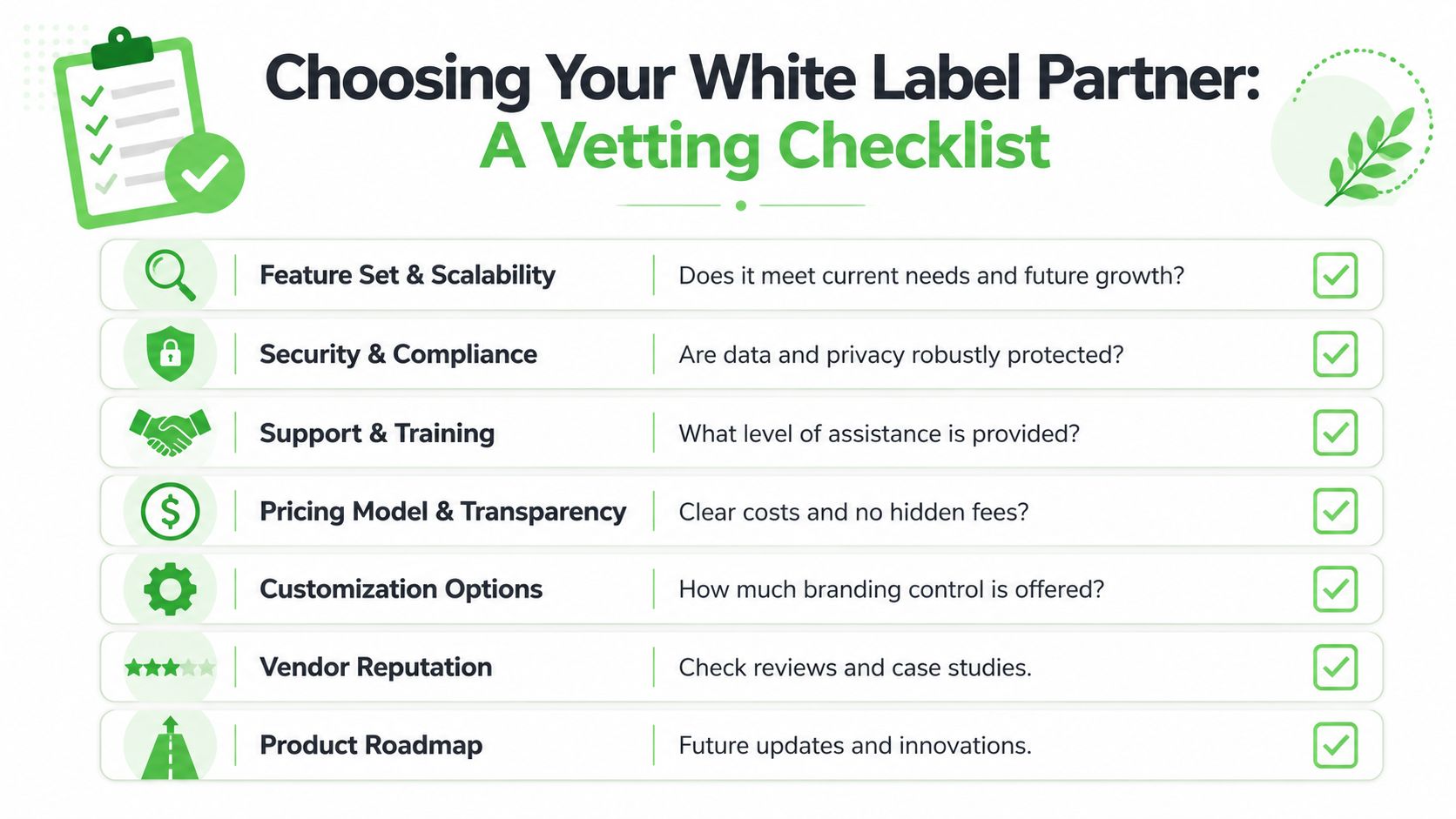
Questions That Reveal True Vendor Fit
Start with the pricing model, because that is where many reseller offers fail. A flat monthly platform fee is easier to package, quote, and protect. Per-message or usage-based pricing can still work, but it creates margin volatility. If client activity spikes, your cost rises before you have time to reprice the account. Agencies that sell communication tools without understanding that exposure usually end up absorbing the overage or having an awkward pricing conversation after launch.
Then check whether the platform gives you API access, webhooks, and usable data exports. Rebranding alone is not enough for long-term value. At first, a custom logo and domain may feel sufficient. Six months later, clients ask for CRM sync, custom reporting, lead routing, approval flows, or billing logic that matches their operation. Without API access, your offer stays stuck at the vendor's default workflow, and that limits both retention and upsell potential.
Support structure deserves the same scrutiny as product features. You are not just buying software. You are buying future onboarding issues, client questions, failed automations, permission errors, and billing disputes. Get clear answers on escalation paths, response times, and what happens when a client problem sits in the gray area between your service scope and the vendor's platform responsibility.
Commercial packaging matters too. A useful outside reference while evaluating service packaging and launch readiness is StartupSubmit's services, especially for agencies that need to tighten the offer before they put sales pressure on it.
A practical vendor scorecard
Use a short scorecard before signing:
- Margin predictability: Can you price the offer with confidence, or will usage swings erode profit?
- API and integration access: Can your team connect the platform to CRMs, forms, internal dashboards, and future automations?
- Brand control: Can you use your own domain, billing flow, and client-facing experience?
- Support model: Does the vendor provide behind-the-scenes help when client issues exceed your team's access?
- Operational stability: Can the platform handle normal client volume without frequent workarounds or manual fixes?
- Roadmap alignment: Is the product improving in areas that matter to agencies, not just direct end users?
Ask one more question during procurement. What happens when a top client wants something outside the default setup?
That answer usually tells you whether the vendor is a real operating partner or just a branded interface. The right choice gives you stable margins today and room to customize later. That combination is what turns a white label platform into a durable service line instead of a short-lived add-on.
Your Agency Implementation Roadmap
Choosing the platform is the easy part. The work that protects revenue starts after the contract is signed. Agencies that launch cleanly usually handle setup as both an operational project and a commercial one.
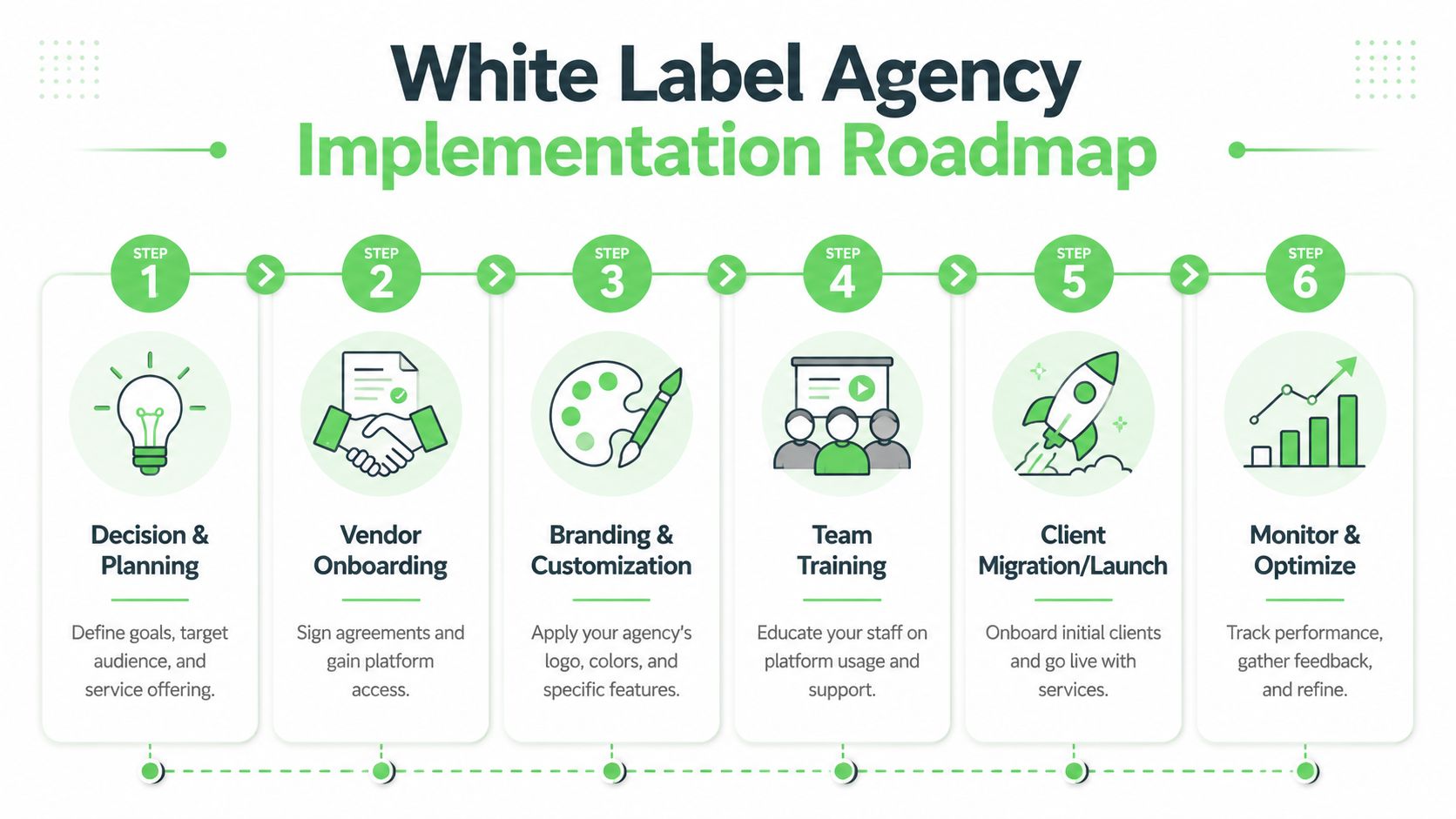
Phase one setup your commercial foundation
Begin with your branded environment. Add your logo, colors, and client-facing copy. If the platform allows a custom domain, use it. Clients trust continuity. They should feel like they're entering your system, not being handed off to a vendor portal.
Then connect billing. This step gets skipped or delayed far too often. If your platform supports branded billing under your own account, put that in place before you onboard clients. Clean billing is part of product credibility. It also reduces friction when you package software with managed services.
You also need a simple packaging model before launch:
- Core workspace offer: The base subscription or seat your client buys from you.
- Managed service layer: Campaign setup, reporting, support, or automation management.
- Add-ons: Extra workflows, integrations, chatbot setup, CRM sync, or advisory work.
This keeps the software from becoming a commodity. The platform is the delivery layer. Your process is where the margin often improves.
Phase two launch without chaos
Next, define client onboarding. Don't improvise it account by account. Build a standard sequence your team can repeat.
- Access creation: Decide who creates sub-accounts and what permissions clients receive.
- Training handoff: Record a short walkthrough for inbox use, broadcasts, tagging, templates, and support requests.
- Compliance review: Add your own Terms of Service and Privacy Policy where the client will see them.
- Support path: Tell clients where to go for billing, setup questions, and urgent issues.
The technical side matters too. A serious messaging platform depends on stable architecture. According to Wasender API's infrastructure guide, white label WhatsApp systems rely on multi-tenant separation, queue workers with rate limits, and health checks that monitor active sessions and trigger alerts when re-authentication is needed. You may not manage those systems directly, but you should confirm the vendor does.
Launch your first few accounts slowly enough that your team can document every point of friction.
The implementation mistake I see most often is agencies trying to sell at full speed before they've established internal ownership. Assign one person to commercial packaging, one to onboarding quality, and one to escalation management. A white label platform becomes scalable when the operations around it are repeatable.
Use Cases and Profitable ROI Models
A client says yes faster when the offer maps to a revenue problem they already feel. The owner is not shopping for "white label software." They want fewer missed leads, faster replies, more booked appointments, and less time wasted in scattered inboxes. That is where a white label platform turns from a tool into a service line.
A real agency offer clients will understand
The strongest use cases are simple and tied to a clear operational outcome. Local service businesses need lead follow-up. Clinics need reminders and reactivation. Coaches and community brands need broadcast delivery without inbox chaos. Ecommerce operators need post-purchase updates and campaign sends that do not depend on one staff member's phone.
That gives agencies a practical offer structure:
- Lead response workflow: Route inbound WhatsApp messages into a shared inbox with tags, notes, and assignment rules.
- Broadcast campaigns: Send launches, reminders, promotions, or update sequences to opted-in audiences.
- Automation layer: Add welcome flows, qualification prompts, and follow-up sequences.
- Reporting and management: Package the platform with campaign planning and account oversight.
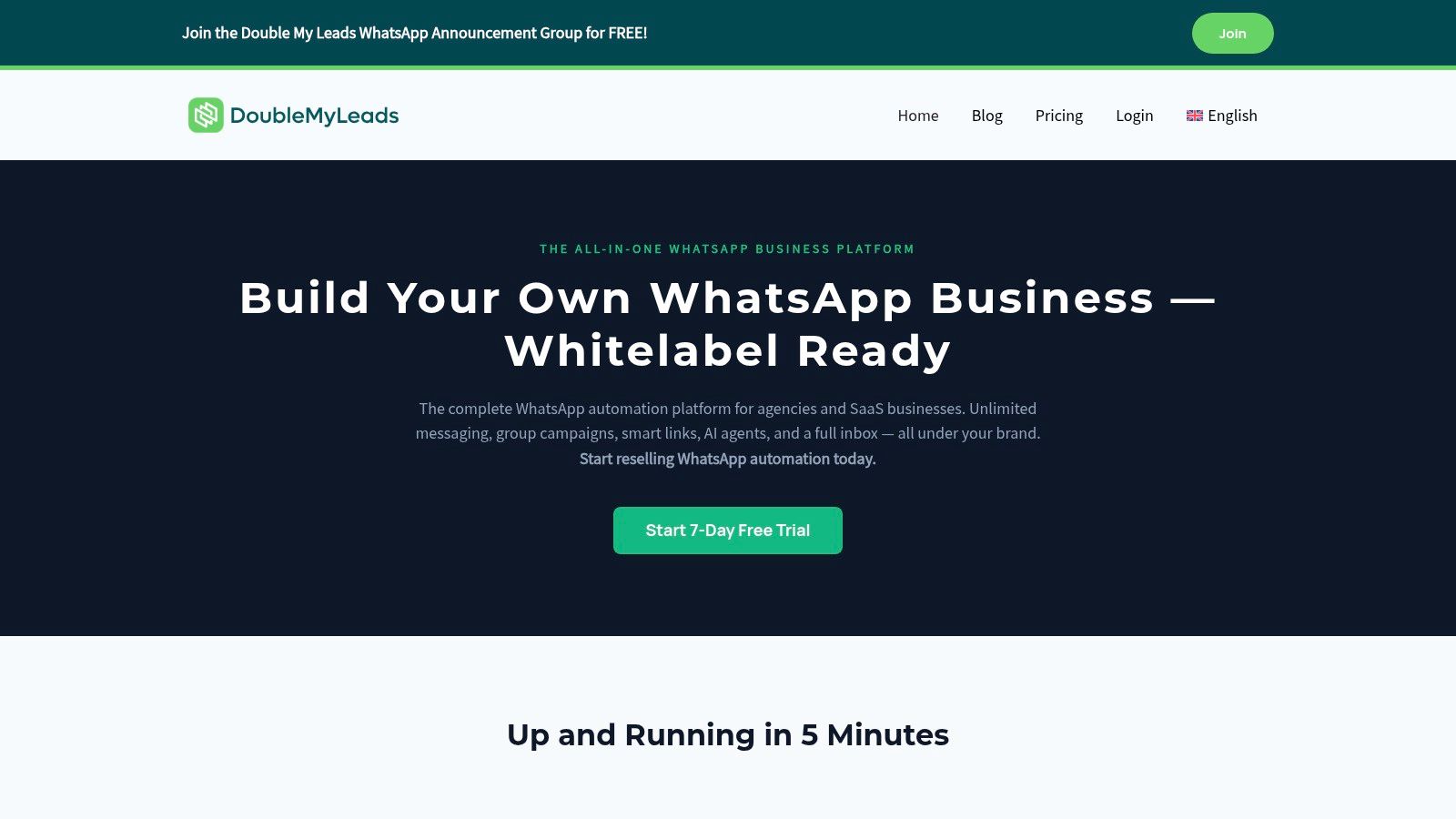
Double My Leads is one example in this category. It offers a white-labeled WhatsApp setup with custom branding, Stripe billing, REST API access, and a flat monthly structure for reselling workspaces. For an agency, that mix matters for two reasons. The flat monthly model is easier to package into a retainer, and API access gives you room to build custom workflows later instead of stopping at logo replacement.
How margin control works
The commercial model matters as much as the feature set. Agencies often underestimate how quickly pricing complexity becomes a sales problem.
With per-message pricing, your cost base changes with client behavior. A client sends more during a launch, adds another audience segment, or increases follow-up frequency. Your costs rise in the same month, and your margin shrinks unless you pass the increase through. That creates friction in sales and tension in account management because your pricing is harder to explain and harder for the client to predict.
Flat-fee workspace pricing changes that conversation. You know your base cost per account. You can set a monthly retainer with management included. You can decide where to hold margin and where to charge separately for setup, integrations, automation, or campaign work.
| Pricing structure | Agency experience | Client pricing impact |
|---|---|---|
| Per-message cost base | Margin moves with usage | More caveats and billing explanations |
| Flat-fee workspace model | Margin is easier to forecast | Easier to package into monthly retainers |
This is the difference between selling a service with stable unit economics and selling one that gets less profitable when a client succeeds.
A short demo can help clients grasp the service beyond the pricing model. This walkthrough format works well during sales conversations:
The highest-margin model is usually layered. Start with platform access and account management. Add setup fees for onboarding and templates. Then add higher-value work once the client depends on the channel: CRM syncs, lead routing, automated follow-up, reporting, and custom triggers through the API.
That last point matters more over time. Rebranding helps you launch. API access helps you keep the account, expand the scope, and protect your position when clients ask for workflow changes that the base interface cannot handle.
The mistake is underpricing the front end and absorbing variable costs in the background. A white label offer works best when revenue is predictable, delivery is repeatable, and customization can be sold as a separate line item instead of bundled in by default.
Avoiding Lock-In and Future-Proofing Your Offer
A lot of agencies buy the easiest platform to launch and only think about lock-in later. That's backwards. If your offer depends on a vendor you can't extend, inspect, or adapt around, your brand eventually becomes a wrapper on someone else's roadmap.
Why no code alone becomes a trap
The common pitch is convenience. No-code setup. Fast launch. Simple branding. Those things are useful, but they aren't enough if your clients need custom workflows or if the underlying ecosystem keeps shifting.
The harder truth is that white labeling can create a black-box dependency. ITU Online's discussion of provider dependence highlights this exact problem: agencies can lose control over product direction, especially when frequent Meta and WhatsApp changes require deeper customization than a basic logo swap.
That risk becomes obvious when a client asks for something operationally important:
- Route events into a CRM in a specific way
- Trigger internal actions from message behavior
- Sync custom fields between systems
- Build native workflows that the base UI doesn't support
If the vendor says no, you don't just lose a feature. You lose strategic control.
A branded interface is helpful. Access to the logic underneath is what protects your agency long term.
What future proofing looks like in practice
A future-proof white label platform gives you room to build. That usually means API access, webhook support, export capability, and enough technical openness that your team or contractors can create custom workflows when needed.
This is how agencies move from reseller status to solution-provider status. Two agencies may use similar base software. The one with extensibility can create proprietary onboarding, reporting, lead routing, and service automation that clients can't easily compare line by line.
What works is choosing a platform that supports today's offer and tomorrow's edge cases. What doesn't work is assuming that “easy now” will also be “flexible later.” Those are not the same thing.
Launch Your New Revenue Stream
A client signs on for a monthly retainer, likes the strategy, and then asks a simple question: can your agency provide the software too? If the answer is yes, you add a recurring revenue line that is easier to renew than another block of service hours. If the answer is no, part of the account value goes somewhere else.
That is why a white label platform matters. It changes how your agency earns, packages, and retains revenue. Instead of selling labor alone, you sell an operating layer your clients use every week. Done well, that creates stickier accounts, cleaner retainers, and better margin control.
The agencies that succeed with this model stay close to the numbers. They choose a platform that solves a specific client problem, fits the way the service will be delivered, and supports the level of control the agency will need six months from now. A good demo is not enough. The pricing model has to hold up once usage grows and support tickets start coming in.
Many agency offers get squeezed. Flat monthly resale pricing is easier to package, forecast, and protect. Per-message or usage-heavy pricing can work, but it introduces volatility into your margin and forces constant explanation when client activity spikes. If your cost base moves every month, your revenue stream is less predictable than it looks on the sales page.
Operational control matters just as much. Branding helps you present a unified offer, but API access is what gives you room to improve onboarding, reporting, lead routing, and client-specific workflows over time. Without that layer, you are reselling a surface-level product. With it, you can turn the same underlying software into a service that fits your agency.
Start narrow. Pick one offer, one client type, and one pricing structure your sales team can explain in one sentence. Then vet vendors like someone who will have to defend the margin, manage the rollout, and handle renewal risk.
If you want to package WhatsApp as a branded agency offer without inheriting per-message pricing complexity, take a look at Double My Leads. It offers white-labeled workspaces, branded billing, and API access for agencies that want to build a longer-term service around the platform.


