
A dental client signs a marketing retainer, approves ad spend, and expects the schedule to fill. Instead, the practice gets a mix of missed calls, vague form fills, insurance-only questions, and a front desk team too busy to chase every inquiry. The agency reports clicks. The dentist asks about booked patients.
That gap is where most dental lead generation breaks down.
The fix usually isn't “more traffic.” It's a tighter system. You need the right patients finding the practice, the right offer meeting them at the right moment, and follow-up that starts instantly instead of when someone at the front desk gets a spare minute. In practice, the agencies that win dental accounts long term don't just run ads or post content. They build a patient acquisition machine with channel strategy, conversion design, CRM discipline, and fast conversational follow-up. WhatsApp now gives agencies a useful edge because it turns static web traffic into active conversations that can be routed, tagged, and automated without adding more pressure to staff.
Table of Contents
- Beyond the Drill Modernizing Dental Lead Generation
- Attracting High-Value Patients Where They Search
- Converting Clicks into Consultations
- The WhatsApp Playbook for Lead Capture and Follow-Up
- Tracking ROI from First Click to Final Visit
- Your Agency's Blueprint for Dental Practice Growth
Beyond the Drill Modernizing Dental Lead Generation
Most dental funnels leak in plain sight. The website looks acceptable. Ads are running. Forms exist. But the practice still has openings next week, and the front desk is stuck sorting weak inquiries from people who were never a fit in the first place.
That usually means the agency is managing channels, not a system.
Modern dental lead generation has three jobs. First, attract people with real treatment intent. Second, remove friction between interest and consultation. Third, follow up in a way that doesn't depend on a busy receptionist remembering who asked about implants yesterday afternoon. When those three parts connect, the schedule gets steadier and reporting gets easier because you can trace where patients came from and why they booked.
A lot of agencies also hit a tooling problem. They have forms, ad platforms, maybe a CRM, and a few disconnected inboxes. That stack creates handoff errors. If you're reviewing options to consolidate intake and follow-up, it's worth comparing how teams find lead generation software based on routing, automation, and reporting instead of just form features.
Practical rule: If a lead can sit unassigned for hours, the process isn't built for dentistry.
Dental practices don't need more dashboard noise. They need fewer dropped conversations, faster qualification, and a booking path that works on mobile. That's why conversational channels matter more now. WhatsApp, used properly, isn't just another inbox. It can become the handoff layer between ad click, service inquiry, and booked appointment, especially when agencies package it with automation and CRM syncing.
Attracting High-Value Patients Where They Search
A practice can rank well, run ads, and still miss the patients it wants most. I see this when an implant clinic gets flooded with low-value whitening inquiries, or when an emergency dentist pays for clicks from people who only want pricing. Channel selection is only half the job. The offer, message, and follow-up path have to match the treatment.
Local visibility wins trust first
High-value dental patients do their homework before they book. They check the website, read reviews, compare services, and look for signs that the practice feels established and responsive. RevenueWell's 2025 dental trends report, as cited in Growth Friday's dental lead generation analysis, says many new patients visit a practice's website before booking and use online reviews during the decision process. That makes the website and reputation system core lead sources, not side projects.
For agencies, that changes the local SEO brief. Ranking matters, but trust signals decide whether a search impression turns into a conversation.
Prioritize four areas:
- Google Business Profile accuracy: Categories, hours, services, photos, and contact details should reflect the current practice, not last year's setup.
- Review acquisition and response quality: Ask consistently after successful visits. Reply in a way that sounds like the office, with enough detail to show attentiveness without creating compliance risk.
- Service-specific local pages: Build pages for implants, emergency care, Invisalign, and other revenue-driving treatments. Generic services pages rarely rank or convert as well.
- Conversion proof on-site: Show clinician bios, financing options, before-and-after examples where appropriate, and one clear next step.
One more point gets missed. A strong local presence should not force every inquiry into a form. For dental clients using WhatsApp automation, the local stack works better when the site and profile funnel patients into a message flow that asks the right qualifying questions first. Treatment type, urgency, preferred location, insurance status, and budget range can all be captured before the front desk gets involved. That gives agencies a better lead mix and gives the practice fewer dead-end calls.
PPC captures demand that already exists
PPC works best for treatments with clear search intent. Emergency dentistry, implants, and Invisalign usually justify the spend because patients are already looking for a provider, not browsing casually.
The failure point is rarely the click itself. It is the mismatch after the click.
Agencies lose money when they send implant traffic to a general homepage, group unrelated services into one campaign, or offer too many actions on the page. A patient searching for "emergency dentist near me" should land on an emergency-specific page with fast trust signals and one obvious response path.
Keep the account structure tight:
- Map one service to one campaign theme. Emergency, implants, and cosmetic services need separate copy, separate landing pages, and separate follow-up logic.
- Write for intent, not traffic volume. "Dental implants consultation" and "same day emergency dentist" signal different urgency and different economics.
- Use one primary CTA per page. Call now, request a consultation, or start on WhatsApp. Secondary actions dilute response.
- Track booked outcomes, not just leads. Form fills and calls matter, but agencies should also track WhatsApp starts, qualified conversations, and appointments set.
For agencies reselling a white-labeled platform like Double My Leads, such an approach improves margin. Instead of handing the practice raw leads, route PPC responses into a WhatsApp automation flow tied to the CRM. A missed call can trigger a message. A form fill can start a qualification script. If the patient asks about cost, the workflow can send financing information and offer a consultation slot. That creates a tighter handoff between media spend and booked revenue.
Social and referrals work best with specific offers
Social ads are usually a better fit for elective treatments than urgent care. People do not scroll Instagram looking for a root canal. They do respond to cosmetic outcomes, limited-time offers, and educational content that lowers hesitation.
Specificity matters here. "Improve your smile" is weak. "Ask about Invisalign before wedding season" gives the patient a reason to act now. "See if whitening is a fit before your next event" is stronger than a generic cosmetic ad because it connects the service to a real buying moment.
What tends to work:
- Consultation offers for elective services: Invisalign, whitening, veneers, and smile design.
- Short educational creative: FAQs, dentist-led videos, and before-and-after visuals that answer the first question before the patient has to ask it.
- Message-first CTAs: WhatsApp often outperforms long forms for cosmetic interest because patients want quick answers before they commit.
Referrals behave differently. They bring higher trust and lower skepticism, but only if the office makes them easy to use. The best practices mention referrals at checkout, send the referral prompt quickly after a positive visit, and keep redemption simple. If the patient has to remember a code, fill out a long form, and wait for a callback, referral volume drops.
WhatsApp can improve this channel too. A referral text or QR prompt can open a prefilled message such as, "Hi, I was referred by Sarah and want to ask about Invisalign." That gives the coordinator context immediately and lets the agency attribute the source cleanly inside the CRM.
Dental Lead Generation Channel Comparison
| Channel | Best For | Avg. Cost/Lead | Time to Results | Key Metric |
|---|---|---|---|---|
| Local SEO | Family dentistry, long-term visibility, branded trust | Varies by market and execution | Slower build, compounding over time | Qualified local inquiries |
| PPC | Emergency, implants, Invisalign, urgent demand capture | Varies by keyword and competition | Fast once campaigns launch | Booked consultations by keyword |
| Social Media Ads | Cosmetic services and offer-led campaigns | Varies by audience and creative | Moderate, depends on testing cadence | Conversation starts and consult requests |
| Referrals | High-trust patient acquisition | Usually low direct media cost | Ongoing | Referred patients who book |
The right mix depends on treatment economics, sales cycle, and front-desk capacity. A practice that wants emergency volume needs speed and tight routing. A practice focused on implants needs stronger qualification and follow-up. A cosmetic-heavy office needs education, social proof, and a fast way to continue the conversation.
That is why I recommend agencies build channel strategy around the response system, not just traffic acquisition. If local SEO, PPC, social, and referrals all feed into the same WhatsApp automation layer with CRM sync, lead handling becomes faster, cleaner, and easier to measure. That is where high-value patient acquisition starts to scale.
Converting Clicks into Consultations
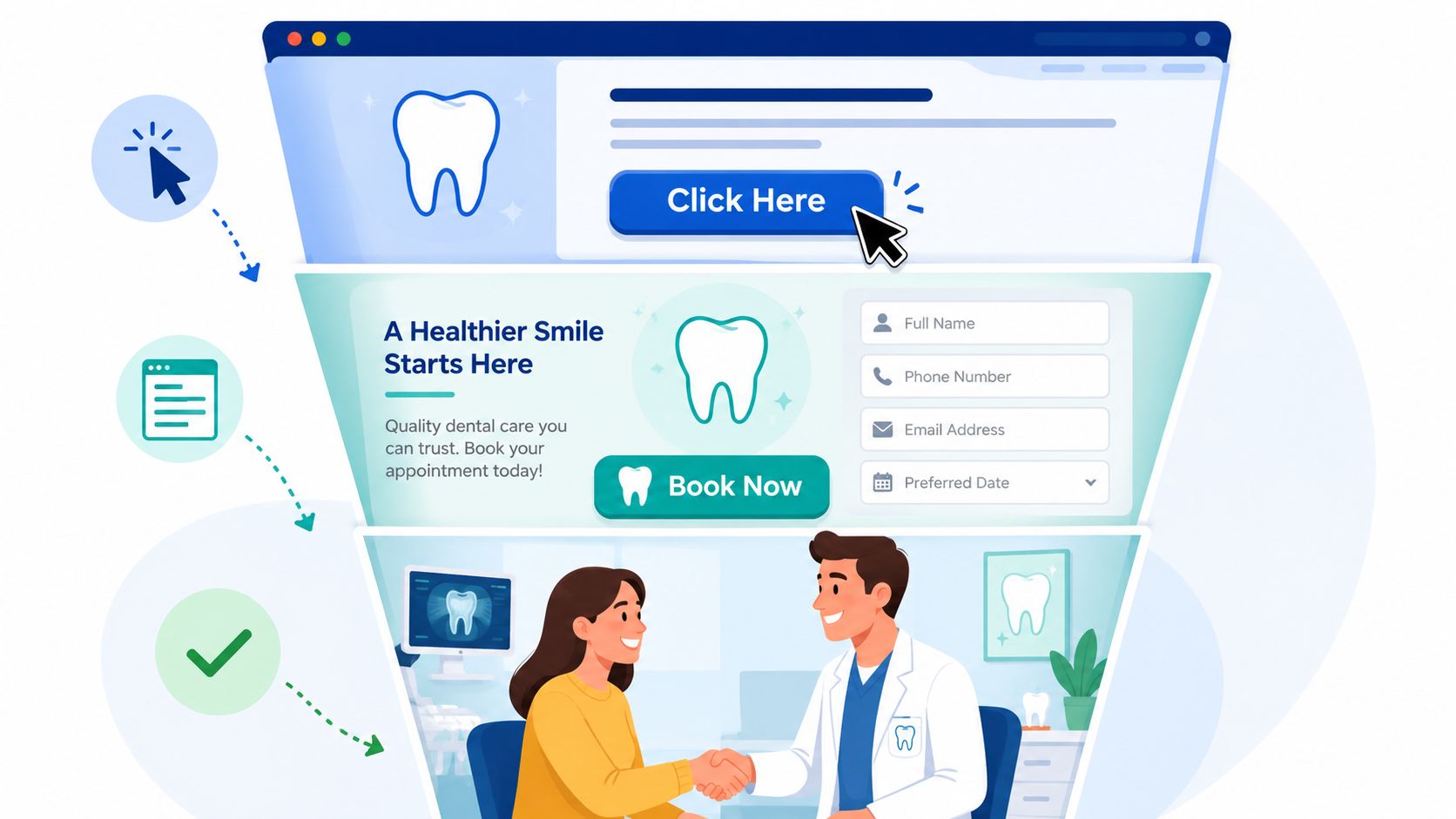
A click only matters if the page earns the next action. In dental lead generation, the landing page is where budget either turns into consultations or disappears into bounce and hesitation.
What a landing page needs to do fast
The best dental pages don't try to explain everything. They make one promise, support it with proof, and offer one clean path to respond.
A strong page usually includes:
- A specific headline: “Get Your Confident Smile Back with Invisalign” works better than “Welcome to Our Dental Office.”
- A service-matched hero section: The image and copy should reflect the procedure, not generic stock photos of smiling families.
- Visible trust elements: Testimonials, review excerpts, clinician credentials, and before-and-after examples reduce uncertainty.
- A single primary CTA: “Book Your Consultation on WhatsApp” is clearer than giving visitors five competing options.
- Mobile-first forms: Ask only what the coordinator needs to move the conversation forward.
The CTA matters more than most agencies admit. If the only option is a long web form, a lot of interested visitors will delay. Giving them a direct WhatsApp route works well because it feels immediate and low friction.
Bad page versus good page
A weak page usually has these problems: generic copy, no service focus, no evidence, and a footer contact form buried under paragraphs of filler. It asks patients to work too hard.
A better page feels obvious within seconds:
- Headline: States the treatment and patient benefit.
- Offer block: A consultation, second opinion, or treatment-specific incentive.
- Proof strip: Reviews, credentials, or real patient outcomes presented clearly.
- FAQ section: Answer price, timing, candidacy, and insurance questions before they become objections.
- Sticky CTA on mobile: Call, WhatsApp, or request appointment.
The best landing pages don't “look high converting.” They remove the exact doubt that stops a patient from booking.
For agencies, the audit is simple. Open the page on your phone. If the service isn't clear, the proof isn't visible, or the CTA isn't immediate, fix that before buying more traffic. Conversion problems are usually page problems, not channel problems.
The WhatsApp Playbook for Lead Capture and Follow-Up
WhatsApp is where agencies can create separation from competitors still relying on forms, email drips, and manual callback lists. Used well, it shortens response time, improves qualification, and gives the practice a cleaner handoff from inquiry to scheduling.
Start with intent not just contact details
A practical workflow for dental lead generation is to segment prospects by treatment intent and route them into stage-based automation, with different actions triggered by CRM stage data so fewer leads leak between inquiry and booked visit, as explained in Teraleads' guide to automating dental lead workflows.
That principle matters on WhatsApp because conversational intake lets you qualify in real time. Instead of collecting a name, phone, and “message,” you can ask what the patient wants.
Useful first-pass segments include:
- Emergency care: Needs fast routing and usually a same-day or next-available response.
- High-value elective treatment: Implants, Invisalign, veneers, or cosmetic consults should go to a treatment coordinator, not sit in a general queue.
- General dentistry: Cleanings, exams, and family inquiries can flow into standard booking.
- Insurance-first shoppers: These leads need fast coverage clarification and expectation setting.
If every inquiry enters the same inbox untagged, staff triage becomes the bottleneck.
A practical WhatsApp flow agencies can deploy
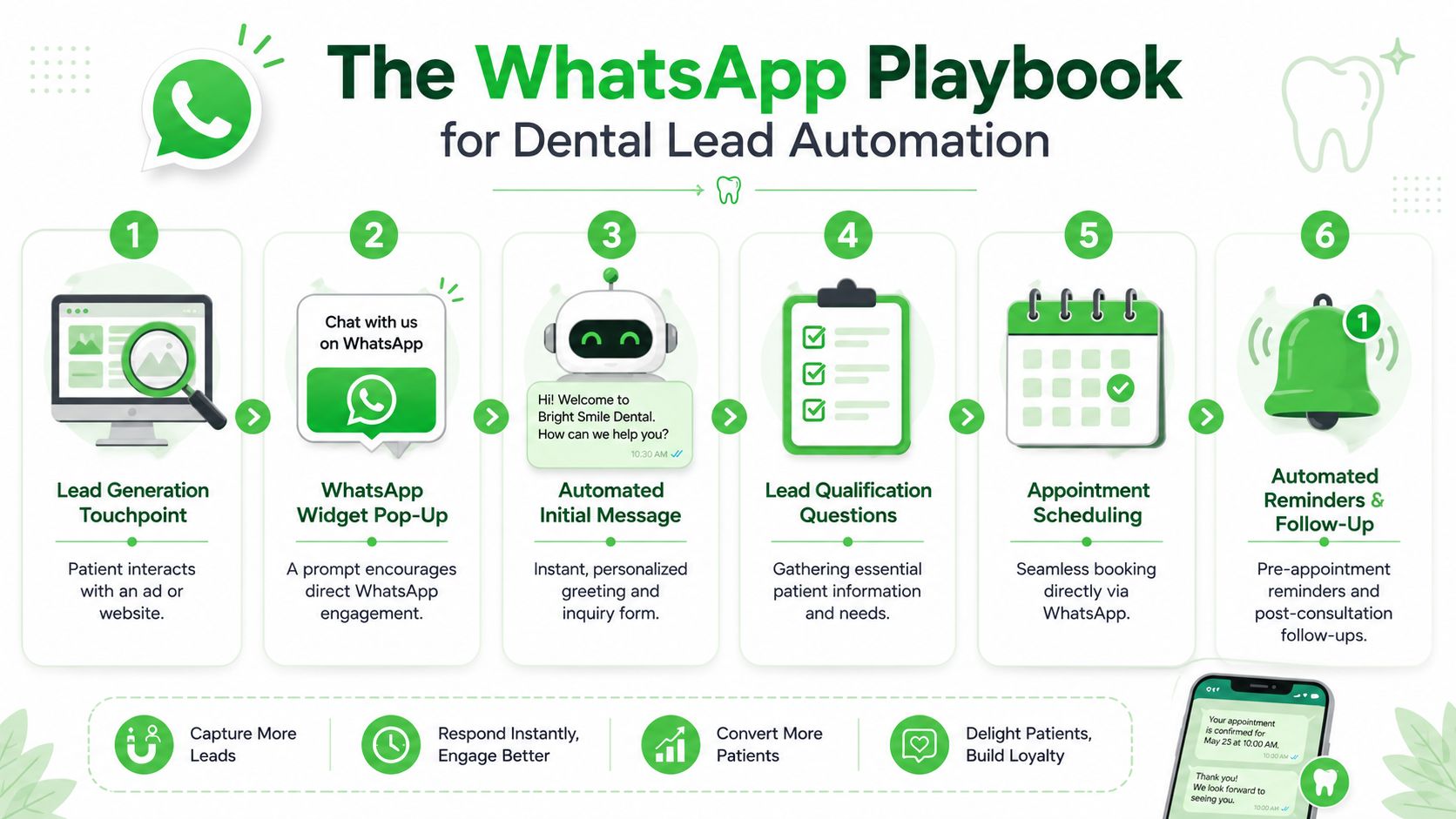
A strong WhatsApp funnel starts before the message arrives. Put tracked smart links on service pages, ad landing pages, QR codes on print materials, and a widget on mobile pages. Then route the conversation by source and intent.
The process usually looks like this:
Lead enters from a tagged source
The smart link or widget passes campaign context into the conversation so the team knows whether the person came from implants PPC, Invisalign social ads, or a website page.Auto-welcome fires immediately
The message confirms the practice received the inquiry and offers quick response options.Qualification starts with short replies
Ask what treatment they're looking for, whether they're a new patient, and when they'd like to come in. Keep it short enough to answer from a phone.CRM stage updates automatically
Prospect becomes lead. Lead becomes qualified lead when intent is clear. Qualified lead becomes patient after booking and attendance milestones are confirmed in your workflow.Assignment rules route high-value leads
Implant and cosmetic inquiries go to the senior coordinator. Emergency goes to front-desk priority. General inquiries can sit in a shared booking queue.Follow-up continues if no reply arrives
At this stage, most practices lose opportunities. WhatsApp lets you continue the conversation naturally without waiting for staff to remember.
This walkthrough is useful for stakeholders who need to see the process in motion:
Agencies that package WhatsApp well aren't selling chat. They're selling response speed, lead routing, and fewer missed bookings.
Copy you can actually use
Most dental automation fails because the messages sound robotic or ask too much too soon. Keep the tone human and the steps narrow.
Auto-welcome template
Hi, thanks for contacting [Practice Name]. I'm here to help you get to the right person quickly. Are you asking about a cleaning, emergency visit, implants, Invisalign, or something else?
If the lead selects implants or Invisalign
Thanks. Are you looking for information, pricing, or a consultation appointment? If you want, I can help you request a time now.
If the lead stops responding after first contact
- Follow-up one:
Message: Hi, just checking back on your request with [Practice Name]. If you'd still like help, reply with the treatment you're interested in and we'll point you in the right direction. - Follow-up two:
Message: We still have your inquiry open. If booking is easier, reply with your preferred day and time and our team can help coordinate options. - Follow-up three:
Message: Closing the loop here for now. If you'd like to continue later, just reply to this message and we'll pick it back up.
For emergency inquiries
Thanks for reaching out. If this is urgent, reply with your pain or issue in a few words and the best callback number. Our team will prioritize this request.
For agencies reselling a white-labeled SaaS, margins improve. You can standardize the logic, brand the workspace to your agency, and deploy repeatable workflows across clients without rebuilding each funnel from scratch. True value isn't the inbox. It's the operational layer around tags, assignments, templates, and CRM stage movement.
Tracking ROI from First Click to Final Visit
A dental client reviews your report and asks one question: which campaigns produced booked visits, and which ones just produced inquiries that stalled. If you cannot answer that from one system, the account stays fragile.
The attribution model that keeps reports honest
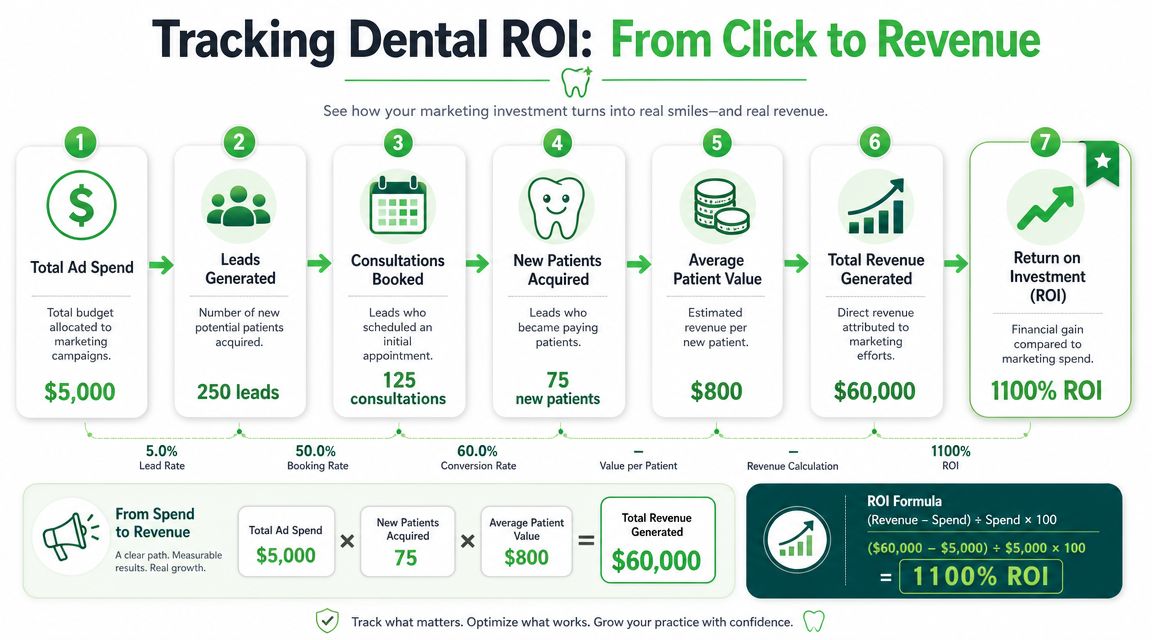
Good ROI tracking starts at first touch and survives every handoff after it. Every form, call event, landing page CTA, and WhatsApp entry point needs campaign data attached before the lead hits the CRM. If someone clicks an implant ad, opens WhatsApp, asks about financing, and books two days later, that chain should stay intact in the record.
Agencies lose clarity when channels report in silos. Ads show conversions. The CRM shows appointments. The front desk keeps notes somewhere else. Then nobody can explain which keyword, offer, or follow-up flow produced revenue.
The fix is operational, not cosmetic. Use consistent fields across every source and make WhatsApp part of the attribution path instead of treating it like a side conversation.
For a practical setup, push these fields into the CRM:
- Original source: Google Ads, Local SEO, referral, Facebook, Instagram, direct
- Campaign and service line: Implants, emergency, Invisalign, cleaning, whitening
- Conversation status: New inquiry, contacted, qualified, booked, attended, lost
- Owner: Which coordinator or staff member is responsible
- Outcome reason: Booked, no show, no response, insurance mismatch, price objection
- WhatsApp engagement: Started chat, replied, clicked booking link, requested callback, went inactive
That last field matters more than many agencies expect. In dental, the gap between lead and appointment often sits inside a conversation thread. When WhatsApp activity is written back to the CRM, you can see whether the problem came from weak traffic, slow response, poor qualification, or dropped follow-up.
Go High Level is common in agency delivery, but the rule applies to any stack. If one record cannot show first click, conversation history, pipeline stage, and final outcome, the report will fall apart under client scrutiny.
The KPIs that matter to dental clients
Practice owners want clear answers. They care about lead volume, booking rate, show rate, and revenue tied to source. Everything else supports those four.
How many qualified leads came in?
Count real inquiries tied to a treatment need. Filter out spam, duplicate submissions, and low-intent contacts.How many booked?
Lead-to-appointment rate shows whether the page, message flow, and staff follow-up are working together.How many showed up and started treatment?
This separates soft bookings from real patient acquisition.Was the spend profitable?
Match closed revenue, or at minimum attended consult value, back to source and service line.
If you cannot show source, stage, and outcome on one record, you do not have ROI reporting. You have channel reporting.
Review cadence matters too. Weekly reviews should focus on response time, unassigned leads, stalled WhatsApp threads, and missed callbacks. Monthly reviews should focus on booked visits by source, lost reasons by service line, no-show patterns, and coordinator performance by pipeline stage.
That analysis helps agencies find effective fixes. Sometimes the answer is higher budget. Often it is tighter routing, a better landing page match, or a WhatsApp automation that nudges undecided leads back into booking. For agencies building a repeatable dental offer, these dental practice growth guides pair well with ROI reporting because they connect acquisition strategy to operational follow-through.
The agencies that keep dental clients longest usually report one level deeper than competitors. They do not stop at cost per lead. They show which campaigns started conversations, which conversations became appointments, and which appointment paths produced revenue. That is the standard a white-labeled SaaS like Double My Leads helps you sell and deliver at scale.
Your Agency's Blueprint for Dental Practice Growth
The agencies that grow in dental stop selling isolated deliverables. They stop positioning themselves as the SEO shop, the ads shop, or the social shop. They become the team that helps the practice acquire patients more predictably.
That shift comes from stacking the right pieces in the right order. Attract demand where patient intent is strongest. Send that traffic to pages built for one service and one action. Start the conversation immediately through WhatsApp. Route by treatment type. Push every interaction into the CRM. Report on booked visits and patient outcomes, not just click volume.
This changes the client relationship. When your agency controls the handoff between traffic, conversation, qualification, and booking, you're much harder to replace. The practice isn't judging you on ad management alone. It's relying on you for operational growth. If you want extra strategic context around positioning and organic demand, these dental practice growth guides are worth reviewing alongside your paid and automation playbooks.
The most durable offer for agencies is a full-funnel one. Not because it's trendier, but because it matches how patients choose a dentist now. They search, compare, hesitate, ask questions, and book when someone responds clearly and fast. Build for that behavior, and dental lead generation becomes far more predictable.
If you want to turn this playbook into a white-labeled service, Double My Leads gives agencies a practical way to launch WhatsApp automation, shared inboxes, smart links, QR-based number connection, CRM syncing, and branded client workspaces without the usual setup drag. It's a strong fit for agencies that want to resell a modern follow-up system instead of patching together forms, inboxes, and manual outreach.


