
You're probably in one of two situations right now. You want to add a messaging product to your agency without hiring a product team, or you run a SaaS and need a branded communication layer fast enough to close current deals, not next quarter. That's where white label providers stop being a nice idea and start becoming a practical revenue decision.
The appeal is simple. You can launch under your own brand, control the customer relationship, and skip the slowest part of the process, which is building and maintaining the infrastructure yourself. That time-to-market advantage is one reason white-label SaaS keeps getting attention. Independent market commentary describes SaaS adoption as having grown by over 30% globally in recent years and frames white-label SaaS as a way to skip months or years of development by launching a pre-built branded product instead of building from scratch (Bidscube on white-label SaaS).
For agencies, this isn't just operational convenience. One industry survey cited by Cloud Campaign found agencies using white label solutions reported 42% higher client retention and 37% faster business growth than agencies that did not (Cloud Campaign on why white label matters). That doesn't mean every reseller setup wins. It means the model can work when the offer, margin structure, and onboarding are done properly.
Messaging is one of the clearest categories for this model because clients already understand the value. They need inboxes, automation, broadcasts, routing, and reporting. You need a product you can package and resell. If you want a broader branded AI layer as part of that offer, the DocsBot white label platform is also worth a look.
Table of Contents
- 1. Double My Leads
- 2. Whapi.cloud
- 3. Growby formerly Whatso
- 4. WhautoChat
- 5. AiSensy
- 6. WasenderAPI
- 7. Zautic
- 8. OnCloudAPI
- 9. APITxT
- 10. Solvear
- Top 10 White-Label Providers Comparison
- Your Go-to-Market Playbook From Selection to Sale
1. Double My Leads
A common agency scenario looks like this. You want to add WhatsApp to your offer this month, not after a long product build. You need client accounts under your own brand, billing that fits your margin model, and a setup your team can support without turning every onboarding into a custom project. Double My Leads fits that model well.
The appeal is less about the interface and more about how the resale business works. Flat monthly pricing, workspace resale, custom branding, and Stripe billing make it easier to package the platform as a recurring service with clear margins. That matters because white-label revenue often breaks down after the sale, when support time, onboarding effort, and add-on requests start eating profit. Broader guidance on white-label services keeps warning buyers to inspect licensing, support, implementation, and margin compression, because the real question is whether the offer still makes money once delivery scales (Fantastic IT on white-label service economics).
Why it stands out
Double My Leads is built for fast deployment. Numbers connect by QR code, and the shared inbox includes assignments, notes, tags, and quick replies in one workflow. For agencies selling to SMBs, that setup reduces the time between close, onboarding, and first usage.
It also gives resellers more room to build an actual product line instead of reselling access at a thin markup.
- Branding and ownership: You can run the portal on your own domain and present the service as part of your own stack.
- Pricing control: You set client-facing workspace pricing, which is what makes recurring margin possible.
- Go-to-market utility: Smart links, chat widgets, scheduled campaigns, and announcement group workflows support both lead capture and client communication use cases.
- Expansion path: The REST API, MCP Server access, and AI agents give technical teams options for custom workflows after launch.
Here is the practical upside. You can start with a packaged service, then add automation or integrations only after demand is proven.
Best fit and trade-offs
Double My Leads makes the most sense for agencies, GHL operators, creators, community-led businesses, and SaaS founders who need to get to market quickly with a branded WhatsApp offer. It is especially useful if you prefer selling plans around inbox access, campaigns, automation, and support workflows instead of explaining variable message charges to every client.
There are trade-offs. If your clients require a specific enterprise architecture, unusual compliance controls, or deep custom integrations from day one, verify those details before you commit. Large-volume broadcast use cases also need a closer look at device-linked limits, account structure, and how support will handle reconnects or number issues at scale.
From an operator's standpoint, the value here is straightforward. Double My Leads gives resellers a cleaner path to launch, package, bill, and support a branded messaging product without building the whole stack themselves. That does not remove operational work, but it keeps the work tied to revenue instead of forcing you into a heavy implementation before you have customers.
2. Whapi.cloud
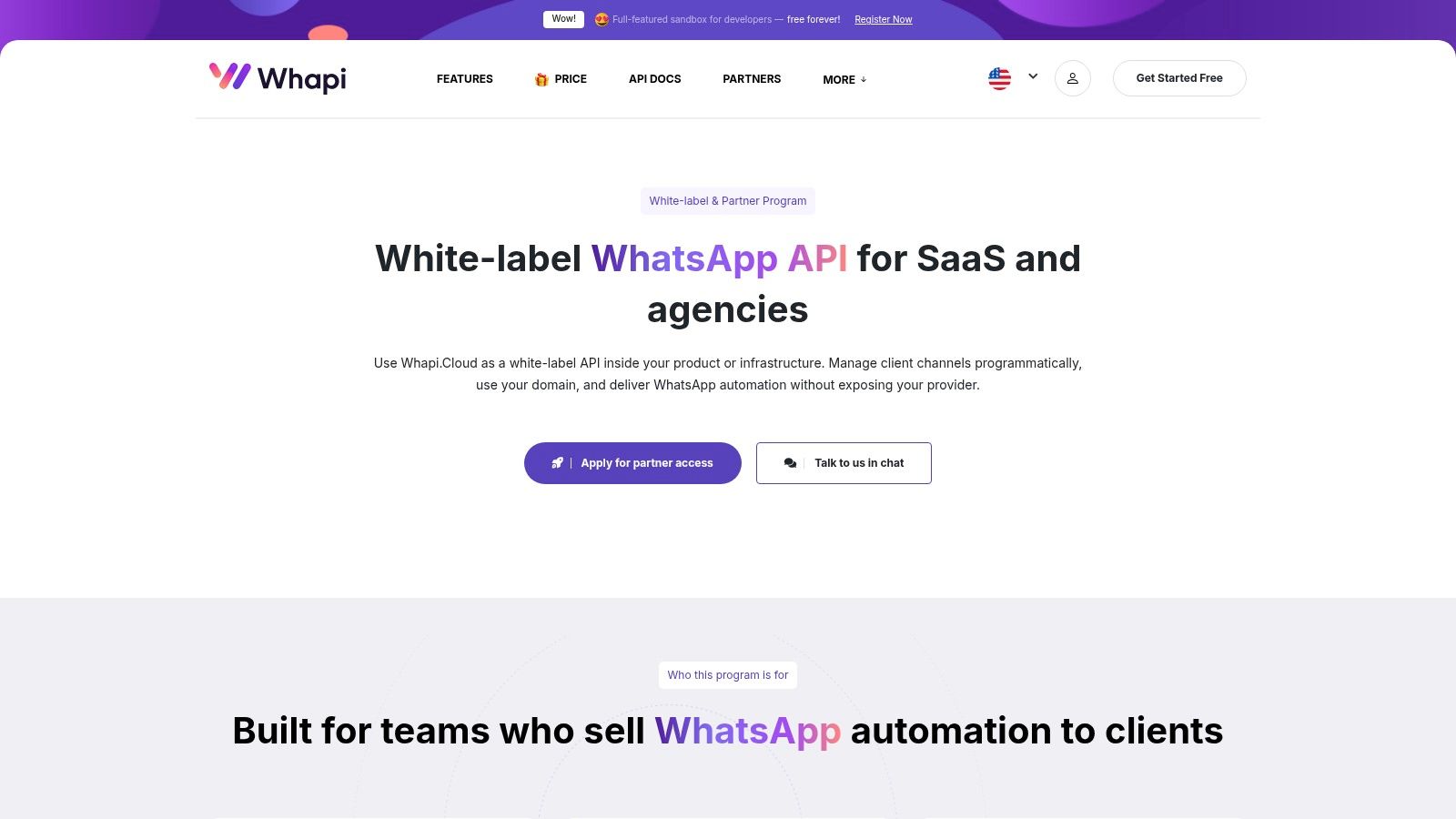
Whapi.cloud is for teams that don't want another vendor-branded dashboard in front of clients. It gives you a white-label API layer and partner flow that you can embed into your own product and domain.
That changes the implementation model completely. You're not buying a ready-made agency portal. You're buying control. If your SaaS already has users, permissions, billing, and workflow logic, that's a strength. If you don't, it becomes extra work.
Where it fits
Whapi.cloud makes the most sense for multi-tenant SaaS products, internal platforms, and teams that want programmatic onboarding. Real-time webhooks and broad WhatsApp feature coverage are useful when you need messaging to act like a native module inside your app rather than a separate tool your clients log into.
This is the key trade-off:
- Good fit: You already have product and engineering resources.
- Bad fit: You need a polished reseller product by next week.
- Good economics model: Fixed, usage-based pricing per active channel is easier to map to account-level packaging than fuzzy enterprise quotes.
- Operational catch: You'll own more of the front-end UX, support flow, and end-user training.
In analytics and embedded software, adoption often depends less on branding and more on reducing friction for non-technical users. BARC reports that only 25% of employees are actively using BI and analytics tools on average, while lack of training, low-quality data, budget constraints, and ease of use remain major blockers (BARC on BI and analytics adoption). The same principle applies here. If you use Whapi.cloud, don't assume white labeling is enough. Your onboarding and UX have to carry the sale.
3. Growby formerly Whatso
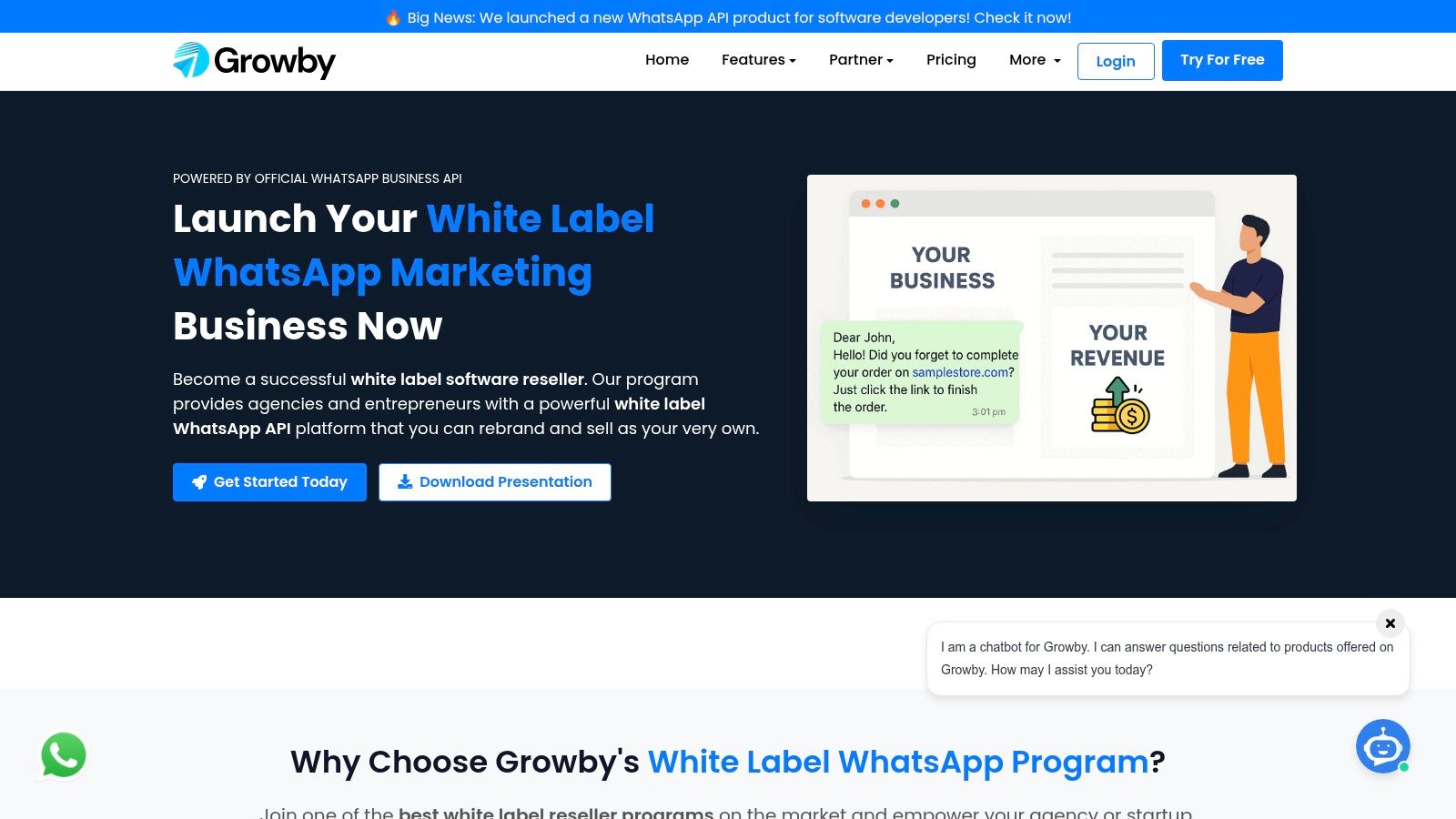
Growby takes a more traditional reseller approach. It's built for agencies and resellers that want bulk messaging, chatbot flows, CRM functions, and white-label controls without having to assemble a stack from multiple tools.
The appeal here is straightforward. Hosted and self-hosted options give buyers flexibility, and the product is designed around getting to market fast. Some teams like that because it reduces dependency on custom development. Others like it because they can secure more control over margins with licensing models that don't keep expanding as they add clients.
Commercial angle
Growby is strongest when your sales motion is simple and volume-oriented. If you're selling WhatsApp marketing to local businesses, education operators, coaches, or regional service providers, a practical platform often beats a more elegant but heavier implementation.
What works well:
- Reseller-first packaging: Custom logo, colors, and domain let you present it as your own platform.
- Broad marketing utility: Bulk messaging, chatbot flow building, CRM, and rich media are enough for many agency offers.
- Hosting flexibility: Self-hosted can appeal to buyers who want more control over data and environment choices.
What doesn't work as well:
- Specialization risk: It's centered on WhatsApp use cases, so broader channel expansion may require separate tools.
- Team training: Mobile-first workflows can feel less natural for larger account teams used to desktop-heavy support operations.
Buy a reseller platform for the business you're actually going to run, not the one you might build later.
Growby is a practical pick when you need a fast-launch WhatsApp product with enough branding control to package and sell confidently.
4. WhautoChat
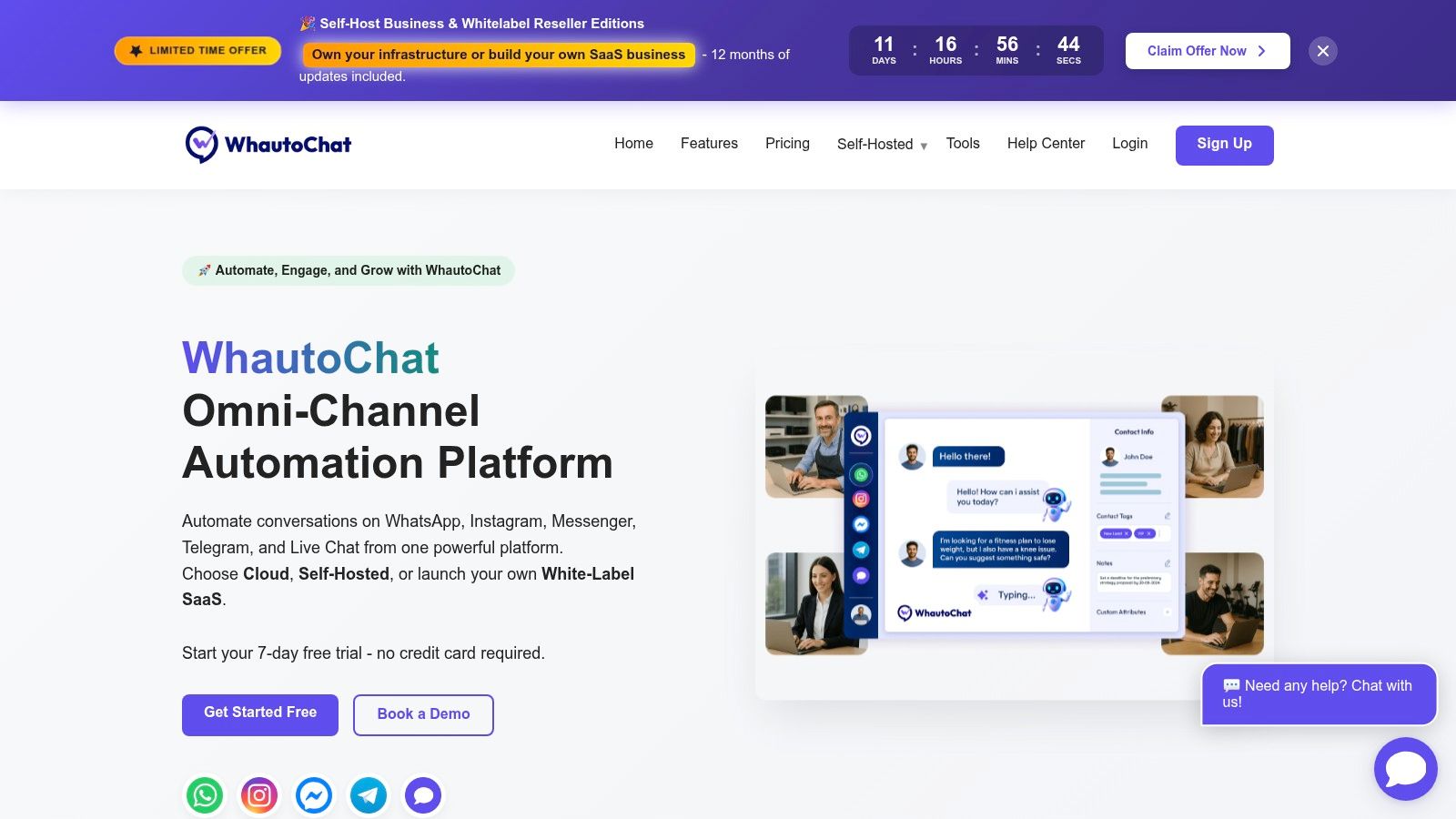
WhautoChat is one of the few tools in this list that pushes beyond WhatsApp without forcing you into enterprise complexity. It supports WhatsApp, Instagram, Messenger, Telegram, and live chat, then layers on AI bots, a shared inbox, broadcasts, workflows, and API access.
That makes it attractive for agencies that already know clients will ask the same question within a few months. “Can this also handle Instagram and website chat?” If the answer is no, your original white-label offer starts looking narrow.
Who should buy it
WhautoChat fits agencies that want to package a communications suite, not just a WhatsApp product. It also works for firms that prefer either self-hosted deployment or managed deployment, depending on how much operational control they want to keep.
There are real trade-offs.
- Multi-channel advantage: It's easier to upsell a broader inbox and automation package than a single-channel utility.
- Ownership appeal: A lifetime license option will appeal to buyers who dislike recurring software exposure.
- Self-hosted burden: Once you self-host, infrastructure, updates, and uptime become your job.
- Capacity planning: Managed plans still require careful planning around message volume and infrastructure sizing.
The practical question is whether you want to operate software or resell software. Some agencies think they want self-hosting until they realize every deployment issue becomes a support problem their clients blame on them. If your technical bench is thin, the managed path is usually safer.
5. AiSensy
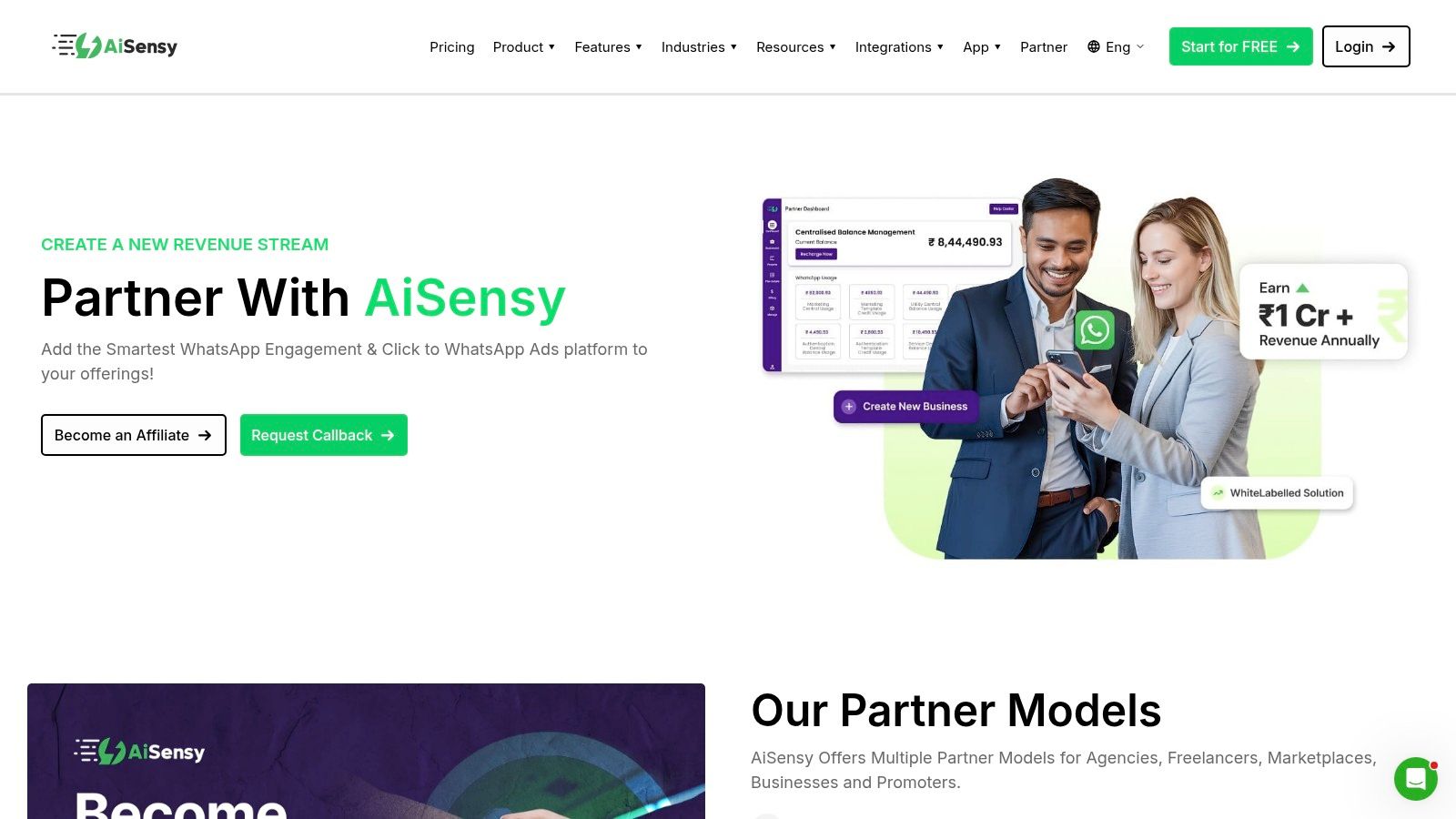
AiSensy is less of a pure reseller tool and more of a partner ecosystem with several ways to work together. That includes a white-labeled dashboard on your subdomain, API and integration options, and partner tracks that suit different business models.
That breadth is useful if you're still deciding how involved you want to be. Some agencies want full resale. Others want referrals, services, or implementation revenue around the platform instead of owning the product line end to end.
Partner model reality
AiSensy looks strongest for firms that want a mature partner structure and broad campaign tooling. Broadcasts, flows, forms, webviews, payments, and integrations make it useful for ecommerce and customer engagement use cases where you need more than basic inbox functionality.
Here's the practical read:
- Strong upside: Broad tools and partner materials can reduce your sales enablement burden.
- Flexible motion: You can align the relationship with your team's actual strengths, whether that's implementation, sales, or embedded integration.
- Commercial friction: White-label pricing isn't fully public, so your margin model needs direct validation before you build an offer around it.
- Regional caution: If your customers are outside the company's strongest market footprint, verify support responsiveness and commercial fit early.
A lot of agencies pick the vendor with the cleanest demo. That's the wrong test. Pick the vendor whose partner model matches how you acquire, onboard, support, and retain clients.
6. WasenderAPI
WasenderAPI is not trying to be a polished out-of-the-box agency product. It's a white-label backend for teams that want to embed messaging under their own UI and control the customer experience themselves.
That's why engineering-led companies will often like it more than service-led agencies do. Programmatic session creation, QR onboarding, webhooks, and multi-tenant control are the useful parts. The missing part is the product layer you still have to build around it.
Engineering-first use case
This fits best when your business already has a customer-facing app and you need messaging as an internal capability rather than a standalone resale dashboard.
What I'd watch closely:
- Integration speed: Engineering teams can move quickly with a backend-first approach.
- Commercial flexibility: Usage-based partner pricing is easier to test than a large upfront commitment.
- Compliance ownership: If you control the front end and customer flows, you also inherit more responsibility for policy, abuse prevention, and support.
- Resale complexity: Non-technical teams may struggle to turn this into a clean, repeatable client offer without extra product work.
The cheaper platform often becomes the more expensive business once your team has to build onboarding, support tooling, and account controls around it.
If you want a backend, WasenderAPI is viable. If you want a business-ready white-label product, it's probably too raw.
7. Zautic
Zautic is built with agencies and franchise-style operations in mind. You can see that in the multi-tenant setup, full white-label portals, team management angle, analytics, and community or group tooling.
This is a good sign if you already know your operation will involve many client accounts, delegated access, and a need to separate data and permissions cleanly. It's less compelling if you only plan to sell a handful of accounts and don't need that much account structure.
Agency operations view
Zautic's main appeal is operational fit. It's trying to help agencies provision accounts, manage teams, and support multiple tenants without stitching together admin controls manually.
What to like:
- Multi-tenant orientation: Better suited to agency fleets than single-account products.
- Workflow depth: Group tools, flow builder, and API access give room for service expansion.
- Onboarding simplicity: QR-based connection lowers setup friction for many clients.
What to question:
- Credit pricing: If pricing relies on credits or top-ups, you need a clear margin model before you publish your own packages.
- Feature roadmap: If mobile apps or adjacent features are still maturing, make sure your clients won't expect them on day one.
Differentiation matters more than branding polish in white-label software. Commentary on white-label business opportunities keeps pointing to a bigger issue. Buyers increasingly expect embedded workflows, analytics, and AI-enabled automation, not just logos and custom colors (My AI Front Desk on white-label opportunities). Zautic is interesting because it leans toward workflow and tenant operations, which is where defensibility usually comes from.
8. OnCloudAPI
OnCloudAPI presents itself in a way agencies often appreciate. The setup path looks direct, the reseller framing is explicit, and the packaging logic is easier to understand than in some partner programs that bury the actual operating model.
That matters because many white label providers are easy to demo and hard to price. OnCloudAPI at least signals that it understands the reseller's job isn't only to use the software. It's to package it, control costs, and onboard clients without a long implementation cycle.
Reseller practicality
OnCloudAPI is a sensible option for agencies that want a branded platform under their own subdomain with dashboard-level controls for billing and storage. It appears designed for the company that wants to get accounts live quickly and standardize the offer across clients.
A few practical checks matter here:
- Packaging fit: Per-client pricing models are often easier for agencies to explain and mark up than highly variable consumption models.
- Setup clarity: Clear prerequisites reduce implementation surprises.
- Commercial visibility: If detailed pricing requires a quote, don't build public offers until you've confirmed your real margins.
- Geographic validation: If your buyers are spread across multiple regions, test support and service quality in those markets.
This is the type of platform that can work well when your go-to-market motion is operationally disciplined. Standardized plans. Standardized onboarding. Standardized support boundaries.
9. APITxT
APITxT is what you buy when WhatsApp alone isn't the actual product. If your clients need SMS, voice, OTP, live chat, commerce messaging, and APIs for custom automations, this broader stack starts making more sense.
Some agencies miss this and buy a WhatsApp-only platform because it closes the first deal faster. Then the second or third client asks for voice verification, fallback messaging, or integrated support flows across channels, and the original product choice starts limiting growth.
When omnichannel matters
APITxT is best for agencies and software companies that sell communication workflows instead of a single messaging channel. It gives you more room to build a bundled service around acquisition, support, notifications, and transactional messaging.
The trade-offs are typical for broader platforms:
- Bigger product surface: You can sell more use cases without replacing your stack immediately.
- Better fit for automation firms: Programmatic APIs are useful if your clients need custom workflows.
- Less WhatsApp specialization: A broad platform may not go as deep on one channel as a more focused vendor.
- Pricing opacity: Application-based reseller pricing slows planning until you get real commercial terms.
If your clients already live in multiple channels, broad beats deep. If they only care about WhatsApp right now, extra channel surface can become noise.
10. Solvear
Solvear sits in the all-in-one camp. It covers WhatsApp, Instagram, Facebook, Telegram, and web chat, then adds shared inbox tools, broadcasts, flows, commerce functions, AI-assisted conversations, and reseller dashboards with branding and pricing controls.
That mix makes it appealing for agencies that want to sell a modern messaging and commerce layer rather than just “WhatsApp automation.” The more your clients care about support plus sales plus follow-up, the more attractive this kind of bundle becomes.
What to verify before buying
Solvear looks promising for resellers who want custom branding and a broader feature package with AI and automation built in. It's positioned like a business platform, not a narrow utility.
Before buying, I'd verify a few things directly with the vendor:
- Admin experience: Make sure the reseller dashboard supports the account provisioning and pricing controls your team needs.
- User experience consistency: If the marketing site and app live separately, confirm the login and client experience feels unified.
- Commercial clarity: Don't rely on high-level positioning. Get the exact pricing, support terms, and feature access for your use case.
- Channel depth: Multi-channel sounds good, but you still need to confirm which workflows are mature in each channel.
Solvear is the kind of product that can be a strong offer when paired with a niche package. Generic “AI messaging platform” positioning won't stand out. Industry-specific onboarding, workflows, and offers will.
Top 10 White-Label Providers Comparison
| Product | Core offering | ✨ Unique features | 👥 Target audience | 💰 Pricing / value | ★ Quality |
|---|---|---|---|---|---|
| Double My Leads 🏆 | All‑in‑one white‑label WhatsApp platform with team inbox & broadcasts | ✨ Unlimited messaging (flat fee), QR pairing, Smart Links, Announcement Groups | 👥 Agencies, SaaS resellers, community managers | 💰 Pro $297/mo · extra devices $19/mo · resell min $97 | ★★★★★ |
| Whapi.cloud | API‑first white‑label WhatsApp layer with Partner API | ✨ Programmatic onboarding, real‑time webhooks | 👥 Dev teams, multi‑tenant SaaS | 💰 Usage‑based per active channel (predictable) | ★★★★ |
| Growby (Whatso) | Hosted/self‑hosted WhatsApp marketing + CRM | ✨ Lifetime license option, bulk messaging | 👥 Resellers, agencies seeking fast GTM | 💰 One‑time lifetime or subscription options | ★★★★ |
| WhautoChat | Omnichannel messaging with shared inbox & no‑code flows | ✨ Multi‑channel (WA, IG, Messenger), AI bots | 👥 Agencies wanting omnichannel resell | 💰 Lifetime license or managed plans (caps apply) | ★★★★ |
| AiSensy | Official WhatsApp engagement & partner tracks | ✨ Subdomain white‑label, payments & webviews | 👥 Agencies & partners needing mature ecosystem | 💰 Sales‑assisted white‑label pricing (regionally focused) | ★★★★ |
| WasenderAPI | Developer-focused white‑label WhatsApp backend | ✨ Programmatic QR sessions, webhooks | 👥 Engineering teams embedding WA | 💰 Usage‑based partner pricing (no big upfront) | ★★★ |
| Zautic | Agency-oriented WhatsApp automation & analytics | ✨ Multi‑tenant portals, high message quotas | 👥 Agencies/franchises with heavy volumes | 💰 Credit/top‑up pricing, verify USD economics | ★★★★ |
| OnCloudAPI | Meta-aligned reseller white‑label provider | ✨ Reseller dashboard, billing/storage controls | 👥 Agencies packaging per‑client offerings | 💰 Flat per‑client examples; quote for details | ★★★★ |
| APITxT | White‑label multi‑channel comms (WA, SMS, Voice) | ✨ Omnichannel stack + OTP & commerce | 👥 Agencies selling omnichannel automations | 💰 Partner pricing by application (apply) | ★★★ |
| Solvear | All‑in‑one white‑label multi‑channel platform | ✨ AI‑assisted conversations + reseller dashboards | 👥 Resellers combining commerce & messaging | 💰 Contact sales, pricing not public | ★★★★ |
Your Go-to-Market Playbook From Selection to Sale
A lot of founders reach the same point. They shortlist a vendor, approve the monthly cost, add their logo, and expect recurring revenue to follow. Then the actual work starts. Sales asks what is included. Clients want onboarding help. Support tickets land in the agency inbox first, not the platform vendor's.
That is why vendor selection is only half the decision. The other half is the business model you build on top of it.
In SaaS and analytics, white-label software became popular for a simple reason. It lets agencies and software companies sell a branded product without funding a full custom build, while the provider handles infrastructure, maintenance, and updates. Zuar makes that case clearly in its explanation of white-label analytics and software economics, including the cost gap between buying and building from scratch (Zuar on white-label analytics and software economics). The practical takeaway is straightforward. You are choosing which costs, risks, and delivery responsibilities stay with you.
I see one mistake more than any other. Teams buy a platform before they define the offer. That usually leads to messy pricing, unclear support boundaries, slow onboarding, and margins that disappear under service work.
Buyer's Checklist 7 Questions to Ask Before Committing
Ask these questions before you sign a partner agreement or move any clients.
- What do you pay for? Get the full pricing logic in writing. Check for flat fees, per-user charges, per-message costs, onboarding fees, markup limits, and overage rules.
- How complete is the white label? Confirm domain mapping, login screens, email notifications, billing pages, help docs, and whether the vendor's brand appears anywhere client-facing.
- What does implementation require? Some tools go live in a day. Others need API work, account approvals, hosting decisions, or Meta-related setup that will slow launch.
- Where do limits show up? Ask about contacts, broadcasts, sessions, seats, channels, webhooks, storage, and throttling. Limits that look minor on day one can kill your margin on client ten.
- Who handles support, and when? Clarify first-line support, escalation paths, response times, and what your team is expected to solve before the vendor steps in.
- What control do you get as a reseller? Look for client provisioning, account suspension, usage reporting, plan management, and billing controls.
- What is stable today, and what is still planned? A roadmap is useful. It is not something your sales team can promise this quarter.
A white-label offer works when the delivery model is tighter than the sales pitch.
The Reseller's Playbook Launching Your Branded Service
Start with one clear use case and one buyer. Agencies get better results selling “WhatsApp follow-up for clinics” than “business messaging for everyone.” Specificity shortens sales calls, improves demos, and keeps onboarding repeatable.
Package the service like a product. Name it. Define the setup scope. Set response times. Spell out what the monthly fee includes and what becomes paid implementation or managed service work. Clients do not buy “access to software.” They buy an outcome with a price and an owner.
Keep pricing simple enough that a salesperson can explain it quickly. In practice, that means two or three plans with obvious differences such as seats, channels, automation depth, usage allowance, or service level. Flat-cost platforms usually make resale easier because your gross margin is easier to forecast.
Build the operating layer before you push volume. That includes a landing page, a demo account, onboarding emails, SOPs, a support triage process, and a service agreement with clear boundaries. Without that layer, every new client becomes a custom project.
Then focus hard on activation. Early churn in white-label products rarely comes from missing features alone. It comes from poor setup, weak training, unclear ownership, and clients never reaching their first useful result. If they do not get live quickly, they question the tool and your agency at the same time.
Document what works. Keep checklists for provisioning, client handoff, permissions, launch steps, common failures, and escalation. That is how a founder-led resale offer becomes something a team can run profitably.
If you want a broader framework for packaging and launching a recurring software offer, this SaaS marketing and growth blueprint is a useful companion read.
For teams that want a practical starting point, Double My Leads stands out for straightforward reseller mechanics and a setup path that is easier to package into a branded WhatsApp offer. It is a sensible option for agencies and SaaS companies that want to control pricing, launch under their own brand, and avoid turning the project into a custom build.


