
You're probably in the same place a lot of agencies reach sooner or later. Client work still sells, but growth gets harder every quarter. Every new account needs more onboarding, more reporting, more meetings, more account management, and usually another hire to keep delivery clean. Revenue goes up, but so does operational drag.
That's where white label SaaS changes the model.
Instead of selling only hours, retainers, or packaged services, you add a productized software offer under your own brand. Done well, it strengthens retention, creates recurring revenue, and gives clients a reason to stay inside your ecosystem instead of stitching together their own tools. It also lets you offer something that feels bigger than an agency service package. It feels like infrastructure.
The part most articles skip is that not every white label SaaS offer is profitable. The technical path you choose, the way onboarding works, how support gets handled, and whether pricing stays predictable under real usage will decide whether this becomes a clean margin layer or a support-heavy mess.
Table of Contents
- Why White Label SaaS Is Your Next Growth Engine
- Understanding the White Label SaaS Model
- Structuring Profitable Business Models
- Choosing Your Technical Integration Path
- Navigating Branding Legal and Pricing
- Your Go-To-Market and Reseller Workflow
- Onboarding Support and Your Launch Checklist
Why White Label SaaS Is Your Next Growth Engine
Agencies usually hit the same ceiling. You can raise retainers, add services, and improve process, but service revenue still depends on people. More clients often means more labor. That's fine for a while, until your calendar fills up with delivery work that doesn't compound.
A white label SaaS offer gives you a unique kind of advantage. You're not replacing services. You're adding a branded software layer that clients use every week, sometimes every day. That changes the relationship from vendor to platform partner.
The timing matters. By the early 2020s, SaaS had become the default software delivery model, with 99% of businesses using at least one SaaS solution according to HiringThing's white label SaaS overview. When clients already expect software to run marketing, CRM, reporting, and operations, selling a branded software offer doesn't feel unusual. It feels normal.
Why this works better than adding another service
Service expansion sounds simple, but it often creates a staffing problem. Add SEO, then you need specialists. Add paid media, then you need creative, tracking, reporting, and campaign operations. Add automation, then clients expect implementation support.
Software behaves differently.
- It scales without matching headcount growth: Once your packaging and onboarding are solid, the next client doesn't require building the product again.
- It improves retention: A client can cancel a campaign. They're slower to remove a tool that's embedded in daily workflow.
- It supports upsells: Software gives you a natural base layer for strategy, setup, optimization, or managed services.
Practical rule: If your agency is already solving a repeated workflow problem, there's a good chance a white label SaaS offer can turn that repeated service motion into recurring product revenue.
There's also a positioning advantage. Clients trust agencies that own a system, not just a process. That's one reason many teams use white-labeled reporting, portals, automation tools, and messaging platforms to boost agency profits while making their offer harder to replace.
The opportunity isn't “sell software because SaaS is hot.” It's simpler than that. If your agency keeps delivering the same operational outcome for clients, white label SaaS lets you package that outcome into something scalable, branded, and much easier to defend.
Understanding the White Label SaaS Model
Think of a supermarket's private-label product. The store didn't build the factory. It owns the customer relationship, sets the positioning, controls packaging, and sells the product as part of its own brand experience. White label SaaS works much the same way.
The provider builds and maintains the platform. You rebrand it, package it, price it, and sell it as part of your agency offer.
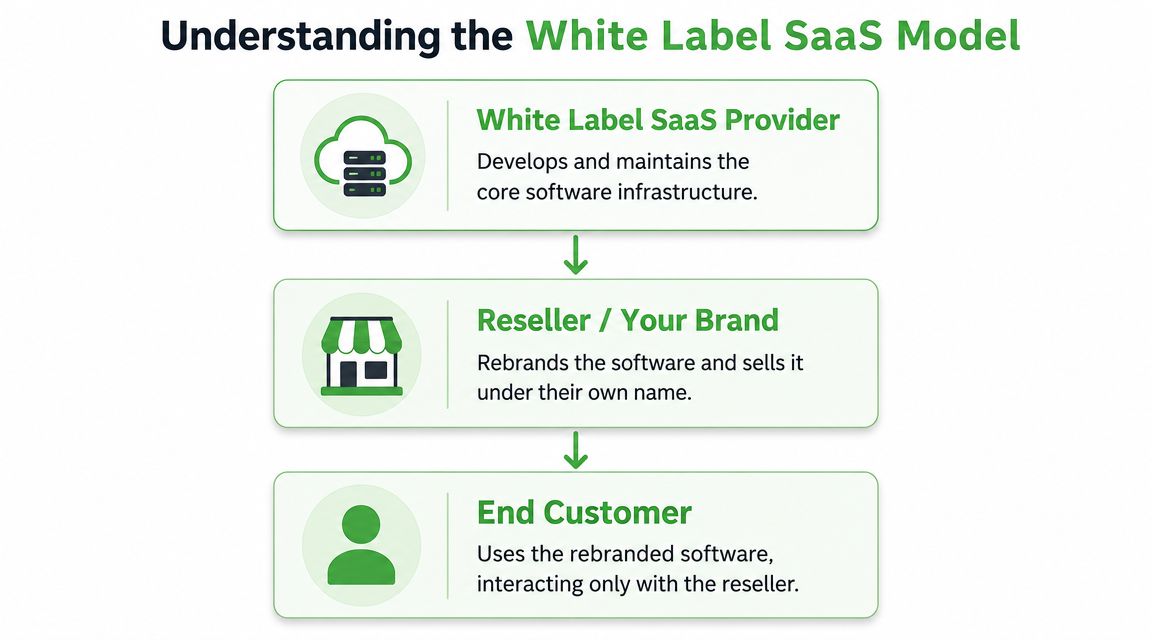
Who does what
The division of responsibility needs to be clear before you sign any deal.
| Role | Main responsibility |
|---|---|
| Provider | Builds the product, maintains infrastructure, ships updates, handles core reliability |
| Reseller agency | Brands the offer, sells it, onboards clients, owns billing and customer relationship |
| End customer | Uses the software as if it belongs to your brand |
That split is the appeal. You don't need to fund a full engineering team to launch software. You need the right partner, a clear use case, and an operating model your team can support.
This also explains why white label SaaS can fit an agency faster than custom development. Building software from scratch means product planning, UI decisions, release cycles, QA, support systems, and ongoing maintenance. Reselling a mature platform under your brand collapses that timeline.
What makes it different from basic resale
A lot of agencies confuse white labeling with affiliate programs or ordinary reselling. They're not the same.
With affiliate or referral deals, the vendor owns the product, the user experience, and usually the billing relationship. You send traffic and collect a fee. That can work, but it doesn't strengthen your brand much.
True white label SaaS gives you more control over the customer experience. The strongest versions feel native to your agency. The client logs into your domain, sees your brand, receives your onboarding, and treats the tool as part of your delivery system.
The closer the product feels to your own operating environment, the easier it is to bundle it into a premium service relationship.
That's why support matters too. If you're considering AI chat, helpdesk automation, or assistant workflows, look closely at how much control you get over configuration, escalation, and branding. A useful example is this guide to customizable AI customer support, which shows the practical difference between a branded front end and a solution you can operationalize.
White label SaaS works best when the product doesn't feel like an add-on. It needs to feel like your agency built a system around a client problem and turned that system into software.
Structuring Profitable Business Models
The financial appeal of white label SaaS is real, but only if you design the offer around margin discipline. One market summary notes that many resellers charge roughly $100 to $700 per client per month, and that healthy reseller margins can be around 40%, according to Camel Digital's white label SaaS marketplace guide. Those numbers get attention for a reason. They show the model can scale without labor increasing at the same pace.
But those margins don't appear automatically. They come from choosing the right billing structure, matching the product to the client, and avoiding support-heavy packaging.
Choose a pricing model your team can actually operate
The most common mistake is starting with a price point instead of a pricing structure.
A stronger approach is to decide first how costs behave when usage rises. That's where agencies need to be careful with variable consumption models. If your upstream vendor charges by message, by user action, or by event volume, your gross margin can get squeezed the moment a client succeeds and uses the platform heavily.
Flat-fee arrangements are usually easier to manage because they make resale math cleaner. Predictable platform cost lets you set tiers around access, support level, locations, workspaces, or bundled services instead of worrying that active clients become less profitable.
A practical pricing stack often looks like this:
- Core subscription: Monthly access to the software under your brand.
- Setup fee: Charged when onboarding requires configuration, migration, templates, or training.
- Managed add-on: Ongoing optimization, campaign handling, or workflow management.
- Premium support layer: Faster response times, strategy calls, or done-for-you execution.
Where agencies usually lose margin
Agencies don't usually lose margin on the software line alone. They lose it in the invisible work around it.
Common examples include:
- Unscoped onboarding: If every client gets a custom setup, your “software” starts behaving like custom services.
- Support creep: Clients ask your team how to use every feature, fix every workflow, and train every staff member.
- Over-bundling: You include strategy, implementation, creative, and software in one fee that's too low to support all four.
- Usage mismatch: Small clients don't adopt enough to see value. Large clients demand enterprise-style support on mid-market pricing.
Don't price the tool based only on vendor cost. Price the full operating burden. Billing, onboarding, support, training, and client success all sit on your side of the ledger.
The best business models also use the software to protect service revenue. If you run lead generation, lifecycle marketing, CRM cleanup, or customer communication, the software should reinforce those services, not replace them. The product becomes the base layer. Your team sells implementation and strategic oversight above it.
That's when white label SaaS starts doing what agencies need. It creates recurring revenue, yes. Additionally, it creates a delivery model that doesn't require adding a matching number of people every time sales go up.
Choosing Your Technical Integration Path
Profitability often gets decided, not in the sales deck or logo customization, but in the technical path you choose before the first client ever logs in.
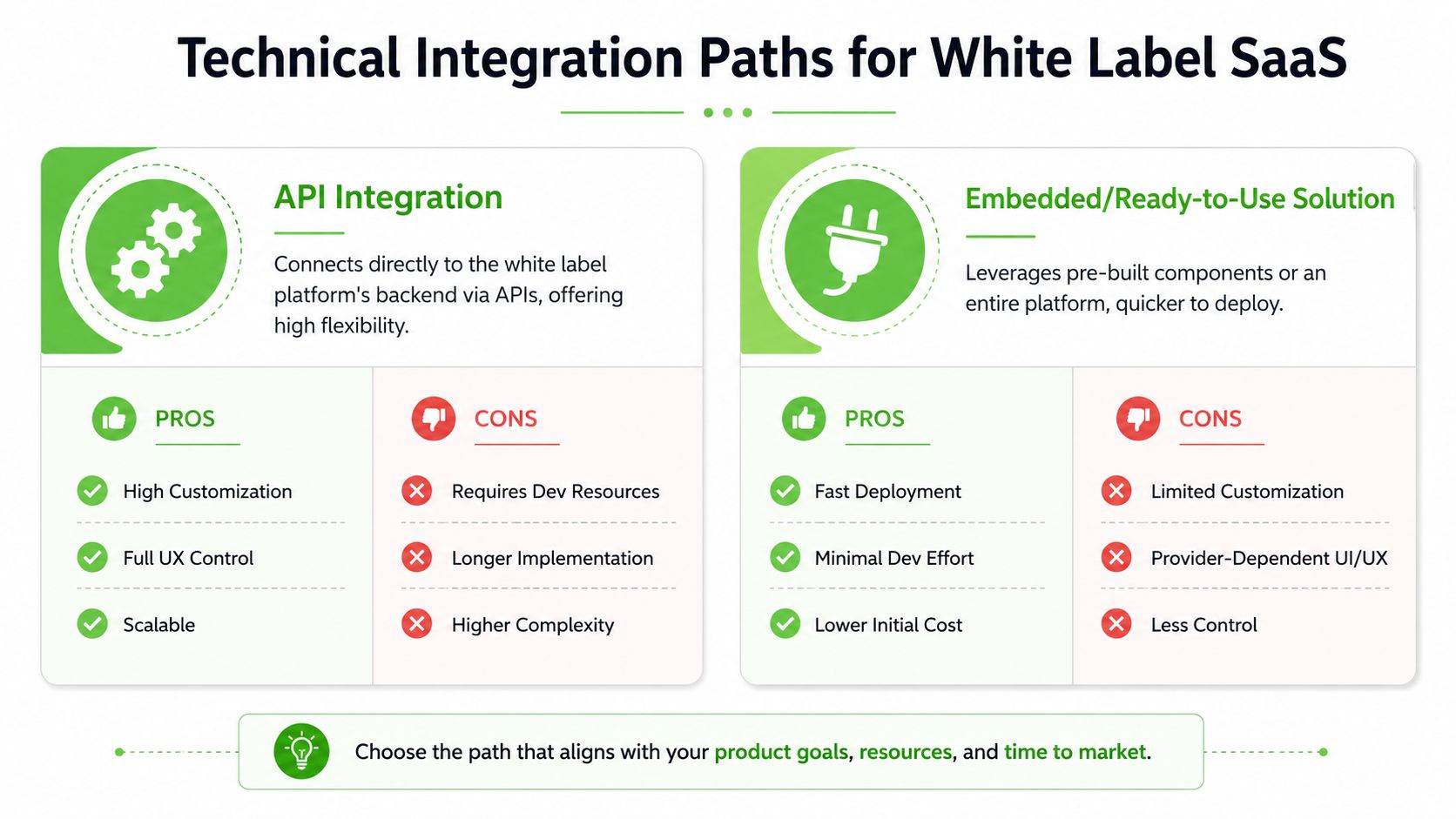
If your agency wants to resell communication tools, automation, inbox software, or client-facing workflow apps, there are usually two broad paths. You can use a ready-to-deploy setup with minimal technical lift, or you can build through API integration for deeper control.
QR code onboarding when speed matters most
For agency operators, speed has real value. If a client can connect quickly and your team can launch without engineering involvement, you shorten the gap between sale and value delivery.
That matters a lot for communication platforms, especially when clients care more about using the channel than understanding the underlying infrastructure. QR-style onboarding or embedded ready-to-use approaches usually work best when your goal is fast deployment, low setup friction, and straightforward support.
This path tends to fit agencies that want to:
- Sell quickly: Less implementation work means you can move from close to onboarding without a technical project.
- Avoid developer bottlenecks: Your ops or client success team can usually manage the launch.
- Test demand first: You don't need to commit engineering resources before the offer proves itself.
The trade-off is control. You may get less flexibility in workflow design, less UI control, or more dependence on the provider's product roadmap.
A quick visual comparison helps if your team is still deciding:
API integration when control matters most
API-led implementations usually make sense later, not first.
They're useful when the software has to fit tightly into an existing system. Maybe you want custom triggers, your own front-end experience, deeper reporting logic, or cross-platform workflows that the standard interface can't support. In those cases, APIs give you room to shape the experience around your agency's model.
But control comes with cost.
| Factor | QR or ready-to-use path | API-led path |
|---|---|---|
| Launch speed | Faster | Slower |
| Dev requirement | Low | Higher |
| Custom UX | Limited | Stronger |
| Support complexity | Lower at launch | Higher over time |
| Margin predictability | Often simpler | Depends on build and maintenance load |
A practical way to choose
Don't ask which integration path is “better.” Ask which one fits your current business.
If you're validating an offer, the simple path usually wins. If you already have stable demand, internal technical capacity, and a clear product thesis, API depth can be worth it.
A simple decision rule works well:
- Start with the low-friction option when your main risk is adoption.
- Move toward API depth when your main risk is product limitation.
- Don't choose the complex path just because it sounds more advanced.
I've seen agencies overbuild early and end up with a product they can't support efficiently. I've also seen teams stay in a limited setup too long and lose deals because the experience never felt native enough. The right technical choice is the one that protects time-to-value and preserves margin.
Navigating Branding Legal and Pricing
A white label SaaS offer only feels premium when three things line up. The branding looks native. The legal terms are survivable. The pricing supports the actual support burden.
Miss one of those, and clients notice.
Branding has to go deeper than a logo
True white label SaaS isn't just logo placement. It includes custom domain support, branded authentication flows, and UI components aligned to your design system, so the client never encounters the upstream vendor, as noted in Toucan Toco's explanation of white-label reporting for SaaS.
That distinction matters because clients can tell when something is only half-branded. If the login page looks different, support emails come from another company, or navigation suddenly shifts into a vendor environment, trust drops fast. The software starts to feel borrowed.
A credible packaging standard usually includes:
- Domain consistency: The product should live on your subdomain or branded environment.
- Authentication consistency: Login screens, password flows, and invite emails should match your brand.
- UI consistency: Colors, labels, and key touchpoints should feel integrated with your service offer.
Legal terms that deserve real scrutiny
Most agency owners spend too much time on branding and too little on contract language. That's backwards.
The provider agreement needs more than generic partner language. You need clarity on what happens if the platform changes, fails, or creates client risk. Review the clauses that affect your downstream obligation to your own customers.
Focus on these points:
- SLA terms: What uptime commitments exist, and what happens when they aren't met?
- Data ownership: Can client data be exported cleanly if you switch providers?
- Feature changes: Can the vendor deprecate functions you've sold into your package?
- Liability boundaries: Who carries responsibility when a platform issue damages delivery or interrupts client operations?
- Support handoff: What issues stay with your team, and what gets escalated upstream?
If the agreement is vague on outages, access control, or offboarding, assume your agency will absorb the pain when something breaks.
Pricing based on value and support load
A lot of agencies default to cost-plus pricing. Vendor fee plus markup. That's fine for a starting point, but it's weak as a long-term strategy.
Clients don't buy software only for access. They buy speed, reduced friction, consolidation, and results. If your white label offer removes manual follow-up, centralizes communication, or improves client visibility, price around that value. Then sanity-check the offer against actual support load.
Good pricing usually reflects three realities at once:
- The platform's direct cost.
- The level of onboarding and support your team must provide.
- The business importance of the workflow to the client.
That's how you avoid the common trap of selling a “high-margin SaaS offer” that behaves like a low-margin service package.
Your Go-To-Market and Reseller Workflow
Launching white label SaaS gets easier when you stop treating it like a big product launch and start treating it like an operational rollout. Most agencies don't need a huge market splash first. They need a clean path from packaging to sale to onboarding to retention.
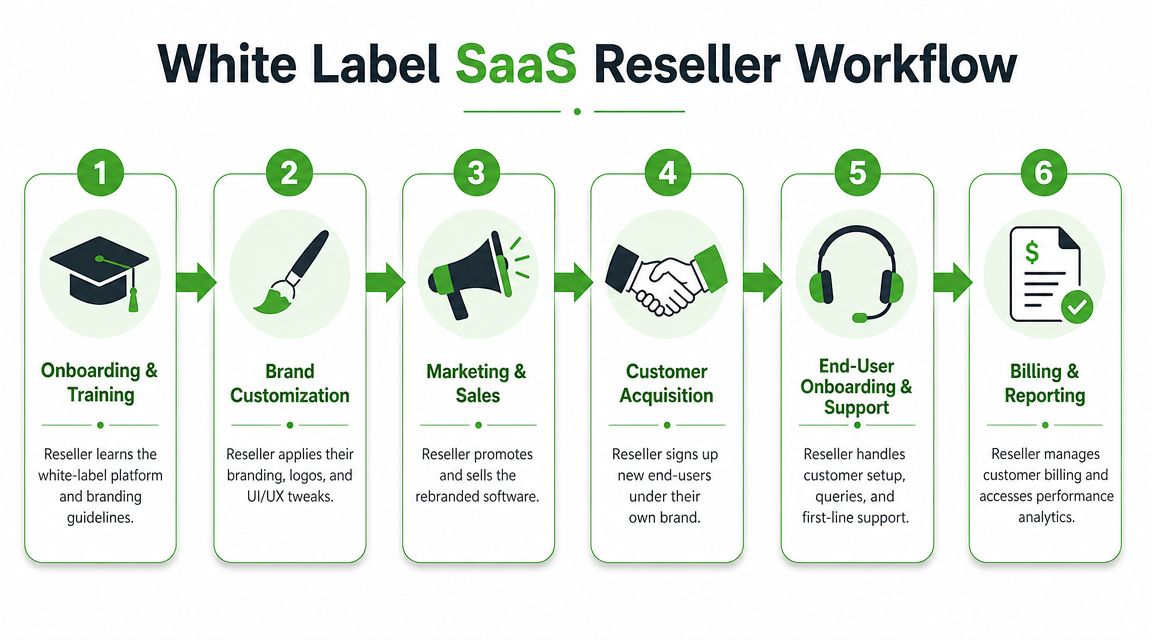
Stage one package the offer
Don't lead with features. Lead with a use case.
If the product helps manage leads, centralize client communication, automate onboarding, or improve reporting, package it around that job. Agencies sell better when the offer sounds like a business outcome, not a software bundle.
That package should answer four things fast:
- Who it's for
- What problem it removes
- What's included
- What your team handles versus what the client handles
Stage two sell to existing clients first
Your current client base is the best proving ground. They already trust your team, understand your process, and usually have the exact workflow problems the software solves.
A disciplined GTM motion matters here. If you need a useful planning reference, MarTech Do's GTM framework is a solid way to think through audience, positioning, channels, and offer design without overcomplicating execution.
Don't try to sell every client the same package. Match the offer to accounts where adoption is most likely and support needs are most manageable.
Stage three tighten onboarding and support
Here, many agency-led SaaS offers either become smooth or become chaotic.
Hidden costs matter more than the pitch deck suggests. Buyers should check onboarding fees and related costs because white label SaaS can reduce hiring and training needs, but profitability gets weaker when usage and service demands expand, as noted in GoHighLevel's guide to white-label SaaS.
That means your workflow should be strict:
- Pre-sale qualification
- Standard onboarding path
- Defined first-week success milestone
- Tier 1 support ownership inside your agency
Stage four review margin every month
Your gross margin on paper isn't enough. Review the actual account cost monthly.
Look at where time is going. Which clients need repeated training? Which ones trigger support tickets? Which package levels create strong retention with manageable effort?
A white label SaaS offer becomes profitable when fulfillment stays standardized. Every exception chips away at the margin you thought you had.
The agencies that win here don't just launch. They keep tightening the workflow until the product is easy to sell, easy to onboard, and boring to support.
Onboarding Support and Your Launch Checklist
The first sale is the easy part. The true test starts when clients log in, ask questions, and depend on the platform for something important in their business.
That's why operations matter more than branding alone. Your clients won't blame the upstream vendor when something breaks. They'll blame your agency, because your name is on the login, your team sold the product, and your invoice lands every month.
Support is part of the product
A good white label partner should be evaluated on support SLAs, outage handling, and data portability, because the reseller stays accountable to the client when the underlying platform has issues, as highlighted in ITU Online's white-label services guidance.
That has a direct operational implication. Your support model needs layers.
- Tier 1 inside your agency: Password issues, onboarding questions, common usage guidance, and account admin.
- Tier 2 with the vendor: Platform bugs, service disruptions, integration failures, and deeper technical incidents.
- Escalation policy for clients: Clear communication on what happened, what's being done, and when they'll hear back.
Clients don't expect perfection. They expect clarity and response. If your agency can provide that, even platform issues become manageable. If you can't, trust erodes quickly.
Treat support scripts, escalation rules, and outage communication as launch assets, not afterthoughts.
White label SaaS launch checklist
Before you open this offer to the market, make sure these pieces are in place:
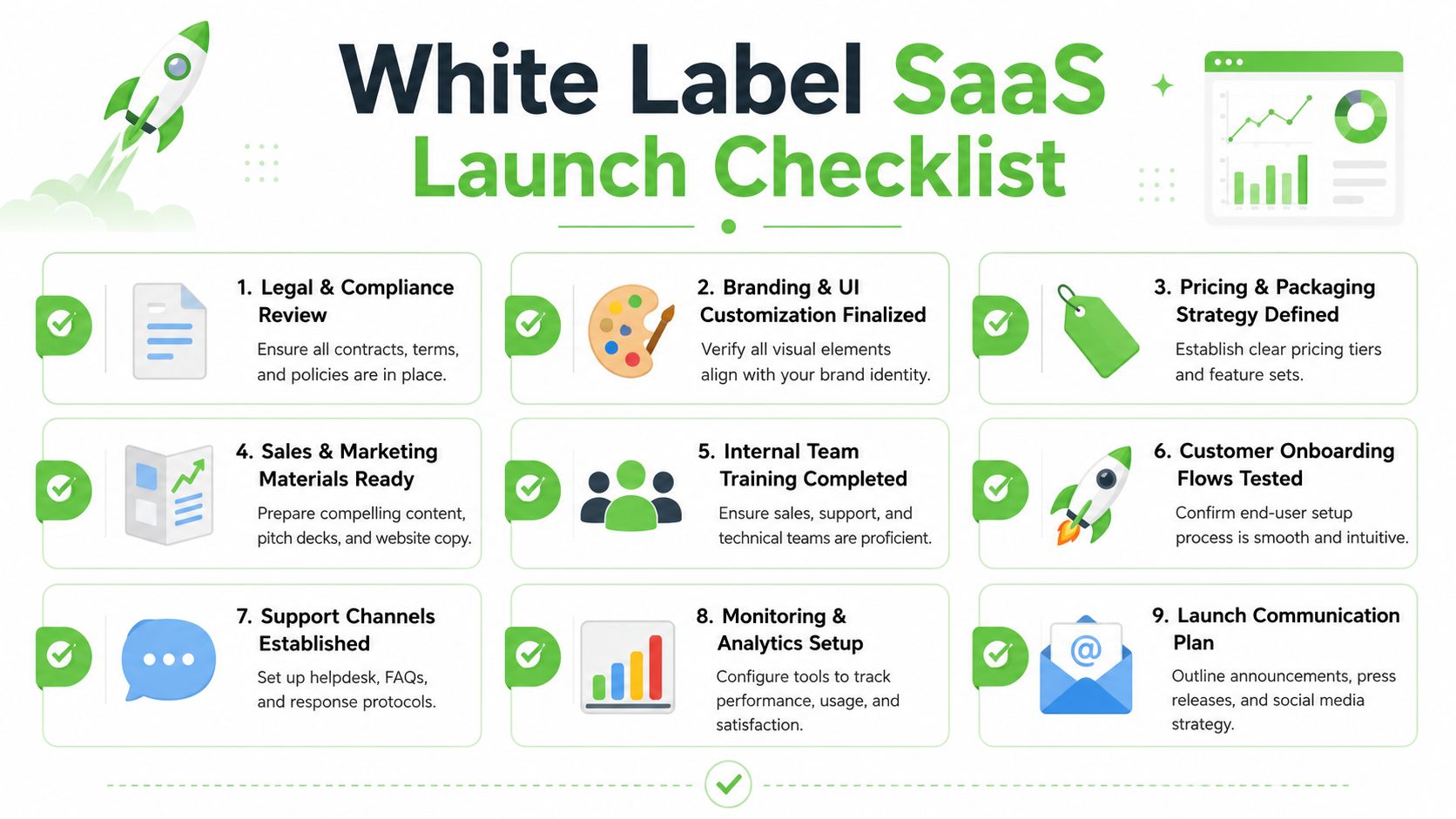
- Partner review completed: Confirm branding depth, support quality, escalation access, and roadmap fit.
- Contract terms checked: Review SLA language, data ownership, liability boundaries, and offboarding terms.
- Brand environment finalized: Domain, colors, email templates, and authentication flow should be consistent.
- Packaging decided: Define what's included, what costs extra, and what support level comes with each tier.
- Billing flow tested: Make sure invoices, renewals, and payment handling work cleanly.
- Sales assets prepared: Your pitch deck, landing page, FAQ, and objection handling should all match the actual product.
- Onboarding sequence documented: Standardize setup, kickoff, training, and first success milestone.
- Support playbooks written: Build responses for common questions, bugs, outages, and escalation scenarios.
- Pilot clients selected: Start with accounts that are likely to adopt quickly and give useful feedback.
The agencies that succeed with white label SaaS don't just find a platform. They build a repeatable operational system around it. That's what protects margin, keeps support sane, and turns a software add-on into a serious growth channel.
If you want to launch a branded WhatsApp offer without building the stack yourself, Double My Leads is designed for agencies and SaaS teams that need speed, predictable pricing, and flexible deployment. You can start with QR-based setup for fast onboarding, use Cloud API when deeper integration makes sense, and resell under your own domain, branding, and billing flow. It's a practical fit for agencies that want a white label SaaS offer they can take to market quickly without turning implementation into a development project.


