Managing Customer Feedback: Your Agency’s 2026 Playbook
Learn to build a complete system for managing customer feedback. Our agency playbook covers WhatsApp collection, triage, analysis, and closing the loop.
Most agencies still treat customer feedback like a side task. That's a mistake. HubSpot notes that increasing customer retention by just 5% can raise profits by 25% to 95%, which changes the conversation immediately. Managing customer feedback isn't a support chore. It's a retention system, a revenue system, and for agencies, a service line clients will keep paying for if it drives visible action.
The second uncomfortable truth is that silence doesn't mean satisfaction. Many unhappy customers never complain directly, so agencies that wait for feedback to arrive are already behind. The practical opportunity is to build a system that collects sentiment in real time, routes it fast, turns it into decisions, and shows clients what changed because of it. WhatsApp is especially useful here because it fits how customers already communicate. It feels immediate, conversational, and hard to ignore.
Table of Contents
- Why Managing Customer Feedback Is Your Agency's Goldmine
- Building Your Feedback Collection Engine
- Triage and Response Workflows That Scale
- Analyzing Feedback to Uncover Actionable Insights
- Closing the Loop and Measuring Business Impact
- Packaging This as a Service for Your Agency
Why Managing Customer Feedback Is Your Agency's Goldmine
A positive service experience materially increases the chance of a repeat purchase. For an agency, that shifts customer feedback from a support task into a retention and revenue service.
That distinction matters because retention work is harder for clients to replace. Agencies already help generate demand. Feedback management helps protect the revenue that demand creates, reduce churn risk, and surface the operational problems that erode margin. When you own that process, you move closer to the client's core economics.
For agencies reselling this service, WhatsApp changes the model. Email surveys are easy to ignore. Phone follow-up is expensive. WhatsApp gives clients a channel customers already use, and platforms like Double My Leads make it practical to collect, route, and act on feedback without building a custom stack. The result is a service that can be delivered consistently across multiple client accounts.
Feedback is a managed service, not a report
Clients do not need another chart with red, yellow, and green scores. They need a team that runs the system, catches issues early, and turns comments into actions that protect revenue.
A strong offer usually includes:
- Collection design: Choose the moments that matter across purchase, onboarding, support, renewal, and churn-risk points.
- Channel operations: Monitor incoming feedback, especially through WhatsApp, and make sure urgent messages reach the right person fast.
- Insight translation: Turn raw comments into patterns that support, product, and marketing teams can use.
- Follow-up management: Confirm changes with customers so feedback leads to trust, not silence.
Practical rule: If a client gets survey graphs, you sold reporting. If they get routed issues, fixed problems, and documented follow-up, you sold an operating function.
Why agencies keep this revenue
Feedback management creates recurring work because customer expectations keep changing. New campaigns create new promises. Product updates create new friction. Support quality shifts by location, team, and season. Clients need someone to keep the listening system running and keep the response standards tight.
It also expands your position inside the account. The agency managing feedback sees patterns across support, reviews, retention, and operations before leadership sees them in a monthly report. That access makes strategy conversations easier to win.
There is a second revenue angle here. Feedback programs create assets agencies can reuse across accounts: message templates, routing rules, escalation logic, dashboards, and review generation flows. That is how the service becomes profitable. You are not selling software access alone. You are selling a repeatable operating system with WhatsApp at the center.
Public proof matters too. Agencies can use feedback wins to improve review volume and reputation management, then show clients real-world discover client reviews as examples of what a structured program can produce.
Agencies that focus only on acquisition leave money on the table. Acquisition gets attention. Retention keeps accounts healthy. Customer feedback management belongs in the second category, which is why it often becomes one of the stickiest services in the agency.
Building Your Feedback Collection Engine
Only a small share of unhappy customers tell a business what went wrong. Industry summaries frequently cite the “1 in 26” pattern, where only 1 customer reports a negative experience while the other 25 leave without explaining it, and InMoment says the average business hears from just 4% of its dissatisfied customers in this customer feedback statistics roundup. For agencies, that gap creates a clear service opportunity. Build a collection engine that captures feedback early, routes it fast, and turns client silence into retention data you can act on.
Start with moments not channels
The right collection system starts with customer moments that produce clear opinions. Channel choice comes after that.
The highest-yield collection points are usually tied to events with immediate commercial impact:
- Right after purchase: Capture checkout friction, delivery confusion, and expectation gaps before they become refunds or chargebacks.
- After support resolution: Ask whether the issue was solved, not just answered.
- After onboarding milestones: Find what slowed activation before new users drift away.
- At review moments: Send satisfied customers toward public reviews and route unhappy customers into a private recovery path.
- When behavior changes: If engagement drops or repeat purchase slows, ask why while the reason is still recent.
Agencies differentiate themselves from basic survey vendors. True value lies not in sending more forms, but in designing trigger points that map to churn risk, review generation, upsell timing, and service recovery.
Use WhatsApp for fast high-intent feedback
Real-time channels matter because response quality drops when outreach feels delayed or generic. Zendesk reported that 72% of consumers expect immediate service. WhatsApp fits that expectation well. Customers already use it, open rates are strong, and replies come back in natural language that teams can tag and route quickly.
For agencies building a repeatable service, WhatsApp also improves margins. It shortens the path from outreach to response, reduces survey abandonment, and gives account teams a channel that works across industries without rebuilding the process from scratch. Platforms like Double My Leads make that model easier to standardize because the agency can deploy the same collection logic across multiple client accounts, then customize prompts by trigger and vertical.
These four client types usually see fast wins:
| Client type | Strong WhatsApp use case | Why it works |
|---|---|---|
| Local service businesses | Ask for service feedback after an appointment | The customer still remembers the technician, wait time, and outcome |
| Ecommerce brands | Request post-delivery sentiment | The product has arrived and expectations are fresh |
| SaaS companies | Trigger onboarding check-ins | Users can describe blockers in plain language |
| Multi-location businesses | Route location-specific complaints fast | Teams can assign issues to the relevant branch or manager |
Keep the prompts short and operational
Long surveys create weak data. Industry guidance recommends keeping surveys to 3 to 5 questions or under 2 minutes in CX Foundation's workflow guidance. On WhatsApp, brevity matters even more.
Good prompts do two jobs at once. They get a reply, and they make the next action obvious.
Use prompts like these:
- Post-purchase prompt: “Thanks for your order. How did everything go today? Reply with one thing that worked well or one thing we should improve.”
- Post-support prompt: “Was your issue fully resolved? Reply Yes or No. If no, tell us what's still wrong.”
- Onboarding prompt: “What almost stopped you from getting started?”
- Review filter prompt: “Would you like to share a public review, or send private feedback first?”
- Re-engagement prompt: “We noticed things have gone quiet. What's the main reason?”
Short prompts produce better language. Better language produces cleaner tags, clearer themes, and faster routing.
For agency delivery, the rule is simple: every prompt should connect to an owner, a tag, or a revenue outcome. If a client wants stronger local reputation, connect positive replies to a review request flow. If you need a practical playbook for that handoff, boost your Google business rating covers the mechanics of turning satisfied customers into public proof without mixing that ask into every feedback conversation.
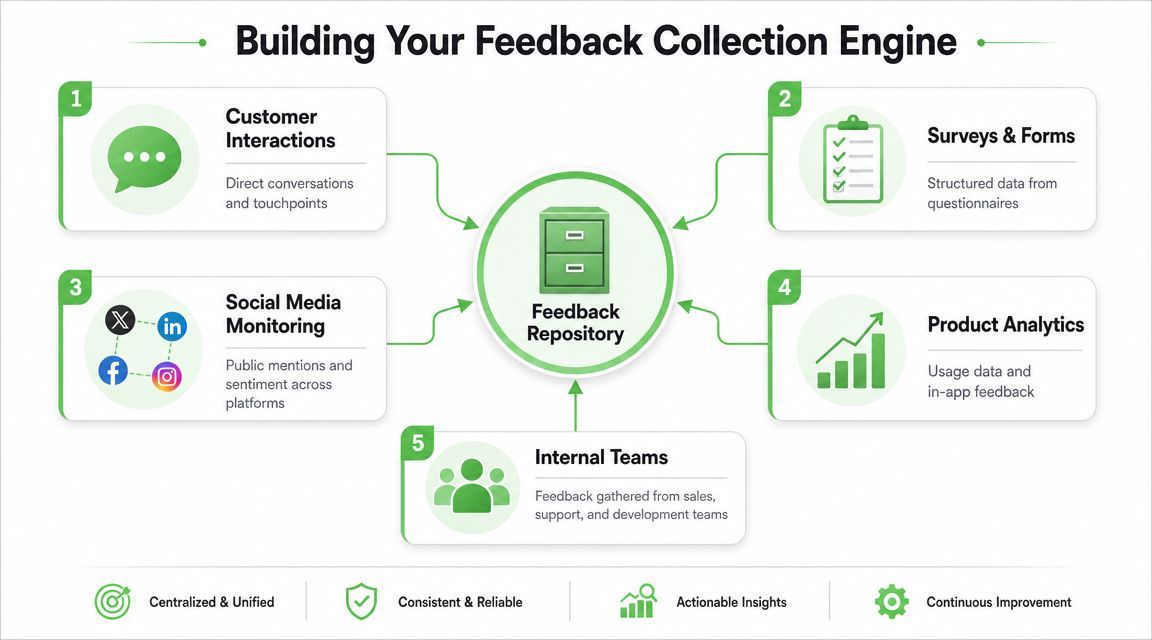
Store every response in one system your team can audit, tag, and report on. Collection only becomes a service clients keep paying for when it is consistent, visible, and tied to business results.
Triage and Response Workflows That Scale
Collection creates volume. Volume creates mess unless the workflow is strict. Without a strict workflow, most agency-run feedback programs break. Messages live in WhatsApp, screenshots get dropped into Slack, someone forwards an email to the client, and a week later nobody remembers who owns the issue.
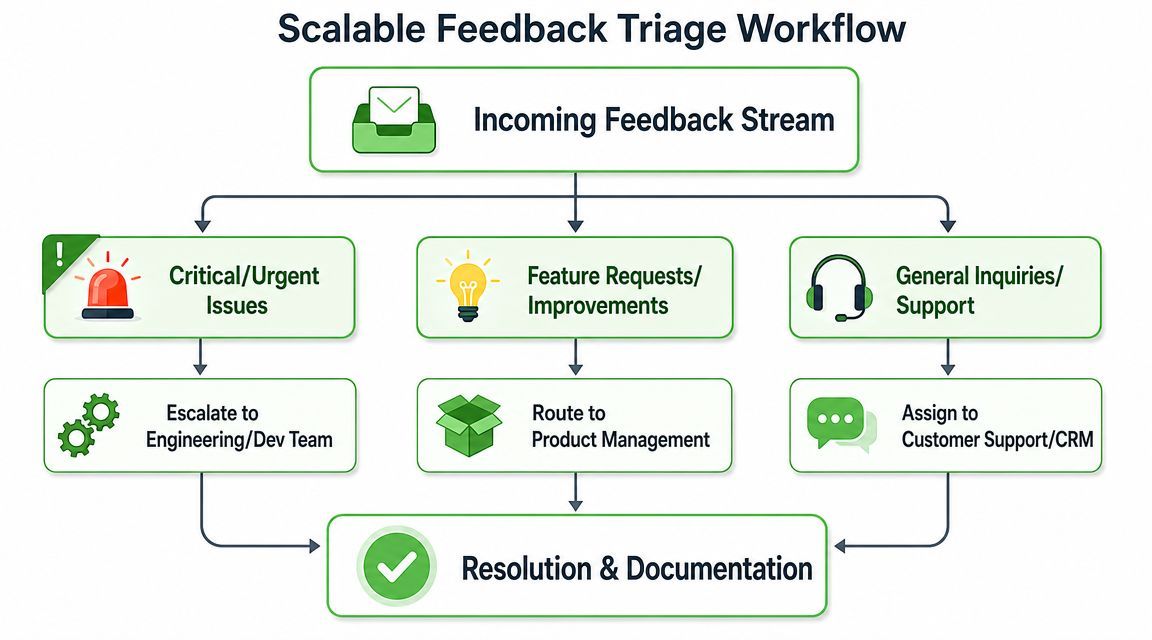
A scalable system needs one intake point, one triage model, and named owners. Best practice is a closed-loop triage model that buckets feedback into critical bugs, feature requests, and service issues, then assesses each item by impact, severity, and feasibility before routing it to the right owner, as outlined in Thematic's closed-loop feedback guidance.
A visual workflow helps teams keep the process consistent.
Use three buckets and clear owners
You don't need a complex taxonomy at the start. Three buckets are enough:
Critical bugs
Anything blocking purchase, access, delivery, or safety. These should move first and go to the operational or technical owner immediately.Feature requests
Suggestions for new capabilities, workflow improvements, or usability upgrades. These belong in a product or roadmap queue, not mixed with urgent service work.Service issues
Complaints about response quality, staff behavior, billing confusion, poor communication, or missed expectations. These need support or client-side management follow-up.
A good triage setup in a shared inbox uses tags such as location, product line, account tier, sentiment, and customer value. That gives the agency two advantages. First, the right person can act fast. Second, monthly reporting becomes easier because patterns already have structure.
Set response rules your team can actually keep
Agencies often write ambitious SLAs and fail to meet them. That hurts more than having modest rules. Define service standards based on staffing reality.
A workable model looks like this:
- Acknowledge quickly: Every message gets a human or approved automated acknowledgment.
- Escalate by category: Critical bugs move to the client's operational owner immediately. Service issues go to support or success. Feature requests go to the roadmap owner.
- Set review cadence: Urgent items are reviewed daily. Trends and lower-priority items are reviewed in a weekly or regular client meeting.
- Document the outcome: Every item gets a status note, even if the answer is “not planned right now.”
Here's a useful training resource for teams setting up service routing and escalation rules:
Informal forwarding feels fast in the moment. It destroys traceability later.
Simple acknowledgment templates
Templates matter because they keep response quality steady across a team.
For a critical issue
“Thanks for reporting this. We've flagged it as urgent and passed it to the right team now. We'll update you as soon as we have the next step.”
For a feature request
“Appreciate the suggestion. We've logged this with the product team and attached your use case so it isn't treated as a generic request.”
For a service complaint
“Thanks for being direct about this. We're reviewing what happened and will follow up after we've checked the details.”
What doesn't scale is improvising every reply and hoping the client will pick it up later. Managing customer feedback gets easier when the workflow is boring, visible, and enforced.
Analyzing Feedback to Uncover Actionable Insights
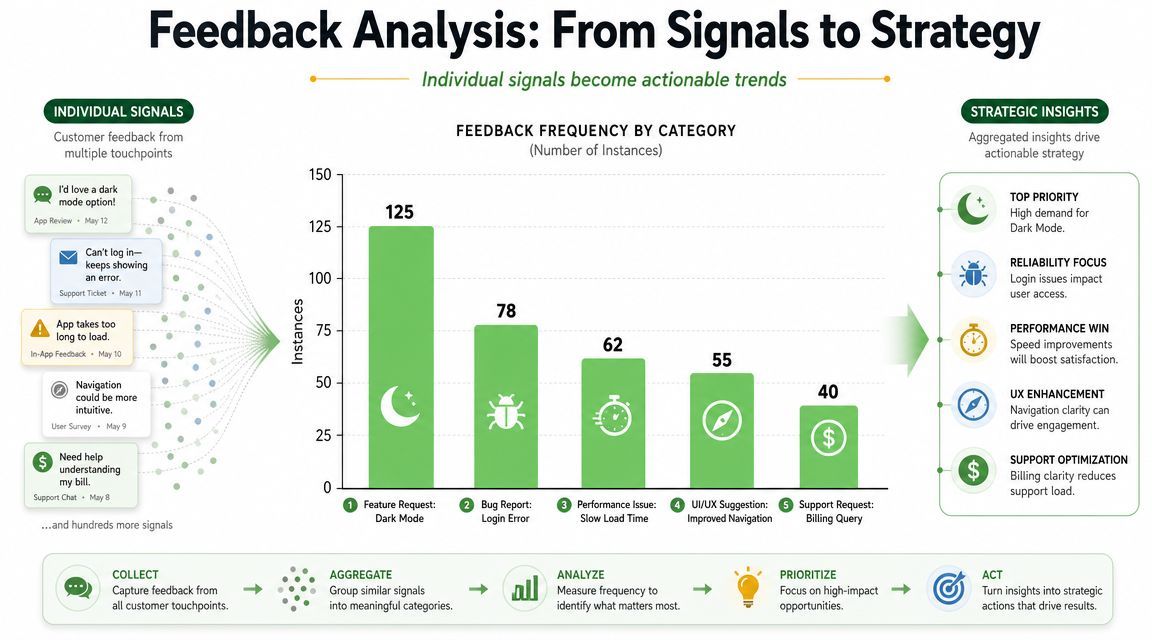
Agencies make money on interpretation, not collection. A client can read a WhatsApp thread on their own. What they usually cannot do, at speed and across locations, offers, and teams, is turn scattered feedback into a clear list of fixes tied to retention, conversion, and revenue.
That is the gap your service should fill.
Stop reporting comments and start reporting patterns
One complaint can matter if it signals legal risk, churn risk, or a broken handoff. For agency reporting, value usually comes from repeated friction. The job is to spot what keeps showing up, where it appears in the customer journey, and which team can fix it.
For WhatsApp-heavy programs, this matters even more. Messages arrive in natural language, often with more context than a form submission, but they also get messy fast. Without a tagging system, your team ends up forwarding screenshots instead of producing decisions.
A practical analysis workflow looks like this:
- Capture the exact phrasing: Words like “confusing,” “expensive,” “slow to reply,” and “nobody followed up” point to different root causes.
- Code by theme: Use categories such as onboarding friction, quote delay, billing issue, support quality, no-show complaint, product defect, or feature request.
- Add commercial context: Tag by client account, location, service line, campaign source, lead status, customer value, or plan tier.
- Map to journey stage: Separate pre-sale feedback from onboarding, fulfillment, renewal, and referral-stage feedback.
- Rank by actionability: Prioritize issues that are frequent, severe, and fixable within the client's current operating model.
If your team needs a clean methodology for coding open-ended comments, this guide for researchers analyzing interviews is a useful reference for building a repeatable process.
Use a metric stack that clients can act on
Agencies lose credibility when reports stop at sentiment. “Customers feel negative” is not enough. A stronger model shows whether feedback is being collected consistently, reviewed quickly, and turned into changes that affect the business.
Track three layers.
| Metric layer | What to track | What it tells the client |
|---|---|---|
| Input | Response rate, feedback volume, channel mix, journey-stage coverage | Whether the listening system is capturing signals |
| Process | Time to first review, time to action, percentage categorized, percentage assigned | Whether the team is turning feedback into operational work |
| Outcome | CSAT, NPS, repeat purchase rate, support-ticket reduction, refund rate, retention trends | Whether the changes improved the customer experience and business performance |
This structure works well for agencies reselling feedback management because it creates a clearer commercial story. You are not selling “monitoring.” You are selling a managed system that collects signals through channels like WhatsApp, routes them into analysis, and produces measurable operational improvements.
Build reporting around decisions, not dashboards
Clients rarely need another dashboard. They need a short monthly readout that answers three questions: what changed, why it matters, and what should happen next.
A useful voice-of-customer report usually includes:
- Top themes by frequency and severity: The recurring issues and wins that deserve attention now
- Representative customer language: Short excerpts or paraphrases that preserve the pattern without overwhelming the page
- Likely root cause: Process gap, staffing issue, unclear offer, slow follow-up, product problem, or training failure
- Recommended action: The specific change the client should make
- Owner, deadline, and success metric: Who is responsible, by when, and how progress will be measured
For agencies using tools like Double My Leads with WhatsApp as the main channel, package this into a monthly or biweekly insight review. Include one operational recommendation, one revenue recommendation, and one retention recommendation for each client. That format keeps the service tied to outcomes executives care about, not just message volume.
Good analysis provides an advantage for the agency business. It gives account managers something stronger than “customers are saying mixed things.” It gives clients a reason to keep the program running because they can see where revenue is leaking, where service friction is growing, and where quick fixes can improve retention.
Closing the Loop and Measuring Business Impact
The feedback system only proves its value when customers see that someone acted. Without that final step, even a well-run intake and analysis process starts to feel extractive. Customers give time, share friction, and hear nothing back.
Closing the loop fixes that. It turns feedback into a visible relationship, not just an internal document trail.
Closing the loop is where trust is won
There are two practical ways to do this.
The first is one-to-one follow-up. If a customer reported a bug, confusing process, or poor service experience, send a direct message after the issue is addressed. Keep it specific. Name the issue, explain what changed, and invite a reply if the fix still falls short.
The second is one-to-many communication. This works well for broader improvements such as delivery updates, onboarding changes, revised help content, or feature releases driven by repeated requests. A simple “you asked, we listened” message can work across email, in-app notices, community posts, or WhatsApp broadcasts.
What doesn't work is vague language. “We value your feedback” is filler unless it points to an action. Customers trust systems that show receipts.
Tie every action to business outcomes
The business side matters because clients won't keep paying for a program they can't connect to results.
Start with a change log:
- What feedback theme appeared
- What operational change was made
- When the change went live
- Which customer segment it affected
- What happened after
Then review the business signals that matter most to the client. Depending on the account, that might include repeat purchase behavior, support load, onboarding friction, feature usage, review quality, or churn risk. Not every outcome will show up immediately, so separate short-term operational wins from slower commercial ones.
A useful way to explain this to clients is simple. Feedback creates three levels of return:
Immediate return
Faster issue handling, fewer dropped complaints, and better visibility across teams.Operational return
Better prioritization, cleaner handoffs, and fewer repeated service failures.Commercial return
Stronger retention, more repeat buying, and better customer lifetime value over time.
The follow-up itself also improves the system. Customers who see action are usually more willing to respond again with useful detail. That makes future feedback richer and easier to interpret.
Managing customer feedback becomes profitable when the client can point to a closed loop, not just a listening post.
Packaging This as a Service for Your Agency
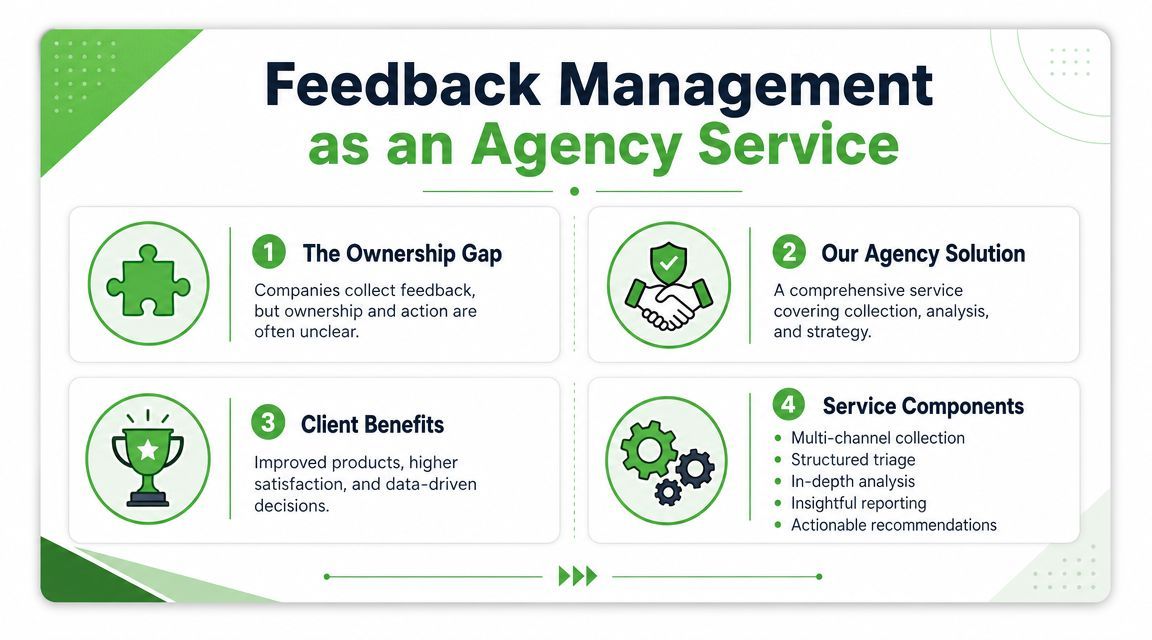
A lot of companies say customer experience matters, but their operating model says otherwise. One CX survey found that 81% of organizations say customer experience is a company-wide priority, yet only 42% have a formal CX management strategy. That gap is where agencies can build a real offer.
Sell ownership not software
Most clients don't need another tool demo. They need someone who owns the last mile.
That means your agency offer should be framed around responsibility:
- We collect the feedback
- We triage and route it
- We surface patterns
- We push for action
- We help close the loop
This positioning is stronger than “we install surveys” because it addresses the actual failure point. Many businesses already have forms, inboxes, or review requests. They lack governance.
The offer gets easier to sell when the promise is clear ownership, clear cadence, and clear next steps.
A simple service structure agencies can resell
You don't need complicated packaging. A three-tier model is usually enough.
| Tier | Best for | Deliverables |
|---|---|---|
| Starter | Local businesses and small teams | Basic feedback capture, monthly summary, review routing, simple response templates |
| Growth | Ecommerce brands and service businesses with volume | Managed inbox, WhatsApp collection flows, weekly triage review, monthly voice-of-customer report |
| Strategic | SaaS, multi-location, and higher-touch accounts | Cross-functional routing, deeper theme analysis, executive reporting, close-the-loop campaigns, roadmap input |
Agencies should define the work in operational terms, not abstract strategy language. Spell out what the client gets: managed inbox hours, number of review meetings, escalation rules, reporting cadence, and who participates on the client side.
How to pitch it without sounding generic
The best pitch is tied to an existing pain:
- For reputation-led clients: “You're asking for reviews, but you're not systematically catching private dissatisfaction before it becomes churn or a public complaint.”
- For SaaS clients: “Your support team hears customer pain every day, but product and success don't get a structured feed they can act on.”
- For service businesses: “Customers will answer a WhatsApp message faster than a long email survey, which gives you cleaner signals while the experience is still fresh.”
When pricing, protect margin by charging for operational complexity. A small local client with one location and one owner is not the same as a SaaS company with product, support, and success stakeholders. Price against volume, routing complexity, reporting depth, and meeting load.
The agencies that win with managing customer feedback don't sell software access alone. They sell a managed operating system for listening and action.
If you want to turn this into a white-labeled recurring offer, Double My Leads gives agencies a practical way to run WhatsApp-first feedback workflows with shared inboxes, tags, assignments, broadcasts, and branded client workspaces under predictable monthly pricing. That makes it easier to package feedback management as a service instead of stitching together tools that are hard to resell.