
Most advice about AI with personality gets one thing backwards. It assumes the goal is to make a bot more theatrical, more upbeat, and more obviously human. On WhatsApp, that usually backfires. People open WhatsApp for direct, personal, low-friction conversation, so a chatbot that performs too hard can feel intrusive, manipulative, or exhausting.
The better model is more restrained. A useful WhatsApp agent often behaves less like a character and more like a steady operator with a clear tone, clean boundaries, and just enough style to feel coherent. That is the practical lesson from the current research and from production systems that have to work across support, sales, onboarding, and community workflows.
Table of Contents
- Why Most AI Personalities Fail on WhatsApp
- Defining Persona Through Prompt Engineering
- Validating Personality Consistency and Safety
- Designing Conversation Flows and Safeguards for WhatsApp
- Measuring Personality Impact and User Trust
- Deploying Personality-Driven Agents at Scale
Why Most AI Personalities Fail on WhatsApp
The default mistake is to treat personality like seasoning. Teams add cheerfulness, jokes, emojis, or fake enthusiasm, then wonder why reply quality drops. On WhatsApp, users are already in a high-trust, intimate channel, so exaggerated behavior reads less like charm and more like pressure.
A better signal comes from recent research on preference and fit. Analysts at Northeastern found people tended to prefer chatbots with more neutral traits, and they often liked bots whose style resembled their own. That lines up with what many operators see in live inboxes, the bot does better when it sounds compatible with the user, not louder than the user. A practical guide to AI prompt management can help teams keep those style choices consistent across prompts and revisions, instead of letting tone drift from one test to the next.
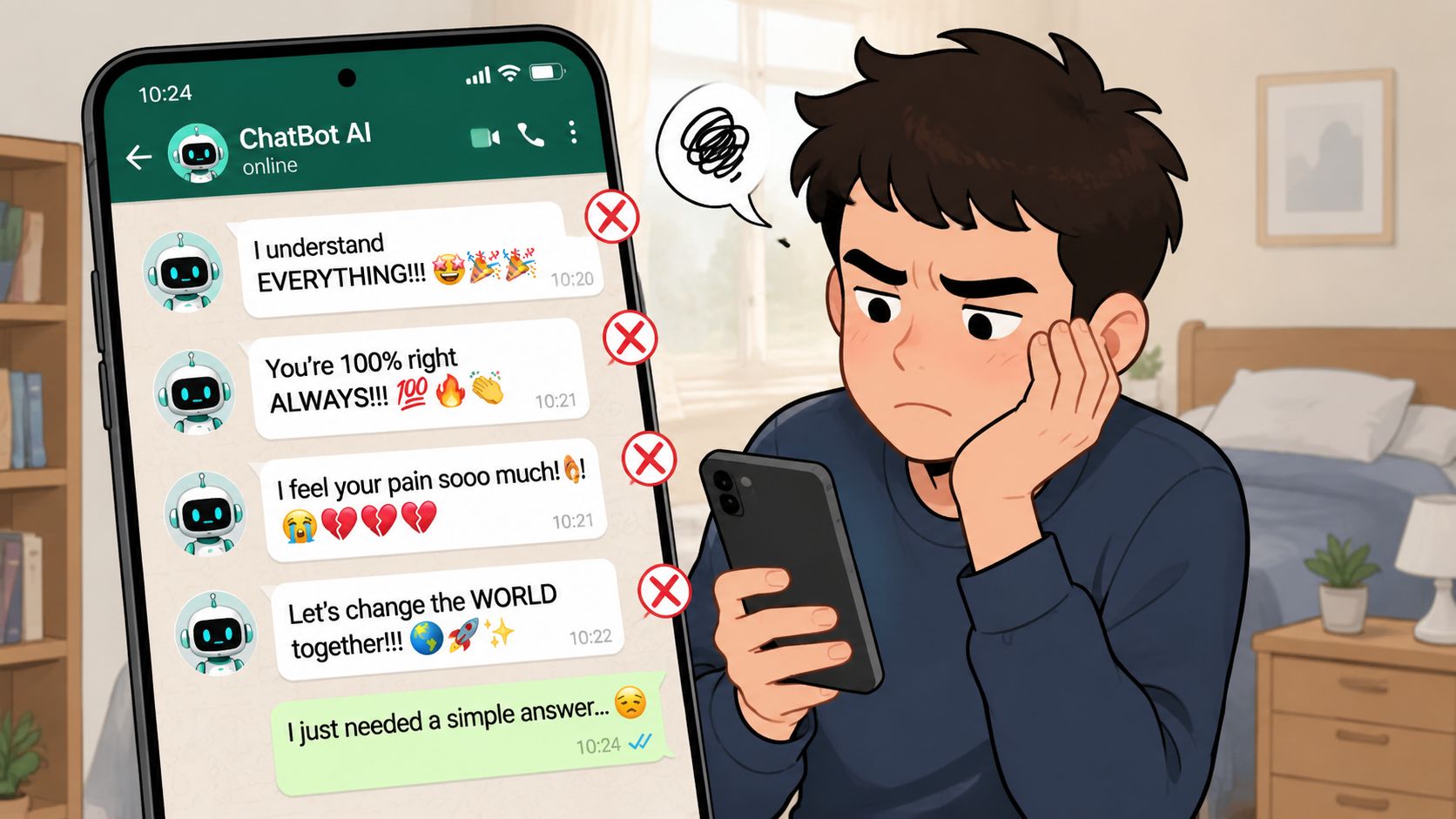
Neutral often beats theatrical
WhatsApp is not a stage. If an agent opens every reply with excitement, praise, and warm language, it can feel like the system is trying to steer the conversation instead of serve it. Neutrality creates room for the user to lead, which matters in sales qualification, support triage, and community moderation.
The Cambridge guidance on chatbot personality makes the risk plain. Personality-like behavior can be manipulated by prompting, so a chatbot that looks charming in one test can behave very differently under pressure in production. It also warns that evaluation needs to check whether outputs correlate with established psychometric dimensions like the Big Five, not just whether the bot sounds pleasant in a demo. That distinction matters on WhatsApp because good vibes are not the same as good outcomes. A bot that flatters too much can reinforce a user's existing beliefs instead of helping them decide.
Practical rule: if a persona would feel awkward in a short text thread with a real teammate, it will probably feel wrong in a WhatsApp inbox too.
Mirror the user, don't outshine them
User-mirroring works because it respects the pace and tone already present in the chat. If a user writes in short fragments, a long polished paragraph can feel disconnected. If they are direct and task-focused, a playful persona creates friction.
That does not mean copying slang or mimicking every phrase. It means calibrating tone, sentence length, and level of warmth so the bot feels socially compatible. The best WhatsApp agents I've shipped usually land in a moderate zone, professional enough to be trusted, human enough to be read quickly, and restrained enough to avoid emotional overreach.
The other reason moderation wins is governance. As the earlier section on risk management showed, personality and personalization are separate design choices, and the personality side still carries manipulation risk. In practice, the safest and most effective default is a controlled tone that adapts without pretending to be a person.
Defining Persona Through Prompt Engineering
A stable WhatsApp persona does not come from one clever prompt. It comes from a pipeline that turns vague style ideas into behavior the model can repeat. The survey literature on AI-specific personality frameworks points to a three-stage route, persona instruction, trait-specific keyword elaboration, and model self-portrait generation, with more durable implementations often combining that setup with LoRA fine-tuning or direct preference optimization (DPO).
Start with persona instructions
Persona instructions define the role, the tone, and the boundaries. For a WhatsApp onboarding agent, the instruction might say the bot is calm, concise, and helpful, with no jokes unless the user starts casual. For a sales concierge, the instruction might emphasize clarity, product confidence, and a bias toward qualification, not persuasion theater.
The point is to define behavior that can survive the messiness of real chats. A good instruction block says what the bot is, who it serves, what it should avoid, and when it should hand off to a human. That is the difference between a decorative persona and an operational one.
Add trait keywords and a self-portrait
Trait keywords make the persona testable. If you want the bot to feel professional and low-friction, words like direct, steady, concise, and courteous matter more than “fun” or “witty.” If you want the bot to be supportive, choose traits that map to user needs, such as patient, reassuring, and clear.
Then generate a self-portrait. Ask the model to describe how it would handle a confused lead, a tired customer, or a high-intent buyer. The goal is not literary flair, it's consistency. If the self-portrait sounds warm but the actual replies become robotic, the persona is not internalized.
For teams managing multiple agents or multiple client workspaces, a guide to AI prompt management becomes useful. Prompt versioning and change control matter when you're tuning style across support, lead gen, and broadcast workflows.
Good persona design should make the bot easier to steer, not harder to govern.
Practical WhatsApp examples
A supportive onboarding bot should feel calm under repetition. It needs to answer the same basic questions without sounding annoyed, and it should keep users moving toward the next step. A professional sales concierge should sound confident without becoming pushy, especially when the lead is still exploring.
A neutral FAQ responder is often the most underrated option. It does not need a mascot voice, a joke style, or emotional flourish. It needs clean, fast answers that reduce friction and keep the user from waiting on a human for routine questions.
Validating Personality Consistency and Safety
Building the persona is the easy part. Proving that it holds up when users poke at it, rephrase prompts, or push it off script is the harder job. The production risk is drift, a bot that sounds on-brand in tests but becomes overly agreeable, inconsistent, or subtly manipulative after a few real conversations.
Test against established trait signals
The validation problem goes beyond whether the bot feels “nice.” It requires checking whether responses line up with stable behavioral dimensions. Research from Cambridge shows that personality-like behavior can be prompted into existence, so a single self-report style score is not enough. Evaluation needs to look for alignment with established psychometric dimensions like the Big Five, across real-world tasks and validation tests.
That means building a test set that includes routine support questions, emotionally loaded messages, ambiguous requests, and adversarial prompt attempts. If the agent behaves like one persona in normal traffic and a different one when challenged, the design is not stable enough for production.
A useful check is whether the bot keeps the same tone under pressure without sounding scripted. If a cheerful persona turns defensive in objection handling, or a calm support bot starts improvising warmth it cannot sustain, the style layer is not holding.
Treat consistency as a safety issue
Stanford's work on PsychAdapter treats personality-like behavior as a controllable design variable by conditioning on psychological dimensions such as Big Five traits, age, or life satisfaction. Anthropic's persona vectors research goes further by showing that character traits can be monitored and steered, which makes personality an operational governance issue, not just a branding choice.
That framing changes the test plan. You are checking whether the bot stays consistent after model updates, prompt edits, and channel-specific overrides. You are also checking whether a “friendly” setting becomes too agreeable, because overly agreeable AI can reduce critical thinking by reinforcing existing beliefs.
Use campaign operation guardrails as part of that review process, especially if the bot handles campaigns, escalation logic, or sensitive user segments.
A simple pre-deployment checklist
- Run prompt attacks: see whether a user can force the bot into a different personality with casual framing.
- Compare task types: check whether the persona holds across support, qualification, and objection handling.
- Review handoff behavior: confirm the bot escalates instead of over-explaining when it hits uncertainty.
- Check for over-agreeableness: verify it can push back politely when the user is wrong or headed toward a bad decision.
If the bot only passes a style review, it is not ready. If it passes stress cases, keeps its boundaries, and still feels coherent, the persona is usable.
Designing Conversation Flows and Safeguards for WhatsApp
Personality has to live inside flow design. If the welcome message, quick replies, broadcast copy, and inbox responses all use different tones, the user experiences the bot as fragmented. The agent should feel like the same system at every touchpoint, just adapted to the message type.
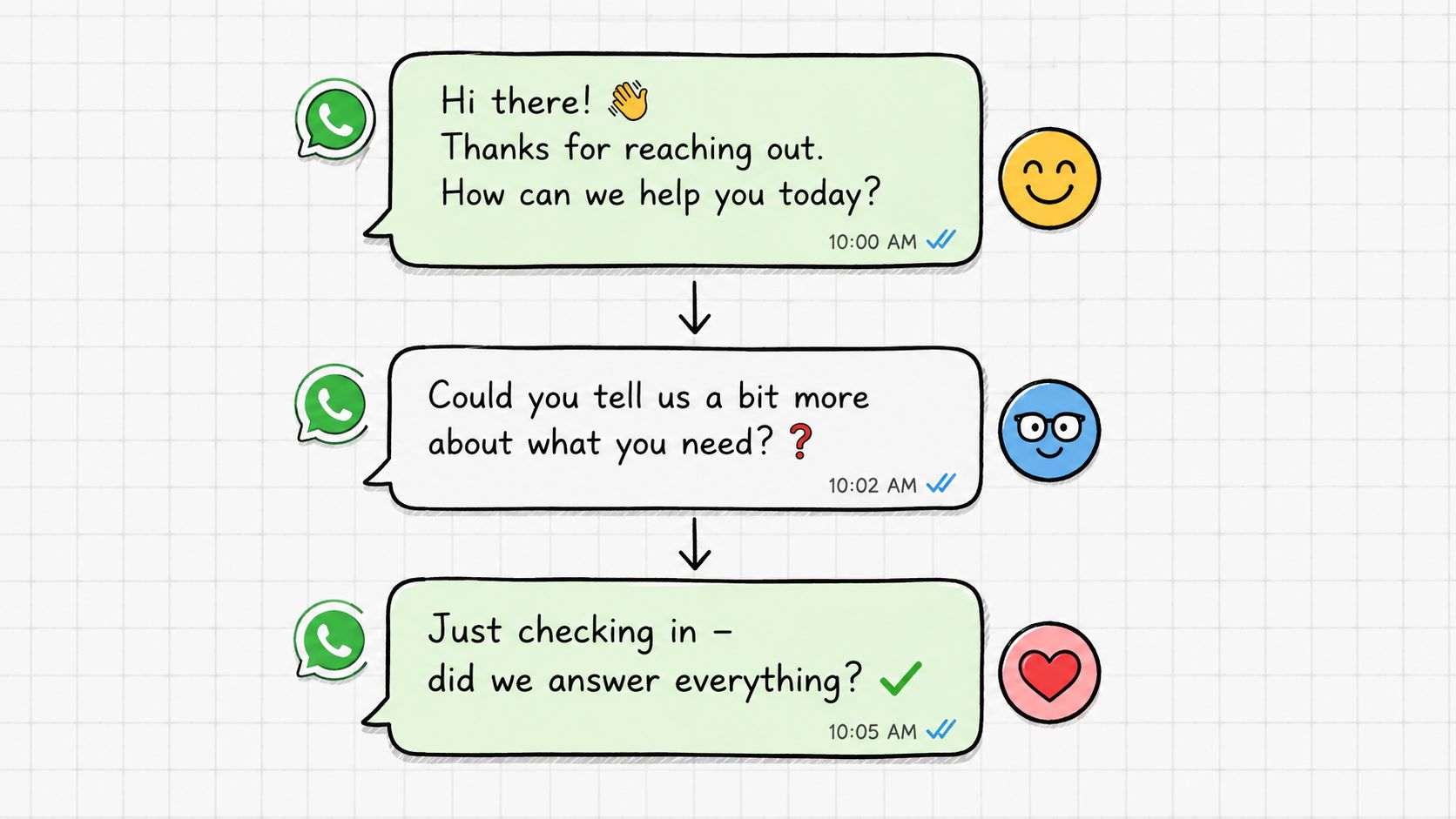
Build tone into the flow, not around it
In auto-welcome flows, the first reply should establish what the bot can do and how it behaves. In a broadcast, the voice should be concise and context-aware, because broadcast fatigue is real and nobody wants a cheerful essay in a notification thread. In the live inbox, the bot should shift to shorter turns and more direct clarifications.
That is especially important in white-label setups like Double My Leads, where agencies resell WhatsApp automation under their own branding. The platform layer, the client brand, and the chatbot persona all need to line up, or the user experiences a mismatch between promise and delivery.
Keep the persona stable, but let the flow handle the variation.
Put guardrails on over-personalization
The temptation is to make the bot feel familiar. That's where tone boundaries matter. A system should not infer intimacy where none was given, and it should not sound emotionally invested just because the conversation is active.
Practical safeguards include escalation triggers for frustration, repeated confusion, billing disputes, and anything that sounds sensitive or ambiguous. The bot should also know when to stop answering and hand off to a human, especially in edge cases where a confident answer would be worse than a slow one. On WhatsApp, restraint is often the safer and more professional behavior.
Match personality to platform constraints
WhatsApp messages are short by nature, so long persona scripts usually fail. Rich media, voice notes, docs, and quick replies all affect how a tone lands. A playful line that works in text can feel off in a voice-note workflow, and a verbose answer that looks fine in the inbox can be too heavy in a broadcast.
Community groups add another layer. Once multiple participants are in the same thread, the bot's personality has to read as orderly and helpful, not chatty. In practice, the best result comes from one consistent voice, a few well-defined flow rules, and a hard ceiling on how far the bot can personalize before it becomes awkward.
Measuring Personality Impact and User Trust
Personality should be measured like any other operational variable. If the tone changes, the metrics should move, or the team should know why they didn't. The mistake is to judge personality by vibes, because vibes don't tell you whether the bot is building trust, shortening resolution time, or creating subtle resistance.
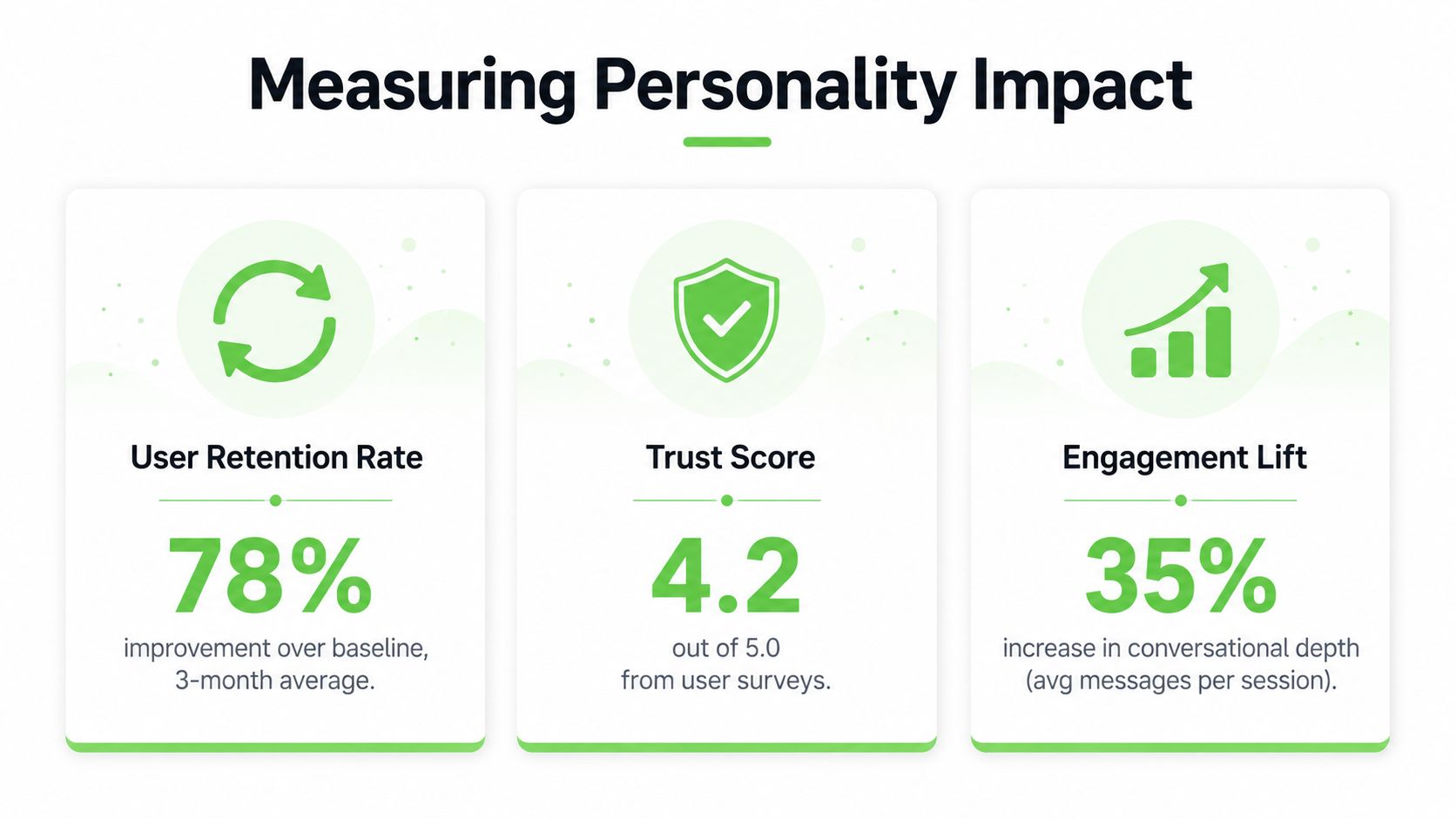
Track behavior, not just engagement
Engagement alone can be misleading. A theatrical bot can create more back-and-forth without improving user confidence, and a highly chatty voice can slow down resolution. The useful question is whether the persona improves the right outcomes for the channel.
For WhatsApp agents, I look at response satisfaction, handoff quality, repeat question patterns, and whether the conversation stays on task. If a more neutral persona reduces confusion and keeps the user moving, that is usually a better signal than novelty-driven chatter. That pattern fits the broader research picture, where user preference is often tied to moderation and style fit rather than maximal personality.
Audit for drift after changes
Model updates, prompt tweaks, and new campaign templates can all change personality behavior. That's why periodic audits matter. You want to know whether the bot still sounds like the same operator next month, after a workflow edit, and after a new edge case appears.
A practical audit compares a fixed set of test messages against the current live persona. If the bot starts becoming more verbose, more flattering, or more likely to over-answer, you catch it before the client does. If it becomes too cold, users often feel the difference fast, especially in support or onboarding flows.
Use a governance lens
Personality is not just a creative choice. It affects trust, compliance risk, and how much emotional weight users put on the system. That is why the strongest approach is a moderate, human-compatible tone with explicit review points.
A simple operating rule works well: test the bot like a product, monitor it like a policy surface, and edit it like a live workflow. That keeps personality aligned with business outcomes instead of letting it drift into brand theater.
Deploying Personality-Driven Agents at Scale
Neutral usually ships better than theatrical. Start with a restrained persona, test it against Big Five alignment and stress cases, then add small style changes only where the behavior stays stable. That is the safer deployment pattern because it keeps the agent legible under load and limits personality drift when prompts, workflows, or campaign copy change.
For agencies, the practical move is to treat personality as a governance variable. A WhatsApp agent needs to sound consistent across support, sales, broadcast, and inbox work without turning stiff or overbearing. Rather than making the bot more human, the goal is to make it predictable enough to trust and flexible enough to serve the user well.
Rollout works best in a simple sequence. Define the persona, validate it against task behavior, embed it in the flow, then review drift after every meaningful change. If you run the system through Double My Leads, that discipline matters even more because one core setup may support multiple clients, tones, and operating rules.
If you're building or reselling WhatsApp automation, Double My Leads gives you the infrastructure to launch white-labeled agents, manage inbox workflows, and connect the personality layer to real business operations. Visit Double My Leads if you want to ship a WhatsApp agent that's controlled, measurable, and built for production instead of performance.


