
Companies that excel in personalization generate 40% more revenue from these activities compared to average players, while top performers achieve revenue lifts exceeding 25% according to Envive's roundup of personalization impact statistics. That's the number that should change how an agency owner looks at the offer stack.
Most agencies still sell traffic, creative, automation, or campaign management as separate services. Clients buy them because they need activity. They stay when those activities turn into better customer experiences and more revenue. That's where personalization at scale becomes more than a brand initiative. It becomes a productized agency service.
For agencies, the fastest path usually isn't enterprise website personalization. It's messaging. More specifically, WhatsApp. It's immediate, conversational, and easier for many local businesses, coaches, e-commerce operators, and service brands to operationalize than a full web stack rebuild. If you can help a client send the right message to the right person at the right moment, then route replies into a process the team can readily handle, you're no longer selling “automation.” You're selling relevance.
Table of Contents
- What Is Personalization at Scale and Why Now
- The Agency Opportunity in Personalized Communication
- The Three Pillars of a Personalization Engine
- A Pragmatic Roadmap to Implementation
- Personalization in Action Examples and Templates
- Common Pitfalls and How to Avoid Them
- Measuring Success and Proving ROI to Clients
What Is Personalization at Scale and Why Now
Personalization at scale means using systems, rules, and AI to make each customer interaction feel specific to the individual without requiring a human to handcraft every message. It doesn't mean blasting the same campaign with a first-name token. It means the message, timing, channel, and next action reflect what the business knows about that person.
That matters because customer expectations changed a while ago, and most businesses are still playing catch-up. The practical shift is simple. Buyers don't compare your client's message only to direct competitors. They compare it to the best digital experiences they get anywhere.
For an agency owner, that creates a very useful reframing. Personalization at scale isn't a luxury add-on for enterprise brands. It's an operational system smaller and mid-market businesses can now adopt through focused channels like WhatsApp, email, and lifecycle messaging.
The difference between personalization and noise
Generic automation says, “We have a list, let's send something.”
Personalized automation says:
- Who is this person now: lead, active customer, lapsed buyer, booked consult, missed appointment
- What signal did they give: clicked a link, joined a community, requested pricing, bought a product, stopped replying
- What should happen next: reminder, offer, support nudge, onboarding, reorder prompt, human handoff
That's a different level of service. It turns communication from transactional into relational.
Practical rule: If the message would still make sense to every person in the segment, it probably isn't personalized enough.
Agencies that want a deeper strategic position should spend time implementing personalization strategies that tie data, intent, and channel execution together. The opportunity isn't just better messaging. It's owning the system that makes better messaging repeatable.
The Agency Opportunity in Personalized Communication
For agencies, personalization at scale is a pricing and retention opportunity.
Clients already know generic automation underperforms. What they often do not know is how to turn customer signals into useful follow-up across channels they can afford to run. That gap is where an agency can build a high-value service line. Instead of selling message sends, campaign setup, or one-off automations, sell a communication system tied to revenue events, service events, and buyer intent.
That shift changes how clients evaluate your work. Channel management gets compared on hourly effort and platform fees. Personalized communication gets judged on booked appointments, repeat purchases, reply rates, fewer no-shows, and faster lead response. Those are harder services to replace and easier services to defend on margin.
Why WhatsApp is the agency-friendly entry point
WhatsApp gives agencies a practical way to productize personalization without waiting for enterprise budgets, custom development, or a long analytics project.
Website personalization can still be valuable, but many small and mid-market clients are missing the basics needed to run it well. Their site data is incomplete, their CMS is restrictive, and every change needs design approval. WhatsApp is simpler to operationalize because the use cases are clearer, the message formats are familiar, and the client can usually understand the workflow in one meeting.
A few examples show how this becomes a sellable offer:
| Client type | Old agency offer | Better agency offer |
|---|---|---|
| Local clinic | Reminder blasts | appointment reminders based on booking status, no-show risk, and service type |
| Coach or creator | Newsletter distribution | lead nurture flows based on join source, content interest, and reply behavior |
| E-commerce brand | Generic post-purchase messages | follow-ups based on item bought, repeat-buyer status, and support history |
That matters commercially. Agencies can package these offers around a concrete business problem, such as missed appointments, abandoned consults, low second-purchase rate, or slow lead response. Clients buy those outcomes faster than they buy a vague promise of "better personalization."
How this improves retention and pricing power
Agencies become harder to replace when they own the operating logic behind customer communication.
- You own the workflow design: segmentation rules, triggers, timing windows, handoff conditions, and message logic
- You sit closer to revenue operations: your work affects sales follow-up, support load, appointment attendance, and repeat purchase behavior
- You create systems with switching costs: once flows are tied to the CRM, inbox, pipeline stages, and staff actions, replacing the agency means rebuilding process, not just replacing labor
There is a trade-off. Personalized communication services demand better intake, cleaner client data, and clearer approval rules than standard campaign work. They also require someone to decide what should happen when a person replies, stalls, books, or asks for help. Agencies that handle that complexity well can charge more because they are solving an operational problem, not just producing marketing assets.
I have seen this work best when the offer is narrow first. Start with one client segment, one channel, and one high-value journey on WhatsApp. Appointment reminders, lead qualification, post-purchase follow-up, and reactivation are usually the fastest paths to proof.
Packaged that way, personalization at scale becomes a service an agency can resell repeatedly. It fits small and mid-market clients, it maps to clear ROI, and it gives the agency a stronger position than generic automation management.
The Three Pillars of a Personalization Engine
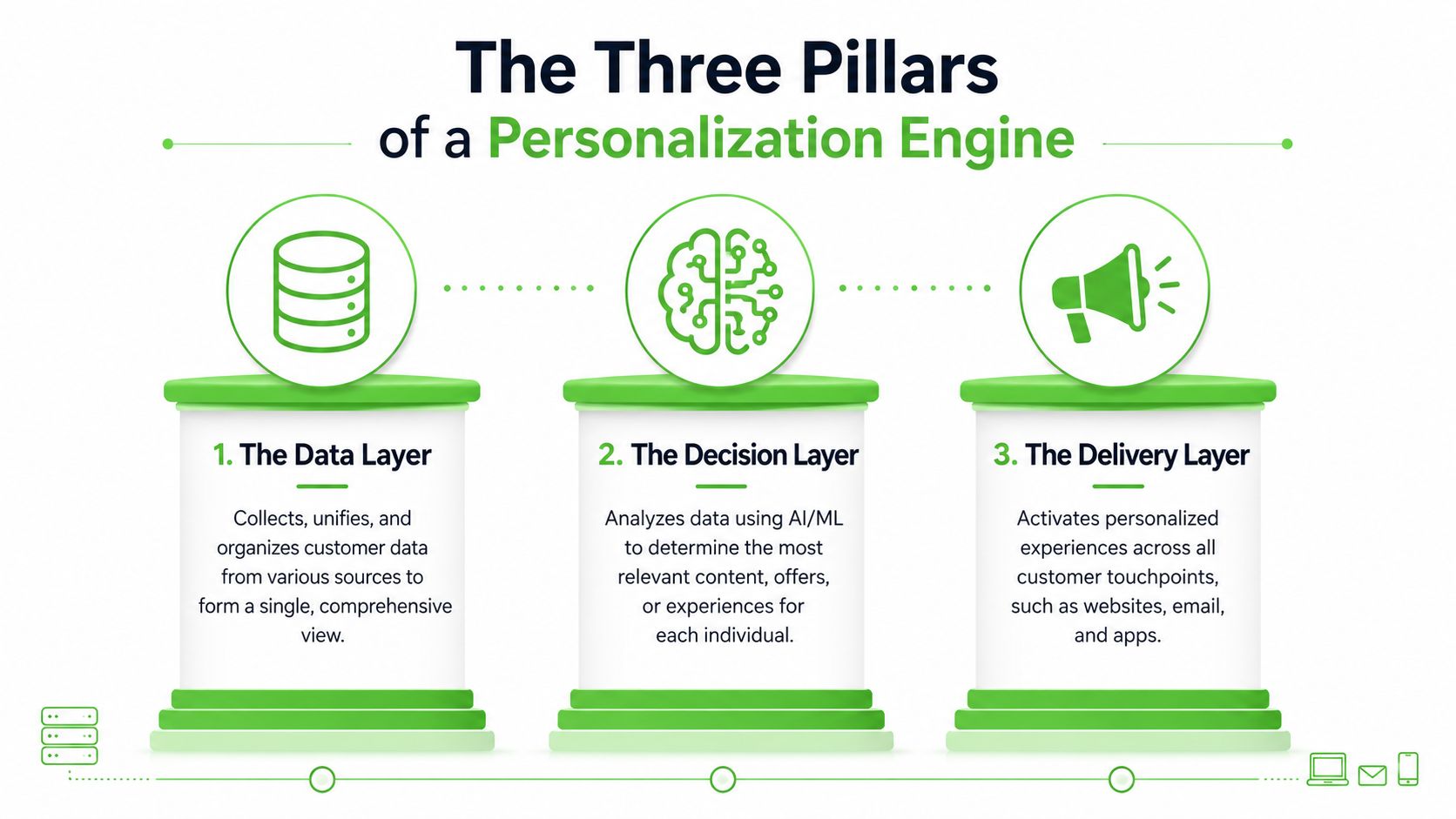
Personalization that an agency can resell needs a system clients can understand and your team can operate. The simplest model is three layers. As House of MarTech's overview of real-time personalization architecture explains, effective personalization relies on a data layer, a processing layer, and a decisioning or serving layer.
A practical way to structure it
A personalization engine works like a professional kitchen, requiring three core components: ingredients, judgment, and delivery. If one breaks, the client feels it fast. Messages go out late, the wrong people get contacted, or the team cannot explain why a workflow fired.
The data layer stores the inputs your logic depends on. That includes CRM records, lead source, purchase history, appointment status, support tags, browsing behavior, form submissions, and notes from staff. Agencies usually find the biggest constraint here first. Client data often lives in five places, names are inconsistent, and key fields are missing at the moment a message needs to go out.
The decision layer turns those inputs into actions. This can be simple rules, lead scoring, AI-assisted classification, or a mix of the three. The point is not technical sophistication. The point is control. Someone needs to define what happens when a lead replies, books, stalls, asks for pricing, or goes quiet for seven days.
The delivery layer sends the message in the channel the customer will see. For many agency offers, that means WhatsApp first, then email or SMS where it makes sense. Delivery should execute a clear decision, not compensate for weak logic upstream.
That distinction matters.
Agencies often overinvest in message copy and underinvest in decision rules. Clients notice the reverse. A plain WhatsApp message sent at the right moment usually outperforms a polished sequence sent with bad timing or thin context.
Where WhatsApp fits
WhatsApp sits in the delivery layer, but in practice it also creates data. Replies, click behavior, attachment opens, conversation outcomes, and handoff notes should feed back into the customer record. Without that feedback loop, the system is just blasting messages with a few merge fields. With it, the agency can adjust timing, routing, and message content based on the interaction history.
For agency owners, this makes the service productizable. The value is not “we send WhatsApp campaigns.” The value is “we run a response system that uses client data, applies message logic, and improves conversion on one revenue-critical journey.”
A lean setup usually looks like this:
- Data layer: CRM, forms, booking tool, e-commerce platform, spreadsheet, or CDP
- Decision layer: automation platform, scoring rules, AI enrichment, routing logic
- Delivery layer: WhatsApp, email, SMS, plus human inbox workflows for replies and exceptions
The common mistake is buying a messaging tool before defining the operating rules. Agencies get better margins when they own the logic first, then plug channels into it. If a client asks why a prospect received a reminder, a discount, or a sales handoff, your team should be able to trace it clearly from source data to rule to message.
A Pragmatic Roadmap to Implementation
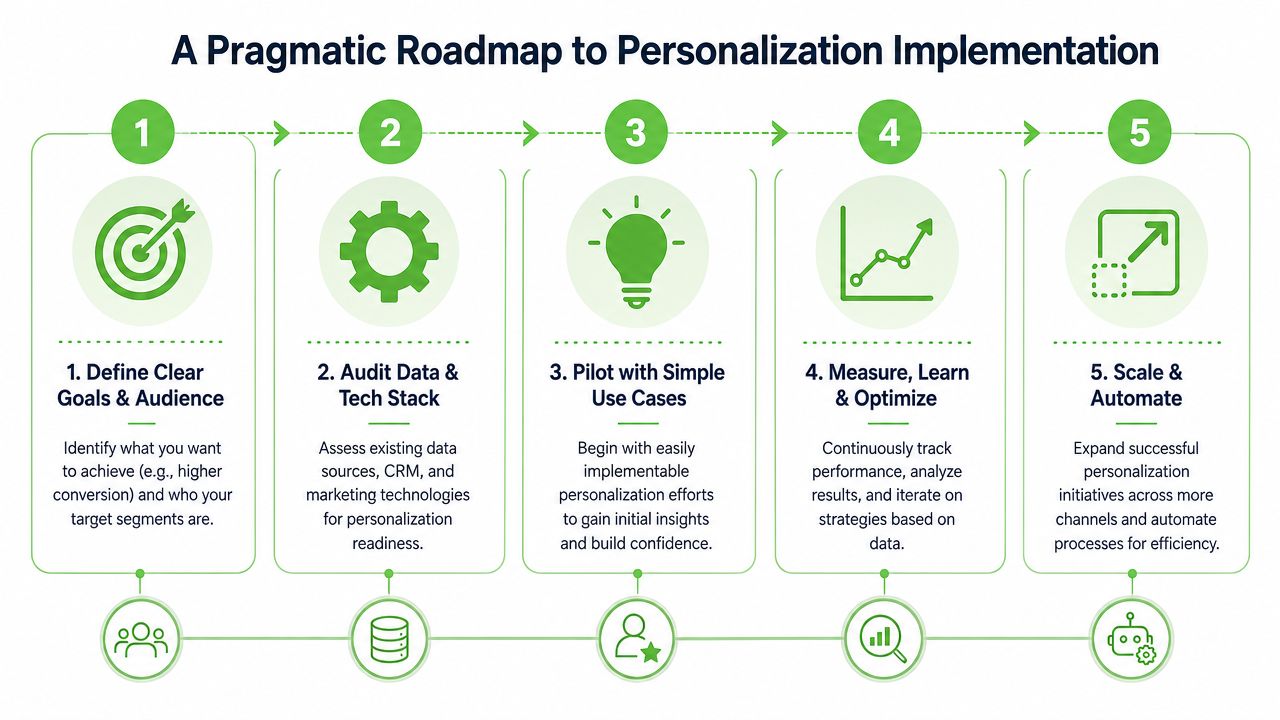
Most personalization projects fail because teams try to boil the ocean. They map every touchpoint, buy too much software, and spend months cleaning data before sending anything useful. The better approach is narrower. Start where timely relevance is easiest to prove, then expand.
Start with the narrowest useful use case
Don't begin with “full customer journey orchestration.” Begin with one moment that already costs the client money when it's handled poorly.
Good starting points include:
- Lead response after inquiry
- Appointment confirmation and no-show prevention
- Post-purchase onboarding
- Reactivation of stalled conversations
- Community welcome and nurture
These use cases have three things in common. The trigger is clear, the message can be adapted based on known data, and the outcome is visible to the client.
Build the 4Ds into delivery
A practical execution model comes from SalesHive's framework for personalization at scale, which emphasizes the 4Ds: Data, Decisioning, Design, and Distribution. That framework works well for agencies because it mirrors how deliverables should be built and sold.
Data
Start with what the client already has. Don't wait for a perfect CDP rollout.
Pull together the most useful fields:
- Identity data: name, company, location, service type, purchase category
- Behavior data: clicked, replied, booked, bought, abandoned, viewed
- Source data: ad campaign, landing page, referral partner, QR code, community join path
- Status data: new lead, qualified lead, customer, inactive, support issue open
If the client's data is messy, create a minimum viable schema. A few clean fields beat a giant database full of inconsistent labels.
Decisioning
Many agencies stay too shallow; they build a trigger but not a decision system.
At minimum, define:
- Entry condition: what starts the flow
- Branch logic: what changes based on behavior or attributes
- Exit condition: when automation should stop
- Human escalation: when a person needs to step in
For WhatsApp, branch logic often beats long sequences. If someone replies with a pricing question, they should leave the nurture flow and enter a sales-assist workflow. If they ask for support, they should stop receiving promotional prompts.
Design
The message has to sound like it belongs in a real conversation. That means short copy, clear next steps, and context that feels earned.
A strong WhatsApp message usually includes:
| Component | What it does |
|---|---|
| Context | shows why the message is arriving now |
| Specificity | references the action, product, booking, or request |
| Relevance | gives one useful next step |
| Friction control | offers a simple reply option |
Design also includes tone. Most clients don't need clever copy. They need copy that sounds human, current, and easy to answer.
Make WhatsApp part of the operating model
Distribution isn't just channel selection. It's how the agency ensures the message lands in a workflow the client can manage.
For WhatsApp-based personalization, keep the operating model tight:
- Use automation for speed: welcome messages, reminders, follow-ups, routing prompts
- Use people for nuance: objection handling, scheduling changes, sales discovery, support escalation
- Use shared visibility: tags, assignments, notes, and conversation status should be visible to the team handling replies
Start with one flow that a client's team can run every day without confusion. Scale after the handoff works.
A good rollout sequence is simple. Launch one use case. Watch replies. Fix branch logic. Tighten templates. Add segmentation. Then expand to adjacent journeys. That's how agencies make personalization at scale feel manageable instead of theoretical.
Personalization in Action Examples and Templates
The fastest way to understand personalization at scale is to look at what it feels like in the wild. Not enterprise theory. Just useful communication tied to a real customer signal.
Example 1 Local service follow-up
A dental clinic gets leads from paid search, referrals, and scan-to-chat QR codes in the front office. Instead of sending one generic follow-up, the agency routes each new contact into a WhatsApp flow based on source and appointment status.
A lead who asked about teeth whitening gets a message that references that service, offers available consult windows, and gives a simple reply path. A patient who already booked gets reminder and prep information. Someone who missed an appointment gets a softer rebooking nudge instead of another promotional message.
The personalization signal is basic but powerful. Service type, booking status, and last interaction are enough to make the conversation feel deliberate.
Example 2 Coach lead nurture on WhatsApp
A business coach runs webinars, free guides, and a WhatsApp community. The old system pushed everyone into the same pitch cadence. The better system separates people by entry point and response pattern.
Someone who joined from a webinar gets recap content and a consult invitation. Someone who downloaded a guide but never attended live gets educational follow-up first. A member who replies with a specific challenge gets tagged for human outreach.
That's where WhatsApp outperforms many passive channels. The channel invites reply behavior, and reply behavior gives you better personalization inputs.
A short training video can help teams think through this kind of conversation design:
Example 3 E-commerce post-purchase flow
An e-commerce brand often treats the sale as the end of the journey. Agencies can create more value by treating it as the start of the next personalized sequence.
If a customer buys a skincare product, the first WhatsApp follow-up can focus on usage guidance and support. If they buy a consumable, the agency can build reorder timing around expected usage. If they're a repeat buyer, the copy can skip education and move straight to convenience.
Notice what's absent here. No creepy references. No overuse of browsing history. Just context the customer would expect the brand to know.
A copy-and-adapt WhatsApp welcome template
Use this as a base for a new lead or new community member:
Hi {{first_name}}, thanks for reaching out about {{interest_topic}}.
You came in through {{source_name}}, so I want to make this easy.
If you want help with {{desired_outcome}}, reply with one of these:
- Pricing
- How it works
- Book a call
- Just browsing
If you already have a specific question, send it here and someone can point you in the right direction.
Why this works:
- It acknowledges context: the person knows why they got the message
- It reduces effort: reply options lower friction
- It creates routing signals: each reply can trigger a different path
- It leaves room for humans: free-text replies still work
Common Pitfalls and How to Avoid Them
Most personalization failures aren't caused by a lack of tools. They come from bad judgment, weak data discipline, and no plan for handling success.
When personalization gets creepy
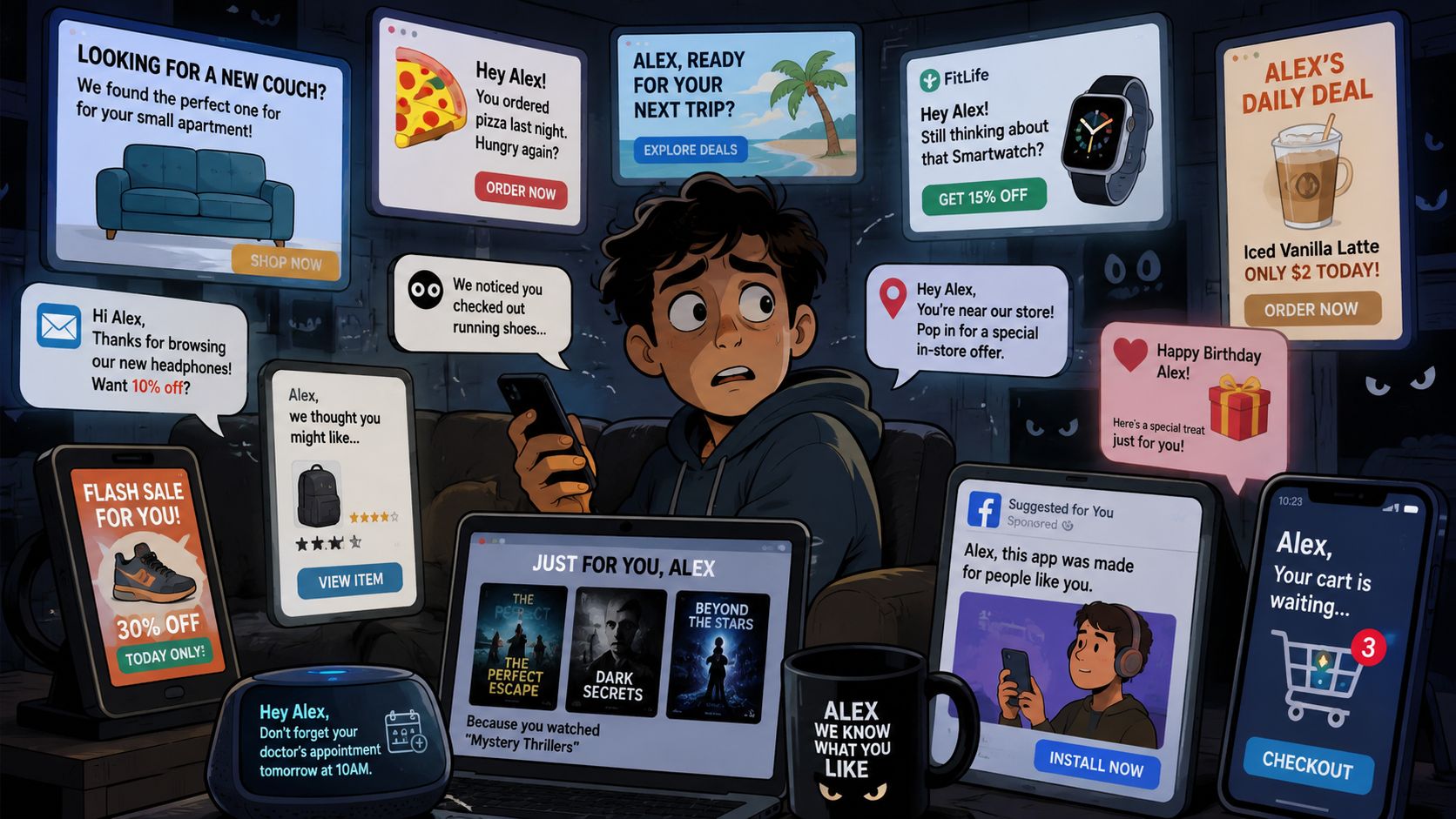
A message should feel helpful, not invasive. If a client uses every scrap of data to prove how much they know, customers pull back.
Good personalization usually relies on obvious context:
- Recent actions: inquiry, purchase, booking, missed call
- Declared preferences: chosen service, stated interest, selected category
- Relationship stage: new lead, active customer, returning buyer
Bad personalization tends to expose hidden tracking or stack too many details in one message. If the recipient's first reaction is “How do they know that?” you've missed the mark.
When the data is messy
Agencies often overestimate what the client's CRM can support. Duplicate contacts, inconsistent tags, wrong owner fields, and stale statuses are common. If the system can't trust the data, the personalization logic breaks.
Use a small operational checklist before launch:
- Audit key fields: make sure source, status, and primary offer fields are populated consistently
- Set naming rules: campaign names, tags, and pipeline stages should follow one convention
- Test edge cases: unassigned leads, repeat customers, and reopened conversations need handling
- Protect deliverability elsewhere too: if your workflow includes email alongside WhatsApp, a tool like the MailGenius inbox placement test can help catch inbox issues before a nurture sequence underperforms for reasons unrelated to message quality
When campaigns succeed but operations fail
This is the trap agencies miss most often. The outbound part works. Replies increase. Inquiries rise. Then the client's team can't keep up.
That's a known operational problem. Braze's discussion of personalization at scale notes that 70% of companies remain stuck in siloed workflows that prevent true real-time engagement, and a critical failure point is scaling broadcasts without scaling the resolution of the resulting inquiry volume.
Personalization doesn't break because the message was too relevant. It breaks because nobody redesigned the response system.
The fix is operational, not creative:
| Problem | Better approach |
|---|---|
| Replies land in one unmanaged inbox | assign ownership and response status |
| Sales and support answer from separate systems | use a shared view of conversation history |
| Automation keeps firing after a human reply | pause or exit flows when live conversation starts |
| Team members improvise tone | create approved reply frameworks and escalation rules |
Agencies that understand this become much more valuable. They don't just launch campaigns. They help clients absorb the conversations those campaigns generate.
Measuring Success and Proving ROI to Clients
Agencies win larger retainers when they can tie personalization to revenue, retention, or labor savings. Activity metrics still matter, but only as supporting evidence. Client reports should answer a simple question: did this WhatsApp flow produce more value than the old process?
Start with one commercial outcome per use case. A lead-response workflow should be measured against reply rate, qualified meetings booked, and conversion to opportunity. A post-purchase sequence should be measured against repeat orders, reduced support load, and reorder timing. An appointment reminder flow should be measured against show rate, cancellations recovered, and rebooking.
The reporting model does not need to be complicated. It needs to be credible.
| Reporting element | What to show |
|---|---|
| Baseline | performance before the personalized flow launched |
| Personalized cohort | results for customers who received the WhatsApp journey |
| Operational findings | where response times slipped, where handoffs stalled, which segments outperformed |
| Next test | the single change the agency will implement next |
That structure does two things agency owners care about. It gives the client a clear business story, and it gives the account team a repeatable way to justify expansion.
Broader market data can help frame the opportunity. As noted earlier, research summarized by WSI points to stronger spending behavior when customer experiences are expertly personalized. That context is useful in the sales process. Renewal conversations still depend on account-level proof, such as more consultations booked, higher reorder rates, or fewer manual follow-ups from staff.
For WhatsApp in particular, the strongest ROI cases usually come from speed and timing. A message sent after a quote request, missed appointment, abandoned cart, or service milestone often outperforms generic batch campaigns because it arrives with context. That makes your reporting sharper. The agency can point to the trigger, the message, the response, and the business result.
Keep the narrative tight. Show what initiated the message, what changed in the customer journey, and what the client gained in pipeline, revenue, or efficiency. That is how personalization at scale becomes a productized agency service instead of another automation line item.
If you want to package WhatsApp-based personalization as a service, Double My Leads gives agencies a practical way to launch under their own brand, manage conversations, and build scalable workflows without turning the setup into a months-long technical project.


