
Some chiropractic clinics still run on hope. A few referrals come in, a patient leaves a good review, a workshop goes well, and the schedule looks solid for a week or two. Then the phones slow down. The front desk starts checking the calendar too often. New patient flow turns into a feast-or-famine cycle that feels impossible to control.
That pattern usually isn’t a traffic problem. It’s a systems problem. Chiropractor lead generation now depends less on vague visibility and more on how well your clinic captures, qualifies, and converts intent the moment it appears. The clinics growing consistently aren’t relying on one tactic. They’re running a connected engine: local search visibility, strong offers, focused landing pages, fast follow-up, and messaging workflows that keep staff from drowning in admin.
If you’re still treating lead generation as a list of disconnected marketing ideas, you’re leaving booked appointments on the table. The winning setup is tighter than that. It works more like an operating system.
Table of Contents
- Beyond Referrals Your New Patient Playbook
- Build Your Digital Front Door with Local SEO
- Design Irresistible New Patient Offers
- Launch a High-Converting Paid Ads Funnel
- Convert Leads Instantly with Scripts and WhatsApp
- Amplify Growth with Content and Community
- Track Your KPIs and Scale with a Budget Roadmap
Beyond Referrals Your New Patient Playbook
Monday starts with three new patient inquiries. One came from Google, one from Instagram, one from a past patient who finally decided to send her husband in. By Wednesday, only one is booked. The other two drifted because nobody answered fast enough, the offer was too generic, or the front desk had to chase details across missed calls and voicemail.
That is the primary problem in chiropractor lead generation. Clinics rarely struggle from a total lack of interest. They struggle from weak handoffs between interest, qualification, follow-up, and booking.
Referrals still help. They just do not give you predictable growth. A clinic that depends on word of mouth can have a strong month, then hit a dry stretch for reasons that have nothing to do with clinical quality. Referral partners change routines. Patients get distracted. Local competition gets more aggressive online.
A stronger model treats lead generation as an operating system. Patients need to find you, understand why they should choose you, take the next step without friction, and get guided into a scheduled visit before attention fades. Clinics that want steadier growth need a system for attracting high-intent patients, qualifying weaker inquiries early, and keeping response times tight without adding constant front-desk pressure.
What a real lead gen system looks like
A clinic-level lead gen system has five parts that work together:
-
Discovery
People become aware of your clinic through search, maps, social platforms, paid campaigns, local partnerships, or referrals. -
Conversion
They land on an asset that gives them a clear next action, such as calling, booking, or starting a message conversation. -
Qualification
Your team or automation filters for location, condition fit, urgency, insurance questions, and booking intent before staff time gets wasted. -
Booking
The lead moves into a confirmed appointment through fast replies, clear scripts, and simple scheduling. -
Nurture and reactivation
Leads who are not ready today still need follow-up. Former patients often do too.
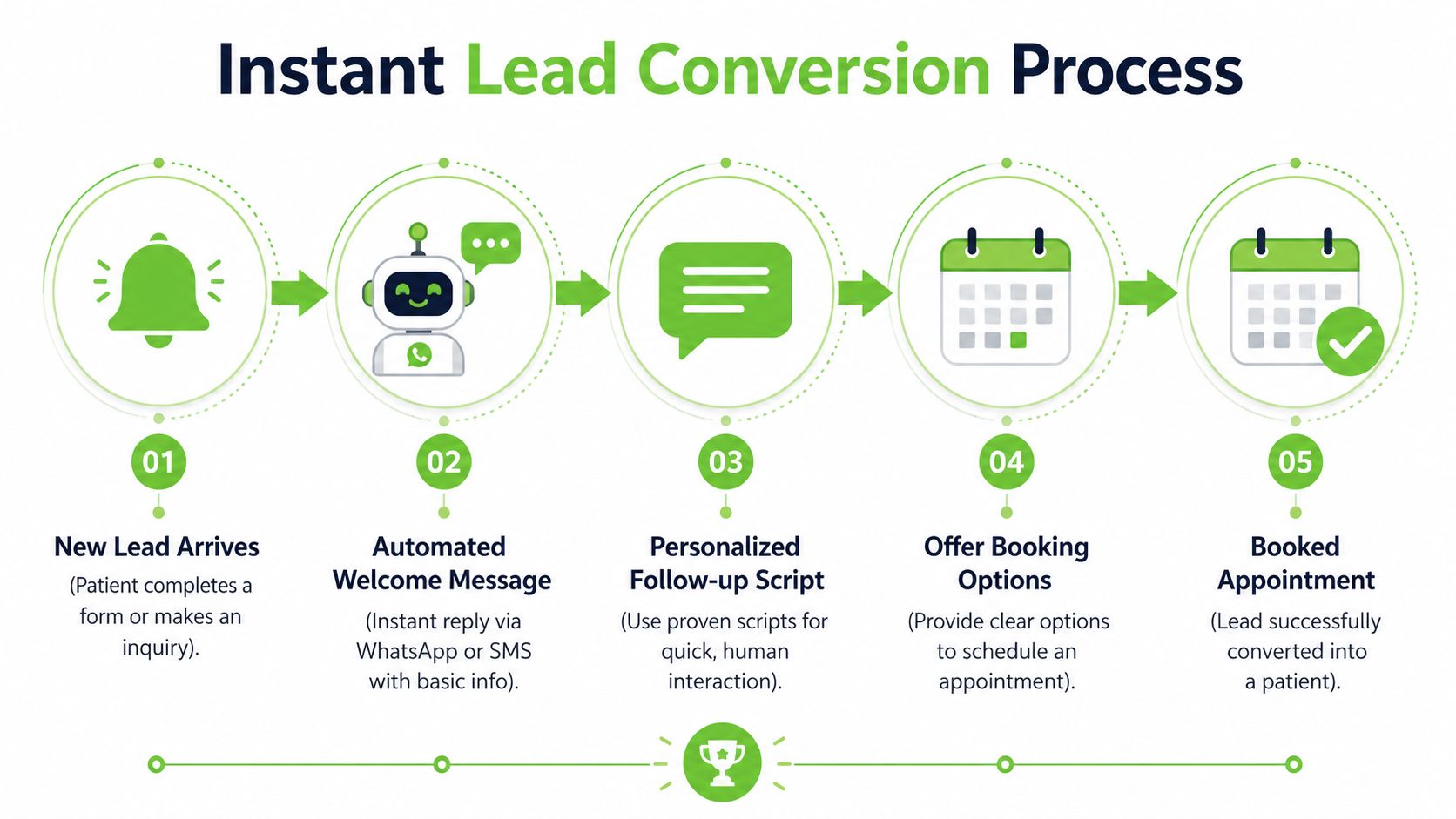
Weak clinics treat those steps as separate tasks. Strong clinics connect them. That is why WhatsApp, SMS, online forms, and booking workflows are no longer side tools. They are part of the core growth engine because speed and consistency now shape conversion just as much as visibility does.
Where clinics usually lose the patient
The breakdown is usually operational, not strategic.
A clinic runs decent ads but answers new inquiries two hours later. A website gets traffic but gives no compelling reason to book now. The front desk spends half the day speaking with people outside the service area or looking for prices only. Social posts get views, but there is no path from attention to conversation.
Each gap lowers return on everything upstream.
I have seen clinics spend heavily to generate interest while still relying on call-backs, sticky notes, and inbox triage to manage demand. That setup works at low volume. It fails the moment campaigns start producing consistent inquiries. A better system uses staff where judgment matters and uses automation where speed matters. If a new lead comes in after hours, they should still get an immediate response, basic qualification, and a booking path before the clinic opens the next morning.
That is the standard now. Not because it sounds advanced, but because it cuts leakage between inquiry and appointment.
Build Your Digital Front Door with Local SEO
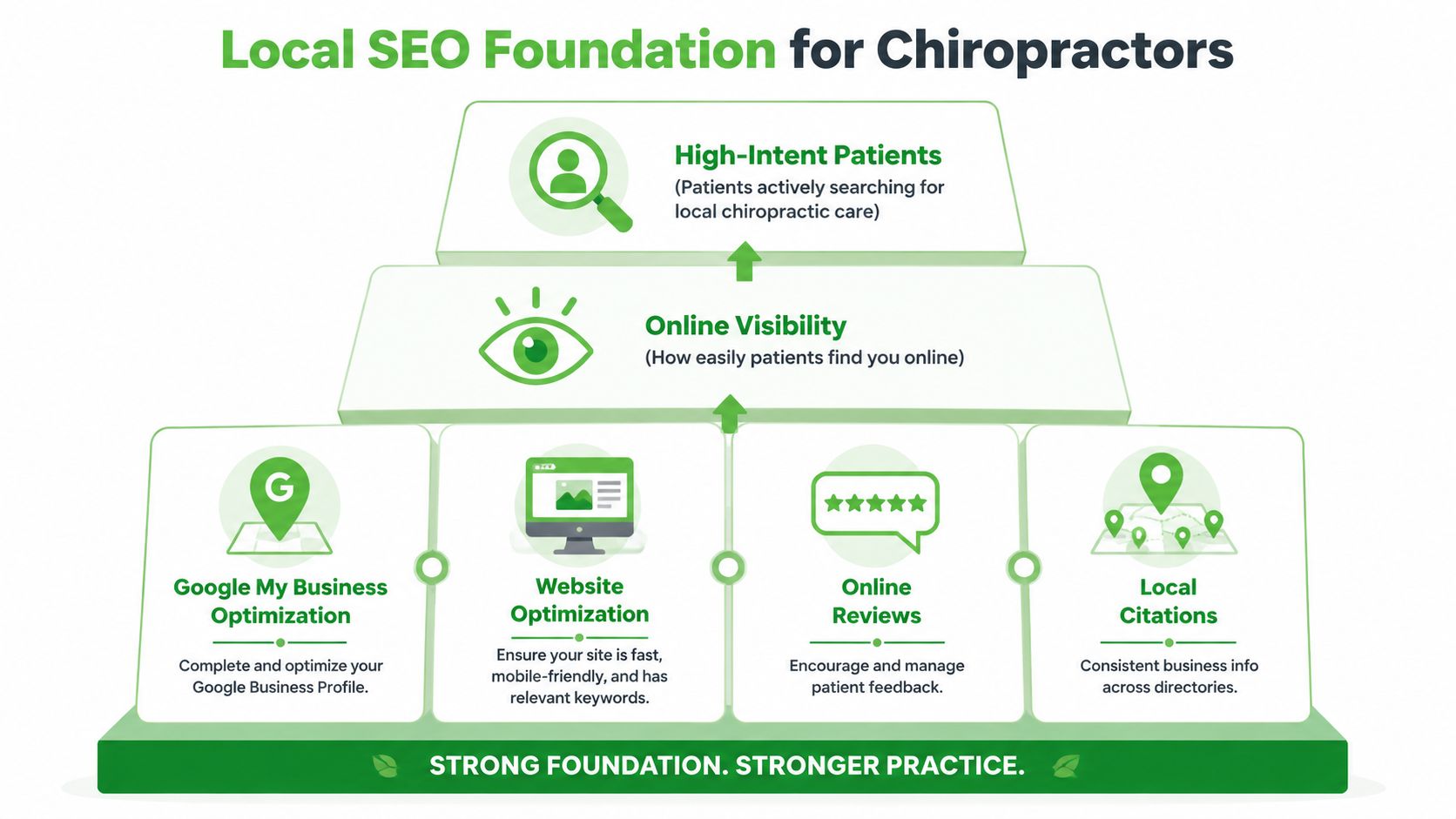
Before you spend on ads, fix the assets people already see when they search for care. For most clinics, the actual first impression isn’t the homepage. It’s your Google Business Profile, your reviews, and what a patient sees on mobile in the first few seconds.
Modern chiropractic lead-gen advice puts the core conversion sequence in plain terms: Google Business Profile optimization, clickable phone numbers, real-time online booking, short lead forms, and rapid follow-up. It also notes that the first breakthrough often comes from converting existing traffic better, not just getting more of it, as explained in this chiropractic lead generation guide.
Own the search moment
Your Google Business Profile needs to do more than exist. It has to answer the silent questions a patient asks before they ever click.
They want to know:
- Are you nearby
- Do you look credible
- Can I call or book without friction
- Do you treat the kind of issue I’m dealing with
That means your profile should be complete, active, and obvious. Add current services, accurate hours, a real appointment link, strong photos, and a phone number people can tap instantly on mobile. Review generation matters here too, not as a vanity exercise, but because social proof heavily shapes whether a patient clicks or keeps scrolling.
If you’re working on attracting high-intent patients, local SEO starts with this exact moment. Search intent is strongest when someone is already looking for a local provider. Your job is to remove doubt and make action easy.
Fix the website before buying more traffic
A chiropractic website doesn’t need to win design awards. It needs to convert.
The homepage, service pages, and campaign landing pages should make three things clear fast:
- What you help with
- Who you help
- What the visitor should do next
Strong websites for clinics usually share the same traits:
- Fast mobile experience: Most local searches happen on phones, so slow load times and clutter kill momentum.
- Clear calls to action: “Book online,” “Call now,” and “Ask a question” should be visible without hunting.
- Short forms: Ask only for what you need to start the conversation.
- Condition-specific relevance: A page about sciatica should feel different from a page about headaches or posture-related pain.
- Trust signals: Provider credentials, treatment explanations, office photos, and review snippets reduce hesitation.
Practical rule: If a patient can’t tell how to book within a few seconds, the page is underperforming.
Booking has to feel immediate
Online booking is no longer optional infrastructure. If someone has to submit a generic form and wait, many won’t.
At minimum, your clinic should offer:
- Click-to-call buttons for patients ready to speak now
- Real-time booking access for patients who prefer self-service
- A short fallback form for people who aren’t ready to commit
- Fast confirmation messaging so the next step feels certain
This is the foundation of chiropractor lead generation. Local SEO gets you seen. Conversion infrastructure gets you paid. Without both, traffic just leaks.
Design Irresistible New Patient Offers
Most chiropractic ads don’t fail because the platform is wrong. They fail because the offer is weak.
“Book now” isn’t an offer. “Call for details” isn’t an offer either. Patients don’t respond to generic availability. They respond to clarity, relevance, and a reason to act while the problem still feels urgent.

Why most chiropractor offers underperform
A lot of clinics default to one of two bad approaches.
The first is too vague. It says things like “quality care for the whole family” or “trusted chiropractic services.” That’s branding language, not conversion language. It doesn’t tell a person with neck pain, back pain, headaches, or post-injury discomfort why they should act now.
The second approach goes too discount-heavy without context. That gets attention, but it can also attract low-intent bargain hunters if the message doesn’t frame the offer around a specific problem and next step.
A better offer sits in the middle. It gives enough value to reduce hesitation, but it still positions the clinic as professional care, not a commodity.
What a strong new patient offer includes
The most effective offers usually bundle early-stage value into one clear package. A common structure is a consultation, exam, and first adjustment or a consultation and assessment with same-day treatment when clinically appropriate. The exact components depend on your legal, clinical, and compliance standards, but the logic is consistent.
A strong offer does four jobs:
- It lowers uncertainty by telling patients what happens first
- It frames the visit around a real problem like lower back pain, headaches, posture strain, or sports recovery
- It makes action feel simple with one click, one form, or one message path
- It protects profitability because you’re not discounting your entire care plan, only simplifying entry
How to write the offer without sounding cheap
The copy matters as much as the structure.
Weak version:
- Affordable chiropractic care available now
Stronger version:
- New patient visit for back pain, including consultation and exam, with easy online booking
Weak version:
- Limited-time special for new patients
Stronger version:
- Start with a focused first visit to understand the cause of your pain and the best next step
Use language that speaks to the patient’s situation, not your clinic’s internal terminology. “Persistent lower back pain after sitting all day” usually lands better than “musculoskeletal dysfunction.” One sounds human. The other sounds clinical but distant.
A few rules keep offers effective:
- Be specific about the entry point
- Tie it to symptoms or situations people recognize
- Avoid fake urgency
- Keep the path from ad to booking tight
If the patient understands the problem you solve and what happens next, response quality improves fast.
A good offer makes every downstream channel work better. Your ads get more clicks from the right people. Your landing page converts more of them. Your follow-up team spends less time explaining basic details because the offer already did that work.
Launch a High-Converting Paid Ads Funnel
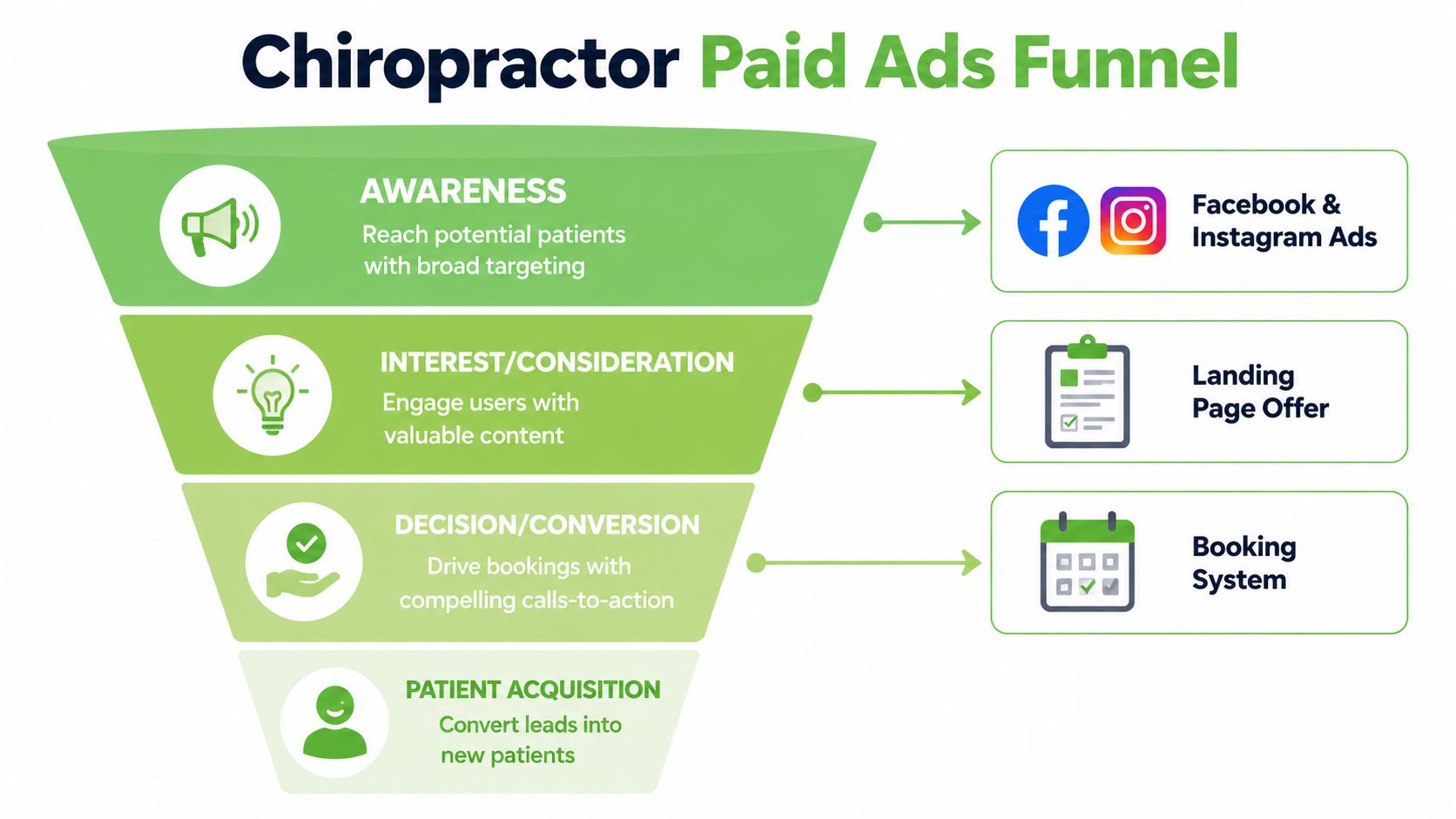
Paid ads are the fastest way to create demand on purpose. They’re also where clinics waste money when they skip funnel design and send people to a generic homepage.
A proper paid funnel is simple. Ad, landing page, form, follow-up, booking. Every extra step hurts conversion.
Start with one audience and one problem
Most chiropractic paid campaigns get too broad too early. They try to speak to everyone in the city who might someday want chiropractic care. That creates bland creative and weak conversion.
Start narrower. Pick one local audience and one pain point.
Examples:
- Office workers dealing with posture-related neck and back pain
- Active adults with mobility or recovery complaints
- Parents searching for help after recurring headaches or tension
- People recently dealing with discomfort after long commutes or sedentary work
On Facebook and Instagram, location still matters more than fancy audience stacking for most local clinics. Keep the targeting rooted in your service area first. Then test adjacent interests only when the message is already working.
Build ads that match patient intent
Good chiropractor ads don’t try to be clever. They try to be recognizable.
That means the creative should reflect situations patients already know:
- Stiffness after desk work
- Pain during workouts
- Trouble turning the neck comfortably
- Recurring tension headaches
- Discomfort that keeps coming back
Use plain-language hooks and pair them with a direct offer. Short videos, talking-head explainers, patient education clips, and simple static graphics can all work if the message is sharp. If your clinic doesn’t have an in-house creative pipeline, using an AI video creation platform can help produce ad variations faster without waiting on a full video team.
Here is the video referenced for this funnel approach:
Your landing page has one job
Never send paid traffic to a homepage if the ad promotes a specific offer. Build a dedicated landing page instead.
That page should include:
- A headline that matches the ad
- A short explanation of the offer
- A few trust elements, such as provider credibility, office imagery, or concise proof points
- A simple form
- A clear next step, such as “request appointment” or “check availability”
You don’t need long copy unless the offer or audience demands more education. For many clinics, tighter pages convert better because they preserve momentum. Someone who clicked an ad about lower back pain wants relevance, not a tour of your entire practice.
A thank-you page matters too. It should tell the lead exactly what happens next. If someone expects a callback, say that. If they’ll receive a message to book, say that. Ambiguity increases drop-off.
Paid traffic exposes every operational weakness. If your booking flow is clunky, ads will find that problem fast.
Creative production matters more than most clinics admit
Most campaigns don’t scale because the targeting ran out. They stall because the creative got stale.
Build a rotating set of assets:
- Educational angle: explain a common symptom pattern
- Offer angle: present the new patient entry point clearly
- Authority angle: show the doctor speaking directly to the camera
- Local angle: reference the community or daily lifestyle triggers your patients experience
Agencies and clinic operators typically differentiate themselves in their approach. The best ones don’t obsess over endless platform tweaks. They keep launching sharper messages, better hooks, and more relevant landing pages.
Convert Leads Instantly with Scripts and WhatsApp
Most leads don’t need more time. They need a response.
The old model says the front desk should call everyone back when there’s a free moment. That sounds reasonable until the clinic gets busy, the phone rings during check-ins, and inbound leads sit unanswered. By the time someone follows up, intent has cooled or the patient has booked elsewhere.
A major gap in chiropractor lead generation content is lead quality, not just volume. The more important question is shifting toward instant conversion and triage without creating more staff load, and WhatsApp’s real-time messaging makes it easier to collect symptoms and preferred appointment times before a clinic ever calls back, according to this analysis of chiropractic lead-gen gaps.
Phone-only follow-up is too slow
Phone calls still matter. They just shouldn’t carry the entire conversion process.
Some people want to talk immediately. Others are at work, in transit, or not ready to answer an unknown number. If your system only calls and leaves voicemails, you’re forcing every lead into one communication style. That’s inefficient and expensive.
Messaging changes the equation because it lets you:
- Acknowledge the lead instantly
- Ask qualifying questions before staff intervenes
- Offer booking paths without playing phone tag
- Capture details the front desk would otherwise gather manually
This is why WhatsApp belongs in a modern clinic workflow. It’s not a novelty channel. It’s an operational tool for speed, triage, and lower admin overhead.
A simple front desk call script
When staff does call, the script should sound human. Not robotic, not overly polished.
Use a structure like this:
-
Open with context
“Hi, this is Sarah from Greenfield Chiropractic. You requested information about a new patient appointment.” -
Confirm the reason
“I wanted to make sure I understand what you’re dealing with so we can suggest the best next step.” -
Ask one focused question
“Is this mainly lower back pain, neck pain, headaches, or something else?” -
Move toward booking
“We can help you check availability. Would you prefer an appointment time earlier in the day or later?” -
Reduce uncertainty
“I’ll also text you the booking details so you have everything in one place.”
The point isn’t to close with pressure. It’s to guide the lead into a decision while keeping the exchange short.
A good script doesn’t sound scripted. It removes confusion and keeps momentum.
A WhatsApp qualification flow that saves staff time
The smarter setup is to let messaging handle the first layer of intake.
A basic WhatsApp flow can look like this:
| Stage | Message purpose | Example |
|---|---|---|
| Welcome | Confirm receipt instantly | Thanks for contacting the clinic. We can help you book or answer a few quick questions first. |
| Symptom routing | Identify need | What are you mainly dealing with right now: back pain, neck pain, headaches, posture discomfort, or something else? |
| Urgency check | Triage appropriately | Is this something that started recently, has been ongoing, or feels urgent? |
| Location and fit | Filter weak leads | Are you located near our clinic, and are you looking for an appointment in the next few days? |
| Booking handoff | Move to action | We have appointment options available. Would you like a booking link or a callback? |
This kind of flow does two important things. It improves patient experience because people get a response right away. It also protects staff time because low-fit inquiries can be filtered before someone starts calling.
What to automate and what to keep human
Automation should handle the repeatable parts. Humans should handle the nuanced parts.
Automate:
- Instant acknowledgment
- Basic intake questions
- Appointment reminders
- Reschedule prompts
- Reactivation outreach to old leads or inactive patients
Keep human:
- Clinical edge cases
- Insurance or billing questions that need judgment
- Leads with unusual symptoms
- Any conversation where reassurance matters more than speed
A strong chiropractor lead generation system uses WhatsApp as the bridge between ad click and booked appointment. It doesn’t replace staff. It lets staff work on the conversations that need them.
Amplify Growth with Content and Community
A clinic can run solid ads, answer leads fast, and still hit a ceiling if it disappears between visits. That gap shows up in slower reactivation, weaker referral flow, and lower trust from prospects who need more than one touch before they book.
Content and community solve that problem when they are treated as part of the lead generation system, not as side marketing tasks. Their job is specific. Stay visible, answer objections before staff has to, and give cold prospects a reason to keep moving toward an appointment.
Random posting does none of that.
Many chiropractic clinics publish generic wellness tips that could belong to any practice in any city. Those posts rarely rank, rarely get shared, and rarely help the front desk close a hesitant inquiry. Better content starts with the questions patients already ask on calls, in consults, in DMs, and at the desk. If the same question comes up three times in a week, it deserves a piece of content.
Turn one patient question into a content system
One strong topic should feed multiple channels for a full month. That is how content produces reach without creating unnecessary work for staff.
Take a common question like sciatica. A clinic can build:
- A blog post that explains symptoms, common causes, what an evaluation covers, and when someone should stop waiting
- A short video from the doctor answering the question in plain language
- Several social posts pulling out one point at a time, such as leg pain patterns, warning signs, or what to bring to a first visit
- A saved WhatsApp response for leads who ask whether their symptoms sound familiar
- A follow-up email sent to people who downloaded a guide or attended a workshop
- A retargeting angle for visitors who read the page but did not book
That is a stronger system than writing four disconnected posts about posture, hydration, sleep, and stress because the calendar says to post. Depth wins. Repetition around one patient problem helps search visibility, improves message recall, and gives your team better sales support materials.
Use content to pre-handle objections
Good chiropractic content does more than attract clicks. It removes friction before the first conversation.
Prospective patients usually want answers to a small set of questions. Will this help my problem? What happens at the first visit? Is it safe? How long will this take? Do I need a referral? Can I bring imaging? Clinics that answer those questions in plain language shorten the sales cycle because the lead arrives warmer.
This also lowers staff workload. Instead of rewriting the same explanation ten times a week, staff can send the right article, video, or WhatsApp asset and then focus on booking.
Community creates demand that advertising cannot buy on its own
Local trust is built in public. People watch how a clinic shows up before they ever reach out.
That is why community participation matters. Local Facebook groups, parent communities, running clubs, youth sports circles, coworking communities, and neighborhood pages often surface intent earlier than search does. Someone asks about headaches, desk pain, sciatica, pregnancy-related discomfort, or recovery after lifting. A clinic that answers clearly and respectfully earns attention long before that person fills out a form.
The clinics that get results here follow a simple rule. Contribute first. Promote sparingly.
Useful comments, short educational videos, local event participation, and partnerships with gyms or wellness businesses tend to outperform constant sales posts. People remember the clinic that helped them understand the problem, not the one that repeated the same discount graphic every week.
Keep the conversation going after the first interaction
Community should not stop at the first visit or workshop. Ongoing communication is where many clinics lose momentum.
WhatsApp works well here because it fits how patients already communicate. A clinic can use it to send workshop reminders, post-visit care tips, mobility challenges, event invitations, and reactivation messages to inactive patients who have gone quiet. That keeps the relationship active without forcing staff into one-off manual follow-up every time.
Used well, this channel supports growth in two directions. New leads see an active, responsive clinic. Past patients stay connected long enough to return, refer, or reply when a new issue comes up.
Referrals improve when you give patients a prompt and a tool
Referrals still matter. They just perform better when the clinic makes them easy.
Build referral moments into the patient journey:
- After a strong early result, send a short message asking for a review and offering a simple link or resource they can pass along
- After a workshop or screening event, follow up with a shareable guide for friends or family dealing with the same issue
- After a care milestone, invite the patient to forward a specific piece of content to someone with similar symptoms
Patients rarely refer on memory alone. They refer when the clinic stays visible and gives them something useful to share.
That is the larger point. Content and community are not separate from chiropractor lead generation. They support qualification, nurture, conversion, retention, and referral with less staff effort when they are built into the system from the start.
Track Your KPIs and Scale with a Budget Roadmap
Most clinics track leads. Fewer track what happens after the lead. That’s where bad decisions start.
If you don’t know which sources produce booked appointments, paying patients, and retained patients, you can’t scale with confidence. You’ll end up rewarding channels that create activity instead of results.
One of the strongest KPI frameworks for chiropractors centers on conversion rate, cost per acquisition, and retention quality, not just lead count. Guidance for chiropractic practices also highlights patient retention as a critical signal, with a healthy range of 60% to 70%. If retention falls below that, lead-gen performance may be hiding a service or follow-up problem, as described in this chiropractic KPI and retention guide.
The metrics that actually matter
Start with a short scorecard your clinic can review every month.
Track:
-
Lead source
Where the inquiry came from, such as Google Business Profile, paid social, search ads, website organic, workshop, or referral -
Lead-to-booking rate
Which channels produce actual scheduled appointments -
Booked-to-show rate
Whether your reminders and confirmation process are doing their job -
Acquisition quality
Whether the lead became a paying patient and stayed in care -
Retention rate
Whether the patients acquired through a given channel are worth continuing to buy
Many clinics are often misled. A campaign can generate plenty of leads and still underperform if those leads don’t show, don’t start care, or don’t stay.
How to decide what to scale
Use simple decision rules.
Keep investing in channels that:
- Produce bookable inquiries consistently
- Match the conditions and patient types your clinic serves well
- Create patients who stay engaged, not just people who ask for prices
Cut or rebuild channels that:
- Create lots of admin work without bookings
- Attract poor-fit inquiries outside your service area
- Generate patients who disappear immediately after the first visit
A source should earn its budget by proving it creates good patients, not just form fills.
Sample monthly lead generation budgets and roadmaps
Below is a practical planning table. It doesn’t use fixed dollar benchmarks because those vary too much by market, clinic positioning, and service mix. The point is how to stage effort and priorities.
| Phase | New Practice (First 6 Months) | Established Clinic (Scaling) | Key Focus |
|---|---|---|---|
| Foundation | Prioritize Google Business Profile, website conversion fixes, online booking, and call tracking | Audit current funnel leaks, tighten attribution, refine service pages | Build accurate tracking and remove friction before adding spend |
| Core demand capture | Run one focused paid offer with one landing page and one follow-up workflow | Expand winning campaigns by condition, audience, or location segment | Buy intent carefully and protect conversion quality |
| Follow-up system | Add instant messaging response, lead qualification, and reminder flows | Add segmented nurture, reactivation, and referral prompts | Improve booking speed without adding front desk overload |
| Content and authority | Publish condition-based content and repurpose into social posts | Turn top-performing topics into broader content and community assets | Support long-term demand and branded search |
| Scale decisions | Keep only channels that create booked and retained patients | Shift more budget to channels with stronger acquisition quality and retention | Scale what produces durable patient value |
The clinics that scale cleanly don’t just spend more. They measure better. They know which traffic turns into conversations, which conversations turn into bookings, and which bookings turn into patients who stay.
If your agency or clinic wants to operationalize fast follow-up, lead qualification, and booking through WhatsApp, Double My Leads is built for that workflow. It gives you a white-labeled WhatsApp platform with shared inboxes, smart links, broadcast tools, automation flows, and CRM sync so you can capture, triage, and convert leads without piling more work onto the front desk.


