WhatsApp Vendors Reselling: A Practical Guide for Agencies
Learn how whatsapp vendors reselling works in 2026 — vendor types, QR workspaces vs Cloud API, pricing models, Meta rules, and a vendor evaluation checklist.
Most agencies hit the same wall. A client wants WhatsApp live this week, wants shared inboxes, wants broadcasts, wants attribution, and doesn't want to hear about Meta onboarding, template approval, or message tiers. You then have to decide fast whether you're buying a QR-based workspace from a vendor, or building on the Cloud API side and carrying more setup overhead yourself.
That decision used to be mostly operational. In 2026, it isn't. It's a compliance and margin decision first.
Meta's own FAQ is the part most reseller guides skip, and that's exactly backwards. If the structure itself gets rejected, your pricing model and your automation stack don't matter. And if your model survives compliance but dies on pricing, you still lose. WhatsApp moved deeper into business messaging long ago. The WhatsApp Business app reached 200 million monthly active users in June 2023, up from 50 million in 2020, and independent 2026 estimates put active WhatsApp business accounts at about 284 million globally, with roughly 50 million businesses using the app and about 5 million using the Business Platform/API, according to this WhatsApp Business adoption breakdown. That scale is why agencies keep trying to productize WhatsApp into a reseller line.
The question isn't whether WhatsApp vendors reselling is attractive. It is. The question is which model is allowed, which model is controllable, and which model still leaves you with margin after pricing changes hit.
Table of Contents
- What WhatsApp Reselling Actually Looks Like in 2026
- The Two Vendor Archetypes Agencies Can Resell
- QR Workspaces vs Cloud API Reselling
- Flat Fee vs Per Message Pricing After the 2025 Shift
- Meta Rules Resellers Cannot Afford to Ignore
- The Reseller Vendor Evaluation Checklist
- Use Cases for Agencies Creators and Community Managers
- Choosing a Vendor and Negotiating the Contract
What WhatsApp Reselling Actually Looks Like in 2026
A common scenario looks like this. You've got a performance agency, maybe a dozen people, maybe less. A clinic, ecommerce brand, education seller, or local service account wants WhatsApp as the main sales and support channel. They want multiple agents in one inbox, faster replies, some automation, and a monthly price they can understand.
You have about two choices.
One is to buy access from a QR-based workspace vendor. That usually means the client connects a WhatsApp number by scanning a QR code into a shared panel. The vendor gives you inbox seats, some light automation, maybe broadcasts, and often white-label packaging. It's fast. You can usually sell it immediately.
The other is to operate through Cloud API reselling. That means using a vendor or stack tied to official Business API infrastructure, onboarding the client into its own WhatsApp business setup, and billing around templates, inbox access, workflow logic, and support.
The actual agency decision
This isn't about which option sounds more enterprise. It's about two outcomes:
- Clean margin per seat
- A compliance posture you can defend when a client asks hard questions
If you ignore either one, you'll regret it. Plenty of agencies make money on the access layer and then get wrecked by support load, bad number hygiene, or message-cost surprises. Others choose the official route, overbuild too early, and turn a decent service line into a setup-heavy mess.
Practical rule: Pick the model that matches the client's communication shape, not the model that flatters your agency.
For most shops, WhatsApp reselling sits on top of an existing retainer. It's not a random side hustle. It's a recurring revenue layer attached to lead gen, support operations, appointment booking, renewals, or community distribution.
Why timing matters now
The urgency is simple. Pricing changed, compliance scrutiny is real, and clients are no longer impressed by access alone. They expect a path from simple inbox sharing to more structured automation. If you're trying to stage that transition, this WhatsApp upgrade path for agencies is the right way to think about it.
Also, the market is already mature enough that client demand isn't hypothetical. Meta reported that more than 175 million people message a business account every day, and broader industry reporting also notes 200+ million people message businesses on WhatsApp monthly plus 316 million WhatsApp Business app downloads in 2023, as summarized in these business messaging usage figures. Agencies aren't trying to invent demand here. Demand already exists.
The Two Vendor Archetypes Agencies Can Resell
The reseller market splits into two camps, and confusing them causes most bad buying decisions.
Informal vendors
These are the vendors selling what agencies often call panels, shared inboxes, QR workspaces, or unlimited WhatsApp tools. Under the hood, the client usually connects a live WhatsApp account through QR authentication. The vendor gives you a web app on top of that connection.
This model attracts agencies because it solves the immediate problem. You can set up quickly, skip a lot of Meta process, and package the service under your own offer. It's especially appealing when your client wants team access more than deep automation.
The problem is that the operational simplicity hides policy risk. You're often sitting in a grey area where the tool is useful, but the business model around it is much less defensible if someone starts asking who owns the number, who controls the data path, and what happens when the account gets restricted.
Formal SaaS resellers
The second group operates around the Cloud API and official business onboarding flows. These vendors may be Tech Providers, BSP-connected platforms, or white-label SaaS layers that sit on top of official WhatsApp messaging infrastructure.
Their pitch is different:
- Structured onboarding
- Template-based business messaging
- Webhook and integration control
- More durable compliance posture
- Better fit for multi-client agency operations
You usually give up speed and simplicity in exchange for cleaner contracts and more predictable scaling.
Agencies often think both archetypes are selling the same thing. They're not. One is selling convenience on top of app behavior. The other is selling infrastructure on top of platform rules.
Why this matters commercially
Both archetypes target the same buyer. A small or mid-sized business wants WhatsApp presence without wrestling with platform complexity. But the contract surface is completely different.
With informal vendors, your risk lives in account continuity, acceptable use, and tool fragility.
With formal vendors, your risk lives in message economics, onboarding friction, and implementation overhead.
That difference is the whole game in WhatsApp vendors reselling. If you sell the wrong archetype to the wrong client, you'll either lose the account during growth or spend your margin servicing avoidable operational problems.
QR Workspaces vs Cloud API Reselling
Most agencies don't need theory here. They need a blunt comparison.
What QR workspaces are good at
QR workspaces win on speed. You can often get a number connected the same day, put agents into one inbox, and start charging a flat monthly fee with almost no client education. For many local businesses, coaches, creators, and simple support teams, that convenience matters more than technical purity.
They also lend themselves to cosmetic white-labeling. If your goal is to package a branded communications workspace under your agency, this route is straightforward.
The trade-off is obvious once you push beyond basic operations. Broadcast behavior, account quality, phone-number health, and app-level limitations still shape what the client can do. Serious automation gets awkward. Cross-system event handling gets awkward. Compliance explanations get awkward.
What Cloud API reselling is good at
Cloud API reselling is heavier, but it's the right fit when the client needs actual system behavior, not just shared access.
WhatsApp's architecture separates throughput from reach. One API guide reports Cloud API defaults at 80 messages per second per number, with higher eligibility up to 1,000 messages per second, while on-premise API setups are lower at 30 messages per second. Reach is governed separately by the business-initiated messaging tier at the portfolio level, stepping through 250, 2,000, 10,000, 100,000, and then unlimited unique customers per rolling 24 hours, according to this WhatsApp API capacity explanation. That's a critical point for agencies. Adding more API keys doesn't magically fix scale. Portfolio qualification and number quality do.
Side by side trade-offs
| Factor | QR Workspaces | Cloud API Reselling |
|---|---|---|
| Setup speed | Fast. Usually same-day if the client can scan a QR code | Slower. Requires proper onboarding and setup |
| Compliance posture | Weaker. Harder to defend under scrutiny | Stronger if structured correctly |
| Automation depth | Limited for complex workflows | Strong. Better for integrations and webhooks |
| Branding | Easy to package and white-label cosmetically | Can be white-labeled, but with more setup complexity |
| Margin model | Usually simple flat-fee resale | Better control options, but exposed to message-cost economics |
| Best fit | Micro-SMBs, creators, light support teams | Lead gen, ecommerce, structured sales and service flows |
My recommendation
Use Cloud API for lead-gen clients, ecommerce brands, and any client buying traffic at scale. Those teams need structured routing, approved outbound messaging, CRM sync, and a stack that won't buckle once campaigns work.
Use QR workspaces for small operators who mainly need a shared inbox, simple broadcasts, and low-friction deployment.
If you want one platform that spans both models, Double My Leads is one of the few options built specifically for agencies that want QR-connected white-label workspaces and also have Cloud API available when the client needs a more formal setup.
Flat Fee vs Per Message Pricing After the 2025 Shift
A lot of reseller offers break on pricing.
The pattern is predictable. An agency sells WhatsApp as a simple monthly package, the client starts sending far more outbound messages than expected, and margin disappears. After the 2025 pricing shift, that model got weaker. In 2026, pricing has to match the actual cost structure.
The right commercial setup is a hybrid model. Charge a flat monthly fee for access, onboarding, support, and account management. Charge usage separately anywhere message volume creates variable cost.
What changed
WhatsApp pricing moved further toward per-message billing on 1 July 2025. That pushed more cost volatility onto anyone reselling outbound messaging. If your clients send campaigns, reminders, follow-ups, or promotional traffic at scale, your vendor bill can move fast while your client invoice stays fixed.
That is the problem.
A lot of reseller pages still pretend the software subscription is the margin engine. It is not. In 2026, margin comes from controlling service scope, passing through message costs cleanly, and refusing bad pricing promises.
Where flat fees still work
Flat pricing still works for small accounts with stable behavior. Shared team inbox. Light support volume. Occasional broadcasts. Low operational variance.
It stops working once a client treats WhatsApp like a growth channel.
| Pricing Model | Best For | Margin Risk | Break Point | 2026 Reality |
|---|---|---|---|---|
| Flat fee | Small clients with steady inbox use and predictable sends | High if usage surges | Breaks when outbound volume becomes inconsistent | Fine for access. Weak for variable sending |
| Per message | Broadcast-heavy or automation-heavy clients | Lower if pass-through is clean | Harder to sell when clients want one simple invoice | Necessary for serious outbound usage |
| Hybrid | Agencies packaging service plus messaging | More manageable | Works when the client understands platform fee versus usage fee | The most durable model |
The pricing rule I would use
Set one fixed monthly charge for the managed layer. That includes the workspace, setup, reporting, support, and any agency service wrapped around the channel.
Then bill message usage separately.
That structure fits both vendor archetypes. QR workspace resellers can usually hold a simpler fixed fee because the use case is lighter. Cloud API resellers need stricter usage billing because the client is more likely to run automations, campaigns, and volume-based workflows. If you ignore that difference, you price support clients and outbound clients as if they behave the same. They do not.
If you bundle volatile message cost into one fixed fee, you are not simplifying the offer. You are taking cost risk the client should carry.
If you need a cleaner way to package that split, this WhatsApp revenue model guide lays out the agency math clearly.
What to avoid
Do not sell "unlimited" outbound messaging unless your contract gives you a hard fair-use ceiling and a way to reprice overages.
Do not offer long fixed terms without a pass-through clause for vendor and Meta pricing changes.
Do not price by seat count alone. Two clients with the same team size can produce completely different message costs depending on whether they use WhatsApp for support, lead nurturing, or promotions.
Meta Rules Resellers Cannot Afford to Ignore
Most reseller content buries this part because it's inconvenient. You should start here.
WhatsApp's own FAQ says reseller use cases are rejected for WhatsApp Business API onboarding through direct provider review, and related connectivity guidance says direct reselling or embedding isn't allowed for WhatsApp for Business API customers, according to Meta's reseller onboarding FAQ. That means the lazy version of reselling, where you try to own the whole setup as if the client doesn't exist, is the wrong structure.
Rule one, the client must be real in the setup
The end client needs its own legitimate business presence in the arrangement. If your model depends on the agency pretending to be the business of record for multiple client accounts, you're setting up future rejection or suspension risk.
That doesn't mean agencies can't monetize WhatsApp. They can. It means the commercial structure has to look like managed fulfillment, not fake ownership.
Rule two, message custody changes the trust boundary
A lot of agencies still pitch WhatsApp as if all business chats are automatically protected in the same way regardless of architecture. That's not true.
WhatsApp states that chats with businesses using the app, or storing messages themselves, are end-to-end encrypted. But when a business uses a third-party vendor to operate the WhatsApp Business API on its behalf, WhatsApp says those chats are not considered end-to-end encrypted because the third-party vendor can access the messages, as stated in WhatsApp's explanation of business chat encryption scope.
That means your vendor stack becomes part of the data path.
What that changes operationally
- Access control matters
- Audit logs matter
- Retention policies matter
- Role-based permissions matter
- Sub-processor disclosure matters
If your vendor can't answer basic data handling questions, don't put enterprise or regulated clients on it.
Your client isn't only buying messaging. They're accepting your chosen trust boundary.
Rule three, bad account structure gets punished fast
The failure patterns are boring and predictable:
- Shared phone numbers used across multiple clients
- Sloppy outbound messaging without approved templates where needed
- Resold access that bypasses the client's own proper business setup
- Weak quality management on numbers used for business-initiated messaging
If you're serious about WhatsApp vendors reselling, treat policy fit like procurement, not like growth hacking.
The Reseller Vendor Evaluation Checklist
Most demos are a waste of time because vendors show inbox screens and avoid the hard questions. Ask the questions that expose operational weakness.
The five checks that matter
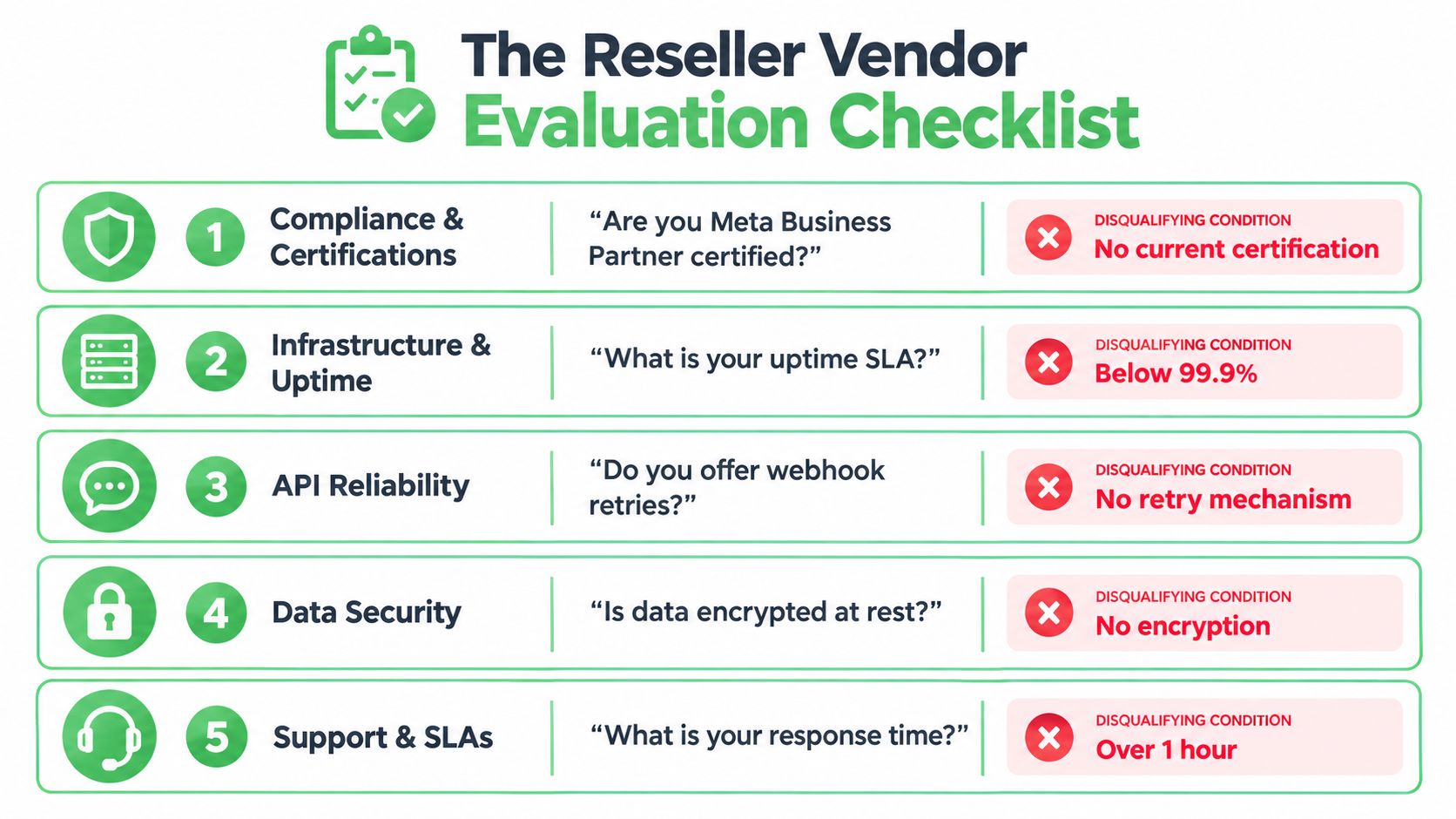
White-labeling
Ask whether you can put your own domain, logo, and brand styling on the client portal.
Disqualifying answer: the vendor's brand remains visible in client-facing areas or billing touchpoints.
Billing control
Ask whether you can invoice in your own currency and add your margin cleanly, or whether the product only supports direct pass-through billing.
Disqualifying answer: the vendor wants the end client relationship while calling the setup "white-label."
Multi-workspace inbox
Ask whether one operator can manage many client workspaces from one view with assignments, notes, and basic operational separation.
Disqualifying answer: every client has to be managed in isolation with no practical agency control layer.
Broadcast behavior
Ask for documented sending limits, throttling behavior, and what happens when quality drops or platform constraints hit.
Disqualifying answer: vague claims about unrestricted sending with no written limits.
API access
Ask whether you can access raw integration capability when needed, or whether you're locked into a closed panel.
Disqualifying answer: no export path, no webhook logic, no extension point.
A simple scoring lens
Use this checklist:
- Must have for your current client mix
- Useful later once you expand the service
- Nice to have but not required now
- Disqualifier if missing
If you're comparing white-label options specifically, these white-label provider considerations are the right questions to carry into procurement.
The wrong vendor doesn't fail in the demo. It fails three months later when your second serious client asks for billing controls, data answers, or an exit path.
Use Cases for Agencies Creators and Community Managers
The same WhatsApp stack behaves very differently depending on who is using it.
Lead-gen agency profile
A paid acquisition agency running dental, real-estate, or home-services accounts usually needs a formal operating model. Leads arrive from ads, need routing, need follow-up, and often need CRM sync. The agency doesn't just need an inbox. It needs accountability.
That profile usually fits Cloud API style reselling better because the client workflow is structured and outbound messaging quality matters. The key decision before signing any vendor is simple. Will this stack support routing and integration once campaigns start producing volume?
Creator or newsletter profile
A creator, educator, or community operator often values speed and simplicity more than deep systems integration. One number, one audience, one VA or small team handling replies, plus recurring broadcasts and simple automations. In that case, a QR-workspace model can be perfectly rational.
The key decision there is different. Can the vendor support audience communication without turning every operational task into manual chaos?
Same category, different operating shape
| Dimension | Lead-Gen Agency | Creator / Newsletter |
|---|---|---|
| Primary goal | Capture, route, and convert leads | Distribute content and manage replies |
| Best-fit model | Cloud API reselling | QR workspace reselling |
| Must-have capability | CRM and workflow connectivity | Fast shared inbox and easy broadcast use |
| Main risk | Workflow breaks during growth | Operational clutter and weak organization |
| Contract focus | Data handling and integration terms | Ease of use and billing simplicity |
Agencies often overcomplicate creator use cases and underbuild lead-gen use cases. That's backwards. Put infrastructure where process complexity exists. Keep it lighter where communication is the product.
Choosing a Vendor and Negotiating the Contract
Here's the clean decision rule.
If you're a boutique agency with a small handful of low-complexity client accounts, a QR-workspace reseller can be enough. It gets you to market quickly and keeps the service operationally simple.
If you're handling multi-brand paid acquisition, structured lifecycle messaging, or client accounts that will demand integrations, reporting discipline, and better data controls, use a Cloud API partner or a platform that gives you a credible path there.
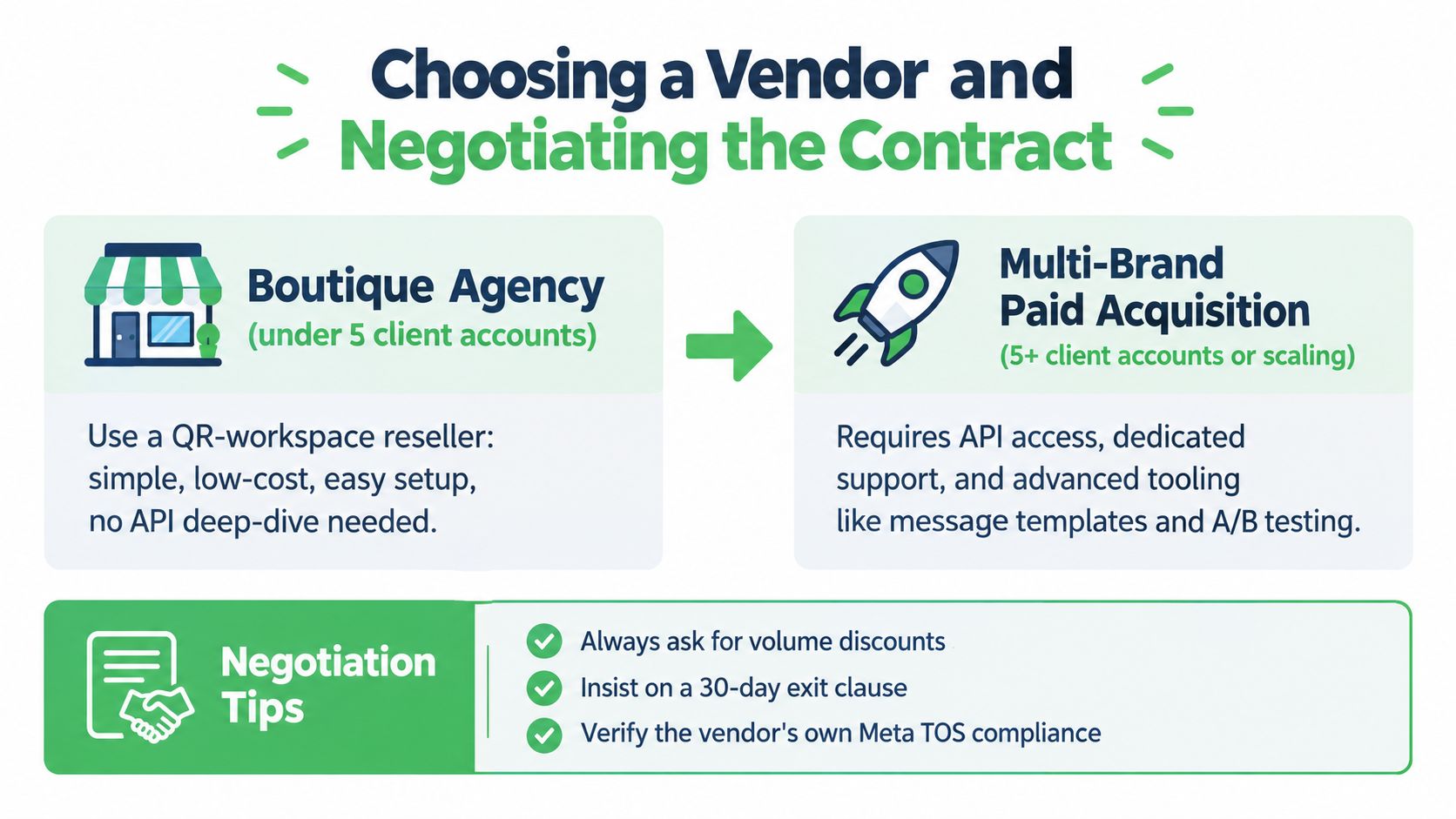
Contract terms to lock down
Don't sign until these are in writing:
- Rate pass-through terms so pricing changes don't land entirely on you
- Broadcast and template throughput expectations so the vendor can't hand-wave delivery constraints
- Data residency and sub-processor disclosure if your clients care about compliance
- Exit terms and number portability so leaving the vendor doesn't destroy the client's operating setup
- White-label scope so you know exactly what the client sees
- Webhook or event-delivery SLA if your workflows depend on automation
Negotiation levers agencies underuse
The first is commitment. If you can credibly offer a longer volume horizon, ask for better commercial terms.
The second is change protection. Ask for a grace period when platform-side pricing changes hit. If the vendor says no, at least you've learned they expect you to absorb pricing shock immediately.
Sell outcomes you control. Never sell a delivery guarantee that Meta itself doesn't promise.
That last point matters more than anything else in WhatsApp vendors reselling. Your agency can control setup quality, routing, templates, billing structure, and support. It cannot control every downstream platform decision. Write your offer and your contract like an operator who understands the difference.
If you want to launch a WhatsApp offer without piecing together separate tools, Double My Leads gives agencies a white-labeled setup for QR-based workspaces, shared inboxes, broadcasts, and an upgrade path into Cloud API use cases. It's built for the exact reseller problem this article covers, including branding, client workspaces, and predictable packaging. See how it fits your model at Double My Leads.