AppLevel Explained: WhatsApp CRM Guide
Discover what AppLevel is and how it impacts WhatsApp marketing. Explore agency use cases, CRM integrations, and alternatives like Double My Leads.
You've got a client asking for more WhatsApp follow-up, your Go High Level account is ready, and the first campaign looks simple enough. Then the operational questions arrive: which number connects, who handles verification, what happens when a device disconnects, and how much every outbound message will cost as volume grows. The campaign may perform well while your delivery margin becomes harder to forecast.
That's the AppLevel question for agencies. It isn't only whether a WhatsApp integration works. It's whether the integration gives you a dependable operating model across client accounts, automation, support, reporting, and resale. A tool can solve the first connection and still create recurring work that your pricing never captured.
Table of Contents
- Understanding AppLevel and the WhatsApp CRM Landscape
- Technical and Operational Implications for Agencies
- Common Use Cases for Agencies and SaaS Resellers
- Integration Considerations and WhatsApp Platform Fit
- Comparing AppLevel with Native WhatsApp Solutions
- Benefits and Limitations of Third-Party Integrations
- Practical Next Steps for Implementation
Understanding AppLevel and the WhatsApp CRM Landscape
AppLevel sits between WhatsApp communication and CRM execution. It's a third-party integration designed to bring WhatsApp workflows into Go High Level, allowing agencies to connect conversations with lead records, automations, and client reporting without building every integration internally. Its stated product relevance includes WhatsApp broadcasts, scheduled messages, media, variables, buttons, delivery tracking, read tracking, and workflow-triggered messages.
That positioning matters because agencies rarely buy WhatsApp software for one isolated campaign. They're trying to package lead capture, follow-up, qualification, reminders, support, and reactivation into a service clients can understand. A dedicated connector can be useful when the agency already operates inside Go High Level and wants to preserve its existing pipeline structure.
AppLevel's market footprint also points to an agency-oriented model. AppLevel reports a $40 million valuation, more than 4,500 active users, presence in 36+ countries, and onboarding of 1,200+ marketing agencies. It also reports that roughly 85% of new customers arrive through agency recommendations, a pattern associated with partner-led distribution in markets where WhatsApp is central to business communication, including Spain, Mexico, the United States, and Latin America. These figures come from MarTech Series' coverage of AppLevel's WhatsApp and Go High Level expansion.
Where the agency fit is strongest
AppLevel makes the most sense when CRM continuity is more important than infrastructure simplicity. A Go High Level agency can keep its familiar triggers, contact records, opportunity stages, and reporting conventions while adding WhatsApp as another communication channel.
That's different from choosing a WhatsApp platform first and connecting a CRM later. The right choice depends on where your team does its daily work. Agencies focused on performance-driven WhatsApp marketing may also benefit from reviewing performance-driven WhatsApp marketing services to clarify the campaign strategy before selecting the messaging layer.
A useful comparison point is the broader WhatsApp messaging platform category. AppLevel is primarily attractive as a CRM-connected integration. Native platforms tend to compete on inbox management, onboarding, broadcast infrastructure, and predictable account economics.
Agency rule: Treat the integration as part of your delivery operation, not as a small add-on inside the CRM.
The hidden cost appears after the sale. Someone must maintain the connection, investigate failed deliveries, answer client questions about message limits, and explain why a workflow behaved differently after a provider-side change. Those tasks affect margins even when the software subscription looks affordable.
Technical and Operational Implications for Agencies
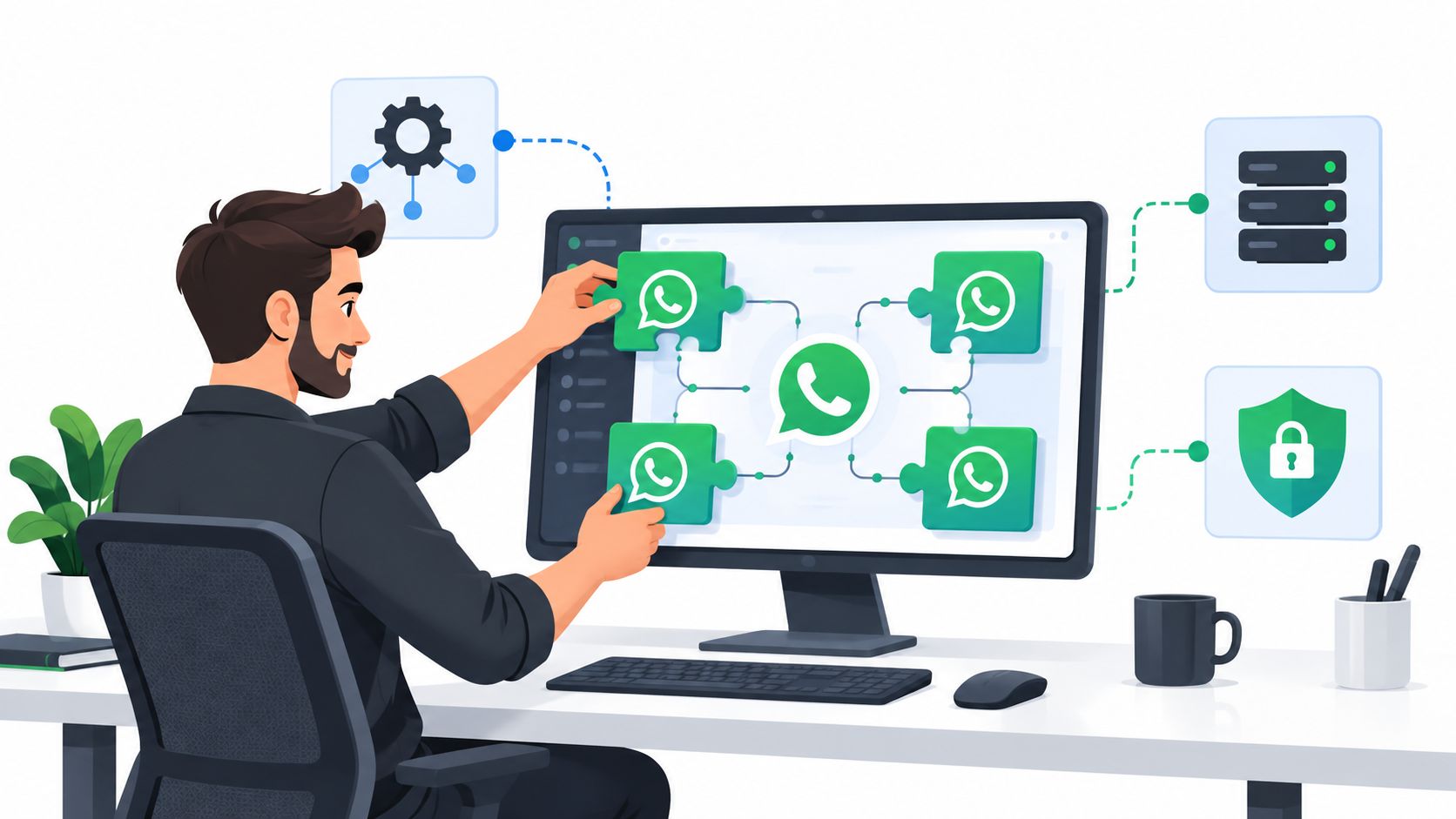
A third-party WhatsApp layer adds another operational boundary to the stack. The CRM stores contacts and triggers workflows. The integration translates those triggers into WhatsApp actions. WhatsApp policies, authentication, device state, templates, and delivery behavior sit outside the CRM, so the agency has to manage the handoff between systems.
The account model creates work
Subaccounts are convenient for reselling, but they also create a repeatable checklist. For each client, your team may need to confirm the WhatsApp number, connect the account, map fields, configure permissions, test workflow actions, and document the recovery process if the number disconnects.
Multiple-device support can reduce some friction, but it doesn't eliminate ownership questions. Who has access to the connected device? Which employee receives the authentication prompt? What happens when a client changes phones, rotates staff, or loses access to the number? The software may handle the connection technically, but your agency still handles the client experience.
AppLevel's marketplace listing describes support for connecting multiple devices per subaccount, and its public listing cites over 1,400 users worldwide. The same listing presents monthly pricing of $49 and an annual plan of $499, along with a 5-day or 7-day free trial, depending on the offer shown. These details are available in the AppLevel marketplace listing. Pricing and trial terms should be verified before you include them in a client proposal.
Provisioning versus repeatability
API-based setups can be sturdy, but agencies pay for the setup process in staff time. Verification, permissions, keys, templates, sender configuration, and CRM mapping can turn an apparently simple onboarding into a technical project. A wrapper may reduce development work compared with building from scratch, but it doesn't necessarily make every client deployment identical.
The most expensive failure is often not a total outage. It's a partial failure that leaves the CRM showing a completed action while the client believes WhatsApp follow-up happened. Your support process needs logs, ownership, escalation rules, and a test contact for every account.
Build onboarding around a written runbook:
- Connection check: Confirm the number, device owner, authentication method, and reconnection procedure.
- Workflow test: Send test messages through the exact triggers the client will use.
- Media check: Validate images, documents, voice notes, buttons, and variables where relevant.
- Failure path: Define what staff do when a message fails, a device disconnects, or a contact lacks consent.
- Margin review: Include support and troubleshooting time in the account's delivery cost.
The economics change when messaging is charged by usage. A client may buy a fixed service package while message volume changes with lead flow, follow-up length, reminders, and reactivation campaigns. The agency becomes responsible for a variable input it may not control, which makes a flat client retainer less predictable.
Common Use Cases for Agencies and SaaS Resellers
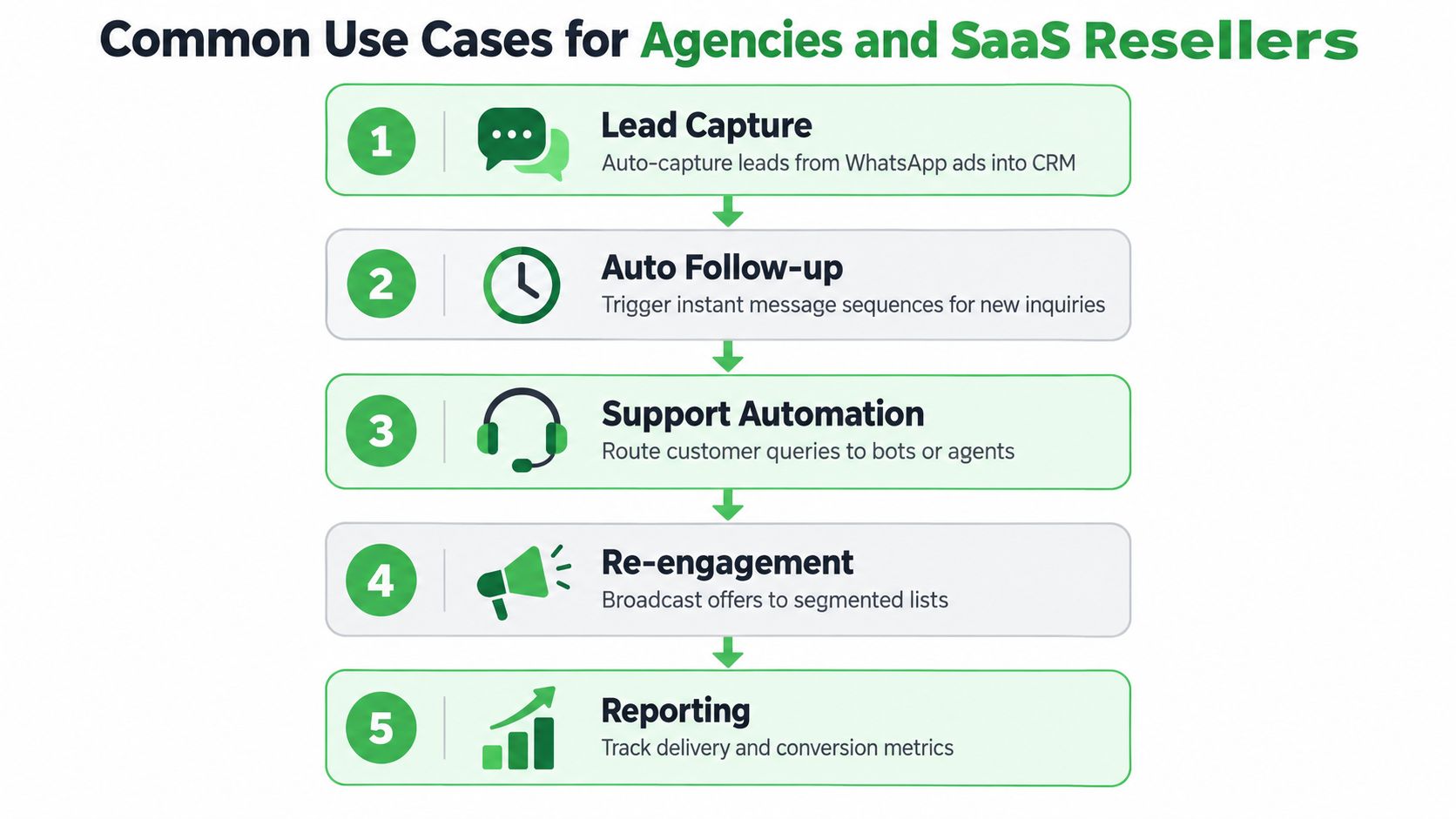
The strongest use cases begin with a specific customer event, not a generic desire to “automate WhatsApp.” A new lead submits a form, a sales opportunity changes stage, a support request arrives, or a past customer becomes eligible for reactivation. The integration earns its place when it turns that event into a controlled operational sequence.
Lead nurturing after capture
A common agency workflow starts with a lead entering Go High Level from an advertisement, landing page, or form. The CRM records the source, assigns the contact, and triggers a WhatsApp message that confirms the inquiry or asks a qualifying question. If the contact replies, the conversation can move to a salesperson. If the contact doesn't reply, later workflow steps can create a task, send a reminder, or route the lead to another channel.
The benefit isn't speed. It's operational consistency. The agency can define what happens after every lead event and make the workflow visible to the client. The risk is that each additional message increases cost or creates compliance exposure, so sequences should earn their place through a clear customer action.
Support triage
Support teams can use WhatsApp as an intake channel for common questions, appointment requests, order updates, or service issues. A first response can identify the topic, collect basic information, and assign the conversation to the right person. The CRM can retain the contact history while the support team works from the inbox.
This model works best when automation handles routing rather than pretending to solve every problem. A bot that asks irrelevant questions creates more work for agents. Agencies should design an immediate escalation path, especially for complaints, payment issues, or requests requiring account-specific judgment.
Broadcasts and community communication
Broadcasting can support announcements, promotions, event reminders, and re-engagement. Segmentation matters more than raw reach. A fitness business might separate active members from former members. A training provider might separate prospects, current students, and alumni. Sending the same message to every contact can damage trust and make reporting meaningless.
Community Announcement Groups add another use case for creators, coaches, and publishers. They can distribute updates to an audience that has chosen to follow the community, but the agency still needs clear consent, content governance, and a process for handling replies or support requests.
The embedded video below provides additional context for the platform workflow:
The SaaS reseller equation
White-labeling turns a technical integration into a commercial product. The agency can sell a workspace, automation setup, campaign management, or a combination of all three. The danger is pricing the visible software while absorbing invisible operations.
A reseller model needs separate line items for:
- Workspace access: The software environment and account administration.
- Implementation: Number connection, CRM mapping, workflow configuration, and testing.
- Campaign operations: Copy, segmentation, scheduling, reporting, and optimization.
- Support: Client questions, failed sends, reconnections, and permission changes.
- Usage exposure: Variable messaging or provider costs that can rise with activity.
If you can't explain which costs are fixed and which are usage-dependent, you don't yet have a reliable SaaS offer. AppLevel can support the integration-led version of that model, but the agency remains accountable for the full service layer around it.
Integration Considerations and WhatsApp Platform Fit
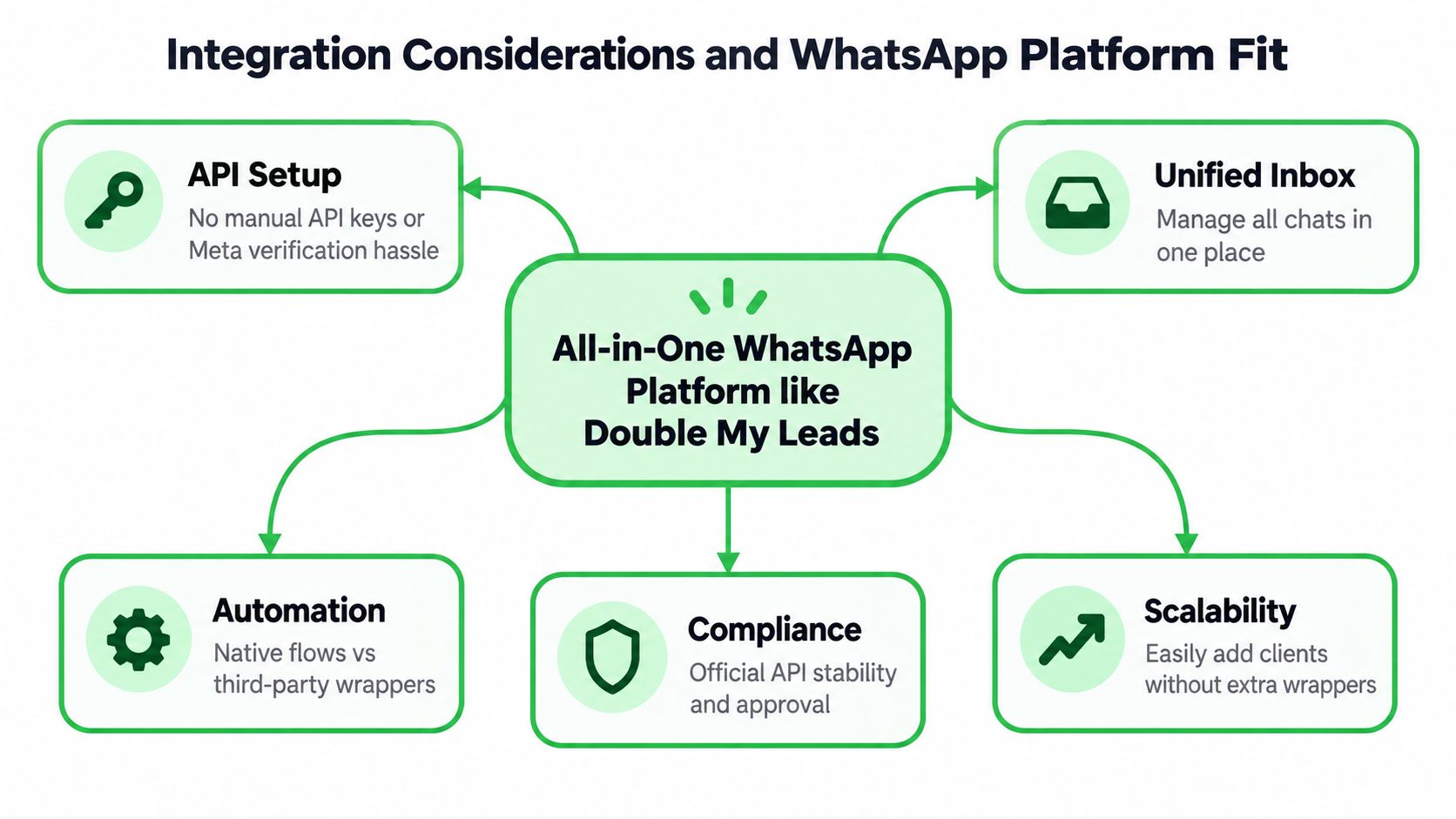
The integration decision should start with the agency's bottleneck. If the problem is keeping WhatsApp activity inside Go High Level, AppLevel may be a practical fit. If the problem is onboarding many client numbers, managing a shared inbox, controlling reseller margins, or offering rich-media communication without multiple wrappers, a broader platform deserves comparison.
Compare the operating layers
A connector typically adds WhatsApp actions to an existing CRM. An all-in-one WhatsApp platform may own the inbox, automation, smart links, broadcasts, assignments, tags, quick replies, and media handling in one environment. Neither approach is automatically superior. The question is which one minimizes the number of handoffs your team must monitor.
QR-code onboarding can reduce setup friction because the team connects a number through a device-led process rather than coordinating every API credential and verification step. Official Cloud API support remains relevant for organizations that need a provider-supported architecture, while device-based onboarding may suit agencies prioritizing speed and operational simplicity.
Double My Leads is one example of the all-in-one model. It offers QR-code number connection, an unlimited real-time inbox for texts, images, videos, documents, and voice notes, assignments, notes, tags, quick replies, smart links, QR codes, auto-welcome flows, scheduling, rich-media campaigns, CRM participant sync, and source attribution. It also offers Cloud API integration, REST API access, and an MCP Server for deeper workflows.
Evaluate fit using workflow questions
Ask these questions before migrating a client:
- Where does the agent work? If staff must move between CRM records, a separate inbox, and another automation console, document the handoff and its support cost.
- How does a new number connect? Count every approval, credential, verification, and troubleshooting step.
- How are sources preserved? A smart link that captures a lead before the conversation starts can be more valuable than a message trigger added after the contact already exists.
- What content can the team send? Check texts, images, videos, documents, voice notes, buttons, variables, and scheduled campaigns.
- What happens at scale? Review client limits, inbox assignments, permissions, reporting, and workspace provisioning.
- Which costs rise with usage? Separate platform fees, message charges, provider fees, support time, and campaign management.
Agencies that also need to optimize CRM for revenue should evaluate source attribution and participant sync as revenue controls, not merely technical conveniences.
The native-platform route generally reduces the number of separate components, but it may require process changes if your team is accustomed to doing everything inside Go High Level. The wrapper route preserves familiar CRM behavior, yet the agency must accept the maintenance and margin implications of another dependency. Review the full WhatsApp CRM integration workflow before choosing based only on the first successful test message.
Comparing AppLevel with Native WhatsApp Solutions
The practical distinction is where complexity lives. With a third-party wrapper, the CRM remains the center of gravity and WhatsApp becomes an added channel. With a native WhatsApp platform, the communication layer often becomes the center, with CRM synchronization connecting conversations back to customer records.
That difference affects agency margins. A per-message model can appear manageable during a low-volume pilot, then become difficult to price when a client adds longer nurture sequences, broadcasts, reminders, or multiple campaigns. A flat monthly model makes the platform line easier to forecast, although the agency still needs to assess plan limits, provider policies, and support requirements.
| Feature | Third-Party Wrapper | Native Platform, such as DML |
|---|---|---|
| Primary workflow | WhatsApp actions inside an existing CRM | WhatsApp inbox, automation, and campaigns in one communication layer |
| Onboarding | May involve API credentials, verification, permissions, or device connections | Can use QR-code onboarding, with Cloud API available where required |
| Cost structure | May combine subscription and usage-sensitive messaging costs | Flat monthly fee can replace per-message platform charges |
| Inbox operation | Often depends on CRM and integration behavior | Unified inbox with assignments, notes, tags, and quick replies |
| Media support | Depends on the wrapper, CRM action, and WhatsApp setup | Designed around texts, images, videos, documents, and voice notes |
| Broadcast workflow | Available where the integration supports it | Can include scheduling, segmentation, smart links, and rich-media campaigns |
| CRM relationship | CRM is the main system of record | CRM sync can preserve participants and source attribution |
| Reseller fit | Strong for CRM-first agencies | Strong for agencies selling white-labeled communication workspaces |
| API access | Depends on the integration provider | REST API, MCP Server, and Cloud API options may support deeper workflows |
| Main trade-off | Familiar CRM execution versus added dependency | Simpler communication operations versus a possible change in team workflow |
A wrapper remains sensible when the client's automation logic is already mature inside Go High Level and the WhatsApp requirement is narrow. It becomes less attractive when every new client needs a separate technical exception.
Agencies comparing AppLevel alternatives can also review why Wasendr is positioned as a Go High Level WhatsApp integration alternative. The useful question isn't which product has the longer feature list. It's whether your team can sell, provision, support, and renew the service without turning every account into a custom project.
Benefits and Limitations of Third-Party Integrations
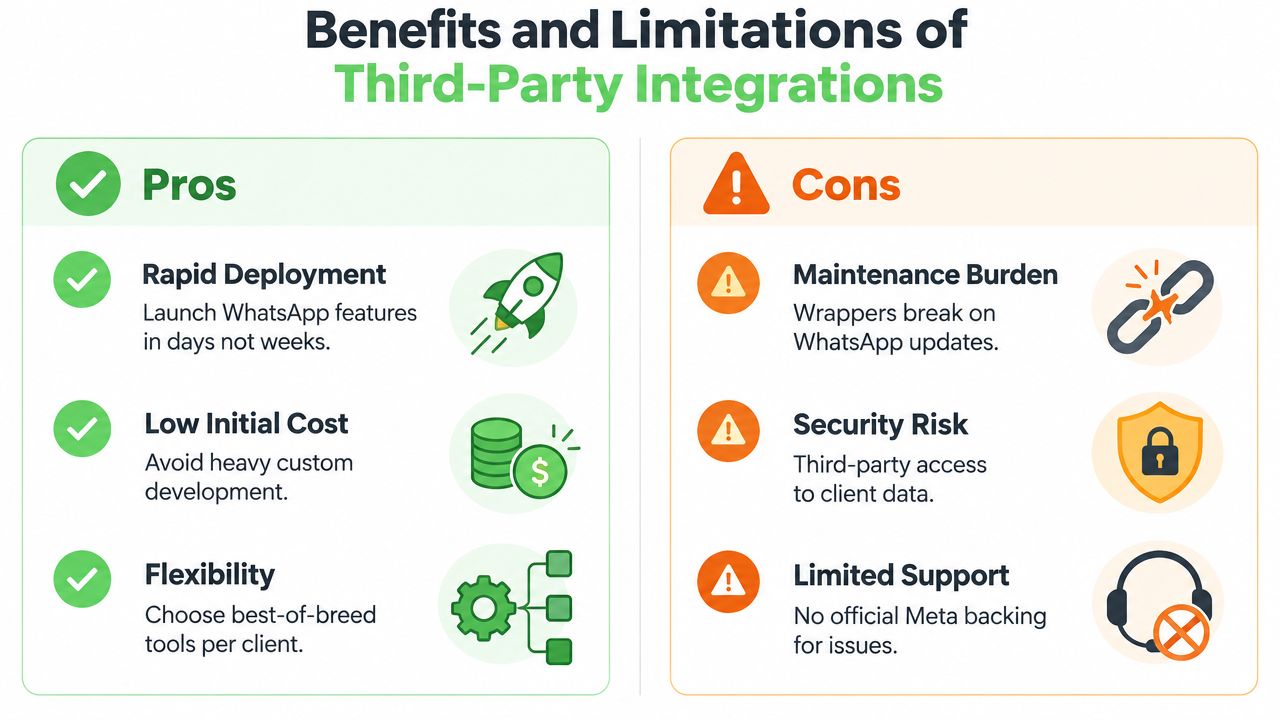
Third-party integrations solve a real problem. They let agencies add WhatsApp capability without building a complete communication product, and they can preserve familiar CRM workflows. For a focused implementation, that speed may matter more than having every inbox and campaign feature under one roof.
The mistake is assuming that a successful connection equals a scalable operating model. A wrapper can connect a number today while leaving your team exposed to provider changes, authentication failures, delivery disputes, and usage costs that weren't included in the original scope.
What third-party tools do well
Rapid deployment is the clearest benefit. Agencies can use an existing CRM, existing workflows, and an established integration instead of designing a messaging backend. That can shorten the path from proposal to first campaign.
Familiar execution also reduces training. If account managers already build pipelines and triggers in Go High Level, adding WhatsApp actions may require less behavioral change than moving the entire team to another console.
Client-specific flexibility can be useful. One client may need lead follow-up, another may need support triage, and a third may only need appointment reminders. A modular stack lets the agency choose different components for different requirements.
Where the model strains
Maintenance is the first pressure point. Your team depends on the wrapper's uptime, authentication behavior, CRM compatibility, and handling of WhatsApp changes. When something breaks, the client rarely distinguishes between the CRM, the integration, and WhatsApp. They contact the agency.
Security and access require equal attention. A third-party service may handle client contact data, message content, account credentials, or device connections. Review permissions, data retention, user roles, export options, and the provider's incident process before placing sensitive client communication inside the stack.
Broadcasting can expose another limitation. Some wrappers support outbound messages but don't provide the same depth of segmentation, community announcement management, media handling, or source-aware lead capture that an agency needs for a complete campaign service. The result is a patchwork of tools and manual work.
Margin test: If every increase in client activity creates more provider charges and more support tickets, your revenue may be growing faster than your profit.
Per-message economics also distort campaign decisions. Teams may shorten useful sequences, avoid reactivation, or under-serve active accounts because they're worried about variable costs. A flat fee doesn't make every campaign profitable, but it removes one source of uncertainty and makes service packaging easier to model.
Third-party integrations are best treated as targeted components, not automatic foundations. Use them when the CRM continuity outweighs the additional operational layer. Consolidate when fragmented inboxes, broadcast gaps, security review, or variable costs start limiting the service you can confidently sell.
Practical Next Steps for Implementation
Start with an audit, not a migration. Export the last period of platform invoices, message-related charges, support records, failed-send tickets, and onboarding notes. Then classify every cost as software, usage, implementation, campaign labor, troubleshooting, or client communication.
You're looking for the gap between the price on the proposal and the effort required to keep the account healthy. If the account appears profitable only when support time is ignored, the pricing model needs attention before you add more clients.
Use a staged implementation plan
- Map the current stack. List the CRM, WhatsApp connector, inboxes, automation tools, number connections, reporting systems, and people responsible for each component.
- Trace one lead end to end. Follow a contact from source capture through assignment, first response, follow-up, reply handling, conversion, and reporting. Record every manual handoff.
- Separate fixed and variable costs. Identify which charges stay stable and which rise with messages, media, recipients, or additional accounts.
- Choose a pilot workflow. Start with one practical use case, such as inbound lead response or support routing. Avoid migrating every campaign before the first workflow is reliable.
- Test onboarding and recovery. Connect a number, remove access in a controlled test, reconnect it, and document what the client or agency operator must do.
- Validate attribution. Use tracked smart links or QR codes where appropriate, and confirm that the source survives into the CRM and reporting layer.
- Set the commercial boundary. Decide what the monthly fee includes, what counts as implementation, how campaign work is billed, and how exceptional support is handled.
- Plan deeper automation. Use REST APIs or an MCP Server when the workflow needs custom actions beyond standard triggers, but document authentication, permissions, error handling, and ownership before production use.
A QR-based onboarding test can reveal whether a native platform reduces the friction your team currently absorbs. A tracked smart link can also show whether your acquisition process captures the lead before the WhatsApp conversation begins, rather than relying only on post-conversation attribution.
Don't migrate because a new tool has more features. Migrate when the new operating model gives your agency clearer ownership, faster recovery, better attribution, and margins you can explain without guessing.
Double My Leads provides a white-labeled WhatsApp business platform with QR-code onboarding, a unified real-time inbox, automation, broadcasts, smart links, CRM participant sync, and API options for deeper workflows. Review the platform at Double My Leads and test whether its flat-fee, reseller-ready model fits the accounts you're scaling.